• Skip to primary navigation
  • Skip to main content
  • Skip to primary sidebar

  • Basketball Plays
    • Ball Screen Sets
    • Horns Sets
    • Man to Man Post Up
    • Man to Man Isolations
    • Backdoor Plays
    • Man to Man 3 Point Shot Plays
    • 2-3 Zone Attack
    • Baseline Inbound Plays
    • Sideline Inbound Plays
    • Combination Defense Attack
  • Drills
    • Defensive Drills
    • Offensive Drills
    • Competitive Drills
    • Passing Drills
    • Rebounding Drills
    • Shooting and Scoring Drills
    • Toughness Drills
    • Transition & Conversion Drills
    • One on One Drills
  • Blueprint
  • Practice
  • Mental Toughness
  • Skill Development
  • Offense
  • Defense
  • Store

Basketball Drills Free Throw Situations

Basketball Drills Free Throw Situations

By Brian Williams on January 30, 2015

submitted by Coach John Kimble
CoachJohnKimble.com

Retired high school and college coach

Published in Basketball Sense Magazine & Athletic Journal

Every basketball coach must design a set of drills to meet his or her particular team’s need for every phase of the game. To have time efficiency for practice, the best drills incorporate several facets of the game at the same time. As the name indicates, this particular drill is not solely a free throw shooting drill—but very much more than that. This drill has been used for over 20 years at various levels of play from 7th Grade AAU teams to varsity high school to Junior College teams. This drill is teach and practice executing the proper offensive and defensive techniques in specific free throw situations with as much game realism as possible.

For the last 20 plus years, we have tried to incorporate the many repetitions of the art of free throw shooting in the most ‘game like conditions’ possible. We incorporate as much as 10-12 % of each and every practice with this drill. We can afford to do this because we incorporate many other offensive and defensive facets of the game during this free throw shooting time.

Obviously, this drill is very much a free throw shooting drill. But the drill offers much more than that, such as a maximum in game-realistic conditions and factors as well as efficiently using valuable practice time. Some of the most important factors incorporated are that there is pressure on individual players in the groups or the team as a whole to perform important offensive and defensive techniques in high level competitive and pressure-packed situations. This drill demands specific important techniques and skills to be emphasized and practiced for all three players involved in each group. The drill provides the setting and opportunity for the coaching staff to be able to carefully observe, critique, correct, teach and praise all three players in each group at their own basket.

The activity we use before we actually begin this drill is some form of full court or live activity that incorporates a great deal of physical activity and running. This is to make the ‘FT Situation’ drill even more game realistic—and that is to make sure all players are fatigued (like they will be in an actual game) as the free throws are actually shot. We work on this drill three times a day at determined times in practice to break up the actual practice. During those designated times in the practice, every team breaks down into the pre-set three man work-groups that are changed daily. Each three man work group has a “FT Shooter” position, an “Offensive Rebounder,” position and a “Defensive Rebounder” position.

The drill gives each ‘Free Throw Shooter,’ while being fatigues, an opportunity to shoot five pairs of free throws, an opportunity for each shooter to take between five and ten jump shots after the free throw attempts. For each ‘Defensive Rebounder,’ the drill provides a maximum number of ten opportunities to align himself in the proper defensive rebounding position and stance, to box out the nearest ‘Offensive Rebounder,’ to then get the defensive rebound and then make an outlet pass to a teammate. For each ‘Offensive Rebounder,’ the drill provides a maximum of ten opportunities to align himself in the proper offensive rebounding position, to overcome and defeat the defensive box-out, to get the offensive rebound and then quickly “power” the inside shot back up (against defensive pressure) until he scores.

The ‘FT SHOOTER’ works on the techniques the coaching staff wants to emphasize as he shoots the pairs of free throws. We want each player to develop his/her own routine that is consistently followed in practice and ultimately during each game that includes fundamentally sound techniques.

Some of the shooter’s most important techniques to be emphasized are: A) develop a method of countering fatigue and calming the breathing down before shooting the free throws, B) to approach the free throw line and perform his own routine in preparing to align himself for his shots and to have full concentration on his shooting techniques (such as the follow-through of the shot, getting the legs involved in the shot, focus on the target, C) a quick and immediate reaction to the ‘made’ or ‘missed’ free throw to then receive a pass and take a mid-range jump shot (with the proper jump-shooting techniques) and D) practice handling the individual and team pressures of making shots.

The ‘DEFENSIVE REBOUNDER’ aligns on the inside position on the predetermined side of the lane. His responsibilities and techniques emphasized are to: A) keep both hands up and stack the feet together as close to the nearest opponent as possible, B) have quick feet and step in the lane directly towards the shooter with the ‘contact’ foot first, C) use the proper box-out techniques that have been already taught in half court defenses, D) jump for the rebound and ‘chin the ball,’ E) pivot away from the ‘Offensive Rebounder’ that is applying pressure on the ball, F) make a two-hand overhead pass to the FT Shooter that is rotating to the nearest elbow area.

The ‘OFFENSIVE REBOUNDER’ aligns on the same side of the lane immediately next to the ‘Defensive Rebounder.’ His responsibilities and techniques that should be emphasized are: A) Keep both hands up, B) stack both feet together on the high side of the rebounding spot (to stay as far away from the defenses as possible,) C) step into the middles of the lane as quickly as possible with his own ‘contact’ foot first, D) offensive rebound the ball and ‘power up’ strong with the ‘stick-back,’ E) apply hard pressure on the ball if the ‘Defensive Rebounder’ gets the rebounds and looks to outlet the ball.

After the planned full court or highly strenuous drill is completed, the FT Situation is announced and all of the 3-man groups quickly sprint to an open basket. The players quickly fill the three positions and the drill begins. Each ‘FT Shooter’ performs his routine and shoots a pair of free throws with one player being an ‘Offensive Rebounder’ and the other player being the ‘Defensive Rebounder’. The ‘Defensive Rebounder’ establishes his position on the typical (defensive) position and the ‘Offensive Rebounder’ ‘stacks his feet’ next to the ‘Defensive Rebounder’ on a pre-determined side of the lane. The next time this drill is used (later in the same practice), the two rebounders can ‘stack up’ on the opposite side of the lane.

If the first free throw is made, the ball is passed back to the free throw shooter for the second shot. When the first free throw is missed, the ‘Free Throw Shooter’ should always rotate immediately to the elbow area nearest the stack side. If the designated ‘Offensive Rebounder’ beats the defensive box-out and gets the offensive rebound; he then should practice what he would do in an actual game. That is—he quickly looks to take an offensive rebound “stick-back.” The designated ‘Defensive Rebounder’ that gets the defensive rebound pivots away from the opposition and makes a two-hand over-head outlet pass to the current (rotating) ‘Free Throw Shooter’.

The ‘Free Throw Shooter’ rotates quickly and ‘gets his feet and hands ready’ to receive the outlet pass and quickly take the jump shot. Once the jump shot is taken, all three players quickly reposition themselves for the second free throw shot attempt. If the first free throw shot is made, there is no missed shot, no rebound and therefore, no jump shot. All three players quickly return to their initial locations.

Regardless of whether the second free throw is made or missed, the FT shot is treated as a missed shot. Therefore, the ‘Offensive Rebounder’ that gets the ball immediately works on his stick-back shot. If the ‘Defensive Rebounder’ gets possession of the ball, he then makes the same type of outlet pass to the ‘Free Throw Shooter’ (who has rotated to the stack side’s elbow area. The ‘FT shooter’ takes the jump shot, regardless of whether the second free throw shot was made or missed.

After the one pair of free throws are shot, all three individuals rotate the three positions. The ‘FT Shooter’ becomes the next ‘Offensive Rebounder’ and the initial “Offensive Rebounder’ becomes the next ‘Defensive Rebounder.’ The initial ‘Defensive Rebounder’ becomes the next ‘FT Shooter.’ All three players shoot five pairs of free throws, with the individual statistics recorded on a daily free throw practice chart. Penalty sprints (for not making individual or team predetermined numbers of made free throws) cold be run at this time; followed by a quick drink of water.

The entire drill (with each player in the three man group shooting five pairs of free throws, anywhere from 5 to 10 jump shots, each player getting 10 opportunities to box out defensively, 10 possible defensive rebounds and a possible 10 potential offensive rebound opportunities), along with reporting the scores and running the penalty sprints as well as getting a quick drink of water can and should take no more than 7 to 8 minutes. We would use this drill three times a practice on the half-hour. Also, at the end of the practice, we would then have one or two players randomly picked to shoot ‘one and ones’ to determine if the entire team would run sprints, as an additional way to shoot free throws.

Another strong point of the drill is that each player is given the pressure to achieve his/her own specific goals that pertain to only his own skill levels in the various skills that must be performed in this drill. In addition, these goals can be modified to fit each player as they progress. There can be goals set for each individual group and they also can be modified from practice to practice (especially when the group members are changed.) To add additional game realism to the drill, there can be penalties not only for failing to meet individual goals but also for each group’s goals.

Group goals could be a set number of free throws that must be made by the group in addition to competing each team against the other groups. A ‘grading system’ could also be developed for the two types of rebounders where individual players could receive a plus grade for offensive rebounds and a negative grade for their opponent getting an offensive rebound (against them and their defensive box-out effort.) Positive and negative grades could also possibly be implemented for the jump shot portion of the drill. Light penalties could be attached for failures to meet individual, team goals and for groups losing in the various forms of the shooting competition against other groups.

As previously mentioned, a good portion of time is committed to this drill. But with techniques such as defensive boxing out, practicing techniques of beating box-outs, working on outlet passing, offensive rebounding and ‘inside shot’ practice, perimeter jump shooting; the time is well spent. The penalties and competition make this drill as game realistic as it possibly be, making it invaluable and worthwhile.

About the Author

Coach Kimble was the Head Basketball Coaching position at Deland-Weldon (IL) High School for five years (91-43) that included 2 Regional Championships, 2 Regional Runner-Ups and 1 Sectional Tournament Runner-up. He then moved to Dunlap (IL) High School (90-45) with 2 Regional Runners-up, 1 Regional, 1 Sectional and 1 Super-Sectional Championship and a final 2nd Place Finish in the Illinois Class A State Tournament. He was an Assistant Basketball Coach at Central Florida Community College in Ocala, FL for 4 years, followed with 10 years as the Head Basketball Coach at Crestview (FL) High School, averaging over 16 wins per season.

He also has had articles published in the following publications such as: The Basketball Bulletin of the National Association of Basketball Coaches, the Scholastic Coach and Athletic Journal, Winning Hoops, Basketball Sense, and Coaching Basketball. He has also written and has had five books published along with over 25 different DVDs by Coaches Choice and Fever River Sports Production.

See him on Twitter @CoachJohnKimble and his Web Page “www.CoachJohnKimble.com”
Basketball Plays George Karl Early Offense

By Brian Williams on January 29, 2015

These 3 ideas for early offense are from George Karl’s 2012-13 Denver Nuggets uptempo offense playbook.

I hope it stimulates some ideas as to how you can tweak your early offense here as the season is beginning the latter stages.

The eBook is paired with the Dribble Drive for High Schools playbook for the special Bundle price of $25.

You can find out about the bundle at this link: Nuggets and High School DDM eBooks

Email me at [email protected] or call or text (317) 721-1527 if you have any questions

Diagrams created with FastDraw


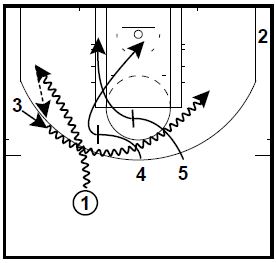
Double Drag DHO Early Offense

double-drag-dho

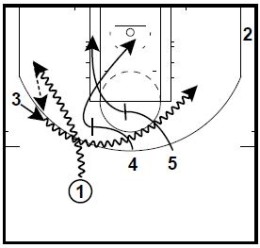
1 runs a dribble hand off with 3.

4 and 5 set a double drag screen on 3’s defender.

3 attacks the right side.

4 rolls to the basket.

5 rolls to the left low block.

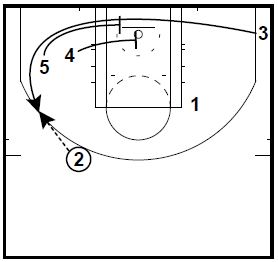
Drag Double Wheel Early Offense

basketball-plays-drag-double-wheel1

5 and 4 set a drag screen for 1.

1 dribbles to the right side.

5 and 4 set staggered down screen for 2.

2 cuts to the left wing.

1 passes to 2.

basketball-plays-drag-double-wheel2

 
4 and 5 set staggered cross screens for 3.

3 cuts to the left wing.

2 passes to 3.


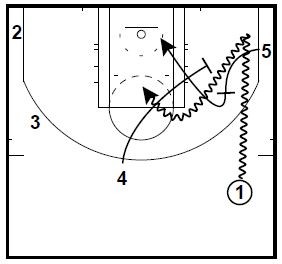
2 Side Big Early Offense

basketball-plays-2-side-big

5 sets a flat ball screen for 1.

1 dribbles to the right corner.

4 sets a ball screen for 1.

5 rolls to the basket.
 
1 comes off the ball screen from 4 and attacks the basket.

The eBook is paired with the Dribble Drive for High Schools playbook for the special Bundle price of $25. You can find out about the bundle at this link: Nuggets and High School DDM eBooks

Email me at [email protected] or call or text (317) 721-1527 if you have any questions

13 Things Mentally Strong People Don’t Do

By Brian Williams on January 28, 2015

I am always looking for mental toughness resources and just finished reading the Book “13 Things Mentally Strong People Don’t Do.”

It is not written specifically for athletic competition, but the lessons are applicable to all areas of living a happy and successful life, including athletics.

A blog post on the was the precursor to the book has some thoughts on mental toughness for us to apply to our own personal and professional lives as well as to share with our staff and players.

13 Things Mentally Strong People Don’t Do

~by Amy Morin, LCSW
AmyMorinLCSW.com

Mentally strong people have healthy habits. They manage their emotions, thoughts, and behaviors in ways that set them up for success in life. Check out these things that mentally strong people don’t do so that you too can become more mentally strong.

1. They Don’t Waste Time Feeling Sorry for Themselves

Mentally strong people don’t sit around feeling sorry about their circumstances or how others have treated them. Instead, they take responsibility for their role in life and understand that life isn’t always easy or fair.

2. They Don’t Give Away Their Power

They don’t allow others to control them, and they don’t give someone else power over them. They don’t say things like, “My boss makes me feel bad,” because they understand that they are in control over their own emotions and they have a choice in how they respond.

3. They Don’t Shy Away from Change

Mentally strong people don’t try to avoid change. Instead, they welcome positive change and are willing to be flexible. They understand that change is inevitable and believe in their abilities to adapt.

4. They Don’t Waste Energy on Things They Can’t Control

You won’t hear a mentally strong person complaining over lost luggage or traffic jams. Instead, they focus on what they can control in their lives. They recognize that sometimes, the only thing they can control is their attitude.

5. They Don’t Worry About Pleasing Everyone

Mentally strong people recognize that they don’t need to please everyone all the time. They’re not afraid to say no or speak up when necessary. They strive to be kind and fair, but can handle other people being upset if they didn’t make them happy.

6. They Don’t Fear Taking Calculated Risks

They don’t take reckless or foolish risks, but don’t mind taking calculated risks. Mentally strong people spend time weighing the risks and benefits before making a big decision, and they’re fully informed of the potential downsides before they take action.

7. They Don’t Dwell on the Past

Mentally strong people don’t waste time dwelling on the past and wishing things could be different. They acknowledge their past and can say what they’ve learned from it. However, they don’t constantly relive bad experiences or fantasize about the glory days. Instead, they live for the present and plan for the future.

8. They Don’t Make the Same Mistakes Over and Over

They accept responsibility for their behavior and learn from their past mistakes. As a result, they don’t keep repeating those mistakes over and over. Instead, they move on and make better decisions in the future.

9. They Don’t Resent Other People’s Success

Mentally strong people can appreciate and celebrate other people’s success in life. They don’t grow jealous or feel cheated when others surpass them. Instead, they recognize that success comes with hard work, and they are willing to work hard for their own chance at success.

10. They Don’t Give Up After the First Failure

They don’t view failure as a reason to give up. Instead, they use failure as an opportunity to grow and improve. They are willing to keep trying until they get it right.

11. They Don’t Fear Alone Time

Mentally strong people can tolerate being alone and they don’t fear silence. They aren’t afraid to be alone with their thoughts and they can use downtime to be productive. They enjoy their own company and aren’t dependent on others for companionship and entertainment all the time but instead can be happy alone.

12. They Don’t Feel the World Owes Them Anything
[adinserter name=”Basketball in article display ad 2 rebecca”]
They don’t feel entitled to things in life. They weren’t born with a mentality that others would take care of them or that the world must give them something. Instead, they look for opportunities based on their own merits.

13. They Don’t Expect Immediate Results

Whether they are working on improving their health or getting a new business off the ground, mentally strong people don’t expect immediate results. Instead, they apply their skills and time to the best of their ability and understand that real change takes time.

You can see a portion of the contents by clicking the cover of the book below.

Coaching Basketball and Playing Time

By Brian Williams on January 27, 2015

I received this article from Mano Watsa of PGC Basketball. I know that deciding upon and communicating about playing time is one of the most difficult aspects of the job of coaching. Everyone has different beliefs, but I hope that you might find something in this post that you can use to help your team either this year or that it can be filed to use next year.

I have also included links to two previous articles from PGC Basketall at the bottom of this post

My coach isn’t playing me much and I don’t understand why…

Below is an email correspondence from this past week between Dena Evans, owner of PGC Basketball, and a PGC grad who she corresponds with throughout the year.

As many players (and parents) have these types of concerns during a season, we thought Dena’s response will benefit everyone in our PGC community. Coaches, we recommend you share this with your entire team in order to pro-actively address this common issue.

Hey Dena,

Just getting home from my game and I didn’t play very much.

I don’t know why.

The last game I won the game for us and today I didn’t play much…kind of frustrating because I really feel like I could’ve helped us out tonight.

It just doesn’t make much sense to me.

A friend has been assisting me through this difficult season and has recommended I look into transferring in the next year or two.

I’m not the type of person who runs from challenges when times get tough.

But, this year just hasn’t been what I thought it would be. It’s still pretty early in the season, so I’m just doing my best to turn it around.

I feel like I’ve made an impact on my team, but my coach seems to think otherwise.

In my opinion, I’m doing everything I am supposed to do, and much more. So, it’s kind of like my coach is telling me one thing, but then doing another.

I know I’m going to go through unfair situations in my career, and I think this is probably one of them.

Any feedback would be greatly appreciated.

Thank you Dena,

Mike

—————–

Mike,

It’s December 8th. Basketball season is a marathon, not a sprint.

Stay in the moment.

Stop thinking about next year or about transferring.

Focus only on the things you can control.

Know that every real athlete who is worth their salt has been through adversities, doubts, frustrations, and unfairness (often in their freshman or sophomore years, in particular).

It’s December 8th. Stop letting every thought and doubt on the surface of your mind lead you down a hole.

Stop analyzing every little decision your coach makes.

Remember why you play. Remember what you love about it. Remember the things you can control and let go of all the things you can’t.

Have a short memory. Let stuff go. Have as much fun as possible.

Touch as many people as possible in a positive way.

It’s December 8th. A whole lot of opportunities, disappointments, ups and downs will come your way before the season is over.

You’ll miss it all if you keep worrying about the little things.

Don’t major in minor things.

Focus on the stuff that matters…your attitude, effort, love of the game, your teammates, doing your best every day, learning every day, staying in the moment, making a fan’s day, being a positive influence on some little kid who looks up to you.

Did I mention that it’s only December 8th?

Stay focused on what matters and what you can control, or you’ll miss the best parts of the season — a season you’ll get only one chance to experience.

Next play, next game, next opportunity.

What matters is NOT what your coach does, but how you respond to it.

Keep in touch,

Dena

More articles from PGC Basketall:

5 Ways Players Can Improve Immediately

Dealing with Season Ending Disappointment

PGC Basketball Camp locations and enrollment are now open for the summer of 2015.

IS PGC FOR YOUR PLAYERS?

PGC offers intense 5-day, 4-night courses for junior high, high school, and college players.

Not just for point guards, PGC courses teach players of all positions to play smart basketball, to be playmakers, and to be coaches on the court.

Click here for information on this year’s camps.

PGC IS FOR COACHES TOO…

Over 500 coaches of all levels attend PGC each summer, as each course serves as an unparalleled, information-packed coaches clinic.

Basketball Plays Curl Pop 4 vs. Sag

By Brian Williams on January 26, 2015

Today’s inbounds play to run against man to man was submitted by Houston Women’s Assistant Coach Vonn Read.

Coach Vonn Read has submitted several plays from his playbook series The Basketball Encyclopedia of Plays to the Coaching Toolbox.

Coach Read has also served as an assistant coach in the WNBA with the Phoenix Mercury, Orlando Miracle, and San Antonio Silver Stars.

He was an advanced scout for the Orlando Magic as well as The Charlotte Sting.

This play is designed to attack teams that sag the inbounder defender in the paint to help take away layups at the rim on UOB situations.


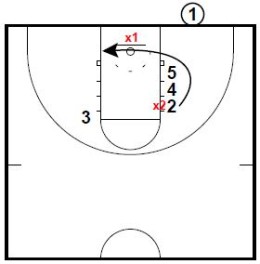
Curl Pop 4 vs. Inbounds

Diagrams created with FastDraw

curl-pop-4-inbounds1

The 2 player will curl around the stack looking for the pass from the 1 player.

X1 will help on the cut by the 2 player, which we want.


curl-pop-4-inbounds2

As soon as the 2 player curls around the stack, the 4 player will pop out to the wing for the pass.

The 5 player will cut to set the screen on X1 helping on the curl.

While X1 is helping on the curl, he will get screened in by the 5 player. We use the curl cut to allow X1 to help, thus setting up the action.

curl-pop-4-inbounds3

The 1 player will pass the ball to the 4 player and quickly step to the corner for the 3-point shot.

Anytime we see a team that helps big in the paint on UOB situations, we will automatically attack with a
counter attack on that defender.

We like to force help at the basket and at the same time screen the helper inside the paint.

Sometimes, the 2 player will block X1 in on the curl, thus setting a double screen.

Coach Read has also put together The Basketball Encyclopedia of plays. You can check them out here: The Basketball Encyclopedia of Plays or read more about the books:

Any coach looking for the latest and innovative plays from the Professional, College, or High School levels can stop looking. With a compilation of over 7,700 different plays, you will never need to purchase another basketball playbook again. These playbooks can be used as a great reference tool for years to come. This 2 Volume Book includes plays from 19 different play categories, and they are the most extensive playbooks on the market.

The Basketball Encyclopedia of Plays (Platinum Series) contains over 7,700 Plays (Both Volumes combined) from the NBA, WNBA, USBL, and College levels from someone who has worked as an Advanced Scout or Coach on each level!!! This book has been intensely compiled over the last 21 years, with plays taken from a lot of NBA Coaches (past and present), WNBA coaches, and College coaches (Men’s and Women’s) from around the country.

Any coach that is serious about improving their knowledge of the game from an X and O standpoint will benefit tremendously from these books. These Books can be used to discover New Quick hitters, add a New Package to your playbook, or develop an entire Offensive System. There are a lot of new ideas and concepts in these books to study, and the Basketball Encyclopedia of Plays can be a great resource for coaches on all levels!!! This book is definitely for those X and O junkies who are always looking to improve as a Coach.

“THE GAME IS ALWAYS CHANGING? ARE YOU?” Vonn Read

Here is the link: The Basketball Encyclopedia of Plays

Basketball Plays 2 Fred Hoiberg 2-3 Alignment Sets

By Brian Williams on January 22, 2015

These 2 Man to Man quick hitters run out of a 2 guard front is taken from the Basketball HoopScoop’s Fred Hoiberg Iowa State Cyclones Playbook (written by Wes Kosel).

These plays are a part of the featured eBook bundle along with Scott Peterman’s Ultimate Matchup Zone Defense Playbook.

You can see more information about what is included in this bundle by clicking this link: Iowa State Offense and Matchup Zone Defense Bundle


Iowa State 2-3 High Ball Screen #1

Diagrams created with FastDraw

basketball-plays-hoiberg1

4 sets a high ball-screen for 1.


basketball-plays-hoiberg2

As 1 clears the screen, 4 screens down for 3 in the corner.

1 looks to hit 3 curling around the screen.


basketball-plays-hoiberg3

If 3 isn’t open on the curl, he continues his cut to the opposite corner off of a screen from 5.

1 passes to 2 who looks to hit 3 for a shot.


basketball-plays-hoiberg4

If 3 isn’t open, 1 can pass to 4 at the pinch post.

Once 4 has the ball, 1 can loop around 4 looking for the hand-off.


Iowa State 2-3 High Ball Screen #2

basketball-plays-hoiberg5

4 sets a high ball-screen for 1.

At the same time, 2 moves in from the corner to set a cross screen for 5.

1 looks to hit 5 at the basket.


basketball-plays-hoiberg6

If 5 isn’t open, 1 looks to pass to 2 cutting up off of a down screen from 4.

These players are a part of the featured eBook bundle along with Scott Peterman’s Ultimate Matchup Zone Defense Playbook.


You can see more information about what is included in this bundle by clicking this link: Iowa State Offense and Matchup Zone Defense Bundle

If you are interested in adding to your Coaching Toolbox take look at what I believe is our best offer.

CLICK HERE to select from a list of more than 70 eBooks.


  • « Go to Previous Page
  • Page 1
  • Interim pages omitted …
  • Page 165
  • Page 166
  • Page 167
  • Page 168
  • Page 169
  • Interim pages omitted …
  • Page 288
  • Go to Next Page »

Primary Sidebar

  • Twitter
  • Facebook
  • Linkedin
coachestoolbox
personaldevelopmenttoolbox
basketballplayerstoolbox
basketballtrainer
athleticperformancetoolbox
coachingbasketball

© Copyright 2026 Coaching Toolbox

Privacy Policy