• Skip to primary navigation
  • Skip to main content
  • Skip to primary sidebar

  • Basketball Plays
    • Ball Screen Sets
    • Horns Sets
    • Man to Man Post Up
    • Man to Man Isolations
    • Backdoor Plays
    • Man to Man 3 Point Shot Plays
    • 2-3 Zone Attack
    • Baseline Inbound Plays
    • Sideline Inbound Plays
    • Combination Defense Attack
  • Drills
    • Defensive Drills
    • Offensive Drills
    • Competitive Drills
    • Passing Drills
    • Rebounding Drills
    • Shooting and Scoring Drills
    • Toughness Drills
    • Transition & Conversion Drills
    • One on One Drills
  • Blueprint
  • Practice
  • Mental Toughness
  • Skill Development
  • Offense
  • Defense
  • Store

Basketball Plays Star Spin Special

Basketball Plays Star Spin Special

By Brian Williams on September 14, 2015

Today’s post is a good backdoor set for a layup.

Houston Women’s Assistant Coach Vonn Read has submitted several plays from his playbook series The Basketball Encyclopedia of Plays to the Coaching Toolbox.

You can also see more of his plays in the Related Posts links at the bottom of this post.

Vonn has also served as an assistant coach in the WNBA with the Phoenix Mercury, Orlando Miracle, and San Antonio Silver Stars. He was an advanced scout for the Orlando Magic as well as The Charlotte Sting.

Diagrams created with FastDraw

Even if you don’t run the play exactly as it is drawn up, I hope you can find a way to modify it to fit your needs.

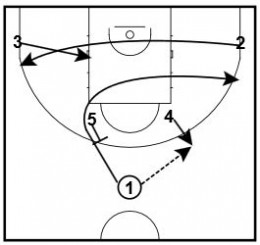
Star Spin Special

basketball-plays-star-spin-special1


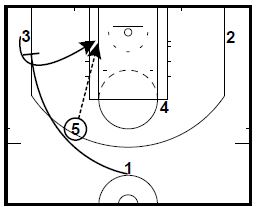
The 1 player will pass to the wing to the 2 player.

The 3 player will cut from the wing to the block off of a curl cut screen set by the 1 player.


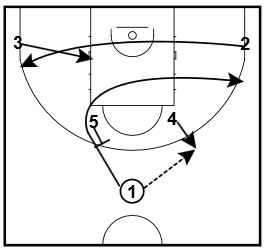
basketball-plays-star-spin-special2


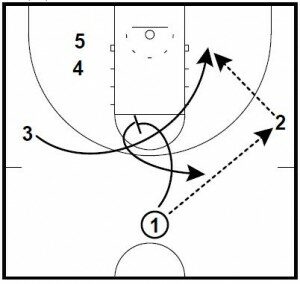
The 1 player will pop back for the pass from the 2 player.


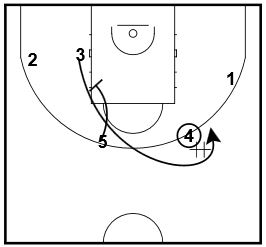
basketball-plays-star-spin-special3

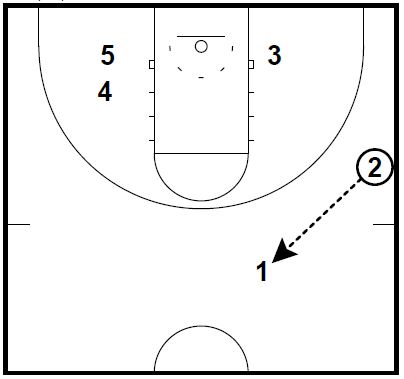
The 3 player will cut hard off of the double screen set by the 4 and 5 players.

This is a decoy action to clear out for the backdoor.

The 1 player will dribble hard, looking to pass to the shooter (3 player) coming off the double screen (Decoy).

The 1 player will reverse dribble and then spin back towards the 2 player.

The 2 player will time their cut as the 1 player spin dribbles, which sets up the backdoor layup.

The 2 player can sell the play by cutting and calling for the ball before going backdoor.

 

Coach Read has also put together The Basketball Encyclopedia of plays. You can check them out here: The Basketball Encyclopedia of Plays or read more about the books:

Any coach looking for the latest and innovative plays from the Professional, College, or High School levels can stop looking. With a compilation of over 7,700 different plays, you will never need to purchase another basketball playbook again. These playbooks can be used as a great reference tool for years to come. This 2 Volume Book includes plays from 19 different play categories, and they are the most extensive playbooks on the market.

The Basketball Encyclopedia of Plays (Platinum Series) contains over 7,700 Plays (Both Volumes combined) from the NBA, WNBA, USBL, and College levels from someone who has worked as an Advanced Scout or Coach on each level!!! This book has been intensely compiled over the last 21 years, with plays taken from a lot of NBA Coaches (past and present), WNBA coaches, and College coaches (Men’s and Women’s) from around the country.

Any coach that is serious about improving their knowledge of the game from an X and O standpoint will benefit tremendously from these books. These Books can be used to discover New Quick hitters, add a New Package to your playbook, or develop an entire Offensive System. There are a lot of new ideas and concepts in these books to study, and the Basketball Encyclopedia of Plays can be a great resource for coaches on all levels!!! This book is definitely for those X and O junkies who are always looking to improve as a Coach.

“THE GAME IS ALWAYS CHANGING? ARE YOU?” Vonn Read

Here is the link: The Basketball Encyclopedia of Plays
Coaching Basketball: Defensive Non-Negotiables

By Brian Williams on September 11, 2015

This post contains thoughts from two articles from Texas A&M Women’s Assistant Bob Starkey on their defense. His Hoop Thoughts Blog is another great resource for basketball coaches.

I hope these ideas give you some ideas for developing or improving the Defensive Non-negotiables for your program.

Defensive Non-Negotiables

We’ll start with some basic concepts (our why) that guide what and how we do what we do:

WE WANT TO TAKE AWAY THE PAINT AT ALL TIMES

When the ball gets to the paint it creates easy shot opportunities in the paint

When the ball gets to the paint it creates easy perimeter shots

When the ball gets to the paint it creates help and recover situations

When the ball gets to the paint it creates closeout situations

When the ball gets to the paint it creates fouling situations

…taking away the paint starts with transition defense

…stance, head, eyes and footwork are critically important

…team defense — having the ability to help early — is a necessity

WE WANT A HAND ON THE BALL

When the ball handler has the ball and has not dribbled…

…we want to have a hand on the ball — constantly mirroring the ball!

When the ball handler is dribbling…

…we want the defender to have a hand on the ball as it is dribbled!

When the ball handler is attempting to pass…

…we want a hand on the ball as it is passed with the goal of deflecting it!

When the ball handler is attempting to shoot…

…we want a hand on the ball to block or alter the shot!

WE WANT TO TAKE AWAY THE OPPONENT’S STRENGTH

This will come from scouting and game preparation


WE WANT TO HAVE A COMMUNICATIVE DEFENSE

We want to be constantly talking at all times

This will increase out concentration and execution


WE WANT TO DO ALL THE ABOVE WITHOUT FOULING

Do not give your opponent’s easy scores and free throws are easy scores

Don’t bail out bad shots or bad plays

Make our opponent’s make plays

WE WANT TO FINISH WITH A BLOCKOUT AND A REBOUND

Grabbing the rebound is like picking up your paycheck at the end of the work week.

The next portion of this post is from Coach Starkey’s article on Transition Defense

GOOD OFFENSE LEADS TO GOOD TRANSITION DEFENSE

In all successful journeys there is the first step. For each defensive possession, there is transition defense and those teams that stress and excel in this phase are further a long in being good defensively than those teams that don’t.

Ironically, I think when you start the conversation about great transition defensive teams, you must being on the offensive end. Your offense can go along way in setting the table for your transition defense.

Offensive keys that aid in solid transition defense include

1. Floor balance…have proper spacing which allows your offense to be in a position to get back defensively is extremely important.

2. Shot selection…how many times have you seen a bad shot lead to a transition basket? You offense can anticipate transition defense better if they know when, where, and by who in terms of the shot being taken.

3. Value the ball…the hardest thing to convert back on is a turnover. If the turnover is in the open court it can be.

Therefore, teams that shot at a high percentage and take care of the basketball tend to be at the least good defensive teams because they have given their defensive an advantage in terms of conversion.

THE CONDITIONING FACTOR

The other element of transition defense before we go over the guidelines is conditioning — and I believe this is two fold:

1. Physical Conditioning
Teams committed to great transition defense are in great physical condition. They pay the price in fall conditioning and continue to value conditioning through their practice habits. One of the first places a player will take off when conditioning is a factor is in getting back defensively.

2. Mental Conditioning
This is one that must be developed through the structure of your practice. There cannot be a mental “delay switch” for players in terms of getting back. It can’t a be a shot taken and then a one or two-second period where the defense is watching.

“If you think that your half-court defense wins your games, you don’t understand the game. If you take film and break it down, you will find out that only 30% of your points are coming out of your set plays and the other 70% are coming in transition, second shots, and foul shots. So the transition game is what it is all about.”

-Hubie Brown

We tell our players its “one or the other.” Either you are going to the offensive boards or you are sprinting back (unless we are in a full court press).

The setup and execution of your practice will be singular most important thing you do to develop both physical and mental conditioning for transition defense. While certainly all coaches have a series of transition defensive drills they live to utilize, one of the most important things you can do is to always convert during scrimmage situations. And in those conversion situations, stress, teach and coach transition defense.

AGGIE TRANSITION DEFENSE GUIDELINES

SPRINT BACK…STRAIGHT LINES…NO BACK PEDALING
Important to know in transition defense that the first three steps are the most critical…don’t worry about find the ball during those first three steps…get out quickly with long strides and cover as much territory as possible.

TALK & POINT UNTIL EVERYONE IS MATCHED UP
To be successful on a consistent basis, all five players must be engaged in talking and pointing…there will be times when we have to defend someone other than are original assignment but there should never be a situation where we have two players on one offensive player and another player wide open.

“LOAD TO THE BALL” HEAVY HELPSIDE…5/4…5/3…5/2
As we are getting back, if you are not sure immediately who you are picking up, move to the middle of the floor in a help and anticipate position…it will give you a closer angle to pick up someone on the ballside…if end up defending someone opposite the ball then you are in help where you should be any way.

PICK UP THE BALL (ONCE THE HOLE IS COVERED)
We want to pick up the ball as early as possible and funnel it out of the middle…however, we don’t want to leave someone under the basket wide open…once we know we have the rim covered, aggressively and intelligently attack the basketball.

TAKE AWAY THE RIM AND THE BALLSIDE LOW POST
While this is the primarily responsibility of our post players, perimeter players may have to assume this responsibility at times…make sure we don’t allow easy post feeds from the point guard or the wings…if we are mismatched, fight to front the low post until help comes.

POST DEFENDERS: MEET THE OPPOSING POST AT THE ELBOW
We want to be waiting with an extended forearm…the goal is to stop the post or force her to veer one way or another…at no time is it acceptable to allow an opposing post a direct cut to the low post for an immediate post up opportunity.

FIND & PICK UP DEAD 3’S EARLY

At least 3 steps above the arc…giving up an open, rhythm 3 is also unacceptable…Goal #1, take away the touch…Goal #2, force catch further away then where she wants to catch…Goal #3 (last resort), closeout hard to force her to put it on the floor and now allow her a clean rhythm look.

Basketball Plays: 2 Horns Sets

By Brian Williams on September 10, 2015

These 2 man to man set plays below are from Wes Kosel’s Ultimate Horns Playbook.

If these sets do not fit your players, I hope you can at least get an idea from them that might fit your needs.

Diagrams created with FastDraw

Horns Hand-Off Jumper

basketball-plays-horns-1

1 passes to 4 then cuts off of 5 into the lane and out to the right wing.

2 moves across the baseline as 3 steps in to the low post.

basketball-plays-horns-2

5 screens for 3 who cuts up and around 4 for a hand-off.

3 looks to shoot (Or drive) after getting the ball from 4.


Spurs Horns Post Entry 3

basketball-plays-horns-3


5 pops out from the elbow and gets a pass from 1.


basketball-plays-horns-4

1 loops around 5 looking for the hand-off.

If the hand-off isn’t open, 1 continues down to the corner to screen for 3.

3 curls around the screen to the basket.

5 looks to pass to 3.

basketball-plays-horns-5

If 3 isn’t open, he clears out to the corner.

5 dribbles toward the opposite elbow as 4 screens down for 2.

2 cuts off of the screen from 4 and takes the ball from 5 on a dribble hand-off.

The screen combined with the hand-off serves as a staggered screen.

5 rolls to the basket as 2 drives into the lane.

Coaching Basketball: Coaching Nuggets

By Brian Williams on September 9, 2015

These basketball coaching thoughts came from Army Men’s Assistant Zak Boisvert’s PickandPop.net site.

Got a chance to spend some time talking/studying some some great coaches this past month. Below are the favorite things I stole:

Billy Donovan, Oklahoma City Thunder Head Coach: Character from outside the lines drives winning inside the lines.

Flip Saunders, Minnesota Timberwolves Head Coach: It doesn’t matter what position he plays. He’s a player. Good teams have guys that can play multiple positions. It makes them harder to guard. Besides, it’s not what position you play. It’s what position you can guard.

John Alesi, Baruch College Head Coach: On a flat hedge versus a midddle ball screen, bigs have a tendency to just keep on dropping (back pedaling). As that hedge man, you must stay parallel, string him out and hold your edge.

Bobby Petrino, Louisville Head Football Coach: Feed the peasants during practice. Get everybody reps, develop guys, spread the ball around. But in-game it’s about getting the ball to the guys who you trust to make you your money (get the ball to your playmakers).

Stan Van Gundy, Detroit Pistons Head Coach: If you sit back and look at the teams that are really good defensively, you see length. That length makes a huge difference what you can do defensively.

Mark Daigneault, Oklahoma City Blue Head Coach: The pros are different. In college/high school, if you slip on player development and focus on the technical, your players are simply never going to be good enough. You’ll execute but the players simply won’t be good enough to get you to the top of your league. Never forget the development side, never neglect to teach.

Micah Hayes, PGC Basketball: If you had enough time to shot fake, you had enough time to shoot.

Pat Clatchey, Mount St Joseph Head Coach: Sometimes the best thing you can do for a young player is give him someone to look up to. Maybe you’re telling a JV kid he reminds you of a varsity kid when they were the same age, maybe it’s texting one of your starters to watch an NBA/college star closely.

Mike Young, Wofford College Head Coach: Stress to your players the importance of BLOBs. There are around 6 points available each game. Make sure your players understand that being good in this area can make the difference between winning and losing.

Jared Grasso, Iona College Associate Head Coach: Make sure as a coaching staff that you are always talking about to your guys about the importance of work ethic, the shape you need to be in, and the importance of daily work.

Chris Harney, St. Mary’s Head Coach: When playing zone, you must be be faster going in (retreating as ball is reversed away from you) than you were coming out (to closeout).

Chip Kelly, Philadelphia Eagles Head Coach: If your system isn’t a QB-friendly system, get a new system.

John Gallagher, Hartford Head Coach: The longer you go in the season, the smaller you play (in order to get your best players on the court).

The following are more bullet points from the Billy Donovan Player Development Article.

Individual instruction is a year-round project at Florida. If you’re only running skill sessions outside the season,
your players’ games will suffer.

You CANNOT rely on your practices to keep your players’ skill sets polished. Do yourself a favor and chart how many shots your guards get up during your next 2-hour practice.

Chart everything during individual instruction.

Post all shooting % numbers (post daily-weekly-yearly)

Great to be able to point to tangible evidence when trying to explain to a kid why he’s always open.

We don’t want to put our players in a box, but we want them to have a realistic understanding of where they’re at.

Hates shooting for the sake of shots (“Getting shots up” makes me sick)

Competitive pressure or goal pressure

Game speed + charting of all shots taken!

If there are 2 or more players in a drill, the players pass (coaches don’t)

Bad passes take guys out of their shots

Throw to inside shoulder

We want to fatigue our shooters.

“Beat the pass”…shot-ready

1:00, make as many shots as you can (whether it’s from one spot or going back-and-forth between two spots).

Basketball Drills with Shaka Smart

By Brian Williams on September 8, 2015

These drills were filmed when current Texas men’s coach Shaka Smart was at VCU

The drills are You Tube videos, so to be able to watch them, you will need to be able to access You Tube.

The first drill is a shooting drill and the second one is a rebounding/inside toughness drill.

Make sure your sound is on as you watch.

Click the play arrow below to see the drills.

If you are interested in learning more about the 2 DVD set that this drill came from, use this link:
Shaka Smart’s 2013 Basketball Coaches Clinic


30 Baskets Shooting Drill

Circle Trap

This final drill is with Akron Coach Keith Dambrot who credits Shaka Smart in the video.

Dambrot and Smart were assistants on the Akron staff together.

Make sure your sound is on. The video is three and a half minutes long.

Click the play arrow to watch the video.

If you are interested in more information about the DVD that this sample came from. click here: Fundamental Drills That Build Champions

Post Player Development Drills

The first two and a half minutes are a drill to work on going strong after offensive rebounds. At about two and a half minutes, the drill changes to making an aggressive duck in.

If you are interested in finding out more about the DVD that this rebounding drill comes from, you can use this link:

All Access Basketball Practice with Shaka Smart – Basketball — Championship Productions, Inc.

Coaching Basketball: Leading with Emotional Intelligence

By Brian Williams on September 4, 2015

These are some of the notes presented by Matt Doherty at a PGC/Glazier Basketball coaching Clinic.

Matt is the former Head Coach at Notre Dame, North Carolina, Florida Atlantic, and Southern Methodist. He currently is a scout for the Indiana Pacers.

The Art of Leading with Emotional Intelligence

Presenter Matt Doherty (Indiana Pacers Scout and former D1 Men’s Head Coach)

Coaches are in the people business

The art of coaching vs. the science of coaching

The art of coaching is more important. X and O’s are secondary.
Without the players feeling good about being a part of the team,
the X and O’s don’t matter.

This is not about us (the coaches)

People will judge you on first impressions and then discount you going forward.

– First 90 days on the job (or the first few weeks of a new school year for high school and middle school coaches with incoming freshman and all new players & parents)
-If you come off as rude, but you are not, people will use that as your default personality even if you are a good person in the future

Servant Leadership

– Serve the people you are leading
– What is in it for them?
– How are you going to make their lives better?
-Off the court you do what is in their best interests. On the court you do what is in the team’s best interest
-Be the model they can respect and look up to when it comes to drinking, cursing, womanizing, and all areas of behavior
-They are watching how you treat people -­‐ family, janitors, women, your children
-Ask your players and assistant coaches what they need to be successful and then do everything you can to provide those things.

Communication

50% Body Language
35% Tone
15% Content
Stand behind players
Praise in public, criticize in private

Primal Leadership: The Art of Emotional Leadership is a great book for leaders
Leadership is a learned behavior

Praise the actions you want repeated

Skill set often flips when you are an assistant and become a head coach.  You have to move into new areas of responsibility and will need to delegate which involves giving up some control.

Spend time with your people and connect
– Sit down
– Get on their level (physically)
○ Eliminate all distractions
– Have a sitting area without distractions

Staff meetings

-Include everyone when possible
-Ask the youngest assistant to answer first as he/she might have the best answer and then won’t be intimidated by someone else’s answer
-Agree to disagree but when you leave that room we are all on the same page

Hire coaches that are loyal to you.  You can teach someone how to guard PNR, but can’t teach them to love you

Let players decide on things that don’t really matter to you

-Meals
-Practice times
-Uniforms, sneakers, practice gear

Have a mission statement

-Develop young people
-Positively impact the community
-Win Basketball Games

Year end evaluations
○ You write things down
○ Staff rights things down
○ Put a list together and you both sign it
○ Unemotional event
○ File it
○ Intermittent meetings during the year.
○ Coach your coaches

  • « Go to Previous Page
  • Page 1
  • Interim pages omitted …
  • Page 143
  • Page 144
  • Page 145
  • Page 146
  • Page 147
  • Interim pages omitted …
  • Page 288
  • Go to Next Page »

Primary Sidebar

  • Twitter
  • Facebook
  • Linkedin
coachestoolbox
personaldevelopmenttoolbox
basketballplayerstoolbox
basketballtrainer
athleticperformancetoolbox
coachingbasketball

© Copyright 2026 Coaching Toolbox

Privacy Policy