• Skip to primary navigation
  • Skip to main content
  • Skip to primary sidebar

  • Basketball Plays
    • Ball Screen Sets
    • Horns Sets
    • Man to Man Post Up
    • Man to Man Isolations
    • Backdoor Plays
    • Man to Man 3 Point Shot Plays
    • 2-3 Zone Attack
    • Baseline Inbound Plays
    • Sideline Inbound Plays
    • Combination Defense Attack
  • Drills
    • Defensive Drills
    • Offensive Drills
    • Competitive Drills
    • Passing Drills
    • Rebounding Drills
    • Shooting and Scoring Drills
    • Toughness Drills
    • Transition & Conversion Drills
    • One on One Drills
  • Blueprint
  • Practice
  • Mental Toughness
  • Skill Development
  • Offense
  • Defense
  • Store

Pipe-Cut

Pipe-Cut

By Brian Williams on April 21, 2022

This play was submitted by John Kimble.

Coach Kimble is a retired Basketball Coach who coached High School teams in Illinois and Florida, as well as Central Florida Community College.

He is the author of five published books and over 25 DVD/Videos by Coaches Choice and Healthy Learning.

John has written over 100 articles from several different basketball magazines.

He has been a regular contributor of articles on many topics to The Coaching Toolbox.


Frame 1
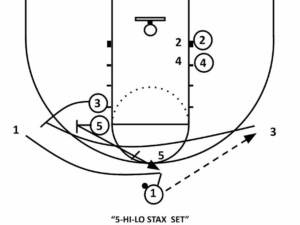
3 pops out of (5-3) ‘Pin-Down Screen” & then immediately ‘Iverson Cuts’ over the top of 5 to the opposite wing. 1 makes ‘Wing Pass’ to 3 then Flare-Cuts off of the 95-1) ‘Flare-Screen’ 4 and 2 remained ‘stacked up.’


Frame 2
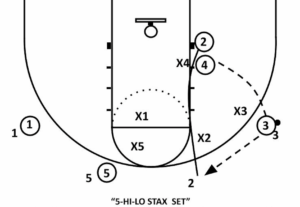
After 3 receives the ball, 2 makes a ‘Pipe-Cue’ up to the new ‘Ballside Slot.’ With 1 at the ‘Weakside Wing,’ horizontally stretching the defense and 5 at the ‘Weakside Slot’ outside of the arc, stretching the biggest or second biggest defender vertically; 4 is able to isolate his defender on the ‘Ballside Block.’ If nothing is available inside, 3 reverses the ball to 2, now located outside of the arc.


Frame 3
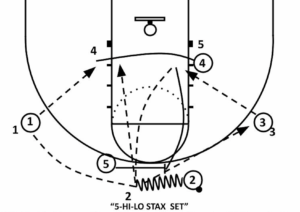
After 2 receives 3’s pass, 5 steps over to set a ‘Big-on-Small Ball Screem’ for 2 to dribble across to the opposite side of the floor. As 2 ‘dribble-scrapes’ off of 5’s top shoulder, 4 chases the ball by cutting across the lane. As 2 breaks contact with 5, 5 ‘Rim-Runs’ to the now vacant weakside of the lane. 2 can make Inside Passes to either 4 or, a ‘Wing Pass,’ to 1 or a ‘Throwback Reverse Pass’ to 3. All five offensive players have repositioned themselves into “3-Out/2-In Spot Ups” to seamlessly continue the offensive action.
Decision Making Progression

By Brian Williams on April 13, 2022

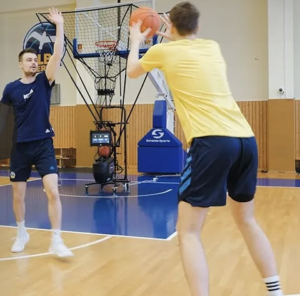
FIBA Player Development Coach Carlos Frade shows a drill to teach 2 on 1 decision making.

There are two drills in the post. The first one is a one on one drill that is good to teach to attack the front hand of the defender closing out.

The second drill is the one that I really like. it is a very good 2 on 1 decision making and is scored based on how efficiently (minimizing passes and dribbles) the 2 offensive players can MAKE a shot.

You can and should modify any of the drills to make them fit your needs or to add variety to your skill development work.

Please make sure your sound is on to see the video.

This drill is hosted on YouTube, so you will need to be on a server that allows you to access YouTube to see the drill.

Click the play arrow to see the drill.

Step Up Screen Series Drill

By Brian Williams on March 14, 2022

This skill development drill is provided by Dr. Dish Basketball.

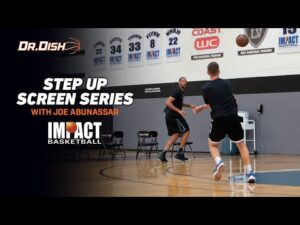
IMPACT Basketball founder Joe Abunassar teaches a drill to work on the skills needed to execute a step up ball screen.

You can and should modify any of the drills to make them fit your needs or to add variety to your skill development work.

Please make sure your sound is on to see the video.

This drill is hosted on YouTube, so you will need to be on a server that allows you to access YouTube to see the drill.

Click the play arrow to see the drill.

The Parent-Coach Relationship: Let’s Bridge the Gap

By Brian Williams on February 25, 2022

While it may not have a direct impact on the score, a positive coach-parent dynamic is crucial for team health.

If you lose a game as a coach, it’s definitely your fault. When you win a game, the players get the credit and someone is probably grumbling that their kid didn’t play enough.

We all want the game decided on the court or field, and the kids to be the chess pieces that make it happen. Studies on the brain have told us neurons must fire at the same time consistently—that’s how I see the parent-coach relationship. We all have to be on the same page.

The Possible Pitfalls

We live in a world of Twitter finger pointing and second guessing of coaches. Often times, some poor kid has to sit through their parent berating the one person who sees him or her more than their family. That man or woman who’s a mentor, who fuses sports and character decisions that to translate to life long, trajectory-changing outcomes.

Who gains the least in this testy dynamic? I’ve witnessed parents walk their children out of practice (why were you even there?). I’ve seen parents try to fight coaches. I’ve observed parents threaten to pull their kid from the school. I’ve been present when parents blame the coach for their young scholar’s lack of academic performance.

See It From the Other Side

For parents to grasp the true genetic makeup of the coaching profession, they must understand that mentoring, accountability and third-party parenting is now a part of the job. Before buying into the team, parents need to buy into the coach.

As a coach, you have to initiate a relationship based on communication transparency, not strategic transparency. The moment you start discussing in-game strategies with a parent, you’re inviting them into your coaches’ huddle. In the same way, parents shouldn’t feel assume a coach’s participation in any parental duties (even though many coaches do without question).

Coaches and parents are teammates—the same rules must apply. We must be respectful and act in the best interest of the scholar athlete. As teammates, we should communicate about development, academics and character, not about playing time, chores at home, other players or how the scholar athlete treats their little brother or sister.

Sharing these types of opinions with parents could lead to team division or a breach of trust within the player-coach relationship. Just like it does when parents push strategies on a coach or berate them.

The Shared Goal

I don’t know one coach who chooses to lose. So never question their intentions around winning. If parents have an issue with delivery, language or environment, those concerns would be warranted. But concerns should be saved for the proper time, like a one-on-one meeting.

For any parents reading this entry, my main motivation is to help your child understand the three pillars necessary for success: effort, talent and competitiveness.

Being a part of a team is a shared mindset. In sports, the team is fixated on success and a player’s individual growth is found within the team’s. So let’s all work together to help players focus on playing, coaches focus on coaching, and parents focus on being supportive.

(All this being said, if your player’s coach is embarrassing or humiliating your child, there’s no excuse. That coach obviously isn’t building character or self-esteem, so remove your athlete from the team.)

Let Me Translate

The messages and actions between coaches, players and parents often aren’t clear. From my experience, these translations could help address the elephant in the room.

Interpretations for athletes
  • You’re not getting played. → You don’t suck, it’s likely because you’re not working hard enough at practice. So go out there and WIN PRACTICE.
  • You’re not starting. → It’s okay to be disappointed, but don’t be upset. Use practice to convince me to play you.
  • You’re told you won’t go pro. → Prove them wrong. Earn it.
Interpretations for parents
  • If a coach subs out your scholar athlete. → It’s not because of one mistake or that they hate your child, they’ve probably seen that mistake a few too many times at practice.
  • The coach wants to talk. → Discuss competitiveness, growth and progress, not personal feelings.
  • Your child is the 12th, 13th or 14th on the team. → Help them understand their role on the team—they’re still a contributing player. And if they want to move up, encourage your kid to come in early, to put extra work in.

The coach-parent relationship may not contribute to a team victory. But an ego-free partnership can help create a blueprint for student athletes to follow, leading to the life skills they need for the real world. Isn’t that what we all want?

Cory McCarthy spent more than a decade coach­ing bas­ket­ball. As Direc­tor of School Cul­ture and Cli­mate at New Mis­sion High School, he has helped lead the school to being named the 2012 EdVestors’ School on the Move, 2013 Nation­al Blue Rib­bon School for Improve­ment, and the 2017 Title One Dis­tin­guished School. McCarthy has rep­re­sent­ed Boston Pub­lic Schools at con­fer­ences such as ASUGSV Tech­nol­o­gy Sum­mit in San Diego and COSE­BOC in Boston, MA and New York, and has been a guest lec­tur­er at Emer­son Col­lege and UMASS Boston.

Relocation Shooting Challenge Drill

By Brian Williams on February 17, 2022

This skill development drill is provided by Dr. Dish Basketball.

IMPACT Basketball founder Joe Abunassar has a drill that you can use in your spring and summer skill development workouts and create a challenge for your team or individuals.

In this drill, the players shoot until they make 20 and their score is based on how long it takes them to hit 20 shots. With the movement that is involved in the drill and the amount of time that it will take to get to 20 makes, the drill is also a conditioner and a toughness drill.

You can and should modify any of the drills to make them fit your needs or to add variety to your skill development work.

Please make sure your sound is on to see the video.

This drill is hosted on YouTube, so you will need to be on a server that allows you to access YouTube to see the drill.

Click the play arrow so see the drill.

2 v 1 Contested Shooting Progression

By Brian Williams on January 12, 2022

This team skill development drill is provided by Dr. Dish Basketball.

The drill is by Coach Joerik Michiels.

Coach Joerik founded the Elite Academy program in 2017 to provide a year-round program for youth players in Belgium. This unique formula has led to international acclaim, with Joerik regarded as a globally renowned skill trainer delivering international camps and coaching clinics all over the world.

Within the Academy, Joerik leads on the player development strategy and spends time working with all age groups on individual skills. Joerik has been featured on several leading podcasts sharing the unique methodology used at Elite Academy

You can and should modify any of the drills to make them fit your needs or to add variety to your skill development work.

Please make sure your sound is on to see the video.

This drill is hosted on YouTube, so you will need to be on a server that allows you to access YouTube to see the drill.

Click the play arrow to see the drill.

  • « Go to Previous Page
  • Page 1
  • Interim pages omitted …
  • Page 11
  • Page 12
  • Page 13
  • Page 14
  • Page 15
  • Interim pages omitted …
  • Page 288
  • Go to Next Page »

Primary Sidebar

  • Twitter
  • Facebook
  • Linkedin
coachestoolbox
personaldevelopmenttoolbox
basketballplayerstoolbox
basketballtrainer
athleticperformancetoolbox
coachingbasketball

© Copyright 2026 Coaching Toolbox

Privacy Policy