• Skip to primary navigation
  • Skip to main content
  • Skip to primary sidebar

  • Basketball Plays
    • Ball Screen Sets
    • Horns Sets
    • Man to Man Post Up
    • Man to Man Isolations
    • Backdoor Plays
    • Man to Man 3 Point Shot Plays
    • 2-3 Zone Attack
    • Baseline Inbound Plays
    • Sideline Inbound Plays
    • Combination Defense Attack
  • Drills
    • Defensive Drills
    • Offensive Drills
    • Competitive Drills
    • Passing Drills
    • Rebounding Drills
    • Shooting and Scoring Drills
    • Toughness Drills
    • Transition & Conversion Drills
    • One on One Drills
  • Blueprint
  • Practice
  • Mental Toughness
  • Skill Development
  • Offense
  • Defense
  • Store

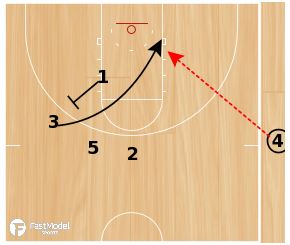
Elbow Stagger Flare SLOB

Elbow Stagger Flare SLOB

By Brian Williams on February 7, 2016

A good play if you need a basket with little time left on the shot clock.

Northern Iowa ran this and got a good look for a three-pointer with 1 second left on the shot clock.

It has three progressions. Posted by Lucas Shapiro.

This play was posted in the FastModel Sports Basketball Plays and Drills Library

You can also find out more about FastModel Play Diagramming software by clicking this link: FastDraw

You can get any 2 of our eBooks for $25 at this link: Coaching Toolbox/HoopScoop eBook Bundles

If you have any questions or are interested in a book that isn’t on the list, email me at [email protected] or call/text me at 317-721-1527‬.

Elbow Stagger Flare SLOB

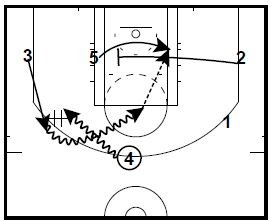
basketball-plays-elbow-stagger1

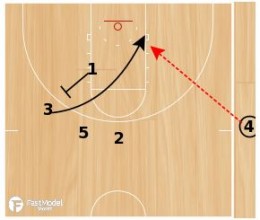
First look is to 3 curling off the screen 1 sets at the elbow.


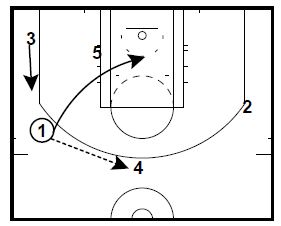
basketball-plays-elbow-stagger2

If 3 isn’t open, 1 comes off a staggered screen from 2 and 5.


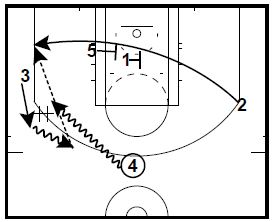
basketball-plays-elbow-stagger3

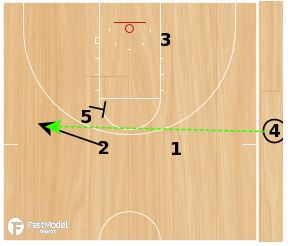
If the first 2 options aren’t open, 5 sets a flare screen for 2.

You can get any 2 of our eBooks for $25 at this link: Coaching Toolbox/HoopScoop eBook Bundles

If you are interested in adding to your Coaching Toolbox take look at what I believe is our best offer.

CLICK HERE to select from a list of more than 70 eBooks.


If you have any questions or are interested in a book that isn’t on the list, email me at [email protected] or call/text me at 317-721-1527‬.

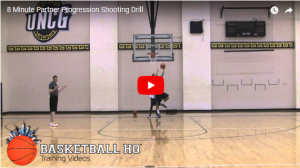
8 Minute Shooting Progression Drill

By Brian Williams on February 4, 2016

This drill is among the thousands of resources for both coaches and player available from basketballhq. They have several more videos as well as basketball coaching resource articles.

You can use this drill to get some ideas for a way to create a similar routine into your practices or improvement season workouts. I like the idea of a timed competition to keep players focused. You can substitute your own finishing moves such as jump hooks, floaters, up and under, or anything that your players use to score in the lane.

A good time for college players is 8 minutes, but for high school it could be 9 minutes. The best way for you to determine the time is by running the drill with your squad a few times–especially if you make adjustments to adapt the drill to different shots.

Layup drills are 10 makes, jump shots require 8 minutes from each spot.

The drill is from Coach Mike Roberts, University of North Carolina Greensboro Assistant Mens Coach

Please make sure your sound is on to see the video.

Click the play arrow so see the drill. The drill is a You Tube video, so you will need to be able to access You Tube to see the drill.

8 Minute Partner Progression Shooting Drill

Spurs Secondary Hand-Off Actions

By Brian Williams on February 3, 2016

These two San Antonio Spurs secondary break actions are contained in Wes Kosel’s 2014 San Antonio Spurs Playbook.

You might not be able to use them as early offense or exactly as presented, but hopefully there are pieces that you might use to add to what you are currently doing.

The San Antonio Spurs Playbook is combined with the Comprehensive Ball Screen Playbook as the featured eBook bundle of the week.

You can find out more about them at this link: 2014 Spurs and Comprehensive Ball Screen Playbooks

If you would like to see a sample from the Comprehensive Ball Screen Playbook, you can click this link: Ball Screen Attack

If you have any questions, you can email me at [email protected] or call/text me at (317) 721-1527

Diagrams created with FastDraw

Secondary Hand-Off #1

basketball-plays-spurs1

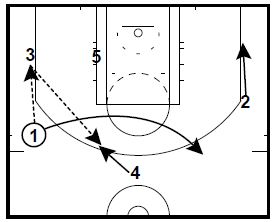
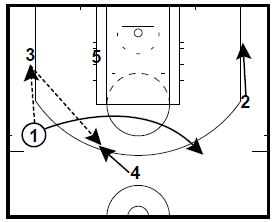
1 passes to 3 then cuts in front of 4 to the opposite mid-point area.

3 passes to 4 at the top.


basketball-plays-spurs2

Once 4 has the ball, he dribbles toward 3 to give him the ball on a dribble hand-off.

3 uses the hand-off as a screen and drives middle.

2 moves in from the corner to screen across for 5.

3 looks to score or pass to 5 at the basket.

Secondary Hand-Off #2

basketball-plays-spurs3

1 passes to 4 at the top then moves into the lane.


basketball-plays-spurs4

1 stops in front of 5 and joins 5 in a staggered screen for 2.

4 dribbles toward 3 and can either give him the ball on a dribble hand-off or pass to 2 in the corner for a shot.


basketball-plays-spurs5

If 3 gets the ball, 5 moves up to the opposite elbow and clears out to the corner.

3 passes to 5 then makes a cut to the basket.

5 looks to make the give-and-go pass to 3.


basketball-plays-spurs6

If 3 isn’t open, 5 dribbles across the free-throw line and looks to give the ball to 2 on a dribble hand-off.

2 cuts from the corner off of a screen from 4 to get the ball from 5.

2 looks to score, to 5 rolling, or to 1 in the corner.


The San Antonio Spurs Playbook is combined with the Comprehensive Ball Screen Playbook as the featured eBook bundle of the week. You can find out more about them at this link: 2014 Spurs and Comprehensive Ball Screen Playbooks

If you have any questions, you can email me at [email protected] or call/text me at (317) 721-1527

Powering Through the Dog Days of Winter

By Brian Williams on February 2, 2016

Powering Through the Dog Days of Winter

Scott Rosberg

While all sports seasons can have their mid-season “dog days,” it seems like they come on stronger during the winter season. It may feel that way because this season is in the dead of winter. The days are much shorter, the weather can be dreary and cold (depending upon where you live), and the beginning of the season seems like it was so long ago, last year in fact. So what can coaches and athletes do to help power their way through these “dog days”?

First, focus on the moment. Too often we tend to think about the past and the future, without focusing on what we are doing right now. If we live in the past, we stop finding ways to advance and grow. If we think only of the future, we forget to take care of all the things that we must take care of right now to create the future we are seeking. By focusing on this day, this hour, this minute, we zero in on what’s important now to make sure that we do all that we can to become our best.

Second, we need to make sure we are taking care of our health. For athletic teams, it seems like a no-brainer that they would be taking care of their health because they are training almost every day. And while training (exercise) is important to good health, let’s not forget some of the other keys to good health like eating a well-balanced diet, upping your intake of vitamins, and making sure you are getting enough rest, like getting 8 hours of sleep each night. Also, getting outside and enjoying nature can be very beneficial to helping one push through the dog days.

Another way to power through the dog days is to engage in mentally and emotionally stimulating exercises. Reading engaging content or literature that inspires you is a great way to get excited about living and becoming all that you can become. Many people find puzzles, board games, and various challenges to the mind and spirit to be extremely stimulating to their brains and their souls, and these can be great ways to help you deal with some of the monotony and drudgery that the dog days can bring.

One huge way to help get through the dog days is to make sure you add variety to your days. They say, “Variety is the spice of life,” and that certainly rings true when you are in a rut or feeling the monotony of the dog days. Change up the order in which you do things, or add something new and different to your routine. Anything to push you out of a rut and moving in a different direction can be truly beneficial at this time.

Another way to overcome and power through the dog days is to focus on all the positives you have going on. Positivity is a powerful force, and it can really help people get through times when they are feeling sluggish. Daily affirmations of all the good things you have going in your life can do wonders to help you feel good about yourself and your surroundings. Taking time to be thankful for what you do have and all the good people and good things you have in your life can really help to elevate your disposition and your attitude.

Finally, for those of you who have created Core Covenants (Team Standards, Guiding Principles) for your teams, the dog days are a very important time to stay focused on your covenants. Teams have a tendency to stray from the path of what they are supposed to do when the dog days start dragging them down. It’s easy to not focus as much, work as hard, and pay attention to the details that we have deemed important. By re-committing and re-focusing on the team’s covenants, you help keep the team on track to accomplishing what they set out to do. You need your covenants during the tough times more than any other time, and the dog days of your season are the perfect time to zero in on them and help your team stay the course of building the identity you seek.

The dog days can be a drain if you let them be. However, if you recognize them, address them, and work to power through them, you will soon find yourself not even feeling as if they exist at all. You will see the “light at the end of the tunnel,” and before you know it, the winter season will be coming to an end and all the excitement that time of the year brings will become your focus.

If you have any other ways that you power through the dog days of winter, I would love to hear them. Leave a comment on our Facebook page www.facebook.com/proactivecoach and let us know what you do to get through the dog days.

About the Author of this Article

Scott Rosberg has been a coach (basketball, soccer, & football) at the high school level for 30 years, an English teacher for 18 years, and an athletic director for 12 years. He has published seven booklets on coaching and youth/school athletics, two books of inspirational messages and quotes for graduates, and a newsletter for athletic directors and coaches. He also speaks to schools, teams, and businesses on a variety of team-building, leadership, and coaching topics. Scott has a blog and a variety of other materials about coaching and athletic topics on his website – www.coachwithcharacter.com. He can be reached by email at [email protected].

Scott is also a member of the Proactive Coaching speaking team. Proactive Coaching is dedicated to helping organizations create character and education-based team cultures, while providing a blueprint for team leadership. They help develop confident, tough-minded, fearless competitors and train coaches and leaders for excellence and significance. Proactive Coaching can be found on the web at www.proactivecoaching.info. Also, you can join the 200,000+ people who have “Liked” Proactive Coaching’s Facebook page at www.facebook.com/proactivecoach. Scott can also be reached through Proactive Coaching at [email protected].

Keeping Practices Meaningful

By Brian Williams on February 1, 2016

I have always felt that it is also important to add as much variety as possible to help players stay focused.  Additionally, I feel that our players have the responsibility to push themselves to get the most out of practice, but as coaches, it is our number one job to make sure that we are creating practices that are as engaging as we can make them for our players.

Even if you already do the things listed in this post, I hope you take some time to think about how you can make those segments even better in contributing to the improvement of your players as individuals and to your team as a whole.

This post contains practice ideas from Texas A&M Women’s Assistant Bob Starkey. His Hoop Thoughts Blog should be on your regular reading..

The following is a great passage from the book “Toughness” written by Jay Bilas which speaks to the mindset of a player in regard to practice.

How many players start practice with the intention or goal of simply “getting through” practice? Instead of “getting through” a workout, players need to “get from” a workout-to get the most from it, and the most from themselves. No player ever got better by just getting through something. True toughness is competing through the end of a practice or workout after having prepared yourself mentally to compete. That is a key mind-set of the toughest players.

A key question for us as coaches is how can we help our players with this process? There are several things that have served me well and here are a few.

INDIVIDUAL PRACTICE GOALS

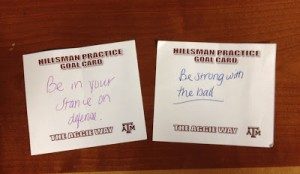
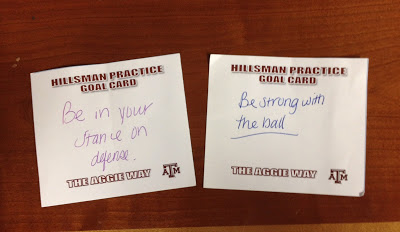
photoSomething I started last here with our freshman post player Khaalia Hillsman was to have an individual practice goal.  I created some cards for her and placed them in her locker.  Each day she has to pick something that she wants to give extra concentrated effort on.  I let her pick it…she writes it down…she gives it to me when she first comes to practice.  I then make sure I am watching her to see how she is doing.  I compliment her when she is successful and remind her when she falls short about her goal.  After practice, I give her a grade on her goal and from time to time support that grade with video.

PRE-PRACTICE

This is a short period at the beginning to do position work.  It’s also quality time between a coach a small, select group of players.  I was even more impressed to find out that it was done on a daily basis each practice of the season — all the way to the completion of the year. As a coach, you can set the tone in terms of what needs to be accomplished as a player and a team for this particular day.

Simply stated, it is a period of time before practice where you work on parts of the game that can sometimes be overlooked once the season begins and you are preparing for an opponent.  The majority of the time we break our team up into post and perimeter players and work on specific areas in relation to their positions.  I’ve been on staffs that have broke the group up into 3’s when space permitted.  At times, we will have half perimeter and post on each end when we want to work on areas that incorporate them both.

While we want focus and concentration in these areas, often it is a time where the coach might do a little more talking to explain and correct.  We can continue to work on fundamentals such as ball handling, passing, screening, dribbling and defense.  We can also work on a phase of the game that maybe we feel the need to improve upon from the previous game.  Possibly we did not do a good job of feeding the post so we can break it down in our pre-practice portion.  It could also be that we can focus on something of importance for an upcoming game.  If we are playing a team that drives the ball baseline from the wing well, we can look at are positioning and talk about and work on that fundamental.

Almost always there will be a drill or two that will relate to our Emphasis of the Day.  If our emphasis of the day is screening, as shown in the practice plan below, then we will have a few screening drills in our pre-practice session.  In the practice plan below you see “1/0 DS w/2nd Cut” — which is a 1 vs. 0 Down Screen situation.

I also like the opportunity to communicate with the players during this period.  We will spend a little more time explaining while also allowing the players to ask questions they may have.

While staff size can be a factor, I would have a Pre-Practice period even if I was the only coach.  Monday I would have the perimeter players come in early with Tuesday being for the post players, etc.

The length of time varies…generally pre-practice last between 15-30 minutes.  When we get into the meat of the season, especially in February, we will cut back on practice time but still have a pre-practice period.  Again, it makes sure that we never veer to far away from fundamentals and teaching.

EMPHASIS OF THE DAY

We believe this is a great way of focusing a team’s attention for a practice.  Picking a phase of basketball or an intangible and making that a special focus for that day.  We will have specific drills to highlight it as the “Emphasis of the Day.” It’s a simple way to make sure that your team improves in one area each day. That sounds simple, but think about it. If you could do something that would ensure that your team improves in one phase of the game each day, wouldn’t you jump at the chance?

Well, we’ve had that type of success with this concept and here is how it works.

First, you must pick what you want to emphasize each day in practice. We have a couple of schools of thought in this regard. The first is obvious—pick something that you struggled with the day before. Maybe on Monday your team didn’t do a good job of blocking out. So on Tuesday you make blocking out your emphasis of the day.

The second way of choosing an emphasis is to look at your upcoming opponent. Maybe the next team on your schedule does a nice job of running with the basketball. Your next practice might have transition defense as your emphasis of the day.

Choosing the emphasis of the day is just the beginning…now it’s time to start emphasizing! This comes from several different means and they all need to be a part of the process for it to be successful.

First, when the players come to practice, they will find a sheet of paper with the emphasis of the day in their locker. On the way out of the locker room they will see that same sheet of paper on the bulletin board. When they walk on to the practice floor, they will see it taped up at each basket and at the water cooler. There will be no doubt in their mind that the coaches are going to work diligently that day to improve that area.

We start each session with a “Pre-Practice.” In this segment, the team is broken down into smaller numbers for some individual attention and part-method teaching. Some of these drills will be devised to work on the days emphasis.

Following Pre-Practice, we will start regular practice by huddling up, at which time I will mention the emphasis of the day and why it is important. We will generally start practice with a drill that is specific to the emphasis of the day. Throughout practice, the coaching staff will constantly mention the emphasis in all drill work. The majority of the time, the emphasis will be related to a basketball fundamental: Blockout, Low Post Feeds, Shot Fake, Contest the Shot, etc. On occasion, it will be a mental emphasis: Concentration, Communicate, Listen, Intensity, etc.

We have also on occasion tied our video into the emphasis of the day. Before going to the floor for Pre-Practice, we might watch some video clips of what our emphasis of the day will be.

PRACTICE STATS

If its going to be important, find a way to measure it.  We keep practice stats everyday.  We might keep a special stat on a specific day to compliment a particular emphasis — and we share it with our players…often in the middle of practice to let them know how they are doing.  Here is an older post about the topic of Practice Stats.

Click here for information on the basketball practice e-book “130 Great Ideas to Get a Lot More Accomplished in Practice”

3 Line Closeout to Help Defensive Drill

By Brian Williams on January 31, 2016

This defensive dill was posted in the FastModel Sports Basketball Plays and Drills Library by Kyle Gilreath, Assistant Basketball Coach at Fort Myers (Florida) High School.

Kyle previously served for five seasons as an undergraduate manager and graduate assistant for Billy Donovan at Florida.

You can also find out more about FastModel Play Diagramming software by clicking this link: FastDraw

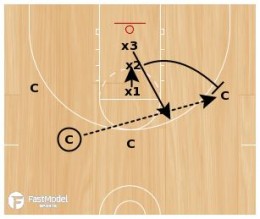
The drill works on players closing out to their help positions when the player they are guarding does not receive the basketball.

You can apply your defensive rules and make any adjustments to make the drill more like your games.

This is a good way to practice skills involved in defensive rotations so that your team has organized defensive rotations and not chaotic defensive scrambles.

closeout1

Players start on whistle slapping the floor and footfire. On the pass they close out to where they should be in conjunction with their man and the ball.

The offense can pass the ball around but do not add dribbling yet.

x2 is guarding the coach who catches the basketball, so he closes out on the basketball.
x3 is guarding the coach at the top and closes out into the passing lane (or help gap depending on your defensive scheme)
x1 is guarding the player on the help side and closes out to the midline.

Make sure the defensive players rotate so they aren’t always closing out to the same player.

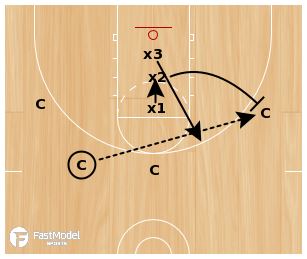
closeout2

The second diagram shows the rotations if ball is passed to top.

The defensive players are guarding the same players, so they have different responsibilities when the ball is passed up top. Again, rotate so that all players are guarding different positions and practicing closing out to all spots.


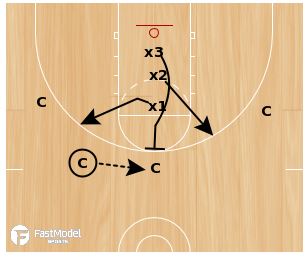
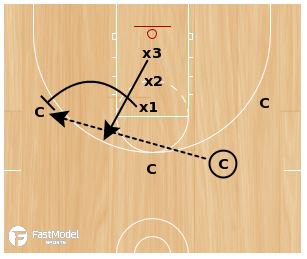
closeout3

The final diagram shows the rotations when ball is passed to left wing.


  • « Go to Previous Page
  • Page 1
  • Interim pages omitted …
  • Page 131
  • Page 132
  • Page 133
  • Page 134
  • Page 135
  • Interim pages omitted …
  • Page 288
  • Go to Next Page »

Primary Sidebar

  • Twitter
  • Facebook
  • Linkedin
coachestoolbox
personaldevelopmenttoolbox
basketballplayerstoolbox
basketballtrainer
athleticperformancetoolbox
coachingbasketball

© Copyright 2026 Coaching Toolbox

Privacy Policy