• Skip to primary navigation
  • Skip to main content
  • Skip to primary sidebar

  • Basketball Plays
    • Ball Screen Sets
    • Horns Sets
    • Man to Man Post Up
    • Man to Man Isolations
    • Backdoor Plays
    • Man to Man 3 Point Shot Plays
    • 2-3 Zone Attack
    • Baseline Inbound Plays
    • Sideline Inbound Plays
    • Combination Defense Attack
  • Drills
    • Defensive Drills
    • Offensive Drills
    • Competitive Drills
    • Passing Drills
    • Rebounding Drills
    • Shooting and Scoring Drills
    • Toughness Drills
    • Transition & Conversion Drills
    • One on One Drills
  • Blueprint
  • Practice
  • Mental Toughness
  • Skill Development
  • Offense
  • Defense
  • Store

Championship Values Leadership Tool

Championship Values Leadership Tool

By Brian Williams on August 29, 2016

Cory Dobbs, Ed.D.

Championship Values

Values are among the most stable and enduring characteristics of people. They are the foundation on which attitudes and personal preferences are formed. Our core values are crucial in making vital decisions, determining life directions, and behaving in social interactions. Values help define our morality and our conceptions of what is “good” and what is “right.” Many of our behaviors are a product of the basic values we have developed throughout our lives.

However, a problem with values is that they are generally taken for granted. Most of the time people are unaware of their values and how they shape attitudes and behaviors. Unless a person’s value’s are challenged they will remain largely undetected. People are not aware that they hold some values as being more important than others. This unawareness leads to actions or behaviors that are sometimes contrary to values, or even leads to confusion about values.

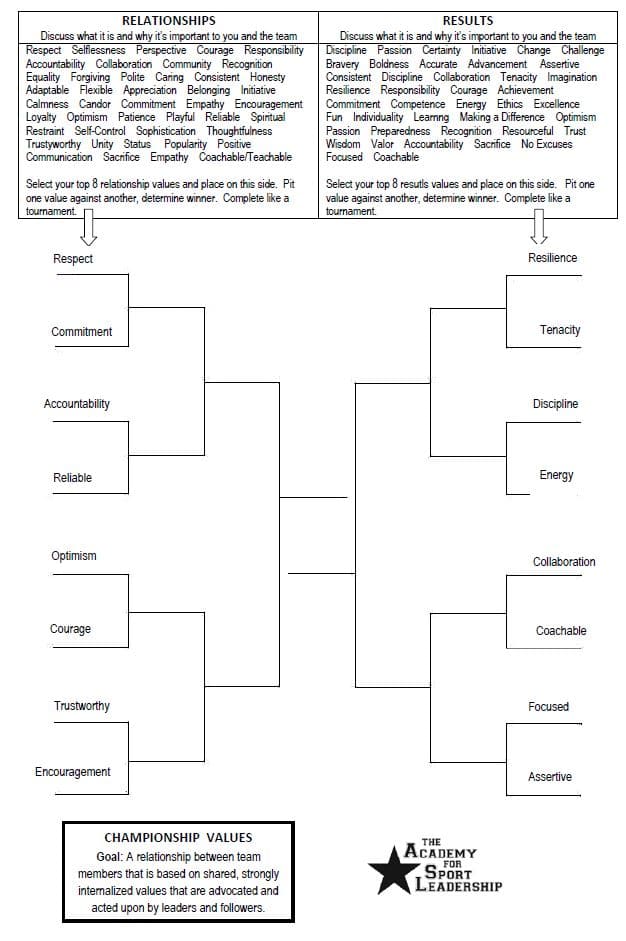
The Championship Values exercise is an interactive tool for you to use in determining your values and those of your teammates. As you work through the eight steps to your team’s Championship Values, keep in mind that sometimes the best way to stimulate discussion of values is to pose a difficult situation that demands a hard look at how a value will help you best resolve the situation.
For additional resources for value-driven leadership consider The Academy for Sport Leadership’sCase Studies.

Step 1 Each team member is to think through the values (Relationship Oriented and Results Oriented) and identify circle the sixteen (8 Relationship / 8 Results) most important values—for you as a member of this team. Be sure to carefully think through just what the value is and why it’s important to you.

Step 2 Fill in the brackets with your eight (8) Relationship Oriented values on the left side and eight (8) Results Oriented values on the right side. Do this exercise individually.

Step 3 Pitting value vs. value tournament style. After placing all sixteen values in the brackets, determine a winner and move the winning values along toward the middle of the chart.

Step 4 Once you’ve completed your Championship Values tournament you’ll have identified your top four values (2 Relationship / 2 Results). Be sure that you’ve thought through the value of each value!

Step 5 Now split your team into triads (groups of three) and discuss the values. As a triad come to an agreement on 16 values and fill out the brackets. This should take some time as you and your teammates will need to work through personal differences to reach shared values.

Step 6 Once you’ve got the 16 shared values begin your tournament. At each stage engage in meaningful conversation to identify a winning value.

Step 7 Once you’ve completed your Championship Values tournament as a triad, begin the same process as a team. When you finish your tournament you will have identified four (the final four values) values that will be strongly internalized, advocated, and acted upon by all team members. The discussion should reveal values a clear-cut set of values for you and your teammates—standards of behavior towards one another and individual and team performance.

Step 8 Do the Championship Values exercise as a complete team. Your goal is a relationship between team members based on shared, strongly internalized values that are advocated and acted upon by all team members.

Click here to download a blank template of the Tool
leadership

“Tell me and I’ll forget. Show me and I may remember. Involve me and I will care.” -Your Student-Athlete The world of coaching is changing. In Coaching for Leadership you’ll discover the foundations for designing, building, and sustaining a leadership focused culture for building a high-performance team. To find out more about and order Sport Leadership Books authored by Dr. Dobbs including Coaching for Leadership, click this link: The Academy for Sport Leadership Books

About the Author

A former basketball coach, Cory’s coaching background includes experience at the NCAA DII, NJCAA, and high school levels of competition. While coaching, he researched and developed the transformative Becoming a Team Leader program for student-athletes. Cory has worked with professional athletes, collegiate athletic programs and high schools teaching leadership as a part of the sports experience and education process. Cory cut his teeth as a corporate leader with Fortune 500 member, The Dial Corp. As a consultant and trainer Dr. Dobbs has worked with such organizations as American Express, Honeywell, and Avnet.

Cory has taught a variety of courses on leadership and change for the following universities:

Northern Arizona University (Graduate Schools of Business and Education)

Ohio University (Graduate School of Education / Management and Leadership in Sport)

Grand Canyon University (Sports Marketing and Sports Management in the Colangelo School of Sports Business)
Duke and Oklahoma Screen The Screener Sets

By Brian Williams on August 28, 2016

A couple of Screen the Screener sets from Oklahoma and Duke.

They are a part of a Wes Kosel’s Pick the Picker Playbook.”

Wes is on the staff at Colorado College.

I also have a link at the bottom of this post if you would like to download his Pick the Picker Playbook.

The idea is to take bits of pieces of these plays that might fit within your offensive system.

Diagrams created with FastDraw
 

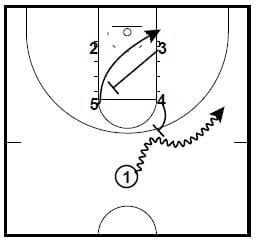
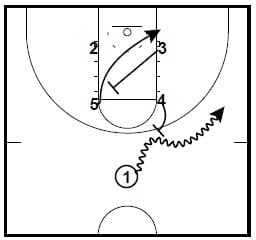
Duke Box PTP

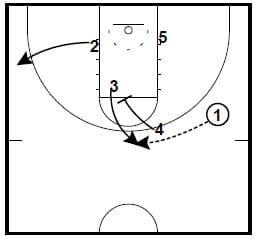
duke-sts-1

4 sets a high ball-screen for 1 who dribbles to the right wing.

3 sets a screen for 5 at the elbow.

5 cuts to the ball-side low post.


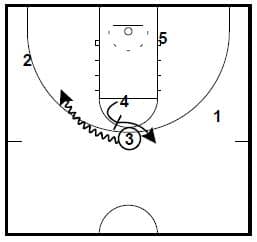
duke-sts-2

If 5 isn’t open, 4 sets a down-screen for 3.

1 passes to 3.


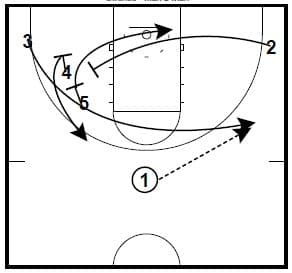
duke-sts-3

If 3 doesn’t have a shot, 4 sets a high ball-screen for 3 then pops to the top of the key.


Oklahoma Corner Stagger PTP

oklahaoma-sts1

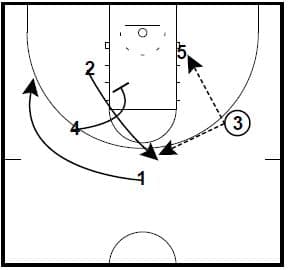
3 cuts off of 4 and 5 to the right wing.

1 passes to 3.

2 sets a cross screen for 5.


oklahaoma-sts2

4 screens down for 2.

3 looks to pass inside to 5 or to 2 for a shot.

Click here to download Wes Kosel’s Pick the Picker Playbook

Half Court Hustle Rebounding Drill

By Brian Williams on August 25, 2016

The following offensive rebounding drill is provided by Coach Jamy Bechler. Coach Bechler has coached several teams that have achieved several national rankings for rebounding. During the 2013-’14 season, they led the nation in Rebounding Margin (+19), Rebounds per Game (55 rpg) and Offensive Rebounding Average (21/game).

They were among the NAIA’s Top-10 in each of these categories in all of Coach Bechler’s years at Martin Methodist College. While at Bryan College, Bechler’s teams were known for their toughness and rebounding. In his three years, the Lady Lions finished in the NAIA’s Top-10 for Rebounding Margin culminating in an incredible +18 rpg average during the 2009-2010 season.

The statistics show that more field goals are missed than made, so the philosophy he instills is that “every missed shot is a pass to me.”

The drill below is a sample from his Championship Rebounding Video.

You can find out more about the video at this link: Championship Rebounding

This is a vimeo video, so make sure that you are able to access that network. Also, please make sure your sound is on for the instruction with the video.

The Seven Essential Roles of a Basketball Coach

By Brian Williams on August 23, 2016

Just as you have segments of the game that you must cover in practice such as offense, defense, shooting, special situations, conditioning, etc… there are also seven segments that you need to perform to effectively lead and develop your basketball team.

  1. Philosophy and Leadership—Define and instill your program’s ideals.
  2. Organization and Management—maximizing the resources at your disposal.
  3. Individual Participant Development–Develop your players’ skills and attitudes within your system.
  4. Team Development– Develop, implement, and teach systems for team play that fit your players’ abilities and strengths.
  5. Role Definition–Assign roles that best fit each players within the system, work to keep them in those roles, and redefine roles as players change or the needs of the team change.
  6. Coaching Staff Development—Intentional professional development for the entire coaching staff.
  7. Service, Promotion, and Public Relations. Promoting the basketball program as a whole and the players individually.

#1: Philosophy and Leadership Define and Instill Your Program’s Ideals

My first priority is to make sure that I have (in writing) a clear direction and philosophy on which to build every aspect of our program around. You also need to update that document annually to make sure that it keeps up with your current thinking and beliefs about your job.  A huge part of your job as the coach is to develop it, present it, and embody it so that our assistant coaches, players, and managers not only “buy in,” but that they believe in it, support it, and feel that it is essential to our success.

Player development (Area #3 in my seven areas of focus) has the biggest impact on winning and losing.  Having your philosophy entrenched as #1 provides direction for your player development efforts within the scope of your overall system.

If a coach doesn’t have a clearly defined and written vision, it is impossible to achieve the consistency, unity, and intangibles a program needs to succeed from year to year as players and assistant coaches change.

#2 Organization and Management Maximizing the Resources at Your Disposal

For a business, this are would fall under “Operations.”  It is not the most enjoyable part of coaching, but it has to be handled well.

Even if your athletic administrator does the purchasing, facility maintenance, and scheduling for your program, you still need to stay on top of each of those areas and offer input.  Taking care of organizational items is not the most exciting part of coaching, however it is definitely important. It is a responsibility that is better handled proactively rather than re-actively.  Often the best way to deal with administrative items is to delegate them to a trusted staff member.

Have a long term plan for funding and purchasing big ticket items such as a shooting gun, or similar items.  Those projects require more planning and possibly even fundraising, so it is important to keep those items on your to do list and in front of the administration. The only way to do that is to give it some thought and review on a continual basis. Even smaller “extra” items such as practice gear, shooting shirts, shoes, travel bags, team meals may require fundraising, donations, or budgeting.

Keep a file of the officials who work your games both at home and on the road. That way you can make recommendations to your Athletic Administrator as far as who to hire at home. You will also be prepared when it comes time to turn in evaluations to your state association.

The more efficiently you can handle these types of items that need to be done, the less they become urgent “in your face” tasks when you are more focused on coaching basketball.

#3: Individual Participant Development of your players’ skills and attitudes within your system

In most games, the team with the best players usually wins. Granted, there is a certain amount of talent and attitude that is natural.  Our most important job in terms of winning games is to develop our players’ on-court abilities and skills so that we can put the team on the floor that has the best players.  In addition to developing basketball skills you can work to improve their athleticism, and to develop their mental toughness to handle the competition and pressures of a basketball season.   You must implement a year round program to develop your players’ skills place both during the season and out of your games season.

We have a plan to develop mental toughness in our players that includes defining what it is and what it is not, not allowing anyone in the program to use or accept excuses, not accepting moping, pouting,  or poor body language, and rehearsing in practice any and all pressure situations we might encounter in a game. That is not to say that we can simulate the pressure of a game in practice, but I feel that if we have rehearsed it in practice, it gives the player confidence that they have a plan of attack for the games.

#4 Develop, implement, and teach systems for team play that fit your players’ abilities and strengths.

Your system of play must take into account not only what each player does well, but also your depth, what it will take to win in your conference, against your schedule, and in season ending tournament play.
This is something that our staff works on throughout the year, but once we have selected the team, it is time to tweak and implement our system of play around the abilities of our players. It is an ongoing process throughout the regular season. We do not make wholesale adjustments, but will add in wrinkles, or subtract things that aren’t working as well as we thought they would when we included them as a part of our scheme.

This is a philosophical decision that you must make as a coach, but my philosophy is that we are going to utilize systems of play and structure our areas that we emphasize in practice, that give us the best chance to advance in our season-ending state tournament. As an example, if we know we’re going to have to beat a team that runs flex in our first round of the state tournament, then without telling our players what we were doing, we will practice defending the flex all season long. If our pack defense gives us the best chance of winning in the sectional, that is what we play during the season and work at daily. We do not play other styles of defense during the regular season even if they might be effective against one or two regular-season foes.

I refer to this role as team development because not only does it involve our offensive and defensive systems, but it includes team building and team chemistry as well. You’re not going to be able to reach your potential as a team unless there is a cohesion and camaraderie among the players. As coaches we can influence that togetherness of our team by the attitudes that we exhibit and instill in our players, the team building activities that we do, and the emphasis that we put on it.

#5: Assign roles that best fit each players within the system, work to keep them in those roles, and redefine roles as players change or the needs of the team change.

Deciding how each player, each assistant coach, and each manager is going to help the team and then working with that team member to coach them and make them better in that role is a crucial part of your job.  Providing those roles in writing in players and coaches notebooks is a very clear way of giving the direction they need to get started. But, just as important as having a plan to get started is your ability to have a plan to evaluate how each person is performing his or her role, how to keep them within their role and what to do if they grow out of that role.

#6: Intentional professional development for the entire coaching staff.

With all of the daily responsibilities that a coaching staff has during the regular season, it is very tough to spend any time on staff development.  Just like you ask your players to work on their game during the improvement season, the coaching staff also needs to sharpen their skills. There are five areas for each coach to work on and that coaches should have an individual development plan, just like players have an individual workout plan. The five areas to develop are:

  1. Technical Knowledge of the game of Basketball.
  2. Ability to teach the game of Basketball.
  3. Ability to bond a team.
  4. Ability to develop players’ individual skills.
  5. Leadership Skills

Create a coordinated development plan as a staff, so that you have different coaches working in different areas and can share their information so that everyone benefits from each other’s work.

Area of Focus #7: Promoting the basketball program as a whole and the players individually.

We don’t do complicated things, but strive to build relationships between our players and our community. The main thing is that you are working to create interest in and present your program in the best possible light.

We have a simple web site promoting our program that we email a link to for potential college recruiters as well as media members.  We write a basic pre-season media guide to hand out at games.  We run a summer youth camp and involve our players as instructors.  Each summer we hold a one day father/son one day clinic on the Saturday before Father’s Day.  We have an autograph night during the season where our players stay in the gym to sign autographs for anyone who is interested. We schedule all of these a year in advance so that we have the facilities and administrative blessings that we need.

We keep a resume for each player of his best games and honors such as player of the game, etc… to use to nominate them for post season honors and scholarships as well as to provide to potential college recruiters.

The key to the success in these seven areas, and ultimately your basketball team and program is your ability to visualize what you want in each of the seven key result areas, write long range, yearly, monthly, and daily goals and tasks, and then implement them through the work of everyone in your program.

5 Habits That Turn Off College Coaches

By Brian Williams on August 22, 2016

This post was written for PGC Basketball by Sam Allen.  Sam is the Director of the Essentials courses on the PGC summer tour, Coordinator for PGC/Glazier Coaches Clinics, and runs Blue Collar Basketball, focusing on team and individual training and basketball strength and conditioning.

Whether you are a high school or a college coach, perhaps your players could benefit hearing this message from another voice.

I have seen it all when it comes to recruiting. I coached college basketball for almost a decade and then ran a NCAA certified recruiting service that had college coaching subscribers from all levels so, to this day, I often get asked by athletes, parents and high school coaches about college recruiting. The recruiting process can be daunting and confusing, at times. However that process could be over before it begins if you allow these 5 habits to be a part of who you are.

While collecting my thoughts to write this article, I reached out to 15 male and female college coaches, from across the country. At every level, from Division 1 to Junior College, here is what they had to say.

POOR BODY LANGUAGE

The inability to show good body language on the court when things are not going well is a sure-fire way to catch the eye of a college coach – for the WRONG reasons. One PAC-12 assistant said he doesn’t want “front runners” or players that are only good when things are going their way.  Another college coach, whose teams have been in 4 of the last 6 NCAA tournaments, said “Non verbal language speaks about character.”Poor body language is a red flag.

Watch More: How to Communicate with Teammates

DISRESPECTFUL ATTITUDES

Disrespect can show up in a few ways.

  • “Players that never say thank you”
  • “Players that are never happy for their teammates’ individual successes.” 
  • “Players who are not respectful to parents”

A Division 1 Ace Recruiter said these, as well as many more, are troubling signs to college coaches. An associate head coach at the mid-major Division I level said “how they talk to their parents matters. We have eliminated a kid because he didn’t respect authority.”

POOR BEHAVIOR ON SOCIAL MEDIA:

Social media has really changed the landscape in college recruiting, especially in the last five years. An athlete’s ability to make the right decisions on their different social platforms is key if their desire is to play at the next level. One college coach said they communicate to their kids how important their social media feeds are by saying, “Don’t put anything on social media that you would not put on a live interview on ESPN.” This has really helped filter out high character players and helped coaches learn where a player’s priorities lie. Excessive retweets and posts all about themselves are a turn off to most coaches.

Don’t put anything on social media that you would not put on a live interview on ESPN

CLICK TO TWEET

INABILITY TO PLAY PITCH AND CATCH

Coaches want to be able to hold a conversation both via text and over the phone. Unresponsive texts and phone calls leaves a college coach concerned and left to wonder. One-word answers leave an impression that you do not care or may struggle to effectively communicate to future teammates and coaches.

One-word answers leave an impression that you do not care or may struggle to effectively…

CLICK TO TWEET

THE ME GUYS

Players that put themselves over the team. One Southern Conference coach said he receives texts that say, “My team lost but I had 21 points.” This simple and harmless looking text will not give a good impression to a potential college coach. Basketball is a team sport and it takes everyone being bought into the system. Being disengaged on the bench, inattentive in huddles or comments after a game that put blame on others are signs the player does not truly care for the team. College coaches desire players that can get along with others and make the most of the situation.

Read More: It’s Not What You Do. It’s How You Do It

How do you not fall victim to these habits?

Get feedback from your current High School coach. Ask he or she what they would tell a college coach about you. You may be on par with that. If you disagree, remember there is a hint of truth in every criticism. There is still time to change your habits.

Next, focus on becoming the best teammate possible. Be “others-focused” rather than “me-focused.” Really good college coaches will demand that you be a phenomenal teammate.

Now, drop the old habits. Build new habits that allow you to stand out in a good way to your teammates, coaches and college recruiters.

To learn more about PGC Basketball, including additional training tips and videos, you can visit their YouTube Channel

Competitive Drills Part 2

By Brian Williams on August 18, 2016

These are some of the notes presented by Dean Lockwood. Dean is currently the Associate Head Women’s Coach at Michigan State. He was an assistant in the Tennessee Women’s Program for 15 years. He was also an assistant in their men’s program for 5 years. In between those stints at Tennessee, he has been the men’s head coach at Saginaw Valley State, and Northwood University.

Thoughts on Competitive Practices 2

This is the 2nd part of my notes. You can see the drills and thoughts that I posted last week at this link:
Tennessee Competitive Drills

Have 2 areas of emphasis each practice and hold players accountable for them. Have a full rack of basketballs on the sideline. Each time one of the areas of emphasis is not followed through on, take a ball of the rack. When the rack is empty, the team runs. You can use it for any area, but as an example, Eliminating Turnovers is the emphasis for the day. Each time a turnover is committed, remove one ball from the rack. It is also a powerful visual teaching emphasis.

It’s not what you teach, it’s what you emphasize (old Don Meyer favorite)

Making layups and free throws are keys to being good. This drill is also a conditioner.

(Teaching point for layups: No defense, jump off 1 foot. With defense, shoot a two foot layup for power and balance.

Make 145 layups as a team in 4 minutes drill
If you do 2 minutes, the target number made is 75
(You can adjust the number made or the time for your level and your team’s ability level.

(Editor’s note from Brian) You might also consider shooting left hand dribbles and layups. You could also run the drill by using a pad to make contact with the shooter as he or she goes in for the layup. Experiment a couple of times to see what is a good standard of makes for your players to shoot for.

layups

Diagrams created with FastDraw

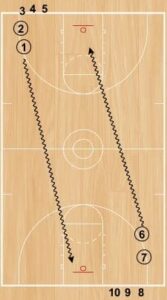
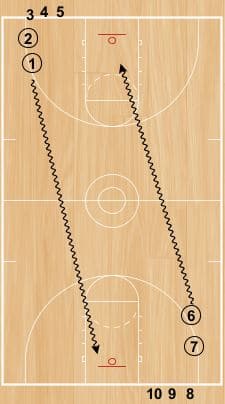
As in, the diagram, start half of the players at each end. 2 basketballs at each end.

In the diagram, players 1, 2, 6, & 7 are circled and start the drill with basketballs.

Each player has 4 dribbles to make it to the far basket at other end to shoot a layup.

Put 4 minutes on the clock.

When the clock starts, 1 & 6 start their 4 dribbles toward the other end. When they are at half court, 2 and 7 start their dribbles. 3 will rebound 6’s layup then start their 4 dribbles to the other end, and 8 will rebound 1’s layup and start their 4 dribbles toward the other end.

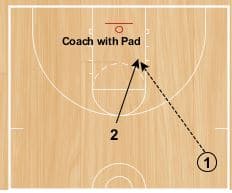
Pass Ahead Contact Layups

pass-ahead-layups

Making layups is one thing, making layups with contact is another.

Work on both sides of the floor and finishing with both hands.

You can make cuts from your half court offense or simulate a player catching a pass in transition.

Player 2 cuts to score, 1 makes the pass to 2.

2 can use one dribble to score.

As soon as the basket is made or missed, the next cutter is up-no wasted time.

Coach at basket with pad to work on the player finishing through contact.

Make the drill competitive by having it going at both ends. The end that converts the most layups in a certain amount of time is the winner.

Circle Transition Drill

Can do the drill 4 on 4 or 5 on 5. Split players into two teams with different color jerseys. Alternate players by jersey colors and have them run in a circle around the key and free throw line area at one end. Throw the ball somewhere on the side of half court where players are. The team that retrieves the loose ball is on offense and looks to fast break to the basket at the opposite end. The team that did not get the loose ball is on defense. They must talk and match up, then play your rules for converting to defense, stop ball, protect the basket, whatever you teach. Play continues like a game until one team scores. Then, reset the drill with the circle rather than inbounding the basketball after the made basket. Play to a set score, or for a set amount of time.

Mountaineer Drill

Split players into 2 teams with different color jerseys. Red vs. White

Keep score like a game for both sides, free throw, 2 pt. shot, 3 pt. shot.

Each team has it’s own basket, like a game.

Start the drill with 1 red player shooting a free throw, 2 white rebounders, and no one else on the court. Just like a game, if the free throw is made, red gets one point.

Make or miss the free throw, white goes the other way 2 on 1 with the ball vs. red. They get the points 2 or 3 if they score

When the 2 on 1 ends, 2 reds come on, making 3 reds, they go the opposite way 3 on 2 vs. the 2 whites.

(Whenever there is a change of possession, play it live like a game, the new players come on on the fly like hockey. The drill does not stop once the free throw is shot)

When the 3 on 2 ends, 2 whites come and go 4 on 3 towards the white basket vs. the 3 reds.

When the 4 on 3 ends, 2 reds come on and go back 5 (reds) on 4 (whites).

When the 5 on 4 ends, 1 white comes on and the go the opposite way 5 on 5.

Each team has 3 possessions.

Start the drill again with white shooting the free throw for the next round.

Play 4 total times, or adjust that number if you need more trips to get all players involved.

  • « Go to Previous Page
  • Page 1
  • Interim pages omitted …
  • Page 111
  • Page 112
  • Page 113
  • Page 114
  • Page 115
  • Interim pages omitted …
  • Page 288
  • Go to Next Page »

Primary Sidebar

  • Twitter
  • Facebook
  • Linkedin
coachestoolbox
personaldevelopmenttoolbox
basketballplayerstoolbox
basketballtrainer
athleticperformancetoolbox
coachingbasketball

© Copyright 2026 Coaching Toolbox

Privacy Policy