• Skip to primary navigation
  • Skip to main content
  • Skip to primary sidebar

  • Basketball Plays
    • Ball Screen Sets
    • Horns Sets
    • Man to Man Post Up
    • Man to Man Isolations
    • Backdoor Plays
    • Man to Man 3 Point Shot Plays
    • 2-3 Zone Attack
    • Baseline Inbound Plays
    • Sideline Inbound Plays
    • Combination Defense Attack
  • Drills
    • Defensive Drills
    • Offensive Drills
    • Competitive Drills
    • Passing Drills
    • Rebounding Drills
    • Shooting and Scoring Drills
    • Toughness Drills
    • Transition & Conversion Drills
    • One on One Drills
  • Blueprint
  • Practice
  • Mental Toughness
  • Skill Development
  • Offense
  • Defense
  • Store

Basketball Plays

Basketball Plays Xavier Zone

By Brian Williams on January 9, 2012

This quick hitting play is from an old Xavier University Basketball Coaching Newsletter.

You can access their archvie at this link: Xavier Men’s Basketball Newsletter

Run this against a 2-3 zone as an entry into your zone attack., or as a set play to get the ball inside.

At the bottom of the page, I have listed some more links to other zone plays.

They call this play “Baseline Runner PT Thru”

The post is not intended to say that all programs should run this play as is.

But, hopefully it sparks some ideas for either incorporating a few of these movements (or a tweak that you make to them) into what you already do.

If you are looking for other resources you can click here to see our products that relate to attacking zone defenses. There are some sample videos included in these as well: Zone Offense Resources

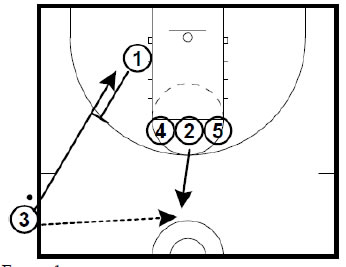
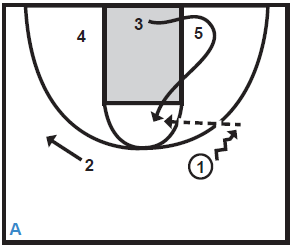
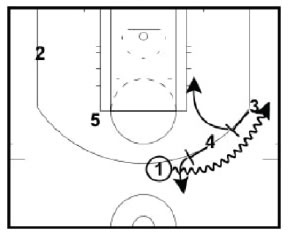
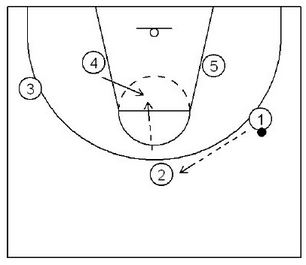
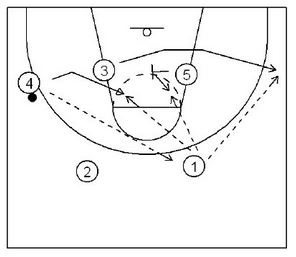
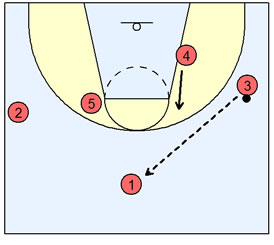
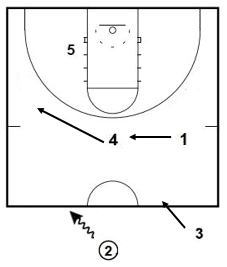
Two guard front.

3 circles into the high post area.

1 passes to 3.

2 moves away.


1 then sprints to the opposite corner.

3 looks at 5 for a possible duck in first.

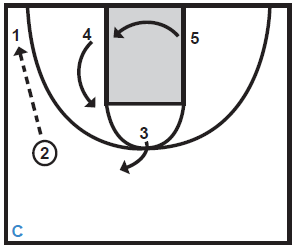
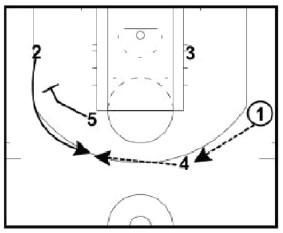
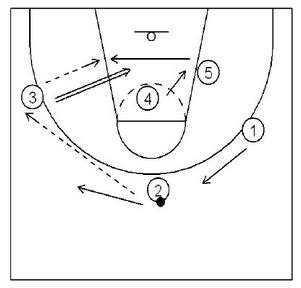
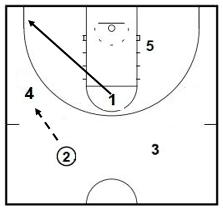
If not available, 3 passes to 2.


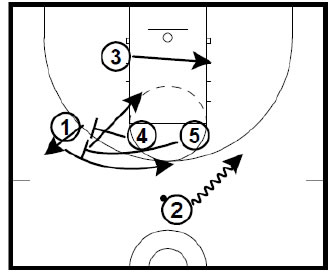
2 quickly passes to 1.

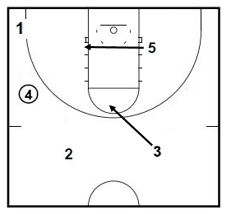
On the catch by 1, 4 slides up the lane.

5 sprints to the ball side block.


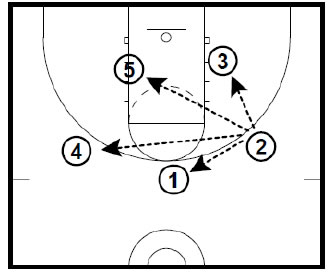
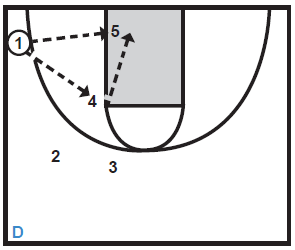
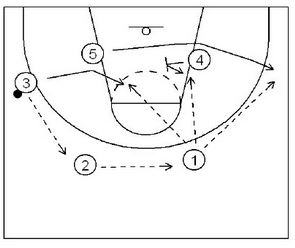
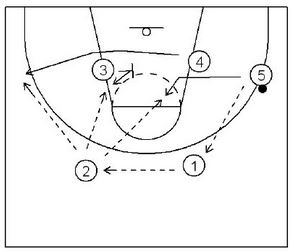
1 can pass to 4 at high post or 5 in low post.


If you are looking for other resources you can click here to see our products that relate to attacking zone defenses. There are some sample videos included in these as well: Zone Offense Resources

Basketball Plays Double Ball Screen

By Brian Williams on January 4, 2012

This play comes from an previous St. Edwards University newsletter.

St. Edwards is an NCAA Division II school located in Austin, Texas.

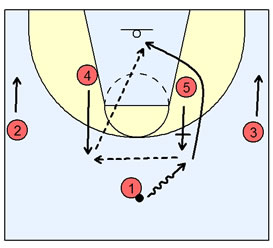
Quick hitter vs. man to man defense.

This is a set originally run by the Orlando Magic.

It is an excellent set to get a quick shot or isolation for 2.

The double ball screen creates an overload on the right side of the floor occupying the help defense.


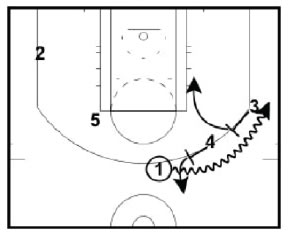
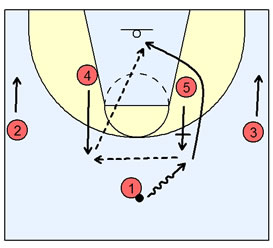
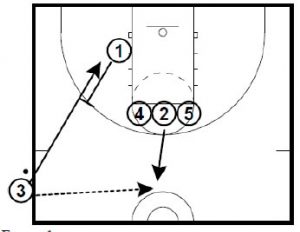
#1 Dribbles off a double ball screen set by 4 and 3. 4 pops and 3 rolls.


1 reverses the ball to 4 while 5 locates 2’s defender and sets a hard screen to get 2 open for a jump shot or isolation.

4 hits 2 coming off the screen.


St. Edwards’ Head Coach Andre Cook’s three points to consider when defending a ball screen:

1) Who has the ball?
2) Who is setting the screen?
3) At what angle is the ball screen being set?

We have posted several other diagrammed plays, animated basketball plays, and videos of basketball plays

There are a couple of sample videos below of more plays involving on ball screens. You do not need to purchase anything to see them.

Basketball Plays 3 Rover

By Brian Williams on February 25, 2010

This play is run against a 2-3 zone defense.

I found this on one of Creighton Burns’ newsletters.

If you are interested in receiving his newsletter, contact us and I will put you in touch with Coach Burns.


#1 Dribble enters to the wing.

#3 rolls away and fills the backside wing.

#2 steps out and fills the point.


On the pass back to #2, #4 will flash into the middle, cutting against the grain.

If #4 is open on the cut,#2 should get him the ball for a shot.

if #4 does not have a shot, he should look down to #5and then to number one on the wing.

If #4 is not open, #2should move the ball down to #3.

On the pass to #3, #5 will slide across the laneto work to free himself.

#3 may have a shot attempt, or a feed to #5.

Note: when #2 makes the pass to #3, #2 and #1 should relocate toward the ball, and to get into a to guard front.

If nothing is open, #3 will start another ball reversal by passing to #2.

On the pass from #2 over to #1, #5 will screen the outside baseline defender and #4 will use the screen to cut to the wing.

#3 will flash into the middle from behind the zone.

#1 can feed #3 in the middle, #4 in the corner, or if #5 slips the screen, #1 may be able to get a ball to him.

This diagram illustrates another ball reversal, with #3 screening for #4, and #5 flashing into the middle from behind the defense.

#2 can feed #5, #4 cutting outside, or to #3 slipping the screen.

He may be able to pass fake and throw back to #1 for a shot opportunity

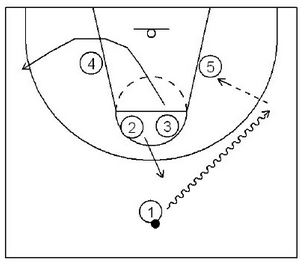
This diagram illustrates still another ball reversal with the three inside players roving into and out of the post area.

Note: if the skip pass is made, it is the same as if #2 made the pass to #1. #5 will screen and #3 will cut on the baseline.

Basketball Plays Illini

By Brian Williams on January 15, 2010

This play was contributed by Creighton Burns.

He has made coaching stops in four states including Georgia, Indiana, Kentucky, and Michigan at both the high school and college levels.

Coach Burns has coached both Men and Women.


Creighton has received numerous coaching honors including Indiana Basketball Coaches Association Coach of the Year in 1988.


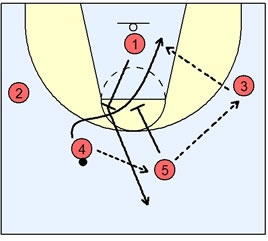
#1 enters the ball to #4, who steps outside the 3-point line to receive the ball.

#5 back screens for #1, and #1 runs a back cut to the rim.

If #1 is wide open, #4 should get him the ball.


If #1 is not open, #4 will pass to #5, who steps to the ball after setting his screen.

#5 swings the ball on to #3.

On the pass from #5 to #3, #1 will back screen for #4 and #4 will run a shuffle cut, over or, under the screen.

If #4 is open, he should get the ball from #3.

After making the pass to #3, #5 will screen for the screener, #1.

#1 will fill the point.

If #4 is not open, #3 will make the pass to #1.

On the wing to point pass, the low post will flash back up to the high side post.

The offense is now reloaded and ready to be executed once again.

Attacking 1 3 1 Half Court Trap

By Brian Williams on March 30, 2008

Some thoughts on attacking 1 3 1 half court trap defenses with “Rotation.”

If you are coaching without a shot clock, I don’t mind making the defense run and cover the whole half court for 25 or 30 seconds. I don’t like to pass up good shots, but if we have to make the defense work to the point of where they aren’t having much fun playing the trap, that often helps render it ineffective after a couple of possessions.

This is more principle and spacing based rather than pattern based.

This was designed for a post player who needed to stay in the lane. It won’t work for everyone, but the three player entry is the best way to keep from turning the ball over at the 10 second line that I have seen.

Hopefully you can pick up a couple of principles to apply when you are attacking a 1 3 1 half court trap.

We want to attack the trap to score, not to just keep from losing the ball.

Always have three available receivers 15 feet from the ball and 15 feet apart from each other. Available to the ball means where the player with the ball can see you and can pass to you. Being unguarded is not enough.

We want to pass the ball to the player in the middle of the defense any time we can.

When the ball is above the free throw line #5 is on the block on the opposite side from ball at all times. He can step to the ball if a release is needed. The number 5 in this diagram is an inside player only. If you have a player who can make plays you can allow him or her more freedom.

Fake a pass to make a pass. Meet every pass.

Always see the basket when you catch the ball. If the defense leaves the basket unguarded to gamble for traps, you need to get a layup.

Our objective is to get the ball in the middle as often as possible and attack from there.

The numbers are just for identification, not as identifying characteristics of the players. The #4 is not necessarily a “Power Forward”

Diagrams created with FastDraw

We would rather pass the ball across the time line than dribble it so that the player with the ball has a live dribble when trapped, rather than have a dribbler pick the ball up when trapped. We do have a dribble entry as our last option to get the ball across the timeline and avoid a 10 second count.

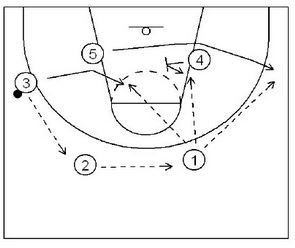
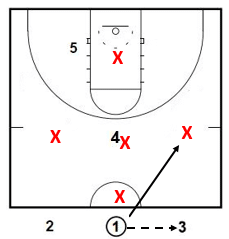
1 can pass to either side–in the diagram the pass is made to the right side.

1 then cuts through to the ball side as one of the three available receivers.

It is important that 1 not cut to the sideline, but stays off the sideline when completing the cut.

I am going to leave off the defenders in the remaining diagrams. You are going to face different rules for the defense when you are attacking a 1 3 1 half court trap.

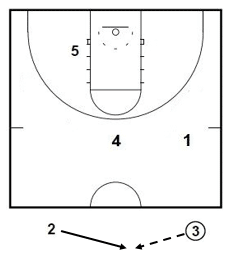
2 then replaces 1, not crossing the timeline yet. #4 is the third available receiver. Anytime a player is open in the middle, we want to get it there.

If we can pass to 1 on the cut, we will, but if he is not open pass back to #2.

If #1, and #4 are covered, reverse the ball to #2 who dribbles the ball across as there is no one to trap him and the side he is dribbling to should have no defenders.

attacking 1 3 1 half court trap

At worst, 2 will be dribbling one on one to get the ball across half court.

Once the ball is across the timeline, everyone crosses the timeline immediately to avoid being in a spot to throw a pass that would result in an over and back violation.

If #4 is open in the middle at any time, we give him the ball. This player must be very active in working to get open in the middle.

Now 1 is in the middle and the middle player continues to be the top option.

If we can get the ball moving and move the defense, we can use dribble penetration as long as we are not dribbling into traffic and trouble.

If the ball goes to 4 on the wing, 1 cuts through to the corner.

The corner 3 is a great shot against a 1-3-1 trap, but is also a place where you don’t want to get trapped. Only put the basketball in the corner when you have a shot.

If the ball does go to the corner, 5 will come across to the ball side to set up the 3 available receivers.

The ball can be reversed to the other side (continually working to get the ball to the player in the middle).

Iowa Delay

By Brian Williams on March 30, 2005


4 and 5 are positioned at the wide wings.

1, 2, and 3 are interchangeable at the free throw line and 2 steps behind the deep elbow.

1, 2 and 3 play a triangle game. Whichever of the three players has the ball, the other two screen for each other.
The screen can be a backscreen or a downscreen.

If 1, 2, or 3 dribbles at either 4 or 5, the player being dribble at back cuts.

4 and 5 can break anywhere to give a release if the ball is in trouble.

  • « Go to Previous Page
  • Page 1
  • Interim pages omitted …
  • Page 63
  • Page 64
  • Page 65
  • Page 66
  • Go to Next Page »

Primary Sidebar

  • Twitter
  • Facebook
  • Linkedin
coachestoolbox
personaldevelopmenttoolbox
basketballplayerstoolbox
basketballtrainer
athleticperformancetoolbox
coachingbasketball

© Copyright 2026 Coaching Toolbox

Privacy Policy