• Skip to primary navigation
  • Skip to main content
  • Skip to primary sidebar

  • Basketball Plays
    • Ball Screen Sets
    • Horns Sets
    • Man to Man Post Up
    • Man to Man Isolations
    • Backdoor Plays
    • Man to Man 3 Point Shot Plays
    • 2-3 Zone Attack
    • Baseline Inbound Plays
    • Sideline Inbound Plays
    • Combination Defense Attack
  • Drills
    • Defensive Drills
    • Offensive Drills
    • Competitive Drills
    • Passing Drills
    • Rebounding Drills
    • Shooting and Scoring Drills
    • Toughness Drills
    • Transition & Conversion Drills
    • One on One Drills
  • Blueprint
  • Practice
  • Mental Toughness
  • Skill Development
  • Offense
  • Defense
  • Store

Defense

1-3-1 Defensive System

By Brian Williams on July 14, 2020

Contributed by Coach Jonathan Klein

If you would like me to put you in touch with Coach Klein to ask him any questions, please let me know.

This post includes his thoughts on adjustments, rebounding, defending baseline inbounds plays, and pressing out of the 1-3-1.

1-3-1 ZONE DEFENSE OVERVIEW

ADVANTAGES
➢ Forces the offense to adjust to your defense
➢ Forces the offense into slow passes (Lobs and Bounce passes)
➢ Creates pressure on perimeter players
➢ Causes the offense to make bad passes and force bad shots / shot choices
➢ Easily creates and flows into fast break opportunities
➢ Can be easily adjusted to fit your personnel or opponent

DISADVANTAGES
➢ Risky defense that will allow the offense to beat you if you make a lot of mistakes
➢ No balance when blocking out on a shot

PHILOSOPHY
➢ Make the offense uncomfortable through constant pressure on the ball and the passing / driving gaps
➢ Keep ball out of the middle of the floor
➢ Close the gaps and not allow any easy passes or drives
➢ Forcing every pass to be a slow lob or bounce pass
➢ Never allow a baseline drive
➢ Play with high energy and maximum effective effort

POSITION PROFILES / RESPONSIBILITIES

Taker (Shown as 4)
✓ Get and keep the ball out of the middle of the floor
✓ If they try to drive across the middle, deny and force them back outside the volleyball lines
✓ Play between the top two offensive players
✓ Make it as hard as possible to reverse the floor
✓ Play the goal side to force the sideline to sideline pass towards the half-court line
✓ If ball is passed into the corner – protect the ball side elbow / high post area

Center (Shown as 5)
✓ Stay between the ball and the rim
✓ If ball is on baseline – sprint down and play high side on the block
✓ If ball is drove –step up and stop the ball
✓ Will play high post according to which adjustment we are in

Wings (Shown as 2 & 3)
    Ball Side
✓ Play ball handlers outside shoulder
✓ Stay in line between the ball and whoever is on the baseline
✓ Protect the sideline – not the middle
✓ If the ball handler drives sideline, deny and force them back towards half-court and middle
Weak Side
✓ Number 1 responsibility is to cover the weak side of the rim
✓ Read the ball handlers eyes and shoulders and try to deflect / steal skip passes

Badger (Shown as 1)
➢ Protect ball side low post
➢ Cover both corners
✓ Close-out baseline and force them middle
✓ Run shooters off the 3-point line

DEFENDING THE DRIVE
➢ Force all drives middle and create a funnel with the center and taker / wing or center and badger / wing
➢ Once the ball handler picks up the ball and is “dead”
✓ Center will keep pressure on the ball
✓ The other two players will drop down / back to the most dangerous passes in their areas

BASIC ROTATIONS
The basic rotations of our base 1-3-1 coverage are shown below

Teaching Points:
➢ Everyone must:
✓ Be Active with high hands and constant communication
✓ Play with high energy and maximum effort
➢ The taker must keep ball pressure until the ball is outside the volleyball lines or the ball is dead then they are allowed to fall back towards the middle to play the pass
➢ The ball side wing must play above the top of the key – always forcing the ball out of scoring range
➢ The center will play behind anyone who enters the high post area – if the ball is entered – square up and play man to man until the ball is passed out
➢ The back-side wing must have good anticipation
✓ Play the weak side rim but anticipate and jump the skip passes
➢ The badger and backside wing must “sit down” on anyone in the low post
✓ Play in front and sit down on them with high hands
✓ On a pass in, stay down and back the offensive player up until the ball is coming down then make your play on the ball

1-3-1 HALF-COURT ADJUSTMENTS

Adjustment 1
➢ Extended / aggressive on the perimeter and in the gaps
➢ Keep same positions except the center comes out to top of key to deny the high post
➢ Fast paced, aggressive, gambling defense that thrives on deflections


Adjustment 2
➢ Packed in, strong in the lane, invites perimeter shooting
➢ 4 & 5 both stay in the lane, while 1, 2, & 3 cover entire perimeter
➢ Packed in safe defense that forces outside shots and attacks the boards hard

Adjustment 3
➢ Strong at rim and on perimeter but weak inside
➢ Badger and center switch places so badger plays high post and center plays low
✓ The badger will still cover the corners
✓ The center will stay in the lane playing block to block
➢ The badger will play the high post exactly like the center does in our base zone


Adjustment 4
➢ Change-up defense; start in a 1-3-1 and morph into a 2-3 as the ball enters the corner
➢ Start with base zone alignment / rotations

PLAYING THE 1-3-1 ON BLOB SITUATIONS

Alignment 1

➢ Pinch ball side with center and ball side wing
➢ Badger denies cross court pass and helps cover rim
➢ Back side wing covers weak side rim
➢ Taker plays middle of the floor out – read eyes and shoulders
➢ After ball is inbounded rotate into normal zone coverage


Alignment 2

➢ Deny ball side corner with ball side wing
➢ Pinch ball side rim with badger and center
➢ Back side wing plays weak side rim
➢ Taker plays middle of the floor out – read eyes and shoulders
➢ After ball is inbounded rotate into normal zone coverage


Rebounding from the 1-3-1

Rebounding out of the 1-3-1 is based on covering areas – not people
Sprint to the area you are assigned then box out whoever enters your area
Attack your Area and Get the Ball!

We should ALWAYS have:
1 player on the Shooter
1 Boxing Out Ball Side
2 Boxing Out Backside
1 Crashing Middle

If a shot goes up from the corner we hit the shooter then look to leak out for a fast break opportunity

PRESSING OUT OF THE 1-3-1

Press 1 – Over


➢ Trap from the middle and rotate help from the backside
➢ Do not engage the front person until the ball crosses the ft line
➢ Ball side wing must never let the pass go over their head
➢ Taker still plays middle and forces sideline
➢ Center get to sideline and seal the trap
✓ Goal is to trap dead corner across HC line (not a huge problem if it doesn’t happen)


Press 2 – Up

➢ Trap from the sideline and rotate help from the backside or the middle (keep them guessing)
➢ Do not engage the front person until the ball crosses the FT line
➢ Ball side wing stunts and retreats ball handler to make them hesitant
➢ Taker still plays middle and forces sideline

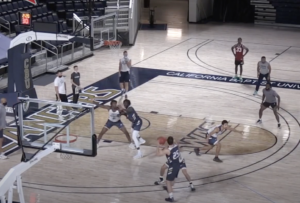
James Jones 2-3 Zone Techniques

By Brian Williams on June 9, 2020

This video is with Coach James Jones of Yale University.

The video is 3 minutes long so you will not get a detailed breakdown of how he coaches a 2-3 zone, but you can pick up a few coaching points that you might be able to apply to your zone defense.

You will need to be on a network that allows you to access You Tube to view the video.

Click the play arrow to view the video.

There is narration with the video, so please make sure that your sound is on.

You can find out more about the Championship Productions video that this clip is from at this link: 2-3 and 1-3-1 Zone Defenses + Zone Offense Sets.

The video with Coach is available in both DVD and online format.

Click the play arrow to start the video.

Defensive Switching Tactics

By Brian Williams on April 22, 2020

Coach Zak Boisvert has assembled some clips of NBA switching tactics.

Most of us don’t coach NBA players and yes, the players in the video are not all playing for the Warriors. I do realize that.

The videos are to share some ideas for switching tactics that might spark some thought in your staff as to ways to enhance what you already do on defense.

His YouTube channel has several videos with various types of man-to-man plays, zone sets, and inbounds plays as well as clips on various defensive coverages.

You can subscribe to receive an update when he posts a new video Zak Boisvert You Tube Channel

You can follow him on Twitter at this link: @ZakBoisvert

Click play to see the video

This is a YouTube video, so you will need to be on a server that allows YouTube access.

Triple Switch

There is narration with this video, so please make sure your sound is on.

Switching SLOB Zipper Cuts

Using 1-3-1 Defense to Change Momentum

By Brian Williams on February 4, 2020

Coach TJ Rosene, Men’s Head Coach at Emmanuel College.

The content is located on the Glazier Coaching Vault at this link: Transition Pistol Offense

All of the basketball content in the Glazier Vault at this link: Basketball Glazier Vault Access

You will need to click on the image of the video to start it.

These are Vimeo videos, so you will need to be able to access Vimeo in order to view it.

PUT YOUR CURSOR OVER THE LOWER RIGHT CORNER OF THE VIDEO AND CLICK (IMAGE LOOKS LIKE THIS) TO WATCH THE VIDEO ON FULL SCREEN TO BE ABLE SEE LARGER DIAGRAMS AND VIDEOS

There are 4 videos in all.

1-3-1 Decision Pressure

Importance of Angles

Driving & Rebounding Responsibilities

Film Examples

Reasonable Defensive Expectations – because there are no shutouts in basketball

By Brian Williams on January 17, 2020

This article is republished with permission. The original article was written by Don Siko and appears at Reasonable Defensive Expectations – because there are no shutouts in basketball.

Finishing up some current thinking on charting individual player defensive accountability, we’d like to share one more thought on how coaches can use postgame defensive charting to zero in fixable issues:

In the sample defensive accountability spreadsheet we’ve used twice before, the team in question gave up 68 points and we assigned accountability to each point two different ways-by player and by the type of score (missed containments, closeouts, blockouts etc.).

  • Every coach out there implicitly understands that of the 68 points scored by the opponent, only a certain number of points were especially avoidable.  While coaches would like to think that all or most scores against us can be prevented, history tells us otherwise.
  • Most good coaches practice honesty with their players when it comes to this issue.  When coaches preach a defensive philosophy or technique and the player executes it perfectly and a score still is the result, most coaches don’t then blame that player for the result.  There are many examples but a couple illustrations follow:
    • A perfect blockout and the ball bounces long to the opponent.
    • A perfect closeout and the opponent buries the trey in spite of little or no space.
  • So, let’s agree that only a certain number of points given up in a game are “truly” accountable.
  • If that it is the case, there is obviously a baseline number, or if you will, a benchmark by which the 68 points can be evaluated.  For sake of argument. Let’s choose the Virginia Cavaliers as the benchmark team. If we agreed that if Virginia played in that same game, they would likely have given up roughly 52.7 points (their current nation-leading points against total).  Granted, Virginia’s slow pace of play contributes to this low total but we also shouldn’t forget that Virginia is also 3rd in the nation in defensive FG%, 5th in defensive 3pt FG%, 6th in TO margin and 5th in fewest fouls.As long as I’m talking Virginia, I also have to ask why the Cavaliers’ defense, aside from pace, isn’t more widely and routinely copied by others.  Ironically, I’m quite sure that as the Virginia staff self-evaluates, among the 52.7 ppg they surrender are points that they believe are avoidable according to THEIR baseline or benchmark standards.
  • So, the purpose of this exercise is that now that we have a baseline of 53 points (maybe 58 adjusted to pace), we’re really focusing in on the 10-15 “worst” points we surrendered, no matter which player was accountable or which type of score we gave up.  Sometimes these points given up are one-offs; sometimes not.  But, if we especially emphasize these 10-15 points to our players, it’s another way of zeroing in on a teaching tool and how we can get our players to adjust and improve defensively from game to game.  “Shrinking” the defensive game results down into some sort of synopsis is good for players.  What method one uses can vary from coach to coach.

X Out Switch for Defending Screen the Screener

By Brian Williams on December 29, 2019

Army Men’s Assistant Coach Zak Boisvert has assembled some clips of a defensive concept for defending Screen the Screener actions.

This tactic allows the defender of the first screener on the cross screen to hedge a little longer.

Zak has an outstanding site with posts on various coaching topics at www.pickandpop.net

His YouTube channel has several videos with various types of man to man plays, zone sets, and inbounds plays as well as clips on various defensive coverages.

You can subscribe to receive an update when he posts a new video Zak Boisvert You Tube Channel

You can follow him on Twitter at this link: @ZakBoisvert

Click play to see the video

This is a YouTube video, so you will need to be on a server that allows you YouTube access.
  • « Go to Previous Page
  • Page 1
  • Page 2
  • Page 3
  • Page 4
  • Page 5
  • Page 6
  • Interim pages omitted …
  • Page 16
  • Go to Next Page »

Primary Sidebar

  • Twitter
  • Facebook
  • Linkedin
coachestoolbox
personaldevelopmenttoolbox
basketballplayerstoolbox
basketballtrainer
athleticperformancetoolbox
coachingbasketball

© Copyright 2026 Coaching Toolbox

Privacy Policy