• Skip to primary navigation
  • Skip to main content
  • Skip to primary sidebar

  • Basketball Plays
    • Ball Screen Sets
    • Horns Sets
    • Man to Man Post Up
    • Man to Man Isolations
    • Backdoor Plays
    • Man to Man 3 Point Shot Plays
    • 2-3 Zone Attack
    • Baseline Inbound Plays
    • Sideline Inbound Plays
    • Combination Defense Attack
  • Drills
    • Defensive Drills
    • Offensive Drills
    • Competitive Drills
    • Passing Drills
    • Rebounding Drills
    • Shooting and Scoring Drills
    • Toughness Drills
    • Transition & Conversion Drills
    • One on One Drills
  • Blueprint
  • Practice
  • Mental Toughness
  • Skill Development
  • Offense
  • Defense
  • Store

Gonzaga Pick and Roll Continuity

Gonzaga Pick and Roll Continuity

By Brian Williams on April 2, 2017

This video is presented by Coach Nick at BballBreakdown.

He has over 4500 other videos available on the BballBreakdown You Tube channel.

I have been asked about this basic pick and roll continuity offense a few times.

I am not implying that it is the only thing that Gonzaga runs. I am not implying that it is the reason that they are in the final game of the tournament.

I am offering it so that maybe you can find a piece or an idea from it that you might be able to apply to your offense.

This is a You Tube video, so please make sure that your sound is on.

You will need to be on a network that allows you to access You Tube to view the video.

Press the play arrow

You can also see the offense diagrammed by Coach Randy Sherman by clicking here to visit FastModel Sports Playbank
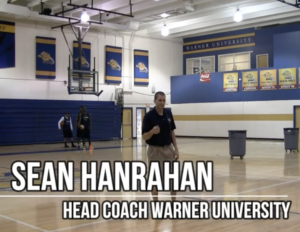
Second Move Competitive Finishing Drill

By Brian Williams on March 30, 2017

This video is one of the great resources available from basketballhq. They have several more videos as well as basketball coaching resource articles.

Sean Hanrahan is the Head Men’s Coach at Warner University.

You can tweak the drill to make it fit what you want.

I like the idea of playing to 10 to improve focus and concentration with the competition.

Please make sure your sound is on to see the video.

Click the play arrow to see the drill.

The drill is a YouTube video, so you will need to be able to access YouTube to see the drill.

Second Move Finishing Drill

Developing a Positive Team Culture

By Brian Williams on March 28, 2017

Posted with permission from PGCBasketball

By Lyndsey (Medders) Fennelly, former director and clinician with PGC.

Our 75-minute presentation was titled, “A Coach’s Role in Impacting Team Culture”. We shared some key points about how the culture of your team can be established, reinforced, and even reinvented, through your team’s basketball practices.

The two main areas that support this belief come from Point Guard College’s brilliant founder, Dick DeVenzio, and also from watching some of the top basketball coaches in the country at the high school, college, and professional level. We have identified some of their championship-level habits in developing the top players and creating the best basketball teams.

A simple formula we’ve come up with is the following:

Successful Team Culture = Procedures + Progressions + Precision + Patience

Procedures are the actions which have to be executed in the same manner in order to obtain the same result. In a prior blog (‘What I Learned from Coach Krzyzewski’) (That excerpt is below), I shared the various procedures you can use with your basketball team to develop daily consistency and expectations throughout the program. Establishing procedures within your program allows you to maximize your time as a basketball coach. While this can create some temporary inconveniences, it will lead to permanent improvement.

Progressions are a series of activities or drills with a definite pattern of advancement. It’s important for coaches to progress through drills in a way that will ‘make sense’ to the athletes. During our summer basketball programs and year-round clinics, I find it especially helpful for basketball players to progress through teaching using this model:

Give instruction that describes the organization of the drill — Provide the rules for the drill — Give them the points of emphasis — Remind them of the intangibles (i.e. how to lead themselves, enhance the drill, and ignite their teammates)

In providing your athletes with the points of emphasis, stick to the ‘Rule of 3’ and explicitly state what you are looking for.

Precision means having a ridiculous attention to detail. As coaches, we have to understand: we teach what we emphasize. In my experience, it’s quite apparent that the best coaches in the world demand a high level of ‘exactness’ from their basketball players at all times.

Patience is required once the above three items are put into play. Be honest… What drives you crazy as a coach? What causes you to slam the clipboard or throw the whistle? Every good coach has a long list.  I think of Dick DeVenzio’s “Responsibility Principle” from Runnin’ the Show that places the responsibility on coaches to be bigger than shortsighted frustrations. Essentially, the thought is: don’t put yourself through a whole season being irritated by the things you failed to explain. Do you lose your patience because your players performed the drill wrong or because you failed to properly explain the basketball drill? It’s our job as coaches to teach with clarity and to ensure we communicate exactly what we want at all times. But, be patient. Have a persistence to your patience. Model the qualities that you want to see embodied in the culture of your team.

After watching both the Duke men’s basketball and Connecticut women’s basketball teams practice this year, it’s quite obvious why both basketball programs won NCAA national championships. In their practices, this formula held true. The daily procedures were run, the progressions made complete sense, the precision was phenomenal, and each coach was patient enough to explain something to their players that was not understood.

PROCEDURES ARE EFFECTIVE

In line with the great precision Coach K demands of not only his team and program, which includes managers, staff, and other personnel involved with the team, there were a definite set of procedures the team understood happened ‘every’ and ‘always’. Dick DeVenzio used to refer to this concept of creating procedures that your team should do every time they are in the gym and at an ‘always’ rate, not a sometimes thing. The shirts were tucked in, the players knew how to line up on the baseline, and even the obtaining of water was a set, routine procedure.

This allows for more coaching and teaching, and less telling. There is a difference between teaching and telling. High level coaches, like Coach K, are teachers, providing useful information in a variety of ways and creating engagement with the athletes. Coach K and his staff no longer had to tell their athletes repeatedly to do something. They understood the procedures, and as a result, time wasn’t wasted on mundane tasks.

I encourage you as either a coach or a basketball player to consider implementing some of these key thoughts above into your practices and basketball training. It will take time, it will take persistence, but most importantly it will take a commitment to be someone better than you already are. None of the prior three statements are easy. But hey, winning NCAA national championships isn’t a walk through the park either!

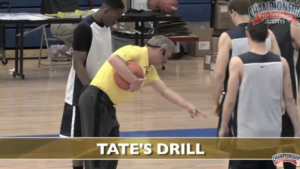
Larry Shyatt Tate’s Conversion Drill

By Brian Williams on March 27, 2017

The video in today’s post is with former NBA Assistant and Division 1 Assistant and Head Coach Larry Shyatt.

He is also the former Head Coach at Wyoming and Clemson as well as an assistant at Florida State.

The drill forces your players to sprint back in conversion defense, communicate, and rotate.

If you are interested in finding out more about the DVD that the video sample came from, click here:

Larry Shyatt: Building a Defensive Culture – Basketball — Championship Productions, Inc.

Make sure your sound is on as you watch.

The video is a YouTube video.

Click the video to start the presentation.

Putting a Defender In Jail in the Pick And Roll

By Brian Williams on March 26, 2017

This post was originally from Zak Boisvert on his basketball Coaching Website: Pick and Pop

This is how Coach Boisvert described the video:

When working with young point guards, I’ve found there to be two common deficiencies in their understanding of pick and roll play.

The first nuance they don’t totally grasp is the art of deception both directionally and in a speed sense. Most young point guards come off a pick & roll at one speed in one direction without recognizing the need to set the on-ball defender up with a foot/ball fake away from the screen and a change in speed as you encounter the screen.

The second problem is the lack of understanding of the physicality you need to play with as the ball-handler. Great stuff below on how NBA point guards use their body when coming off screens.

-Linked below is a fantastic video of Ty Lawson explaining “how to put your defender in jail” (or what John Beilein calls a “Hostage Dribble”) put together by BBALL BREAKDOWN.

The video is a You Tube video.

You will need to click the play arrow to view it.


Mike White Florida Transition Offense

By Brian Williams on March 22, 2017

A couple of man to man sets from Florida’s Mike White. The first is an early offense set, the second is a half court set. You could make some adjustments and use either for early offense or for half court.

They are from Mike White’s Florida Playbook which is included in this week’s eBook special.

This week’s special is a bundle of your choosing of any four eBooks for $35.

If you have any difficulty email or call/text me ‪(317-721-1527‬) for assistance.

Click here for all choices: eBook Bundle Sale Choices

Diagrams created with FastDraw


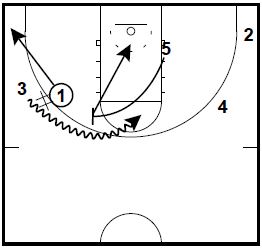
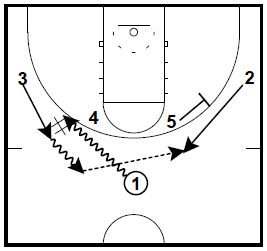
Florida Pistol 5X Early Offense

4 slash cuts in front of the basketball.

1 dribbles off back of 4 cut.


1 runs a dribble hand off with 3.

5 sprints out and sets a Pick and Roll behind the Dribble Hand Off


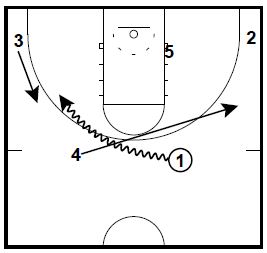
Florida Circle High Ball Screen

1 dribble hand offs with 3.

5 pins down for 2.

3 passes to 2.


2 dribble up.

1 curls cut to under rim and comes off pin down from 5.

4 sets flare screen for 3.


After setting flare screen, 4 steps up and sets high ball screen for 2 and pops.


These plays are from Mike White’s Florida Playbook which is included in this week’s eBook special.

This week’s special is a bundle of your choosing of any four eBooks for $35.

If you have any difficulty email or call/text me ‪(317-721-1527‬) for assistance.

Click here for all choices: eBook Bundle Sale Choices

  • « Go to Previous Page
  • Page 1
  • Interim pages omitted …
  • Page 96
  • Page 97
  • Page 98
  • Page 99
  • Page 100
  • Interim pages omitted …
  • Page 288
  • Go to Next Page »

Primary Sidebar

  • Twitter
  • Facebook
  • Linkedin
coachestoolbox
personaldevelopmenttoolbox
basketballplayerstoolbox
basketballtrainer
athleticperformancetoolbox
coachingbasketball

© Copyright 2026 Coaching Toolbox

Privacy Policy