• Skip to primary navigation
  • Skip to main content
  • Skip to primary sidebar

  • Basketball Plays
    • Ball Screen Sets
    • Horns Sets
    • Man to Man Post Up
    • Man to Man Isolations
    • Backdoor Plays
    • Man to Man 3 Point Shot Plays
    • 2-3 Zone Attack
    • Baseline Inbound Plays
    • Sideline Inbound Plays
    • Combination Defense Attack
  • Drills
    • Defensive Drills
    • Offensive Drills
    • Competitive Drills
    • Passing Drills
    • Rebounding Drills
    • Shooting and Scoring Drills
    • Toughness Drills
    • Transition & Conversion Drills
    • One on One Drills
  • Blueprint
  • Practice
  • Mental Toughness
  • Skill Development
  • Offense
  • Defense
  • Store

3 Basketball Finishing Moves

3 Basketball Finishing Moves

By Brian Williams on April 13, 2017

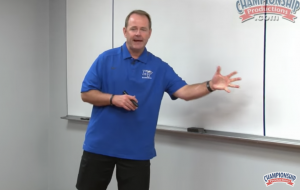
The Coach in the video is PGC Basketball Director Tyler Coston.

This video was filmed at the PGC/Glazier Spring 2016 Chicago Clinic.

If you want the best in basketball education, then you need to attend the PGC/Glazier Basketball Clinics this year!

They’ve changed the coaching clinic game forever with more topics, superior speakers, and a staff pass that includes unlimited coaches from your school.

2018 Clinic Dates

  • April 27-29, 2018 Chicago

Fall Dates and Locations Coming Soon

Whether you agree or disagree with his opinions, I hope you might be able to find a teaching point or term that you can use in your program.

The moves he talks through and demonstrates are the:

1) Sweep Over
2) Dribble-Drop-Close Spin Move
3) Floater

Make sure your sound is on to hear the presentation
Maximizing the Capacity for Excellence

By Brian Williams on April 11, 2017

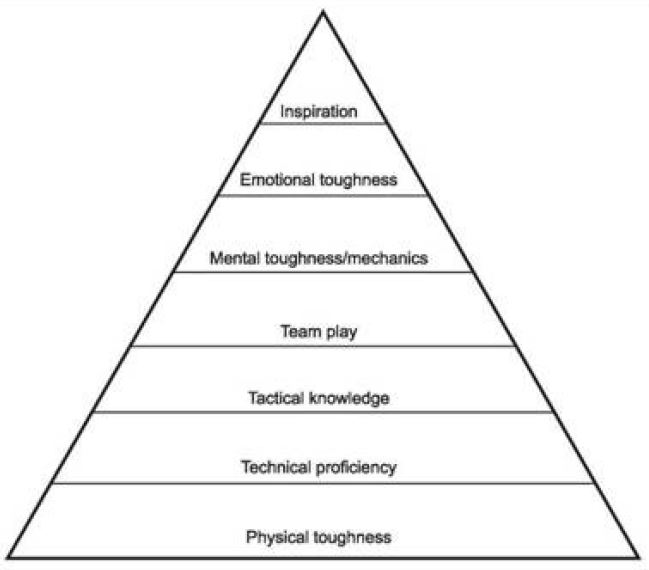
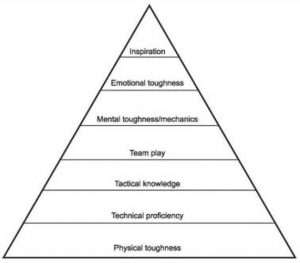
These notes on connecting mental and physical toughness are from Mental Toughness Training for Basketball by Mike Voight and Jeff House. I hope that you can use it as a model to think about ways to help your players improve. I like that it breaks down mental toughness into different capacities. Players have different mental strengths and weaknesses just like they have different strengths and weaknesses to their game.

“Nowhere is it more abundantly clear than in competitive sports that everything is interconnected. What you think, how you act, what you eat, how much you sleep, your fighting spirit, your fitness, your passion for life are all intimately connected”
—Jim Loehr, Ed.D., Mental Skills Trainer

Below are some questions for players to answer that can help them gain a better awareness of their present capacity level. Before a player can operate to his/her maximal capacities, he/she must be aware of his current level and how far it may be from his top effort.

Upon getting responses from each player and/or the team as a whole, individual/ team meetings with players can be conducted to discuss specific areas that players need to commit to improving, as well as to list the players’ areas of strengths. Coaches who take the time to talk about specific ways to maximize each athlete’s capacities show the athletes how committed they are in assisting the players in their pursuit.

The critical piece to this model is that your athletes and the team are being asked the “right” questions—questions that range across the seven different capacities.

Another exercise is to ask your players to determine the percentage of their mistakes that are due to each of these seven components.

Another activity is to have players brainstorm why they have not been able to accomplish their preferred goals due to barriers in these seven components. Then the players should be asked to brainstorm some solutions to these barriers. The feedback gathered during these exercises can be an
important foundation for subsequent team goal-setting sessions targeting solutions to common team problems and barriers.


Inspiration
What do you love about the game?
What are your reasons for playing the game and the position?
What makes you the happiest while playing?
What is your paying philosophy?
What drives you? What do you want to accomplish?

Emotional toughness 
Are you a risk taker?
Do you deal well with changes?
Do you try new ways to improve your game?
Do you cope well with your frustration?

Mental Toughness for Mechanics
Do you use a pre-practice and pre-game routine?
Does your focus fade during practice or games?
Are you confident regardless of how you’re playing?
Do you stay positive (self talk, thoughts) when you’re not playing well?

Team Play
Are you honestly committed to the team’s goals?
Do you and your positional teammates think as one?
Do you make positive contributions to the team every day?
Do you feel connected to teammates and coaches?

Technical Knowledge
Do you know the demands of your position?
Do you know all of your positional responsibilities?
Do you know the positional responsibilities of teammates
do you look for your opponent’s weaknesses/tendencies?
[adinserter name=”Basketball in article display ad 2 rebecca”]
Technical Proficiency
Do you know your technical strengths and weaknesses?
Do you practice on your own to improve?
Do you know the specific technical elements that are faulty?
Are the majority of your practices quality sessions?

Physical Toughness
Do you adequately fuel and hydrate your body each day?
Do you ensure that you get proper sleep before games and practices?
Do you work to improve upon your flexibility?
Do you put in maximum effort on your conditioning training?


You can find out more about and purchase the eBook that this article is from at: Mental Toughness Training for Basketball

33 Attack Drill

By Brian Williams on April 10, 2017

Today’s post is more drills from a collection put together by Nate Hill, Assistant Boys Coach at Colonel Crawford High School in North Robinson Ohio.

These drills are drills to work on advantage reads that do not last very long.

He has coached for 18 years from 7th grade through Varsity Head Coach.

He has also started a basketball coaching newsletter.

You can see find more information about the Newsletter at this link: Next Level 419 Coaching Newsletter

In case you have any questions or comments for Coach Hill, here is his email address: [email protected]

The best use of these drills would be to use the concepts, but change the execution to fit your system.

Diagrams created with FastDraw

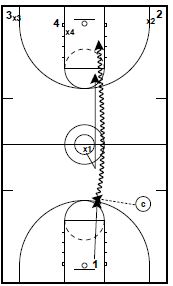
33 Attack

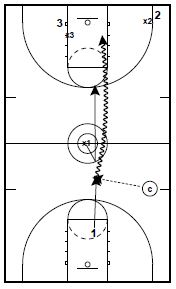
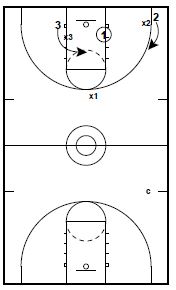
3 on 3 with Drive and Space reads.

Coach starts with ball and passes to 1 who is sprinting.

1 gets ball, runs through the circle and attacks the basket.

x1 cannot leave until he touches the dribbler in the circle.


1 must make the correct read.

1 looks to pass to whoever stops him (x3 or x2).

2 and 3 also must read the driver.

Change offense and defense. Keep score like a game or come up with a scoring method that is better for your team for the purpose of this drill.


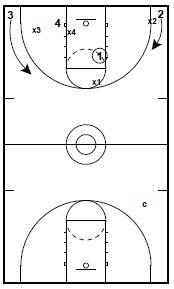
44 Attack

Same concept at “33 attack”.

1 sprints and receives pass at full speed from the coach.

He looks the defender in the eyes and dribbles through the circle.

The defender must touch the ball handler before he can leave.


Driver (1) must make the correct read.

Pass to post (4),

kick out to wing (2),

or skip to weak side wing

Install your reads, rules, and reactions for your system.

Rotate offense to defense and keep score.

Play to a specific number of points or for a set time.

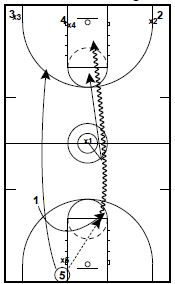
55 Attack

Same principles of “44 attack”.

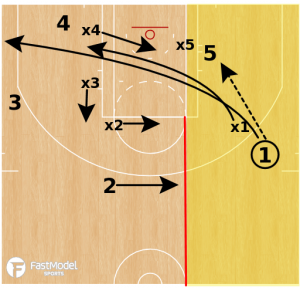
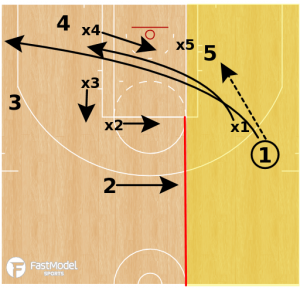
5 inbounds to 1 “looping” to the middle.

1 must run through the circle and get touched by the defender (x1).

x5 plays the inbounder (5) then sprints down the court.

Trail man (5) runs to the opposite midpoint.


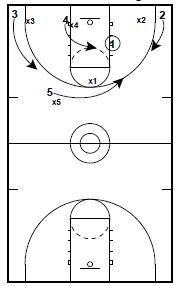
Driver (1) must make the correct read.

Pass to post (4),

Kick out to wing (2),

Skip to weak side wing (3),

Or kick out to trail making a “euro” (5).

All players must read the drive

Dribble Follows Footwork Drill

By Brian Williams on April 9, 2017

This video is of a 4:05 whiteboard session with former Middle Tennessee (currently at Mississippi State) Coach Kermit Davis going through a drill he uses daily to work with his players on footwork, passing, and catching against defensive pressure.

The video is a YouTube video so make sure that you are on a server that allows YouTube access.

If you are interested in learning more about the DVD that this sample was taken from, click here: Offensive Skill Development Against Pressure

I have also listed some skill development drills that have already been posted on the site below the video.

There is no on-court demonstration, but I think you can understand the way that he runs the drill by following along with his diagrams and his demonstrations. Like any other drill, you should tweak it until it is something that fits your system and improves the skills of your players.

Make sure your sound is on The video is 4 minutes long.

Brendan Suhr Coaching Notes

By Brian Williams on April 6, 2017

These notes are from Brendan Suhr, veteran NBA and Division ! Assistant Coach.

His presentation was at the 2013 “A Step Up” Assistant Coach Symposium

I am really big on purpose and what you’re trying to do.
My purpose is to teach, share, help you grow, and help you become a continuous learner. I want to make an impact and an influence on as people as I can.

BOOK RECOMMENDATION- What got you here Won’t get you there- Marshall Goldsmith
BOOK RECOMMENDATION- Outliers- Malcolm Gladwell
BOOK LIST- GeorgeRaveling.com (reading section) — one book a week — Jon Gordon, Energy Bus, Training Camp, Positive Dog, The Seed, One Word (after reading this book we had our team each choose a word individually and write it on a basketball. Then choose one TEAM WORD that was big on the basketball- that ball came with us everywhere we went all year) – (examples of words chosen: finish, U-turn, family).

Now you have to get better. You have to keep looking to grow.

I coach people, not basketball. It’s about engaging with your players, your people. It’s about taking players where they can’t take themselves.

You need someone that’s a truth-teller so they can get better.

“The WHY”- Jon Gordon
Why do you Coach? You have to answer that. Why do I coach the way I coach? [Your style, your behavior] How does it feel to be coached by me? Would I want to play for myself? If you’re an Assistant, would you want to play for the Coach you are working for?
Remember, “There is a Mike Rice in every single one of you”.
He’s not the only one out there, there’s a positive dog and a negative dog– whichever one you feed the most will come out. You have to decide who you want to be as a coach.

What the Best Coaches Have
1. Energy, High level of enthusiasm, Great passion.
2. Incredibly determined and mentally tough (be able to handle adversity) You got to go after it, you can’t get discouraged (Charlie- Brendan Suhr’s dog, always goes full speed to the door when the door-bell rings- never can stop, always runs into the door- never gets discouraged) You want more shots (Vinny Johnson in NBA playoffs was 1-9, says he is just getting hot)
3. You have to be an optimist every single day.
4. You must develop your skills in what you do (Mastery). Must be an expert in some field of the game (Establish something) – (10,000 hours to develop mastery) (Must be able to say “I can recruit and my style of play wins” or something that you can do)
5. You have to love ALL of your players (Love tough- they have to know you love them first)
Coaching, leadership, parenting– same skill set
Coaching is about helping people when their down.

Assistant Coaches
-Stay in the present (Best job you have is the one you got)
– Become an expert at something (press, BLOB, etc.)
– Be a great recruiter
– On the bench, 2 things you can do (emotion, evaluation) 10%should be emotion, 90% evaluation (find something that can help your HC), you can’t have personal agendas- you work for the HC and the school. You work and serve the players, they don’t serve you.
– Have to have one united voice (nothing negative can come out of your mouth as an entire staff)
– You can never have a bad day, bad practice, bad game. You always have to be UP
– Don’t complain. “Complaining is kind of like vomiting, after you do it you feel better, other people can’t stand it.” Lou Holtz. Don’t bring problems, instead come with solutions.
– Head coaches make decisions, Assistants make suggestions.

You need to have your OWN philosophy.
– How will you defend pick and roll? How will you fast break? How will you play Post Defense? Will your team press? Will your team play zone?
– You need to have at least 4 plays for your best player to get a shot
– What will your crunch time offense be? What will it be the last 4 minutes of the game? (We have things we don’t run until we are pressured and last 4 mins. of game) Comes down to execution. (Culture of execution- 7 plays, check out CoachingULIVE podcast)
– Know what you will do in situations.
– What do you do post game? (You don’t leave scars on your players, better not to say much of anything until after you watch the game film. Remember- they make mistakes as players and you make mistake as a Coach)

There’s no limit, no testing in basketball, you can learn as much as you want to. I truly feel that I have never had to work a day in my life, coaching isn’t working.

Best defense in Pick and Roll D in my opinion—On the side (make the action go down hard hedge or ice- I wouldn’t let them come off picks) Screens in the Middle (Switch)

To keep players motivated- Do what you do best, love what you do, and treat it as the only thing you do.

About your attitude- remember you are a servant leader. This is very humbling because all you’re focused on is others. Engage your players by saying “All I want is what’s good for you- you will get a degree and leave as an adult. Playing time is up to you as a player.”

Become a continuous learner. Open your mind up to learning from other people.

Doubling The Low Post and Rotating

By Brian Williams on April 4, 2017

This conversion defense drill was contributed by Mo Dahkil, former video coordinator for the Clippers and Spurs to the FastModel Sports Basketball Plays and Drills Library.

You can also find out more about FastModel Play Diagramming software by clicking this link: FastDraw

These were Coach Dakhil’s comments about the post:

Rotations are extremely difficult to nail down and teams must drill constantly to make sure there is an understanding of who is rotating. The other factor that makes these rotations work is constant communication. The best defenses are constantly talking and communicating with each other. Another note when practicing the rotations, it is important to have all players practice every position in the rotation. It helps them learn what their teammates are doing but situations may occur where they will be in position.

Editors Note from Brian: A point of emphasis on helping or trapping and then rotating from Kevin Eastman is that you want your defense to rotate and not scramble. Rotation implies having an organized system. Scrambling implies disorganized chaos.

With more emphasis being put on “one more pass” from an offensive standpoint, it is even more important that defensive rotations be organized and practiced.

Not to say that this is the exact system you should use, but my hope is that it will give you some ideas to apply if you do double the post and rotate out.

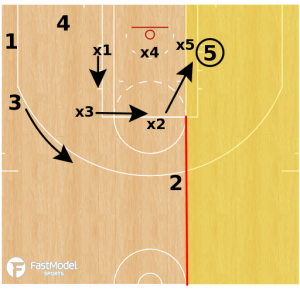
1 enters the ball into the post and then cuts to the WS corner.

X4 can tag the 1 as they cut but should remain at the low HL position.

X1 will go with the 1 and stop at the WS key.

As the 2 will slide over, X2 will become the one responsible for doubling the post.


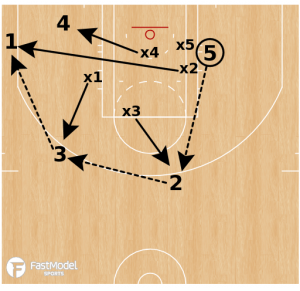
When X2 goes to double, this forces a few rotations.

X3 will move to the high HL position and is responsible for any pass to the 2.

The X1 will slide and maintain an equal distance between the 3 and 1; they are responsible for any pass out that way.

X4 will remain in the low HL spot.


The defense is willing to concede the pass to the 2 because it is the easiest to recover to.

The second rule defines who is rotating where.

In the previous example X1 rotated to the 1 because he was in between the SS elbow and the sideline.

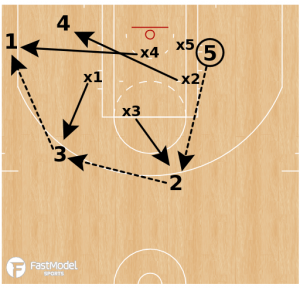
If the 2 passes the SS elbow then the first example of rotations is intact and X2 will rotate to his man.


The ball is kicked out to the 2, and as the offense swings the ball, X3 takes the 2, X1 takes the 3, and X2 leaves the double team and sprints to the 1 in the corner.

Whoever doubles the post will have the longest distance to cover but should be able to get there as the ball is swung.

An adjustment can be made, and teams could have X4 take the corner and X2 rotates to the 4 if the team is comfortable with the match up.

  • « Go to Previous Page
  • Page 1
  • Interim pages omitted …
  • Page 95
  • Page 96
  • Page 97
  • Page 98
  • Page 99
  • Interim pages omitted …
  • Page 288
  • Go to Next Page »

Primary Sidebar

  • Twitter
  • Facebook
  • Linkedin
coachestoolbox
personaldevelopmenttoolbox
basketballplayerstoolbox
basketballtrainer
athleticperformancetoolbox
coachingbasketball

© Copyright 2026 Coaching Toolbox

Privacy Policy