• Skip to primary navigation
  • Skip to main content
  • Skip to primary sidebar

  • Basketball Plays
    • Ball Screen Sets
    • Horns Sets
    • Man to Man Post Up
    • Man to Man Isolations
    • Backdoor Plays
    • Man to Man 3 Point Shot Plays
    • 2-3 Zone Attack
    • Baseline Inbound Plays
    • Sideline Inbound Plays
    • Combination Defense Attack
  • Drills
    • Defensive Drills
    • Offensive Drills
    • Competitive Drills
    • Passing Drills
    • Rebounding Drills
    • Shooting and Scoring Drills
    • Toughness Drills
    • Transition & Conversion Drills
    • One on One Drills
  • Blueprint
  • Practice
  • Mental Toughness
  • Skill Development
  • Offense
  • Defense
  • Store

2 Minute Magic Shooting Drill

2 Minute Magic Shooting Drill

By Brian Williams on July 3, 2017

This drill is among the thousands of resources for both coaches and player available from basketballhq. They have several more videos as well as basketball coaching resource articles.

You can use this drill to get some ideas for a way to create a similar routine into your practices or improvement season workouts. I like the idea of a timed competition to keep players focused. You can substitute your own finishing moves such as jump hooks, floaters, up and under, or anything that your players use to score in the lane.

A good time for college players is 8 minutes, but for high school it could be 9 minutes. The best way for you to determine the time is by running the drill with your squad a few times–especially if you make adjustments to adapt the drill to different shots.

Layup drills are 10 makes, jump shots require 8 minutes from each spot.

The drill is from Coach Mike Roberts, University of North Carolina Greensboro Assistant Mens Coach

Please make sure your sound is on to see the video.

Click the play arrow so see the drill. The drill is a You Tube video, so you will need to be able to access You Tube to see the drill.
2 Minute Magic Shooting Drill

Ganon Baker Hunt the Paint Drill

By Brian Williams on June 28, 2017

This video is a video with Skills Trainer Ganon Baker to work with your drivers on getting into the paint and bouncing off to keep their dribble alive until they have a shot or a pass.

Make sure that your sound is on.

This is a YouTube Video, so please make sure that you are on a network that allows YouTube access.

Finishing Against a Help Defender

By Brian Williams on June 27, 2017

3 Finishing moves for players to use against a helping defender from Drew Hanlen.

Drew is an NBA skills trainer and founder of Pure Sweat Basketball.

This video is posted in the Pure Sweat You Tube channel. You can access their channel of instructional videos at this link:

Pure Sweat You Tube Channel

This is a You Tube video, so please make sure that you are able to access that network.

Also, please make sure your sound is on for the instruction with the video.


Beating The 2nd Line Of Defense

10 Traits of Coaches’ Favorite Players

By Brian Williams on June 23, 2017

Posted with permission from PGCBasketball

Do Coaches Play Favorites?

Have you ever thought your coach or your child’s coach was playing favorites? In the coaching profession you often hear many complaints. In basketball, one complaint that particularly sticks out is playing favorites. Do coaches play favorites? Yes they do.

Coaches do play favorites. I play my favorite players and am not ashamed to admit it. You might be surprised to hear that, but I hope you understand after reading. As coaches, we play the players who possess the best (and often our favorite) traits. Here are 10 traits that make a player a coach’s favorite.

Be a hard worker.

Coaches love players who show up for everything. We love the players who are the first ones in the gym and the last ones to leave. A hard-working player gives their best effort every time they take the court, whether it’s a practice or a game.

Be a leader.

Coaches love players who lead in action and through words. Leaders inspire their teammates to reach another level. They inspire their teammates to give it their all through their example. Leaders are an extension of the coach on the floor. They buy into the program’s philosophy and get their teammates to as well.

Be a great teammate.

Coaches love players who support their fellow teammates. Great teammates are accepting of all team members and help others to get better. Coaches love it when an upperclassman goes out of their way to help the underclassmen learn. A great teammate embraces their role no matter what it is and does it to the best of their ability. Great teammates are all about “we” and whatever is best for the team.

Be a competitor.

Coaches love players who do the little things it takes to win. We love players who treat practice like it’s a game. Great competitors never go through the motions. They want to win every drill, game, and contest. Through their desire to win, and more importantly their preparation to win; great competitors inspire their teammates to give more.

Be a good citizen.

Coaches love players who represent the program well on and off the court. We love players who give back to the game and their community. Being a good citizen means doing the right thing even when it’s the most difficult thing to do. Good citizens behave in school, get good grades, and support the entire school community.

Be a playmaker.

Coaches love players who not only know what to do but can do it. Playmakers step up and make the big plays when the team needs it most. They are always making plays. Coaches love players who ask questions that will make them better. Playmakers know “why” because it gives them the confidence to go out and perform.

Be coachable.

Coaches love players who can take constructive criticism. We want players who want to be coached and who want to be told what they need to do to get better. Coachable players never roll their eyes at the coach. They make eye contact with their coaches, and aren’t afraid to ask questions. Coachable athletes listen to their coach and not the stands.

Have pride

Coaches love players who consistently wear and represent the program’s gear. We want players that help promote our programs. Players who exemplify pride express it through their words and actions. They act like being a part of the program is a big deal and means something. Coaches love players who take pride in the little things and doing them well.

Be dependable.

Coaches love players who are always on time. Don’t be late. Don’t miss practices, events, or games. We love players who offer no excuses and no explanations. Coaches want players they can depend on both on and off the court to make the right decisions. Being dependable also means you’re always there for a teammate in need.

Have heart.

Coaches love players who play with enthusiasm, courage, and spirit. Having heart means having and playing for a purpose beyond the scoreboard. When the score’s out of reach, players with heart continue to play hard to honor the game. They play for purpose that means something to them. We love players who never give up or give in. Having heart means getting back up and going again, even when it seems the most difficult.

If a player has these traits, they will quickly become a coach’s favorite and earn more playing time. It’s not always about talent. It’s about what you do with that talent. It doesn’t take the most athletically gifted person to have any of these traits. It doesn’t require skill. However, it’s not easy. It requires a lot of mental and physical fortitude and it’s not for everyone. That’s why the few who are able to do it become Coach’s favorite.

Written by: Lead ‘Em Up (@Lead_Em_Up) – Kyle Elmendorf  (@K_elmendorf)

Mike Dunlap Conversion Defense Drill

By Brian Williams on June 22, 2017

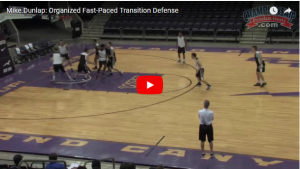
This defensive conversion drill is from former Loyola Marymount and Charlotte Bobcats (now the Charlotte Hornets) Men’s Coach Mike Dunlap, who now serves as the Men’s Coach at Colorado Mesa.

I like the idea of forcing the defense to react with a higher sense of urgency when converting by having the offense shoot quicker.

However, you might not have a second team that can get a good shot in 7 seconds, so like all drills that you see, you will need to make some adjustments. You could give the defense a point each time they do not allow a game-like good shot in 7 seconds and require 4 points to complete the drill. You could play with 4 defenders to make it more competitive. You can adjust the 7 second time requirement to fit the skill level of your team.

There is sound with the video, so please make sure that your sound is on.

The videos are hosted on YouTube, so you will need to be on a network that allows you to access that site.

The videos are from the Championship Productions You Tube Channel..

Click the play arrow to play the video with the drill.

If you are interested in learning more about the Championship Productions Basketball Coaching Video (available in both DVD and Instant Video Format) that this drill came from, you can click the following link: Mike Dunlap: Organized Fast-Paced Transition Defense

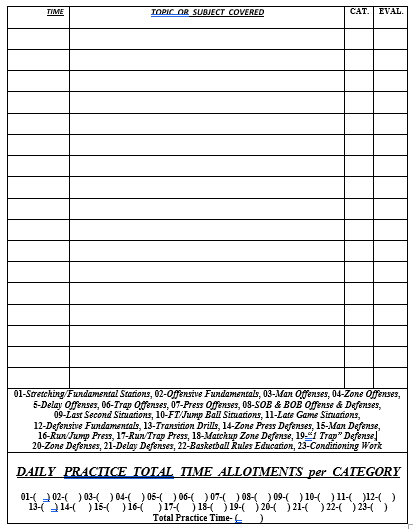
Master Practice Plan Outline

By Brian Williams on June 18, 2017

Submitted by Coach John Kimble of CoachJohnKimble.com

Retired high school and college coach

Follow him on Twitter @CoachJohnKimble

Editor’s Note from Brian:  The purpose of this post is to give you some ideas on how to organize your practices in a way that you cover what you need to cover for your system.

INTRODUCTION

Every successful basketball coach is a master teacher of the game.  Just as excellent teachers who teach any subject, the outstanding “teachers of the game of basketball” must be certain that he/she thoroughly teaches every facet there is of the game that he is coaching.

To prevent the coach from omitting a minor or a major aspect of the game, the coach must also have a “game plan” for each practice session.  This daily practice plan allows the coach to adhere to the specific foundations, techniques, skills, and strategies being taught, worked on, and/or prepared for in the practice sessions.  Some of the major factors of successful practices are that each drill or activity in each practice should be:

1) Organized,
2) smoothly flowing,
3) extremely time efficient,
4) interesting (and not boring to the players),
5) all-involving (for each and every  player),
6) educational and informative,
7) competitive,
8) physically, mentally, and emotionally challenging to every player,
9) motivating to all players,
10) meticulously detailed and imaginative, and
11) intermittently repetitive.

In order that practices constantly have these attributes, a coach must carefully and conscientiously establish fundamentally sound practices for each and every day.  He/she must be painstakingly detailed  in his/her planning to achieve as many of the previously mentioned attributes in each of the activities of each and every practice.  Coaches must follow these two old clichés:  “Plan your work!!  Work your plan!!”  and  “Failing to prepare is preparing to fail!!”

There are three major components in the successful administering  of basketball practices.  These vital components are:

1)  Practice planning (before the actual practice takes place),
2) the executing of the practice plan (during the actual practice), and
3) the evaluating and critiquing of the practices (done after the practice has concluded).

It is of utmost importance to successfully perform all three components to have informative, worthwhile, and therefore worthwhile practices to prepare your players for absolutely anything and everything that could possibly happen in a game.  This is done in order for those players to be prepared and ultimately to be successful in their games.

This third component of  the administration of basketball practices sometimes can easily be omitted, forgotten, and ignored.  It is a requirement for successful programs to devise an overall master plan of each of the daily practice sessions.  This tool aids a coach to plan ahead and also to keep a season-long summary of past practices to record every aspect and phase of the game.  This ‘diary of the practices’ should illustrate the frequency and the quality of each and every drill and activity of every practice session.

The ‘MASTER  PRACTICE  PLAN’ is an invaluable instrument that will help a coaching staff insure that every fundamental, every drill, every skill, every rule, every aspect of the game is taught and practiced.  Each activity is documented and accounted for, and evaluated.  This should help the staff from having any ‘practice slippage’.  Nothing is then assumed or forgotten by the coaching staff.  Every phase of the game is effectively and efficiently taught, reinforced, practiced, and repeated for the players’ development in an organized system of practice planning.

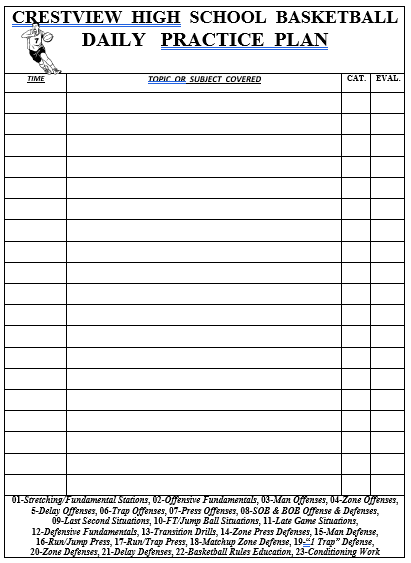
The ‘DAILY  PRACTICE  PLAN’  should contain certain key elements, such as:

1) the name of the activity,
2) the time period for that specific activity,
3) the ‘major points of emphasis’ for that specific drill or activity,
4) as well as the overall practice’s ‘major points of emphasis’ for that day.

For the coaching staff’s recordkeeping and evaluation purposes, each drill/activity can (and should be) classified into one of the twenty-one categories, with the amount of time spent, as well as the staff’s overall evaluation of that drill/activity.   The ‘DAILY  PRACTICE  PLAN’ keeps the coaching staff focused and on task, avoiding the many types of distractions that can take place to prevent the staff from accomplishing what they have attempted to set out to do in that day’s practice.  It also becomes an instrument to where they can critique and evaluate themselves, the practice, and their team’s daily and overall progress.

PHASES,  ASPECTS,  AND  ACTIVITIES  INCLUDED  IN  THE  DAILY  PRACTICE  SESSIONS

01 STRETCHING &  FUNDAMENTALS  BREAKDOWN  STATIONS

02 OFFENSIVE FUNDAMENTALS 

100s) MIKAN DRILL, BABY HOOKS, 3 “DOT SHOT” DRILLS,”POWER” LAYUPS

200s) CLOSEOUT SHTG.-NO DRIBBLE,

300s) CLOSEOUT SHTG-DRIBBLE,

400s) 55 SEC. SHTG DRILLS  (INSIDE SHOTS, SECOND SHOTS, PERIMETER SHOTS

500s) 55 SEC. ‘RAPID FIRE’ SHTG.,

600s) POWER MOVES & SHOTS,

700s) FLEX BREAKDOWN  SHTG.,

800s) ’35’ SHOOTING CONTEST,

900s) “BEAT MICHAEL JORDAN” SHOOTING DRILL,

1000s) ‘FOLLOW YOUR SHOT’ DRILL,

1100s) ‘FREE THROW “SWISH” DRILL’,

1200s)  SOLO SHOOTING DRILL,

1300s) FT BONUS SHOOTING,

1400s) ‘TENNESSEE FREE THROW  SHOOTING” DRILL

03 PRIMARY & SECONDARY FASTBREAK OFFENSE
a) Options (Chase & Stagger, Chase & Lob, Veer Cut, Early Ball-Screen, Late Ball-Screen.

04 MAN OFFENSES

a) MAN OFFENSE ENTRIES
b) MAN OFFENSE CONTINUITIES
c) MAN OFFENSE BREAKDOWN DRILLS

05 ZONE OFFENSES

a) ZONE OFFENSE  ENTRIES
b) ZONE OFFENSE CONTINUITIES
c) ZONE OFFENSE BREAKDOWN DRILLS

06 DELAY OFFENSES

a) DELAY OFFENSE CONTINUITIES
b) DELAY OFFENSE BREAKDOWN DRILLS

07 HALF-COURT TRAP OFFENSES

  1. TRAP OFFENSE  CONTINUITIES
  2. TRAP OFFENSE  BREAKDOWN  DRILLS

08 PRESS OFFENSES (vs. Zone Presses, Man Presses, Run & Jump Presses)

09 SIDELINE AND  BASELINE  “OUT-OF-BOUNDS” PLAYS  (OFF. AND/OR DEF.)
a) NORMAL’ SITUATIONS, b) ‘QUICK’ SITUATIONS’

10 “LAST-SECOND SHOT”  SITUATIONS  (OFFENSE  AND/OR  DEFENSE)
a) FAR ENDLINE,    b) (Near) SIDELINE,      c) (Far) SIDELINE,      OR   d) BASELINE

11 FREE  THROW  SITUATIONS  &  JUMP  BALL  SITUATIONS  (OFFENSE AND/OR DEFENSE)

  1. a) OFFENSIVE REBOUNDING “STUNTS”  (‘Jack & Jill’, ‘Rambo’, ‘Kamikazi’)
  2. INTENTIONAL MISSES (on ‘our’ part  and our ‘opponent’s part’)

12. LATE GAME  AND  OTHER   SPECIAL   SITUATIONS  (OFFENSE  AND/OR  DEFENSE)

13. DEFENSIVE FUNDAMENTALS  AND  BASICS
a) “Defensive Stance” Drill,
b) “Push-Push” Drill,
c) “Push-n-Talk” Drill
d) “PRIDE DRILL”
e) “SHELL DRILL
f) “0 MATCHUP  ZONE” SHELL DRILL
g) “PASSING GAME” LIVE ACTION (Offense and Defense)
h) “TRIANGLE POWER GAME” LIVE ACTION (Offense and Defense)
i) “FLEX GAME” LIVE ACTION (Offense and  Defense)

14. TRANSITION DRILLS
a)  FROM OFFENSE to DEFENSE (‘Man’ and Zone Offenses, from  BOB & SOB. Plays)
b) FROM OFF. to PRESS DEFENSES (‘Man’ and Zone Offenses, or BOB & SOB Plays)
c) FROM DEF. to OFFENSE  ((‘Man’ and Zone Defenses, or BOB & SOB Defenses)
d) “SUPER TRANSITION” DRILL   (From ‘Offense’  to ‘Defense’ )

15. ZONE & MAN  PRESS  DEFENSES

a) “10 Press”  Full Court  Press  Defense    (1-2-1-1  Full Court Zone Press)(3 Stunts)
b) “20 Press”  Full Court  Press  Defense    (2-1-2  Full Court Zone Press)( 3 Stunts)
c) “30 Press”  Full Court  Press  Defense    (Full Court “Face Guard 2 Press” Press)( 3 Stunts)
d) “40 Press”  Full Court  Press  Defense    (Full Court “Run and Jump or Trap” Press)
e) “55 Press”  Full Court  Press  Defense    (Full Court  Man to Man Press )
f) “DELAY” Defenses

16. “5” DEFENSE (Half Court Man to Man Defense)
a) MAN DEFENSE  INDIVIDUAL  BREAKDOWN  DRILLS      
b) MAN DEFENSE  TEAM  BREAKDOWN  DRILLS    (5 & 6-Man Shell Drill)

17. “0” MATCHUP  ZONE  DEFENSE   (1-1-3 Zone)
a) “0” ZONE  INDIVIDUAL BREAKDOWN DRILLS
b) “0” ZONE  TEAM BREAKDOWN  DRILLS
c) “3” Zone   (1-3-1  Matchup)
d)  “2”  Zone   (2-3  Matchup)

18. “1” TRAP (1-2-2 HALF  COURT  DEFENSE)
a) “1” TRAP  INDIVIDUAL  BREAKDOWN  DRILLS
b) “1” TRAP  TEAM  BREAKDOWN  DRILLS

19. ZONE DEFENSES

20. DELAY DEFENSES

21. ‘BASKETBALL RULES’ EDUCATION
a) Interpretations on various rules for different situations

22. CONDITIONING WORK

a) “Leaper/Jumper” Conditioning Work
b) or “Heavy Rope”  Work
c) or “Jump Box”  Plyo-metric Work
d) or “Weight Lifting”
e) and “Sprint Work”
f) and “Positive (Fun) Activity to end the practice”
g) and Announcements


  • « Go to Previous Page
  • Page 1
  • Interim pages omitted …
  • Page 90
  • Page 91
  • Page 92
  • Page 93
  • Page 94
  • Interim pages omitted …
  • Page 288
  • Go to Next Page »

Primary Sidebar

  • Twitter
  • Facebook
  • Linkedin
coachestoolbox
personaldevelopmenttoolbox
basketballplayerstoolbox
basketballtrainer
athleticperformancetoolbox
coachingbasketball

© Copyright 2026 Coaching Toolbox

Privacy Policy