• Skip to primary navigation
  • Skip to main content
  • Skip to primary sidebar

  • Basketball Plays
    • Ball Screen Sets
    • Horns Sets
    • Man to Man Post Up
    • Man to Man Isolations
    • Backdoor Plays
    • Man to Man 3 Point Shot Plays
    • 2-3 Zone Attack
    • Baseline Inbound Plays
    • Sideline Inbound Plays
    • Combination Defense Attack
  • Drills
    • Defensive Drills
    • Offensive Drills
    • Competitive Drills
    • Passing Drills
    • Rebounding Drills
    • Shooting and Scoring Drills
    • Toughness Drills
    • Transition & Conversion Drills
    • One on One Drills
  • Blueprint
  • Practice
  • Mental Toughness
  • Skill Development
  • Offense
  • Defense
  • Store

Season Organization Chart

Season Organization Chart

By Brian Williams on August 24, 2017

This pre-season checklist was sent to me by Derek Sheridan, Head Boys Basketball Coach at Delta High School (Ohio).

I hope that this can serve to stimulate your thinking and your staff’s thinking about what you need to do to get the most out of your team for the upcoming season.

I know for me, putting my thoughts and ideas in document format, and making lists works best for me to flush out and clarify my beliefs, and then turn them into actions.

Here is Coach Sheridan’s Document that he and his staff use:

The value in this exercise is what you will plan to do and then execute to play to your strengths and avoid your weaknesses.

Just because the worksheet suggests listing 10 does not mean that you should have 10 items for each list.  You might want to list 10 possibilities and then trim that number down as you have flushed out the possibilities or as you experiment with them once practice starts and see that some are not a good fit for this year’s team.

A. Offensive Strengths

1.

2.

3.

4.

5.

6.

7.

8.

9.

10.

B. Offensive Weaknesses (also list 1-10)

C. Defensive Strengths (list 1-10)

D. Defensive Weaknesses (1-10)

E. Best team in our sectional

F.  How do we have to play in order to beat the best team in our sectional?

1) Offensively

2) Defensively

G. Projected starting 5

H. Projected second 5


TEAM ZONE OFFENSE

A. Zone Motion/Continuity Offenses vs. even-front ZONE defenses that highlight our strengths and hide our weaknesses (List 1-6)

B. What sets will allocate inside scoring vs. even-front ZONE defenses (list 1-10)

C. What sets will allocate perimeter scoring vs. even-front ZONE defenses (list 1-10)

D. What sets will allocate driving (getting to FT Line) scoring opportunities vs. even-front ZONE defenses (list 1-10)

E. Zone Motion/Continuity Offenses vs. odd-front ZONE defenses that highlight our strengths and hide our weaknesses (List 1-6)

F. What sets will allocate inside scoring vs. odd-front ZONE defenses (list 1-10)

G. What sets will allocate perimeter scoring vs. odd-front ZONE defenses (list 1-10)

H. What sets will allocate driving (getting to FT Line) scoring opportunities vs. even-front ZONE defenses (list 1-10)

I. BLOB plays vs. Zone Defense (list 1-10)

J.Offense vs. Junk Defenses (list 1-10)

K.SLOB plays vs. Zone Defenses (list 1-10)

L. Press offense vs. Half Court Trap (list 1-10)

M. Full Court Press Offense vs. Zone Presses (1-10)


TEAM MAN TO MAN OFFENSE

A. Motion/Continuity offenses that highlight our strengths and hide our weaknesses. (list 1-10)

B. What offensive actions will allocate inside scoring and who needs to get the ball? (list 1-10)

C. What offensive actions will allocate perimeter scoring and who needs to get the ball? (list 1-10)

D. What offensive actions will allocate driving (getting to the FT line) scoring opportunities and who needs to get the ball? (list 1-10)

E. Sets for inside scoring (list 1-10)

F. Sets for penetration (list 1-10)

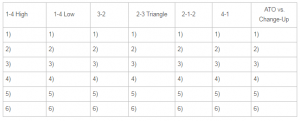
G. Master Entry List

1-4 High     1-4 Low      3-2           2-3 Triangle 2-1-2        4-1           ATO vs.
Change-Up
1) 1)  1)  1)  1)  1)  1) 
2)  2)   2)   2)   2)   2)   2)  
3) 3)  3)  3)  3)  3)  3) 
4)  4)  4)  4)  4)  4)  4) 
5) 5) 5) 5) 5) 5) 5)
6) 6) 6) 6) 6) 6) 6)

H. Master Set-Play List (Families)

Family
Names      
Chase Goes
Ball Side
Chaser
Trails
Switching Backdoor   Lob Full Front
Post
Play
Behind
Post
1) 1)  1)  1)  1)  1)  1)  1)            
2)  2)   2)   2)   2)   2)   2)   2)
3) 3)  3)  3)  3)  3)  3)  3)
4)  4)  4)  4)  4)  4)  4)  4)
5) 5) 5) 5) 5) 5) 5) 5)
6) 6) 6) 6) 6) 6) 6) 6)

Special Situations/Game Winners:

BLOB vs.
Man to Man
1)        2)       3)       4)        5)       6)      
BLOB vs.
Zone
1)  2)  3)  4)  5)  6) 
Deep SLOB
vs. M to M
1)   2)   3)   4)   5)   6)  
Deep SLOB
vs. Zone
1)  2)  3)  4)  5)  6) 
Short SLOB
vs. M to M
1)  2)  3)  4)  5)  6) 
Deep Corner
BLOB/SLOB
1) 2) 3) 4) 5) 6)
Full Ct.
Need 2
vs. M to M
1) 2) 3) 4) 5) 6)
Full Ct.
Need 3
vs. M to M
1) 2) 3) 4) 5) 6)
Half Ct. Need 2 vs. Man to Man 1) 2) 3) 4) 5) 6)
Half Ct. Need 3 vs. Zone 1) 2) 3) 4) 5) 6)

Free Throw Sit Down 3

1) 2) 3) 4) 5) 6)


Michigan & South Carolina Man to Man Plays

By Brian Williams on August 23, 2017

These 2 man to man plays are from Matt Bolger’s 2017 NCAA Tournament-Best of Man Offense Plays.

Diagrams created with FastDraw

My hope is that you can take bits and pieces of these plays to enhance what you already do and what suits your players.

You can purchases any four of our digital playbooks for $35 (62 titles in all–Virginia, Texas Tech, Duke, Kentucky, Brad Stevens, and many others included!) 20 new titles on July 11!

Click this link for all choices! 4 digital playbooks for $35


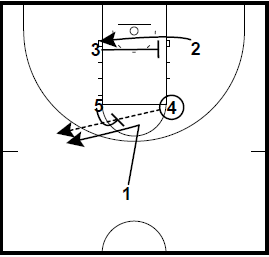
Michigan Chin STS (Screen the Screener)

2 comes up to wing.

1 passes to 2 and cuts to corner.

3 and 4 exchange on the weak side.

2 dribbles up just past the top of the key.


2 passes to 4.

5 steps up to set back screen for 2.

2 goes off 5’s back screen and loops just under the elbow.

5 pops out to 3 point line. 4 reverses to 5.


On 5’s catch 1 runs up to wing.

5 passes to 1.

2 steps up to set back screen for 4.

4 cuts through lane to corner.

5 sets down screen for 2.

After setting backscreen 2 comes off 5’s screen to top of key.

1 passes to 2 for shot or drive

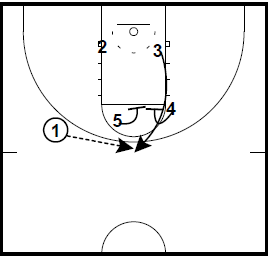
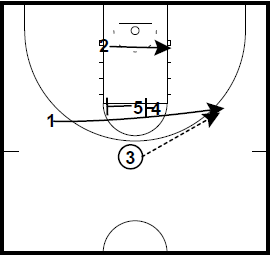
South Carolina STS Iverson

2 cuts over 5 and 4 to the short corner.

3 cuts to the opposite block.

1 passes to 4.


After the pass 1 comes off a flare screen by 5.

4 passes to 1.

On the pass to 1, 3 sets a cross screen for 2 to the block.


After setting the cross screen 3 comes off a double screen by 4.

and 5 to the top of the key.

1 passes to 3 for a possible shot.


After passing to 3, 1 does an Iverson cut off of 4 and 5 to opposite wing.

3 passes to 1.

1 can drive or look to 2 posting up on the block.


Basketball Coaching Nuggets

By Brian Williams on August 22, 2017

These basketball coaching thoughts came from Army Men’s Assistant Zak Boisvert’s PickandPop.net site.

The site has a lot of quality coaching ideas and information.  Definitely worth a look!

These are his Coaching Takeaways from August:

-Pete Carrill (Princeton): Players win games. Coaches win practices.

-Jay Wright (Villanova): Your reads on a dribble pickup off a penetration drive are the following: Down (to the big), Opposite (weakside perimeter), Behind (to a teammate circling behind), Back (turn back to the rim to score).

-Fran Dunphy (Temple): “Know who you are” is a phrase we use a lot. If you’re a good jump shooter, let’s get you some jump shots. When you step outside your comfort zone, you can find success, but we want to do things that will make us successful 60 to 70 percent of the time.

Steve Kerr (Golden State Warriors): I think team chemistry is determined by your top two players and your bottom few players on the totem pole. There’s usually, on most teams, a pretty good pecking order, and you know who’s leading the team — and their leadership is critical. But there’s always stuff that can go either way. Players can fall from one side of the fence to the other.

-Chris Mack (Xavier): Break up your personnel into 3-4 different lineups for all dry-run offense segments. Doing this beforehand eliminates the coach having to worry about the right players getting the right reps during the segment. Example: you might have a kid that plays some 1 and some 2. He’s the 1 on Team 1 and maybe he’s the 2 on Team 3. It allows the players to get the reps at the spots they need to know with game-like lineups. Coach would call out “Diamond Rip” and Team 1 would run it then Team 2, Team 3, etc.

-Shaka Smart (Texas): “Cutthroat Catches” Post Drill. “How many post touches can you get in 30 seconds?” 3 passers around the perimeter (wing-top-wing) with 2 guys inside (O/D). 1 basketball amongst the 3 perimeter passers. 2 Managers on the baseline and another manager up top (manager is the facilitator who is feeding the 3 passers). Clock starts and offensive post works to get a catch in “The Box” as defensive player works to prevent catches. Offensive player should be communicating with the passers about where he wants the ball to go so he can seal. No lobs, only bounce passes into the post (own your space – don’t break contact). As soon as he gets a catch, he drops the ball in the direction of the baseline and the facilitator up top puts another ball into play as the managers on the baseline scurry to collect the ball and throw it out to the facilitator up top.

-Phil Gaetano (Coppin State): when chasing the snake, you want to chase when the guard goes east to west, if he gets downhill to the rim then we Veer, which means big takes ball and guard cracks down to box out the big.

-Tobin Anderson (St. Thomas Aquinas): We don’t shoot at all during practice. We do all our shooting in individual sessions outside of our practice time (aim for guys getting in 3 times per week).
-Lennie Acuff (Alabama Huntsville): Whether you run Princeton or not, you should be running “Princeton Point Screen Away” as a set.

-Fran Fraschilla: “Weaking” the high pick & roll to the player’s left hand can backfire when you’re in a “Drop” coverage because the PG will just snake it back to his right hand.

-Steve Kerr: “My whole thing as a coach is I want open shots. I don’t keep track of how many 3’s. I just want open shots. I’m not into the math stuff. We have great 3-point shooters and if we should space the floor and move and take a bunch of them, it makes perfect sense.”

-Anthony Lynn: When I was promoted to Offensive Coordinator [mid-season on September 16th], Coach Parcells called and gave me advice. His systems have always been personnel-driven. It was something he always said in Dallas: Do what your players do best. Sometimes we get a lot of scheme in our head and we put too much on the players. You can have way too much volume. He’s always told me insecure coordinators carry a lot of volume because they feel they don’t have enough bullets. But it’s not fair to your players because they can’t play fast or physical and you can’t see their talents. He encouraged me to look at the volume and figure out what we did best. He told me to cut the volume in half.
Steve Donahue (Penn):Before they go home for the summer, give your players an empty notebook to track their workouts. Note-taking is one of the most consistent habits in highly successful people.

-Mike Brey (Notre Dame): I’m a big believer in not getting too deep and relying on a core of guys who really know how to play together.

-Kevin Eastman: Something you can get out of your practice tape is slight offensive wrinkles/adjustments your first unit is making (sometimes unknowingly) to your offensive system due to the second team knowing what they’re running. Some of our best offensive wrinkles in Boston were born out of KG doing this or that in practice against the second unit.

-Tony Dungy: With the Patriots, what’s amazing to me is their ability to be able to execute and be on your fundamentals and still change approaches week in and week out, I have no idea how they do it, but that to me is the genius.

-Dave Faucher: When you have certainty of movement, you can play with great pace

-Boris Diaw:

 “A change of tempo is also very important in footwork so you’re not always going at same the speed,” Diaw said. “Sometimes you need to be slow to have good footwork. Having good footwork going 100 miles per hour is something that’s really, really difficult.”

-Fred Hoiberg (Chicago Bulls): I’m not a system guy. I like to run actions based on the strengths of personnel. Find actions to take advantage of a mismatch and play out of that.

6 Zone Offense Actions

By Brian Williams on August 19, 2017

These 6 actions for attacking a zone defense are presented by Aaron Garrett, Head Coach at Amber-Pocasset (Oklahoma) High School.

There is sound with the video, so please make sure that your sound is on.

The video is hosted on YouTube, so you will need to be on a network that allows you to access that site.

The videos are from the Championship Productions You Tube Channel..

You don’t have to run the plays in their entirety.

You can take parts of them and incorporate into what you do. In my opinion, all ideas you get from others should be modified to your needs.

You might have to put in some work to get something out of this and watch the video several times to be able to imagine how the zone will shift to cover these movements.

Click the play arrow to play the video with his thoughts.

If you are interested in learning more about the Championship Productions Basketball Coaching Video (available in both DVD and Instant Video Format) that this drill came from, you can click the following link: The Break Point Offense: The All-Encompassing Offensive System

Big “We,” little “me”

By Brian Williams on August 17, 2017

An Academy for Sport Leadership Case Study–Dr. Cory Dobbs

Instructions: give a copy to every team member.  Read alone.  Answer discussion questions.  Come together as a team and engage in a spirited conversation.  When you’re done, identify two action items for your team.

Big “We,” little “me”
Thinking and Acting Like a Committed Teammate

Introduction

Erin arrived late to her first class of the day.   She was still brooding about not playing in last night’s game.  Consumed with disappointment  in her coaches, teammates, and herself, Erin was contemplating quitting the team.  She reflected on the hours upon hours invested over the past two years simply to eke out a few minutes of playing time each game.  She’d set high goals for herself, and she met most of them.  She improved in the weight room and on the playing field.  She always gave all she had in practice and the coaches were usually pleased with her as a member of the team.  However, she seemed to be stuck on starting.  Playing time.  Seemed little else mattered to her.  She wasn’t quite sure why she felt this way, she’d always thought of herself as a very good teammate.  She enjoyed working alongside everyone, had not grudges and couldn’t muster a bad word about her teammates.  She just wanted to play.  And she’d just realized after last night’s game she really wouldn’t get much playing time this year—her senior season.

Questions for Discussion

  • Why might a team member become discouraged about a lack of playing time?
  • How can you encourage teammates to balance “Me” with “We?”
  • How might you unknowingly discourage a teammate from accepting “we?”
  • How might Erin’s thoughts determine her behavior?
  • What happens when one team member goes in his or her own direction?
  • What might happen when a team member places too much emphasis on themselves?
  • What are the benefits of being a member of a team? (physically, intellectually, emotionally, socially)
  • What “rewards” might a player receive that doesn’t get much playing time?

What’s at Stake?

While we all have to take responsibility for ourselves and our success in life, we need to do so in a way that honors the various wholes of which we are a part.  Thinking and acting “BIG We, little me” is not about denying yourself, your needs, or your individuality.  It is about realizing that you are part of a whole that is greater than you.

Point to Ponder

A famous proverb states, “The best potential in ‘me’ is ‘we.’”

*This case is a part of a portfolio of cases created by The Academy for Sport Leadership.  Case studies legitimize a range of issues by giving the student-athlete an opportunity to explore the physical, intellectual, emotional, and social dimensions of existing or potential problems.

“Tell me and I’ll forget. Show me and I may remember. Involve me and I will care.” -Your Student-Athlete The world of coaching is changing. In Coaching for Leadership you’ll discover the foundations for designing, building, and sustaining a leadership focused culture for building a high-performance team. To find out more about and order Sport Leadership Books authored by Dr. Dobbs including Coaching for Leadership, click this link: The Academy for Sport Leadership Books

The Little Big Things

By Brian Williams on August 17, 2017

From the Academy for Sport Leadership–Dr. Cory Dobbs
A Note to the Student-Athlete

THE LITTLE BIG THINGS: Excellence Begins by Sweating the Small Stuff

“HEY STUDENT-ATHLETE!”
It’s All About the Locker Room

I recently visited a neighborhood Denny’s. Prior to ordering my meal I visited the restroom. Upon entering I noticed scraps of paper towel all over the floor. The sink basin revealed soap drippings that had probably been there since the day before. No, I’m not a neat freak. It’s just that in a world addicted to mediocrity little things are really big things. I left the restaurant. My experience with the filthy restroom sapped me of any confidence in the restaurant’s ability to deliver a quality meal.

The small stuff matters.

To me, a clean and attractive restaurant is the best indicator that the people running the show—at the restaurant, school, hotel, you fill in the blank, care about the people that use the facilities (and this includes the workers!). Make no mistake, the restroom screams commitment to excellence. It takes great leadership to ensure clean restrooms. If you want to be different—successful—a great place to start is your locker room (And here’s the kicker…each and every one of you will be running a show somewhere and sometime in the future.).

How do you and your teammates care for your locker room? Do you use it and wait for others (coaches, janitors, etc) to pick up the mess? To me, a clean and attractive locker room tells me the people running the program care. Come to think of it, the way you take care of your playing field, court etc. tells a lot about your commitment to excellence.

The small stuff matters. What little things might you do today to make a big difference in your team?

Humility matters. Every small action reflects not only on you personally, but also on your teammates. Act in a manner that honors yourself and your teammates. Act in a manner that will reflect well on you and the others in your life.
Today’s headlines and daily news stories are filled with accounts of self-centered and irresponsible professional athletes. The world of sports often breeds excess—it is noble and ignoble, beautiful and ugly. Sports reveals the best and the worst of human nature in a highly visible action-packed arena dominated by intense emotion.

Humility is the quality of being respectful. It is displayed in conduct that dignifies others. Humility is found in the small stuff. How you talk to your teammates reveals your care and concern. How you listen to others reveals your commitment to them and your team. Model humility: serve and honor your teammates.

Sometimes one minute (a very small thing) makes all the difference.

How long does it take for you to care for your locker room? Your playing field? Your teammate? My guess is you can do a lot in one minute…and when all those small one-minute actions accumulate…

The small stuff matters. What little things might you do today to make a big difference in your team? Select at least one thing. And do it.

You can make excuses for not doing that one thing. If so, then excuses are probably small stuff to you. But remember, the small stuff matters.

In the final analysis, it is the small stuff that determines what we draw out of the sports experience. The little things make all the difference.

“Tell me and I’ll forget. Show me and I may remember. Involve me and I will care.” -Your Student-Athlete The world of coaching is changing. In Coaching for Leadership you’ll discover the foundations for designing, building, and sustaining a leadership focused culture for building a high-performance team. To find out more about and order Sport Leadership Books authored by Dr. Dobbs including Coaching for Leadership, click this link: The Academy for Sport Leadership Books

  • « Go to Previous Page
  • Page 1
  • Interim pages omitted …
  • Page 85
  • Page 86
  • Page 87
  • Page 88
  • Page 89
  • Interim pages omitted …
  • Page 288
  • Go to Next Page »

Primary Sidebar

  • Twitter
  • Facebook
  • Linkedin
coachestoolbox
personaldevelopmenttoolbox
basketballplayerstoolbox
basketballtrainer
athleticperformancetoolbox
coachingbasketball

© Copyright 2026 Coaching Toolbox

Privacy Policy