• Skip to primary navigation
  • Skip to main content
  • Skip to primary sidebar

  • Basketball Plays
    • Ball Screen Sets
    • Horns Sets
    • Man to Man Post Up
    • Man to Man Isolations
    • Backdoor Plays
    • Man to Man 3 Point Shot Plays
    • 2-3 Zone Attack
    • Baseline Inbound Plays
    • Sideline Inbound Plays
    • Combination Defense Attack
  • Drills
    • Defensive Drills
    • Offensive Drills
    • Competitive Drills
    • Passing Drills
    • Rebounding Drills
    • Shooting and Scoring Drills
    • Toughness Drills
    • Transition & Conversion Drills
    • One on One Drills
  • Blueprint
  • Practice
  • Mental Toughness
  • Skill Development
  • Offense
  • Defense
  • Store

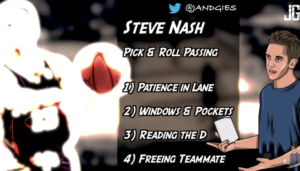
Steve Nash Pick and Roll Passing

Steve Nash Pick and Roll Passing

By Brian Williams on December 21, 2017

This video was sent to me by Jon Giesbrecht. Jon is currently an assistant coach with the University of Regina Women’s program.

Jon is also an assistant coach with the 17U Male Provincial team for Team Manitoba (Includes National Championship 2013-14). In previous years, Jon spent two years with the University of Manitoba as an assistant coach, he was also the head coach of the John Taylor Collegiate Junior Varsity Boys team for four years.

To contact Jon, please email him at [email protected]

He has a Tweet from Steve Nash about the video below. Steve said:

“Very nice breakdown for pg’s. Not just coz it’s me ha. Well done @jandgies”

Jon;s Twitter handle is @jandgies

The video is a YouTube video, so please make sure that you are on a network that allows You Tube access. Some school networks may block YouTube access.

Click the play arrow to watch the videos.

There is sound with the video, but there is no narration.

“Editor’s Note from Brian. I realize that 99.99% of the coaches viewing this page do not have and never will coach a player who is as good as Steve Nash. I also believe that no one will be able to apply all of the moves in the video. The purpose of this post and the video is to offer food for thought (even if it is only 1 technique or teaching point) for you to come up with ways to help your players to improve.
Numbered Rebounding Drill

By Brian Williams on December 19, 2017

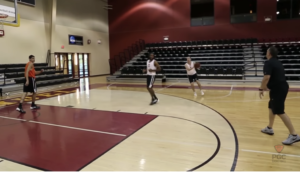
This shoting drill came from the FastModel Sports Basketball Plays and Drills Library.

You can also find out more about FastModel Play Diagramming software by clicking this link: FastDraw

The drill was contributed by Kyle Gilreath, Head Boy’s Basketball Coach at Astronaut High School, Titusville, FL. Kyle is also the author of the basketball coaching website, Words on the Bounce.

Coach Gilreath was a graduate manager for Billy Donovan at Florida and learned the drill from Coach Donovan.

Editor’s Note from Brian:

1) The coach should shoot the ball to create a rebounding opportunity.
2) You can also run this with 3 or 4 players blocking out.
3) You can create two different teams and add a scoring system to make the drill competitive.
4) Another adjustment you can make is to have the players on the perimeter move so that the defenders who will be blocking out have to find them to block them out.


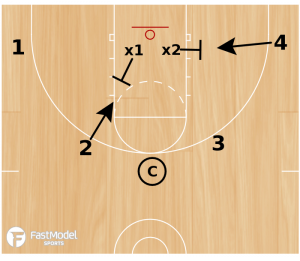
Players are on the outside are all offensive players. Place two defenders in the paint.

Coach calls out a number combo. For example: 24. X1 and X2 must block out 2 and 4.

Validation Competitive Basketball Shooting Drill

By Brian Williams on December 18, 2017

This video is with Emmanuel College Head Men’s Coach TJ Rosene, who is also a Director for PGC Basketball.

You can see more drills and posts from PGC Basketball by visiting their Basketball Blog

The purpose of this drill is to give you another competitive shooting drill to add to your Drill Book.

Like a game, players experience not only relying on themselves to make shots to win, but also relying on their teammate.

You need 2 pairs of players to run the drill.

The drill gets it name from the way it is played. If the first player makes the shot, the second player must make his or her shot to validate the first shot and earn a point.

If the first player misses the shot, then the other team’s first shooter will shoot.

Tweak the rules and types of shots and spots/sides of the floor to fit your needs and to add variety.

Please make sure that your sound is on and click on the video to play.

Click the play arrow to view the video.

Perfection Drill

By Brian Williams on December 17, 2017

This drill is from the Xavier Men’s Program Basketball Coaching Newsletter.

You can see the archives of their basketball coaching newsletter at this link: Xavier Newsletter

Editor’s Note from Brian. A lot of teams run a drill similar to this, but the idea behind this post is to set the expectation of perfection, no bobbles, bad passes, missed layups, etc… when you are doing warm up or technique drills.

Diagram created with FastDraw

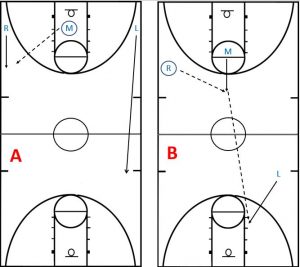
1. The drill begins by your team forming one line along a baseline. The line has two balls in it. The following progression takes place:

a. A player dribbles the length of the court and shoots a right hand layup. He gets his own rebound and dribbles the length of the court and shoots a second right hand layup. The next player in each line goes when the player in front of him is at half court.

b. A player dribbles the length of the court and shoots a left hand layup, he gets his own rebound and dribbles the length of the court and shoots a 2nd left hand layup. The next player in each line goes when the player in front of him is at half court.

c. “Box to box”- two players stand as wide as the lane. One ball is utilized. Both players run the length of the court passing back and forth to each other without dribbling. A player shoots a layup. The passer rebounds the ball and the shooter continues on, turns and runs back. The rebounder passes the ball to the shooter and they once again pass back and forth to each other without dribbling until the second layup is shot at the other end.

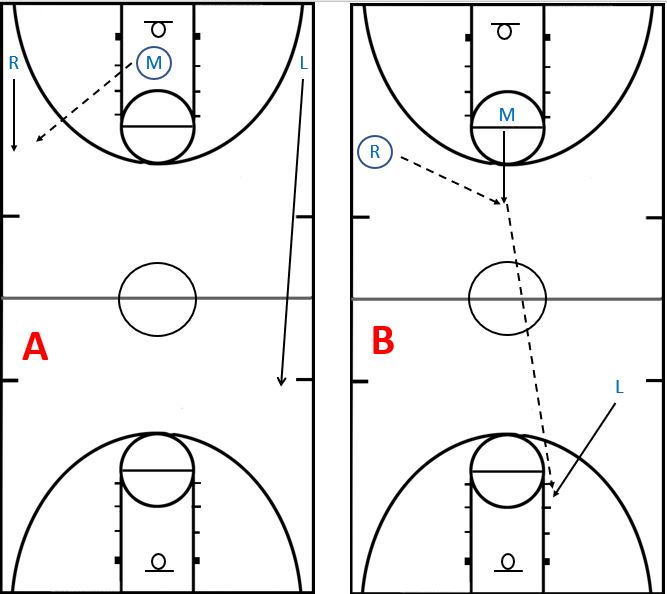
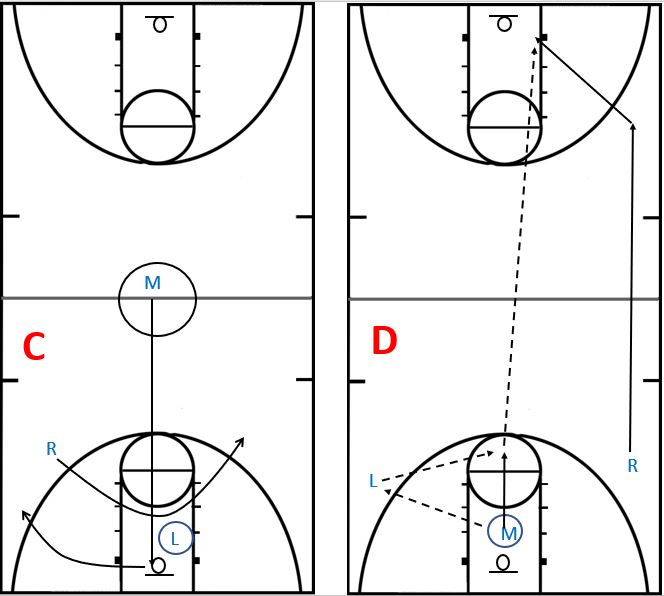
d. “Michigan”- Three players are standing along the baseline. The middle player passes to the player on his right side. The right player passes the ball back, the player on the left side runs wide to the basket and prepares for a pass from the middle. No dribble is allowed. A lay up is shot. Right and left cross as the middle player rebounds. Middle then passes the ball to left because he shot the layup. Repeat on way back. (see diagram #4)

e. “Three man weave”- Three or four passes. No dribbles allowed.

f. “Three man weave with jump shot”- Instead of a layup, a ten foot pull up is shot. A dribble by the shooter is permitted.

Rules
Any travel, bobbled pass, turnover pass or missed shot (exception for F) the group or player must go again until perfection takes place. Every player on the team goes once each on A, B, and twice each on C-F segments of perfection.

Diagram A: The M player passes to the R player. The L player runs wide and at an angle to the basket.

Diagram B: The M player receives a pass back from R and delivers a pass to L on the run so that L doesn’t have to dribble.


Diagram C: The L player shoots the lay up and crosses with R to return back to the original end. M rebounds the ball.

Diagram D: M passes to the L player – because L shot the layup. L return passes to M and M delivers a 3/4 court pass to R in stride for the groups second layup.

Relationship Building

By Brian Williams on December 14, 2017

This article was provided by Coaches Network

By Dr. Wade Gilbert

A great way to learn about quality coaching is to listen to coaches and athletes talk about the coaching styles they believe are most helpful for achieving success. Coverage of recent sporting events such as the women’s World Cup, and the NBA and NHL finals, provided many opportunities to hear some of the world’s most successful athletes and coaches share their insights on this topic.

Whether coaching females or males, and regardless of differences in coaching styles, these championship coaches all share one thing in common: they make building relationships with their athletes a top priority.

U.S. women’s national soccer team coach Jill Ellis, who led the American team to their first World Cup championship in 16 years, has been lauded by current and former players alike for her open and honest communication style. Moreover, she places great emphasis on learning how to connect with players in ways that are uniquely meaningful and relevant to each one of them.

Chicago Blackhawks coach Joel Quennville has gained the trust of his players, and led them to three ice hockey championships in the past six years, by keeping an open-door policy and showing a genuine interest in listening to his players.

Golden State Warriors coach Steve Kerr, in just his first year of coaching the team, built a culture of trust and engagement by making relationship building a regular part of his daily routine en route to the team’s first basketball championship in 40 years.

A quote from coach Kerr perhaps best summarizes the emphasis these championship coaches place on relationship building with their athletes: To me, the X’s and O’s … they’re an important part of coaching but a relatively small part. Eighty percent of it is just relationships and atmosphere.

Successful coaches have long known that the time and energy invested in building quality relationships with their players pays huge dividends. For example, one of the winningest college football coaches of all time Eddie Robinson proclaimed that showing genuine care for each of his players was the cornerstone of his coaching approach. More recently, Cameron McCormick – longtime coach of the world’s hottest golfer Jordan Spieth – revealed that building quality relationships with athletes was at the top of his the list for becoming a successful coach, based on his study of the world’s best golf coaches.

The surest way to show players that you care about them is to ask them about their lives and then give them your undivided attention. Never forget that you are coaching people first, and the sport second. Keep a file for each athlete to record notes about things and people that are meaningful to them. Regularly check in with each athlete and update their ‘life’ file.

Some high coaches like to give their athletes a survey to complete at the start of the season, with questions about their dreams, passions, favorite subjects in school, and family. Other coaches find that setting aside a few minutes before practices for ‘social time’ allows them to speak with athletes about their lives while athletes are starting to warm-up.

However, for relationship building to work, coaches must also be willing to share information about people and things that are meaningful to them. If you want your athletes to share with you, you must share with them. Ultimately, building relationships with athletes is an act of courage – both for the coach and for the athlete. Each must show the courage to be vulnerable.

Coaches show courage, and build relationships, when they create emotionally safe environments. Giving frequent encouragement and helping athletes pull the lessons from performance failures creates an environment where athletes feel safe to risk failure.

Ask any championship coach to reflect on what they cherish most from their career and they’ll tell you it was the relationships they built with their athletes along the way. Take a page from the playbooks of the world’s most successful coaches, and set aside time in your daily routine to make a personal connection with each of your athletes. This simple strategy not only leads to better performance, but makes for a more enjoyable and enriching sport experience.

This article is adapted from an article on the Human Kinetics “Coach Education Center” website.  Click here to read the full article.

Consequences Matrix

By Brian Williams on December 14, 2017

2 articles contributed by Dr. Cory Dobbs.

How Will Your Decisions Help or Hurt Your Teammates?

A short, but very powerful post to share with your athletes.

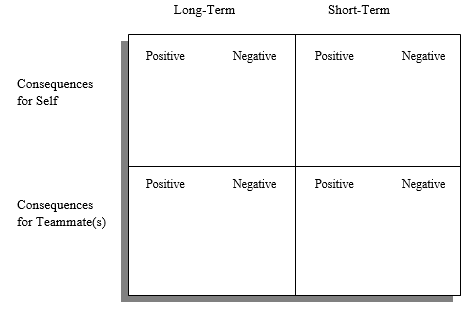
You will make better decisions if you focus on how the consequences of your actions affect your teammates.  While this is only one criterion which can and should be applied to any decision you make, it is an important one.  You begin by asking “What will happen to my teammate(s) if I act upon this decision?   Over time, such reflective thinking will become habit.


Decision-Making
-I should act on this decision.
-I should not act on this decision.
-I cannot decide at this time (Need more information, time, etc.)


Using this matrix will not guarantee that your decisions will be good ones.  However, the consideration of the consequences of a given decision in terms of one’s self and one’s teammates in the near and distant future should increase the probability that harm to relations and relationships can be avoided.
[thrive_leads id=’36827′]
Reflection and Discussion Questions

  • Do you agree with the idea that the best decisions are those that have the most positive consequences for you and your teammate? And that the poorest decisions are those that have the most negative consequences?  Give an example to explain your reasoning.
  • How do you know positive consequences will result from your action(s)? Inaction?
  • How do you know negative consequences will result from your action(s)? Inaction?
  • In which of the four quadrants would you find the most “immature” behavior? Why?
  • As a team member, how can you use this matrix to help your teammates make better decisions?

Article #2

The People Principle

Nothing is More Fundamental to Tap Human Potential than the Power of Relationships

Think about this: How often do your decisions and actions influence the direction of a student-athlete’s life? It’s an incredibly humbling thought, isn’t it? That a person’s life-direction can be guided by your views, your values, and your choices.

Simple truths are often overlooked, yet powerful in action. Nothing is more fundamental to tap human potential than the coach and player relationship—let’s call this **The People Principle.**

The People Principle, when applied, increases the utilization of human potential in the team and school settings, creating conditions that generate commitment to a meaningful experience. The skillful and authentic use, or neglect, of The People Principle can make the difference between change for the better or no change at all in the student-athlete.

As a coach, administrator, and educator of young student-athletes your ability to help them become their best is perhaps your greatest responsibility. Yes, you need to win to validate your coaching skills and abilities, but how do you know when you’re succeeding in developing future leaders and people of character? How do you nurture, challenge, and build young people up, equipping them to make a difference in the lives of the people they’ll interact with throughout their lives?

NEW RESOURCE FOR COACHES

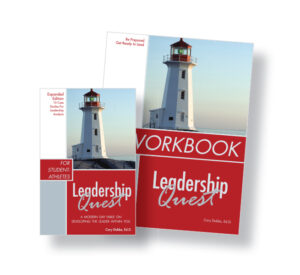
In Leadership Quest Dr. Cory Dobbs offers student-athletes a leadership fable that is engaging, instructive, and transformative. This book provides a simple, yet powerful, model of leadership that will build confident and effective team leaders for any sport. Using the power of storytelling, Leadership Quest presents a proven framework for student-athletes to follow and become exceptional leaders on the playing field and in everyday life. Leadership Quest advances an athlete-centered approach to developing the leader within each and every student-athlete.

Click here for more information on the: Leadership Quest Pack

About the Author

Dr. Cory Dobbs is a national expert on sport leadership and team building and is the founder of The Academy for Sport Leadership.  A teacher, speaker, consultant, and writer, Dr. Dobbs has worked with professional, collegiate, and high school athletes and coaches teaching leadership as a part of the sports experience.  He facilitates workshops, seminars, and consults with a wide-range of professional organizations and teams.  Dr. Dobbs previously taught in the graduate colleges of business and education at Northern Arizona University, Sport Management and Leadership at Ohio University, and the Jerry Colangelo College of Sports Business at Grand Canyon University.

  • « Go to Previous Page
  • Page 1
  • Interim pages omitted …
  • Page 76
  • Page 77
  • Page 78
  • Page 79
  • Page 80
  • Interim pages omitted …
  • Page 288
  • Go to Next Page »

Primary Sidebar

  • Twitter
  • Facebook
  • Linkedin
coachestoolbox
personaldevelopmenttoolbox
basketballplayerstoolbox
basketballtrainer
athleticperformancetoolbox
coachingbasketball

© Copyright 2026 Coaching Toolbox

Privacy Policy