• Skip to primary navigation
  • Skip to main content
  • Skip to primary sidebar

  • Basketball Plays
    • Ball Screen Sets
    • Horns Sets
    • Man to Man Post Up
    • Man to Man Isolations
    • Backdoor Plays
    • Man to Man 3 Point Shot Plays
    • 2-3 Zone Attack
    • Baseline Inbound Plays
    • Sideline Inbound Plays
    • Combination Defense Attack
  • Drills
    • Defensive Drills
    • Offensive Drills
    • Competitive Drills
    • Passing Drills
    • Rebounding Drills
    • Shooting and Scoring Drills
    • Toughness Drills
    • Transition & Conversion Drills
    • One on One Drills
  • Blueprint
  • Practice
  • Mental Toughness
  • Skill Development
  • Offense
  • Defense
  • Store

Doubling the Low Post Loyola Chicago

Doubling the Low Post Loyola Chicago

By Brian Williams on April 1, 2018

This article on the tactics used by Loyola Chicago to double team the low post was posted to the FastModel Sports Basketball Plays and Drills Library by Matt Wheeler.

Matt Wheeler has spent the last 10 years coaching in the Orlando, FL area.

For the last 6 seasons he was at Olympia High School where he spent time as assistant boys varsity coach, head girls varsity coach, and head boys varsity coach.

You can also find out more about FastModel Play Diagramming software by clicking this link: FastDraw

Some ideas for defending the low post if you have a lack of size.

They will usually bring the extra defender from one of three areas: from the top, from the baseline and from the closest perimeter player.

Skilled teams can make you pay for putting an extra player on the ball.

Passing it out of the double team will put the defense in outnumbered situations.

The Ramblers excel in rotating out of these situations to get matched up before the offense can make them pay.
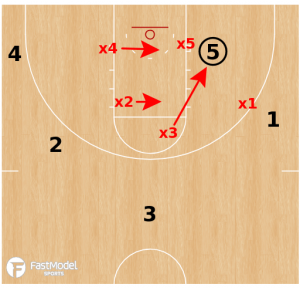
Doubling from the Top

x3 double teams 5 in the post.

x2 cuts to the nail

x4 cuts to the rim.
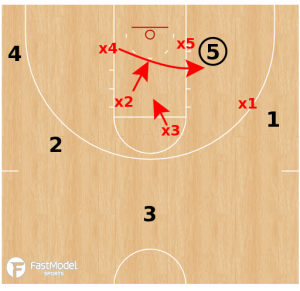


Doubling from the Baseline

x4 double teams 5 in the post.

x3 cuts to the nail

x2 cuts to the rim.
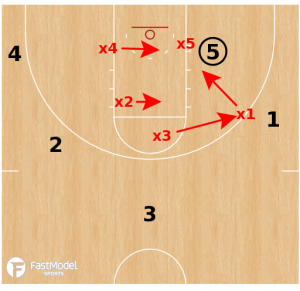


Doubling from the Closest Perimeter Player

x1 double teams 5 in the post.

x2 cuts to the nail

x4 cuts to the rim.

x3 rotates to take away the pass to the wing.
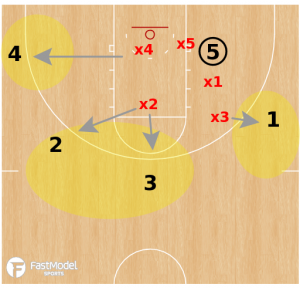
 

Defensive Responsiblities w/ No Cut to the Basket

x3 denies the pass out to 1.

x2 takes the first pass to the top.

x4 takes the furthest pass to the corner opposite corner.
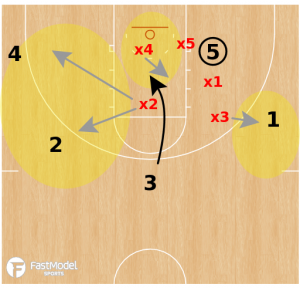


Defensive Responsiblities w/ Cut to Basket

x3 denies the pass out to 1.

x2 bumps the cutter then must close out on the two furthest passes.

x4 denies the cutter and protects the rim.


Traits of a Good Rebounder

By Brian Williams on March 25, 2018

This article was originally posted by Texas A&M Women’s Assistant Bob Starkey on his HoopThoughts basketball coaching blog.  You can see the original post and all of his other great coaching resources that he has posted at: Traits of a Good Rebounder

Maybe one of the most unglamorous parts of basketball is rebounding yet there is a direct correlation between rebounding and winning. Rebounding is also a great way for a player to create a niche for herself on a team. Maybe you can’t dribble the ball exceptionally well or possibly you’re not a good shooter – but if you live on the boards, the coach will find playing time for you.

First and foremost, let’s understand what a rebound represents – a possession! That’s critically important. It doesn’t matter if it’s a defensive rebound or an offensive rebound, you have just given your team a possession that they may not have otherwise received.

Excellent rebounding teams often win because they usually have a greater number of possessions than their opponent. It means they have more opportunities to scores while their opponents have less.

Excellent rebounding teams usually win because they shoot a higher percentage. They shoot better because they rebound which leads to fast break opportunities. They shoot better because they get second chance opportunities on the offensive glass which often leads to a follow up shot from close in.

Excellent rebounding teams usually win because they hold their opponents to a lower field goal percentage. They do this by keeping them getting out and running consistently. They also take away the second chance points on the opponent’s offensive end.

Excellent rebounding teams usually win because they get to the free throw line more. They get to the free throw line more because of extra possessions they create for themselves as well as the ones they deny their opponent. How many times do you see a fouling situation occur on a offensive rebound put back?

Excellent rebound teams usually win because they have more heart. It is heart that is a primary ingredient in good rebounding and if you have a big heart on the glass, then it is probably going to spill over to the defensive end of the court as well as the offensive end.

A big part of rebounding is obviously technique and certainly we are going to talk about methods of rebounding – both individually as well as a team. We will delve into offensive and defensive rebounding and the various methods that are used for maximum results. But first and foremost, we should look at the make-up of a great rebounder. The individual that excels in rebounding has a special blend of physical and mental characteristics that allows her help her team on the boards.

A good rebounder is a well conditioned athlete.
Rebounding is one of the most tiring phases of basketball if a player is truly committed to rebounding. The pace of the game already makes is a demanding game but the good rebounder is going hard to the glass on every shot – and over the course of the game, that’s a lot of shots. So the good rebounder is going to understand the importance of conditioning. She is going to work hard with the team during conditioning and probably do a little on her own as well. She must be tireless in her approach.

A good rebounder is physically strong.
Because the good rebounder knows she must sometime move through people as well as over them, she can appreciate the work she must do in the weight room. This doesn’t mean she has to be big and muscle bound but she knows she must have the strength necessary to hold off her opponent when she is blocking out. She’s going to work hard in the weight room, more than the average player and she’s going to do the extra push-ups. Strength is important on the boards and there no reason in today’s game that she can’t improve in that area.

A good rebounder is mentally and physically tough.
Going to the boards is a very demanding job. It gets extremely physical inside with a lot of bumping and pushing. Some players don’t mind going to the boards occasionally, but the good rebounder is tough and not only does she not mind the contact, but she relishes it. She loves not only to receive the contact but likes to dish a little out as well. Mentally she knows the importance of rebounding and she blocks out any aches and pains. Mentally she also makes sure the contact doesn’t go too far. She wants to bang with her opponent but not to the extent that she draws a foul.

Good rebounders are smart players.
You have to be smart to read the where the shot may fall off…especially one shot by your opponent. The smart player can anticipate when and where her own team will shoot. She makes mental notes on opponents and understands their tendencies in terms of how she best get around them and get to the backboard.

Good rebounders have a rebounding mentality.
I’ve never seen a good rebounder that didn’t think every shot was a miss. When the ball is shot, they know that ball is not going in and they follow it’s path and try to make a read as to where it will come off. Part of that special rebounding mentality is they have a great hunger to rebound. The good rebounder loves to rebound more than she loves to score.

Good rebounders are relentless.
Good rebounders have a strong desire to rebound – they are relentless. They go to the boards to try and grab the rebound. If they can’t grab the rebound, they are going to work as hard as they can to try and get their hand on the ball where the can tip to themselves or to a teammate. If they get bumped, they recover and keep going. If they get knocked down, they hustle up. They are not going to let anyone or anything stop from going to the glass.

Good rebounders love rebounding.

I’ve learned this from having the blessing of coaching one of the best rebounders I’ve been around – Anriel Howard.  This past season, and it’s not quite over, she set the Texas A&M single season rebounding record.  Despite only being a junior, she has become the all-time career rebounding here in Aggieland.  She also owns the NCAA Tournament record for rebounds in a game — 27!  And, please pay close attention — she is only 5 foot, 11 inches tall.  But if you watch her play and see her grab a rebound in traffic, or chase one down you will see the biggest smile on her face.  She genuinely loves rebounding.

Coach Don Meyer always had a saying, “It’s not what you teach, it’s what you emphasize.”  All coaches will readily agree to the importance of rebounding.  But how strongly are you emphasizing it on a daily basis?

One year at LSU, to commit to emphasizing rebounding, we decided to take the games leading rebounding to the post-game press conference after every game whether the press requested them or not.  The player could’ve shot 2 for 10 from the field and turned it over 4 times but if she let the team with 13 rebounds that game she was going to the press room.  It was are way of letting our team (and the media and fans) know that rebounding matters in a big way.

Do you break it down in drill from every day?

Are you pointing it out and holding players accountable in practice every day?

Do you have rebounding stats that players can see on a daily basis?

Do you watch specific video clips on rebounding?

As a coaching staff, what are you doing every day to commit to improving your rebounding?

Talls and Smalls Basketball Drills

By Brian Williams on March 22, 2018

This drill is from Mike Neighbors, Arkansas Women’s Basketball Coach.

The drill is available on the Arkansas Women’s Basketball You Tube Channel

Throwing it out as an idea to use for your summer practices and or skill development team workouts.

Please make sure your sound is on to see the video.

Click the play arrow to see the drill.

The drill is a YouTube video,

So you will need to be on a server that allows you to access YouTube to see the drill.

Mississippi State Competitive Defense and Rebounding Drill

By Brian Williams on March 22, 2018

This competitive defense and rebounding drill is coached by Mississippi State Coach Vic Schaefer.

At the time of this post, Mississippi State will has reached the Sweet 16 as a #1 seed in their region.

They ended UConn’s record consecutive win streak at 111 in the 201 Final Four.

There is sound with the video, so please make sure that your sound is on.

The video is hosted on You Tube, so you will need to be on a network that allows you to access that site.

The video is from the Championship Productions You Tube Channel

You will want to modify the drill to defend actions that your opponents run.

I like the fact that the defenders are moving to defend more in a game-like way than many rebounding drills I have seen.

Coach Schaefer calls the drill “Auburn.”

If you are interested in learning more about the Championship Productions Basketball Coaching Video (available in both DVD and Instant Video Format) that this drill came from, you can click the following link: 40 Minutes Baseline-to-Baseline Defense

The video is 5 minutes and 38 seconds long and shows this drill for the entire clip.

Rules vs. Standards

By Brian Williams on March 19, 2018

This article was contributed by:

Justin Matthew Brandt
[email protected]
CoachJB.weebly.com
Here is a link to his YouTube channel
Here is a link to his Instagram

I have been asked on multiple occasions on what my rules for my classroom or team are. My response is always the same, we do not have rules, we have standards. From reasoning to prescription practices, you will be able to decide for yourself which one is actually more beneficial after digesting the information provided below.

There are major differences between the two terms, even in their simplest of forms, the definitions. Provided below are the results for the two words if you were to search for them on Google.

Rule – one of a set of explicit or understood regulations or principles governing conduct within a particular activity or sphere.

Standard – a level of quality or attainment. An idea or thing used as a measure, norm or model in comparative evaluations.

By definition alone you can see that rules are very forceful and demeaning. In fact, if you were to reference a thesaurus for synonyms for words used in the definition, you would also find words such as “command”, “controlling” and “dominant”. Individuals are forced to bow DOWN and abide by a set of rules they may not even agree with. On the contrary, if you did a similar search for standards you would find words such as “character”, “individuality”, “genius”, and “virtue”. In this case, individuals rise UP in the situation to increase their likelihood of success. Thus, by definition alone, rules are negative, while standards are positive.

During an interview, Coach Mike Krzyzewski once described his reasoning for use of standards instead of rules by stating…

“When I was at West Point, we had a bunch of rules, all of which I didn’t agree with. Usually when you’re ruled, you never agree with all the rules, you just abide by them. But if you have standards and if everyone contributes to the way you’re going to do things, you end up owning how you do things.”

Take a moment to reflect upon this statement with the provided example. You are abiding by the rules just because it’s what you are supposed to do. So instead of running the floor with reasoning, maybe because the team you are playing against enjoys slowing the pace, you jog because it’s January and you are tired of running due to the rule. Or, my favorite, for the purpose of “because I said so”. Sound familiar?
Unfortunately, the reasoning provided above is far from being bizarre or a foreign concept. Knowing the why is the first step to buying into anything! You rarely spend your money on products without any reasoning behind it, why would you spend your time, something that has no return policy, on buying into a rule that makes no sense to you?

I’ll answer this one for you…you wouldn’t! What makes you think that your athletes will? Here are the positives and the negatives of changing this ONE statement. Negatives, you are no longer able to be lazy and some of your views that you thought were good, may actually reveal themselves to be bad. Positives, you and everyone else involved will gain perspective and reasoning, you will work harder, you will increase your program’s comprehension and you will eliminate bad habits/mentalities that were potentially holding you back. All by simply providing reasoning and answering the why.

While knowing the why is the first step when it comes to buying into anything, that does not mean it stops after day one. You will have to continue to reinforce the why on a regular basis. Your standards should also be relevant, realistic, have background data to support them, be developing and have consequences.

Relevant. The easiest way to make standards relevant is to gain input from your athletes. It is very easy to look up standards from other great teams and attempt to implement them. However, as Coach K said before in his interview, “if everyone contributes to the way you’re going to do things, you end up owning how you do things.” Ownership cannot be understated. When people don’t live up to the standards that they put into place, you can hold them accountable for both the decision they made to set the standard and the decision they made to not live up to it. Coaches, support staff and athletes alike.

Realistic and Background Data. I put these two in the same section because they work harmoniously. Your standards must be realistic for your players to live up to. If your team is young and struggling with turnovers, don’t set your standard to zero turnovers. It’s unrealistic to expect someone to go from 10 turnovers in a game to none. You wouldn’t expect a beginner weightlifter to squat two and half times their body weight, so why should your basketball player be any different? With that, you must provide some background data not only to hold them accountable, but to provide them with a standard to live up to.

The best example I can provide is drill work. One drill we do consists of athletes getting two jump shots and a lay-up in during one trip down the floor. It is a continuous transition drill that lasts three minutes long. Each year our standard is set by the numbers they achieve while running through the drill. If they don’t live up to the standards there is a consequence. The JV players and Varsity players have different standards. However, they are given the standards that are used for local collegiate programs as well. This leads into developing.

Developing. Once your players reach the standard consistently, it is time to raise the bar. In doing so, you promote a growth environment as opposed to a simple living at status quo. But remember to keep it realistic. What does that look like? If your team’s standard for “shooting drill A” is 13 and they reach 15, then the new standard is 15. If your squat workout this week is 3×10 at 200lbs, next week it’s 4×10 at 200lbs or 3×10 at 205lbs.

Consequences. While it is the least favorite portion of most people’s programs, consequences are essential to growth. You can talk goals, rules or standards until you’re blue in the face, but if there’s nothing there to hold you accountable afterwards, the majority of the population will continue to come up short. However, like your standards, make sure that your consequences are realistic and appropriate. The days where coaches make their student athletes run 30 suicides because they missed one free throw should be long gone. ESPECIALLY, if you have a coaching philosophy of running and scoring in transition. By punishing athletes with running, they associate running with a negative consequence. Do not make punishments as you go, have them predetermined, this way your emotions from the situation don’t dictate what happens in the moment.

The quick summary… Standards are instinctively more positive than rules. Rules encompass negative connotations and empower the coach/supervisor while standards inspire everyone in the program to contribute/grow their level of excellency. In order to set standards, you should be able to answer the why, make them relevant, realistic, have background data to support your standards, make sure they are always developing and growing and you MUST inforce consequences. The question you have to ask of yourself, staff and athletes now is, what standards do you want to set in order to raise your level of excellency?

Cincinnati Bearcats – 3 Low BLOB

By Brian Williams on March 18, 2018

This baseline inbound play run by Cincinnati (coached by Mick Cronin at the time) and was posted to the FastModel Sports Basketball Plays and Drills Library by Tony Miller.

Tony is the men’s assistant basketball coach at Bob Jones University in Greenville, SC.

You can also find out more about FastModel Play Diagramming software by clicking this link: FastDraw

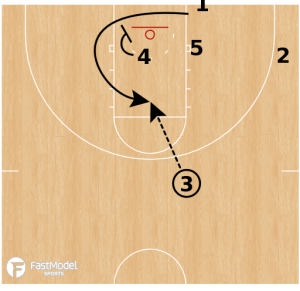
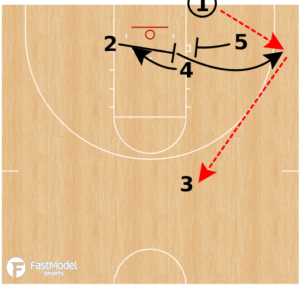
These guard-to-big and big-to-guard screens will create mismatches when defenses switch or open shots when screen defenders “show” on offensive players receiving screens.


Cincinnati Bearcats – 3 Low BLOB


2 sets a back screen for 4.

5 sets a cross screen for 2.

1 passes to 2 for the shot.


If no shot, 2 passes to 3.

4 sets a down screen for 1.

1 curls or flares for a pass from 3.


  • « Go to Previous Page
  • Page 1
  • Interim pages omitted …
  • Page 69
  • Page 70
  • Page 71
  • Page 72
  • Page 73
  • Interim pages omitted …
  • Page 288
  • Go to Next Page »

Primary Sidebar

  • Twitter
  • Facebook
  • Linkedin
coachestoolbox
personaldevelopmenttoolbox
basketballplayerstoolbox
basketballtrainer
athleticperformancetoolbox
coachingbasketball

© Copyright 2026 Coaching Toolbox

Privacy Policy