• Skip to primary navigation
  • Skip to main content
  • Skip to primary sidebar

  • Basketball Plays
    • Ball Screen Sets
    • Horns Sets
    • Man to Man Post Up
    • Man to Man Isolations
    • Backdoor Plays
    • Man to Man 3 Point Shot Plays
    • 2-3 Zone Attack
    • Baseline Inbound Plays
    • Sideline Inbound Plays
    • Combination Defense Attack
  • Drills
    • Defensive Drills
    • Offensive Drills
    • Competitive Drills
    • Passing Drills
    • Rebounding Drills
    • Shooting and Scoring Drills
    • Toughness Drills
    • Transition & Conversion Drills
    • One on One Drills
  • Blueprint
  • Practice
  • Mental Toughness
  • Skill Development
  • Offense
  • Defense
  • Store

Angle 3 on 3 Drill

Angle 3 on 3 Drill

By Brian Williams on November 12, 2018

3 on 3 Drill was posted to the FastModel Sports Basketball Plays and Drills Library by Mike Shaughnessy of Dr1ven Training and Stockton University.

You can also find out more about FastModel Play Diagramming software by clicking this link: FastDraw

Angle 3v3

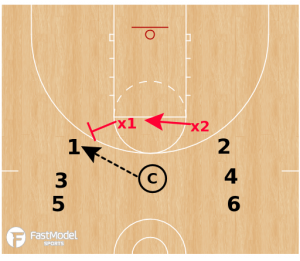
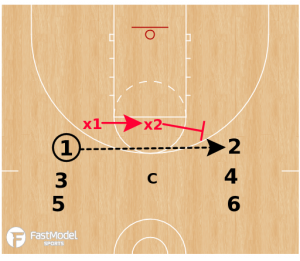
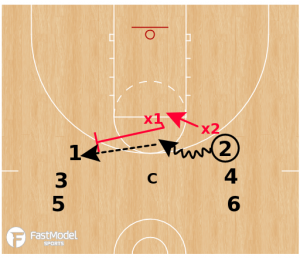
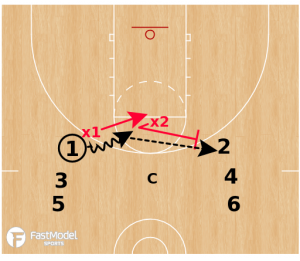
Advantage/Disadvantage 3v3 putting the offense in a position to make a quick decision out of drive and kick while making the defense provide great helpside defense to contain the offense.

Description:

  • Player 1 starts the drill once they make their movement downhill.
  • Player x1 can’t move to try and recover until player 1 starts their movement.

Rules:

  • Player 1 has to attempt to get downhill through the elbow.
  • Player’s 2 & 3 have to relocate once player 1 attacks downhill. (* If 1 passes early before the elbow [kick ahead], player in the strong side corner can hold the spot being shot ready).
  • If the ball sticks and movement becomes stagnant, it will result in a turnover for the offense.
  • Hold players accountable to re-space with urgency after a drive and kick-out.

Goals:

  • Play drive & kick game until the 3 players on offense are able to creat a rhythm shot, downhill drive to the rim, or a one more pass for a catch and shoot.
  • Score it, you keep it. Play to a certain amount of points or time.
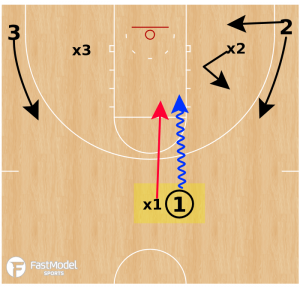
 

– Player 1 starts in the slot (shoulders facing the basket).

– Player x1 starts on player 1’s hip with their chest facing the inside shoulder.

– Player’s 2 & 3 start in the corners.
Dealing with Foul Trouble

By Brian Williams on November 7, 2018

Some thoughts to stimulate your thinking on dealing with foul trouble.

DEALING WITH FOUL TROUBLE

As basketball coaches we will inevitably face the dilemma of what to do when our impact players get in foul trouble.

 We’re talking about offensive IMPACT PLAYERS; individuals we NEED in the game on offensive possessions for scoring, playmaking, ball handling or rebounding.

Here are some ideas to consider:

Do we sit a player with two fouls until the beginning of the second half, or do we keep him in the game and take our chances of him picking up a third foul and then sit him until toward the middle or end of the second half?  What if we sit him, then as soon as we put him back in, he picks up another quick foul…do we decide to sit him again?

After the game is over we will evaluate what we did and figure out if it was the right call or not.  Too often we only know if we made the right decision after the game is over. This is why we call this a dilemma; It is hard to know what to do.

Here is an idea that we have used with good success; sit a player with 2 fouls in the first half or 3 fouls in the second half – until your team gets in the bonus, then sub him “offense/defense” (the rest of the half with 2 fouls in the first half, until the last 8 minutes of the game with 3 fouls in the second half.  If the player picks up his 4th foul, sub offense/defense the last 3 min of the game)

Offense/defense substitution; sub your foul plagued player in the game on dead-ball offensive inbounds possessions and sub him out on dead-ball defensive inbounds possessions.  ALSO, use free-throw situations; sub him in on opponent free-throws and sub him out on your free-throws, if he is shooting the free-throw(s), sub for the shooter and hope he makes his final free-throw attempt.

When any of our impact players picked up their second foul in the first half or their third foul early in the second half we would always make getting in the bonus as quickly as possible a top priority.  This would involve running offenses designed to draw reaches on drives, use lift (shot) fakes and always go up for shots off two feet in the paint – especially in traffic. If we have a player who has a knack of drawing fouls, we would try to get the ball in his hands as much as possible.

If we decided to keep a player in the game who picked up a first half second foul or second half third foul, we would let him know that he was coming out of the game for an extended strategic period of time as soon as he picked up his next foul.

of course all these decisions are dependent on how the game is going; if you’re winning or losing and by how much.  Not all chess matches are the same!

Other ideas to consider 

When a big man is in foul trouble:

  • Use defensive schemes which reduce the chances of the ball getting to the low or high post
  • Use “double down” techniques when the ball does go to the high or low post
  • Teach your guards how to defend the drive so your bigs don’t have to pick up fouls on guard penetration.
  • Don’t use a big man in foul trouble to set ball screens (especially if the reffs have called any bad screens earlier in the game)
  • On selected defensive possessions; consider using different zone defensive alignments to protect your bigs

When guards get in foul trouble:

  • Consider switching defensive assignment of the guard in foul trouble on to a player who he is less likely to foul
  • Consider using different zone defensive alignments on selected defensive possessions

Teach your players not to leave their feet and not to reach, make sure they understand and can use individual and team defensive CONTAINMENT techniques

IN REGARD TO FOUL TROUBLE STRATEGY; DISCUSS ALL THE STUFF YOU MIGHT HAVE TO DO ON THIS TOPIC WITH YOUR TEAM AHEAD OF TIME SO THEY KNOW AND UNDERSTAND WHAT TO EXPECT. ALSO TEACH THEM HOW TO STAY OUT OF FOUL TROUBLE.

“It’s not what I know, it’s what my players know…… It’s not what my players know, it’s what my players DO!”

We hope these ideas on dealing with foul trouble have been helpful, it is an area of the game that all coaches will face at one time or another.

Cincinnati’s Open Defensive Stance

By Brian Williams on November 5, 2018

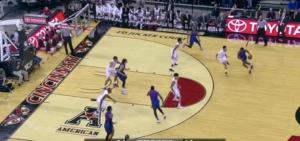
Army Men’s Assistant Coach Zak Boisvert has assembled some clips of Cincinnati’s Open Stance man to man defense technique under Coach Mick Cronin. Coach Cronin is now at UCLA.

Zak has an outstanding site with posts on various coaching topics at www.pickandpop.net

His YouTube channel has several videos with various types of man to man plays, zone sets, and inbounds plays as well as clips on various defensive coverages.

You can subscribe to receive an update when he posts a new video Zak Boisvert You Tube Channel

You can follow him on Twitter at this link: @ZakBoisvert

Click play to see the video

There are subtitles with the video.

This is a YouTube video, so you will need to be on a server that allows you YouTube access.

2 Sprints, 2 Stunts, Live

By Brian Williams on November 2, 2018

This 4 on 3 Scramble Defensive Drill was posted to the FastModel Sports Basketball Plays and Drills Library by Matt Wheeler.

Matt Wheeler has spent the last 10 years coaching in the Orlando, FL area.

For the last 6 seasons he was at Olympia High School where he spent time as assistant boys varsity coach, head girls varsity coach, and head boys varsity coach.

You can also find out more about FastModel Play Diagramming software by clicking this link: FastDraw

This competitive defensive drill focuses on closeouts, sprinting to help, and stunting at the ball.

To add a communication component to it, require the defenders to say “I Got Ball” on the closeouts and “Help” when they are in help. The defense must defend and communicate four passes perfectly then they can play live 2v2. On the first two passes, the defenders sprint to help/closeout. On the third and fourth pass the defenders stunt at the ball as it is driven at them, then sprint to closeout/help.

Use defense scoring in this drill. If the defense gets a stop they get a point and they stay on defense against the next team. If the defense doesn’t communicate, sprint to help, close out correctly or they get scored on, they immediately lose and go to the end of the line and the offensive team goes to defense.


Coach passes to 1.

x1 closes out on 1.

x2 sprints to help.


1 passes to 2.

x2 closes out on 2.

x1 sprints to help.


2 dribbles at x1.

x1 stunts at the ball.

2 passes to 1.

x1 closes out on the ball as x1 sprints to help.


1 dribbles at x2.

x2 stunts at the ball.

1 passes to 2.

x2 closes out on the ball as x1 sprints to help.

Play is now live 2 on 2.

4 on 3 Scramble Defense Drill

By Brian Williams on November 2, 2018

This 4 on 3 Scramble Defensive Drill was posted to the FastModel Sports Basketball Plays and Drills Library by Matt Wheeler.

Coach Wheeler has coached at Florida A&M, Daytona State, and Olympia High School as an assistant boys varsity coach, head girls varsity coach, and head boys varsity coach.

You can also find out more about FastModel Play Diagramming software by clicking this link: FastDraw

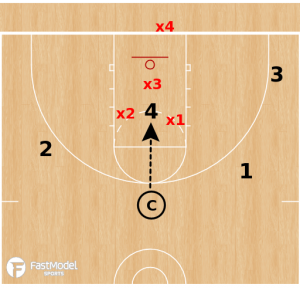
This defensive drill works on defending scramble situations when the defense is temporarily outnumbered. Once the ball is entered the drill is live and the offense tries to score 4v3. The 4th defender can enter play after 7 seconds or after a shot is taken. The three initial defenders will not have a match-up, but whoever is closest to the ball must pick it up as they buy time for the 4th defender to get on the floor.

To add a communication component to the drill, require defenders to say “I Got Ball” when they closeout on the ball so they don’t accidentally get two defenders on the ball. If a defender is in a situation where they are guarding two people, have them say ” I Got Two.” The 4th player enters the floor going furthest from the ball. They must communicate who they are guarding and tell their teammates where to match up so they can get out of the scramble situation.


The offense starts with 3 players on the perimeter and 1 and in the paint.

Coach passes to 4 in the paint.

All 3 defenders look to strip the ball from 4.


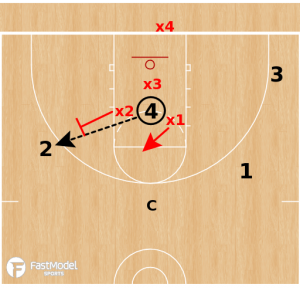
4 passes to the perimeter and the offense plays live 4 on 3.

The defense must scramble and obtain new matchups as the ball moves.

The 4th defender enters play seven seconds after the ball is passed to the perimeter.

Make sure that your sound is on and that you are on a server where you can access YouTube to watch the video below.

Do your basketball players have Valgus Knees?

By Brian Williams on October 31, 2018

By Jon Sanderson MS, CSCS, MSCC, USAW, NASM-CES, TPI, FMS

Head S&C Coach Michigan Basketball

What is a valgus knee?

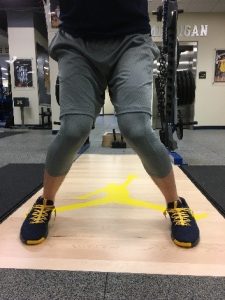
A valgus knee position is when the femur internally rotates and collapses inward.

It is also commonly referred to as knock knees.  (See Diagram 1 Below)

Why is this a concern?

Studies show there is a link between athletes that exhibit valgus tendencies and knee injuries, specifically ACL tears.

Also, athletes that have Valgus knees are typically less efficient in movement skills

Diagram 1

Who is at risk?

There are more than 120,000 ACL injuries in high school and college athletes per year. 

Research shows that females are 4-8 times more likely to tear an ACL than their male counterparts. 

However, this does not exclude male athletes.  They too are susceptible to this injury.

Below are a few exercises that are recommended to improve Valgus Knee dysfunction:

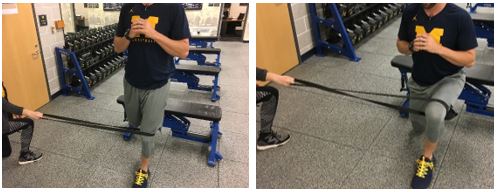
RFE Split Squat w/ Band RNT

(See Diagram 2)

Diagram 2

Elevate the back leg and descend down into a squat.  A coach or partner should be pulling the band so the knee is being pulled inward.  The goal is to resist the inward movement and maintain a neutral knee while executing each rep.

Diagram 3


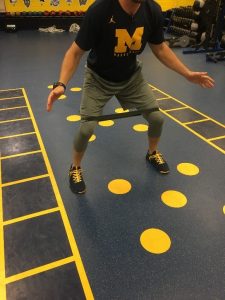
Band Defensive Slide

(See Diagram 3)

With the Band around the knees slide in a defensive position, typically 10 yds down and back would equal a set.


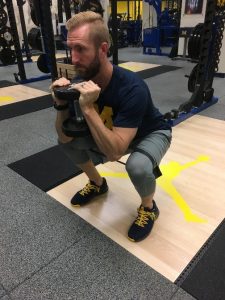
Goblet Squat w/ band around knees

(See Diagram 4)

With a band placed around the knees execute the goblet squat emphasizing a neutral knee (don’t let the band pull your knees inward)


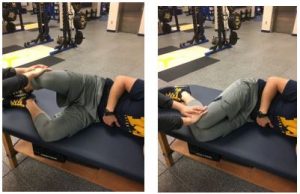
Manual Clams

(See Diagram 5)

Assume the clam position, laying on your side. 

Have a partner apply steady pressure downward as the hips open and close.


If interested in the Camp Sanderson S&C program powered by Blueprint Athletes App


Apple Phones   https://apple.co/2FYcJ00

Android Phones   https://play.google.com/store/apps/details?id=com.blueprintathletes.android

Jon Sanderson has been the head strength and conditioning coach for the University of Michigan men’s basketball team since 2009.

Regarded as one of the basketball strength and conditioning coaches in the business, Sanderson is the only strength and conditioning coach in NCAA history to participate in a Final Four as a player (Ohio State in 1999) and a coach (Michigan in 2013 & 2018).

Before joining the Michigan staff, Sanderson spent three years (2006-09) working at Clemson as the men’s and women’s basketball strength and conditioning coach, as well as the director of the Littlejohn Coliseum weight room. During Sanderson’s time at Clemson, the men’s basketball team won 20 or more games for three straight seasons — a first in program history. Also, during those three seasons, only North Carolina and Duke had more wins than Clemson in the ACC.

Prior to his time at Clemson, he served as the head strength and conditioning coach and sports nutrition coordinator for Olympic sports at Marshall University (2003-06). Before heading to Marshall, Sanderson was a strength and conditioning intern at North Carolina, working with the men’s basketball program (2002-03).

Throughout Sanderson’s career with the U-M basketball program, he has trained 11 student-athletes that have gone on to play professional basketball in the NBA, including MDarius Morris, Manny Harris, Tim Hardaway, Jr., Trey Burke, Nik Stauskas, Mitch McGary, Glenn Robinson III, Caris LeVert, D.J. Wilson, Derrick Walton, Jr. and Moritz Wagner.

  • « Go to Previous Page
  • Page 1
  • Interim pages omitted …
  • Page 57
  • Page 58
  • Page 59
  • Page 60
  • Page 61
  • Interim pages omitted …
  • Page 288
  • Go to Next Page »

Primary Sidebar

  • Twitter
  • Facebook
  • Linkedin
coachestoolbox
personaldevelopmenttoolbox
basketballplayerstoolbox
basketballtrainer
athleticperformancetoolbox
coachingbasketball

© Copyright 2026 Coaching Toolbox

Privacy Policy