• Skip to primary navigation
  • Skip to main content
  • Skip to primary sidebar

  • Basketball Plays
    • Ball Screen Sets
    • Horns Sets
    • Man to Man Post Up
    • Man to Man Isolations
    • Backdoor Plays
    • Man to Man 3 Point Shot Plays
    • 2-3 Zone Attack
    • Baseline Inbound Plays
    • Sideline Inbound Plays
    • Combination Defense Attack
  • Drills
    • Defensive Drills
    • Offensive Drills
    • Competitive Drills
    • Passing Drills
    • Rebounding Drills
    • Shooting and Scoring Drills
    • Toughness Drills
    • Transition & Conversion Drills
    • One on One Drills
  • Blueprint
  • Practice
  • Mental Toughness
  • Skill Development
  • Offense
  • Defense
  • Store

Top 20 Basketball Training Mistakes

Top 20 Basketball Training Mistakes

By Brian Williams on May 22, 2019

This post was written by Nick Bartlett and originally posted on the Dr . Dish Basketball Blog

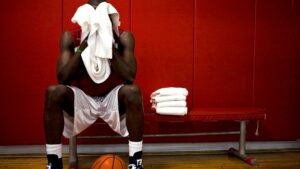
While there are many hard workers out there, there are still many pet peeves of mine when it comes to basketball training. Admittedly, I committed many of these myself when I was a player. Now I cringe every time I see these mistakes from players today.

These mistakes are also committed many times during the season and in practice! Often times, basketball coaches are just as culpable as their players.

Avoid these mistakes and ALWAYS train with a purpose behind everything you do. That is what we we’re all about at Dr. Dish Basketball – whether you’re training with our machines or not!

Thankfully, Dr. Dish machines with our Skill Builder addresses many of these mistakes head-on! For pricing information, fill out this form.

1. Not having a goal

The best players know exactly what their goal is when they get to the gym. Whether it’s getting up 500 shots, 200 makes, or 15 minutes of purposeful ball-handling, great players have a goal before they go to work.

2. Not having a plan

Much like having a goal, always have a plan when you get into the gym. What are you specifically going to work on to get better today? Be able to answer that question before starting your workout. Always train with purpose.

3. No accountability

Whether it’s having a coach, parent, teammate, or even yourself keep you accountable, it’s essential to push yourself to hit your goals and stick by your word. If you committed to making 500 shots a day and you only made 200 yesterday, you better make 800 today. That’s the mindset that separates good from great.

4. Not being coachable

Never think you know everything. Listen to your coach and implement the suggestions he/she gives. I can’t stand players that don’t want to be coached or think they are smarter than their coach.

5. Not catching ready to shoot

Always catch shot-ready. It always makes me cringe to see players catch the ball standing straight up and down AND THEN start their shooting motion. You won’t have time to that in a game so don’t practice it that way!

6. Not diversifying your workout

Catch and shoot shots are great for warming up and getting into a good rhythm. And yes, it’s great if you can get up 500 shots in a workout. But, if they are all catch and shoot shots, you’re grooming yourself to be a one-dimensional player. Work on pull ups, finishing, and off-the-move shots as well. Game shots, game spots, game speed.

7. Not training at game speed

Again, taking rhythm shots is great for locking in your form, but I can’t stand watching players take a couple hundred shots and then calling it a workout. Train like you’re in the game under game-like conditions!

With the integrated Polar Heart-Rate monitor paired with Dr. Dish, you can now track player intensity!

8. Not training in an athletic stance

Much like training at game speed, everything you do should be in an athletic stance. It’s hard to watch players “attack” the basket while barely getting low or doing ball-handling drills standing straight up. Get used to playing low and in a stance.

9. Being afraid to make mistakes

I always encourage players to push themselves to the point where they are making mistakes. If you’re scared of making mistakes, you won’t get better. If you’re making mistakes you’re pushing your limits. That’s a good thing!

10. Taking no warm up shots

One of my biggest pet peeves is watching players step on the court, grab a ball, and immediately start jacking up long 3 pointers. Work your way out there. Even the best players in the world start right under the basket and gradually work their way back.

11. Practicing things you’ll never do in games

It’s always frustrating watching players work on things that don’t apply to their game. This could be a post player working on his 25 foot jumper when 80% of his shots in a game are from the paint or a point guard working on his hook shot down low.

12. Spending significant time working on dunking (or trying to dunk)

I’m all for working on finishing moves, but time spent trying to dunk could be used working on valuable skill development. Don’t be the player who can throw down sick dunks but has no jumpshot, handles, or relevant basketball skill.

13. Focusing on time in the gym instead of purpose and quality

One of my biggest pet peeves is listening to players talk about how they spent HOURS in the gym working out. This tells me they spent a majority of it NOT working out. Focus on training with purpose. Get in, put in the work, and get out.

14. Spending more time talking/Twitter-ing than training

One of the biggest reasons many players spend so much time on the court is because they’re busy “Tweeting” or “Instagraming” their workout to prove they’re working hard. I’m all for a quick post, but I can’t stand players doing a quick drill and immediately going to their phone for 15 minutes before starting the next drill. Everyone will know what kind of a worker you are when you prove it on the court during game-time.

15. Not tracking progress

How will you know if you’re improving if you don’t track your progress? Establish your goals with your workout and specific drills and then push yourself to reach them. You will see the progress you’re making which will then motivate you even more.

16. No consistency

One great workout to begin the week is a good start. But in order to see serious improvement, you have to develop consistency. Make sure you’re doing something every day to make yourself better than yesterday. 1% better every day.

17. Not pushing to fatigue factor

For example, shooting 100 free throws is great. But to best prepare for game-like conditions, you must train with a fatigue factor. While shooting free throws when you’re not tired is important to find your rhythm, it’s essential that you prepare for game-like conditions as well. Since you shoot free throws when you’re tired in games, that’s how you should practice them.

18. Casual shooting

This is probably my #1 pet peeve when it comes to basketball training. Players that spend a half hour shooting around casually with no purpose and no routine don’t get better. In many cases they actually develop bad habits and can actually become worse. You can always focus on these 3 C’s when shooting to avoid casual shooting.

19. Only working hard when others are watching

The best players don’t need a coach or parent watching for them to work hard. I never understood why players would turn on an extra gear only whenever a coach was watching. Even if you have to pretend Coach K is in the gym with you every time, give 100% regardless if anyone is there or not.

20. Quitting when things get tough

I’ve been there. Some days just don’t go your way. You’re tired, your jumpshot isn’t falling, your handles aren’t nearly as tight as they usually are. If your solution is just to pack it up for the day, how do you expect to improve? When things get tough, true competitors push themselves even more and NEVER quit.


Make sure you’re aware of these 20 basketball training mistakes. Each one of these is committed every day and many times players have no idea they are doing anything wrong. Don’t take the easy way out. Train with purpose and focus on efficiency!

What else did I miss in this list? Let us know in the comments or via Facebook or Twitter!


Ready to upgrade your training equipment? See why a Hall of Fame Coach chooses Dr. Dish!
Why a Hall of Famer Chooses Dr. Dish

50 Passes Drill

By Brian Williams on April 11, 2019

This passing drill was contributed by Matt Wheeler, Olympia High School (Orlando, FL), to the FastModel Sports Basketball Plays and Drills Library.

This is what Coach Wheeler had to say about the play:

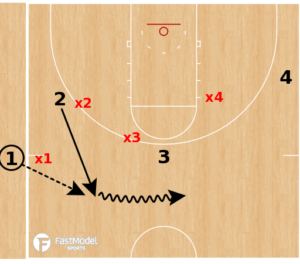
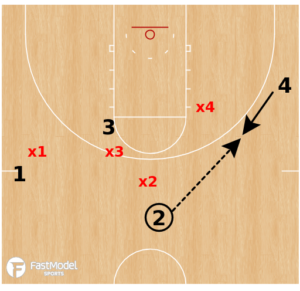
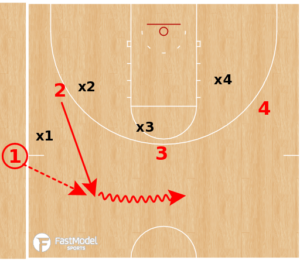
50 passes is a competitive team drill that focuses on ball toughness, passing, screening and communication. The goal of 50 passes is to be the first team to successfully complete 50 passes without getting the ball deflected and having the passer say the name of the person they are passing to. Eliminating dribbles after the first pass increases the pressure that the defense can put on the offense, making it more difficult to complete the passes. Requiring the passer to say the name of the receiver helps to build good communication habits while under duress.

You can also find out more about FastModel Play Diagramming software by clicking this link: FastDraw

Editors’s Note from Brian. Like many drills that you use to isolate a specific skill, it also has drawbacks.

I like the fact that not dribbling forces the players to screen and cut hard away from the ball to get open. It also gives players with the basketball practice in being strong, faking passes, passing away from the defense, and pivoting.

The negatives, I see are that:

1) Players can get out of the habit of looking at the basket on the catch.
2) Looking to pass and not score
3) The movements you will see are probably not your offensive principles
4) Defense could develop bad habits of gambling for steals and getting out of position.

I see great value in emphasizing passing over dribbling and cutting to get open. So, I think it is worth adding additional rules for the drill such as allowing the offense to score and counting it towards the 50 point total, counting not looking at the basket on a catch as a turnover, running your offensive scheme in the drill (you will have a some situations each game when a dribble is picked up and the offense breaks down anyway), and requiring a player to pass to another teammate than just passed to them (unless it is a give and go.)

I know your staff could come up with other rules if you see value in working to develop the toughness to complete 50 contested passes and catches.


The first team to 50 passes wins.

The first offensive player with the ball on the court gets unlimited dribbles until they make a pass.

After the first pass no dribbles are allowed.


In order for a pass to count towards the total.

– Pass is not tipped by the defense

– Passer calls the name of the receiver while passing


On turnovers, change possession and start with an inbounds pass.


Below is a short YouTube demonstration of the drill. The play is not perfect in the drill, but is is probably similar to what many teams will look like as they are learning the drill.

Gauntlet Shooting Drill

By Brian Williams on April 7, 2019

This drill and concepts are provided by our partners at Dr. Dish Basketball.

Like all drills that you see, you can either modify it or take parts of the drill for your use and your needs.

You can develop your own timing and scoring system and change the cuts and shots to match what you will do in your offensive system.

Please make sure your sound is on to see the video.

Click the play arrow to see the drill.

These drills are YouTube videos, so you will need to be on a server that allows you to access YouTube to see the drill.

Michigan Wolverines Loop Down Flare BLOB

By Brian Williams on March 27, 2019

This baseline inbound play was contributed by Justin Cellars, Men’s Assistant Basketball Coach at Lamar Community College, to the FastModel Sports Basketball Plays and Drills Library.

The play was run by the Michigan Men’s Team when John Beilein was the coach.

You can also find out more about FastModel Play Diagramming software by clicking this link: FastDraw

My intent with the posts that I make is not to say that the play should be run as it.

The hope is that you will get some ideas of ways that you can add or change what you currently do that will fit your personnel, your philosophy, and your system.


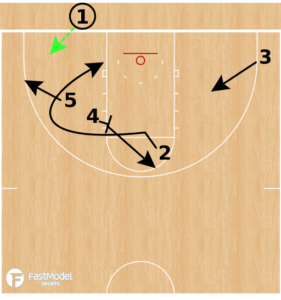
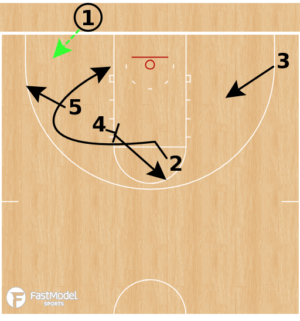
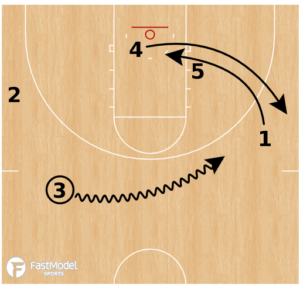
2 walks his defender in and cuts around 4 and 5 to the middle of the lane.

As 2 gets around 5, 5 will pop out for the entry short corner.


1 receives a hand-off from 5 and dribbles out.


As 1 begins to dribble up after receiving the hand-off, 3 is sprinting into a flare screen for the 4.

5 is setting a down screen for 2 sprinting out corner.


Louisville Women Box Loop Elevator

By Brian Williams on March 27, 2019

This man to man play was contributed by Dave Nedbalek, Assistant Men’s Basketball Coach at The University of Texas at Tyler, to the FastModel Sports Basketball Plays and Drills Library.

These are Coach Nedbalek’s comments on the play.

The Louisville women’s basketball team is a 1-seed in the NCAA Tournament.

Coach Jeff Walz runs some terrific box sets.

This is a really good three point set, that also features the ability to throw the ball inside.

They ran this in their second round game against Michigan.

You can also find out more about FastModel Play Diagramming software by clicking this link: FastDraw

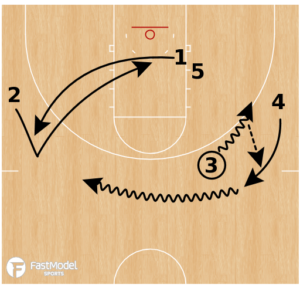
5 and 4 set a double stagger screen

2 loops/curls back to the block

3 comes off the double stagger

1 passes to 3.


4 and 5 set an elevator screen

2 cuts through the elevator screen

3 passes to 2

5 and 4 split (5 to post | 4 pops to three)

Ohio State Weave Euro Chase

By Brian Williams on March 27, 2019

This man to man play was contributed by Dave Nedbalek, Assistant Men’s Basketball Coach at The University of Texas at Tyler, to the FastModel Sports Basketball Plays and Drills Library.

This is what Coach Nedbalek had to say about the play:

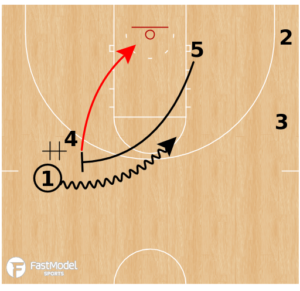
This set involves a great amount of false motion that can easily be used to create scoring opportunities if you look to exploit any missteps. Have your players not rush the backdoor cuts especially on the weak side opposite of the big as this is a viable scoring cut.

If there are any miscues on the hand offs the ball handler can easily fake the handoff and have a wide open lane to the rim.

There are lot of great counters you could run out of this such as turn the last backdoor cut into a smash cut or even cross screen for a throwback post feed.

You can also find out more about FastModel Play Diagramming software by clicking this link: FastDraw


  • « Go to Previous Page
  • Page 1
  • Interim pages omitted …
  • Page 51
  • Page 52
  • Page 53
  • Page 54
  • Page 55
  • Interim pages omitted …
  • Page 288
  • Go to Next Page »

Primary Sidebar

  • Twitter
  • Facebook
  • Linkedin
coachestoolbox
personaldevelopmenttoolbox
basketballplayerstoolbox
basketballtrainer
athleticperformancetoolbox
coachingbasketball

© Copyright 2026 Coaching Toolbox

Privacy Policy