• Skip to primary navigation
  • Skip to main content
  • Skip to primary sidebar

  • Basketball Plays
    • Ball Screen Sets
    • Horns Sets
    • Man to Man Post Up
    • Man to Man Isolations
    • Backdoor Plays
    • Man to Man 3 Point Shot Plays
    • 2-3 Zone Attack
    • Baseline Inbound Plays
    • Sideline Inbound Plays
    • Combination Defense Attack
  • Drills
    • Defensive Drills
    • Offensive Drills
    • Competitive Drills
    • Passing Drills
    • Rebounding Drills
    • Shooting and Scoring Drills
    • Toughness Drills
    • Transition & Conversion Drills
    • One on One Drills
  • Blueprint
  • Practice
  • Mental Toughness
  • Skill Development
  • Offense
  • Defense
  • Store

Iverson Ghost Throwback ATO

Iverson Ghost Throwback ATO

By Brian Williams on May 11, 2020

This man to man after time out play came from the FastModel Sports Plays and Drills Library.

It was posted by Kostas Kalogeropoulos of Olympiacos BC in Greece.

His Twitter handle is: @KostasKal4

Seattle Storm – Horns Flex – FastModel Sports.

You can also find out more about FastModel Play Diagramming software by clicking this link: FastDraw

Here are Coach Kalogeropoulos comments on the play:

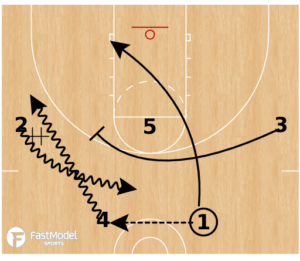
ATO play run by Brooklyn Nets to win a game during the 2019-20 NBA season. 2 should attack baseline like he’s trying to penetrate and 4 should make a ghost screen to misdirect defenders, while 3 (shooter) gets open through staggered screens.
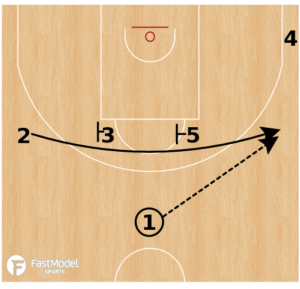
 

3 and 5 set Iverson Screen for 2.

1 enters the basketball to 2.
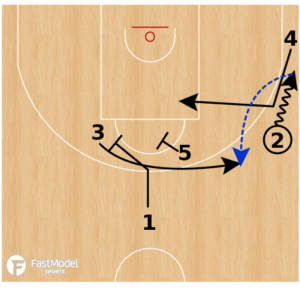


4 sprints into fake pick and roll and cuts inside (ghost)

2 dribble toward fake pick and roll.

1 and 5 screen for 3.
 

Choosing Success Every Day

By Brian Williams on May 11, 2020

Ask Why Before You Ask How

Dr. Cory Dobbs
The Academy for Sport Leadership

One simple way to gain more control over your life is to ask the correct questions at the correct times.  Everything that you do in your life has at least two basic parts to it.  One part is the reason for you to do it and the other part is how you can do it.  You must first discover whether or not you should do something and then ask yourself why you want to do it.  If you determine that it is important, then you should learn the best way to complete it.  Simply put, you should ask “why” questions before you ask “how” questions.

Asking “why” questions is central to determining whether what you are about to do is worth doing.  In short, you are addressing the key human motivational question “Is it worth it?”  Your success in leading yourself and others depends on your ability to work with the why questions.  The actions you prioritize should revolve around improving and differentiating yourself thereby propelling you to success every day.  Examine your choices, priorities, and dreams to help make decisions that will impact your teammates and help you achieve your goals and dreams.

This may sound like common sense.  But many student-athletes aren’t yet very skilled at making optimal decisions on some of life’s key questions—whether the issue is simple or complex.  However, as you mature you’ll find yourself not only desiring to make more choices but provided the opportunity to make decisions that affect you and your teammates.
[thrive_leads id=’36827′]
All of us are constantly asking ourselves, whether it’s a trivial task or a key life decision, “Is it worth it?”  Before we exert physical or intellectual energy we generally respond either impulsively or with great thought to this motivational question.

The why questions are so important because they are the first questions successful people ask to focus their actions. If you want to experience more success on a daily basis take time to thoughtfully respond to the concerns and consequences posed by the Why questions.

Answering the question “Why?” helps you by planting seeds that:

Guide you in clarify your objectives.
Push you to think of alternatives.
Challenge you to see a different perspective.
Increase your productivity.
Force you to think about the consequences of your actions.

Studies have shown that by taking as little as ten minutes each day to carefully craft your priorities and actions steps you’ll improve the likelihood of your success.  Here is a process for you to use as a tool for maximizing your success every day.

Daily Leadership Action Steps

Focus on priorities.  As you encounter your daily calendar your challenge is to clarify your objectives and do those things that are going to help you as a student, as an athlete, and as a team leader.

Implement something every day.  Each day provides you an opportunity to produce results.  What are you going to do and why?  Results matter.

Reflect on what happens/results.  To learn from experience you must reflect on what happens. When you detach yourself—as best possible—from an experience you are able to make better sense of daily actions, events, and incidents.

Seek feedback and support.  Learning from experience requires feedback from coaches, teammates and self-generated.

Transfer learning.  A skilled learner will find ways to transfer learning from one context to another.  Start by looking for opportunities to use your new skills and knowledge.

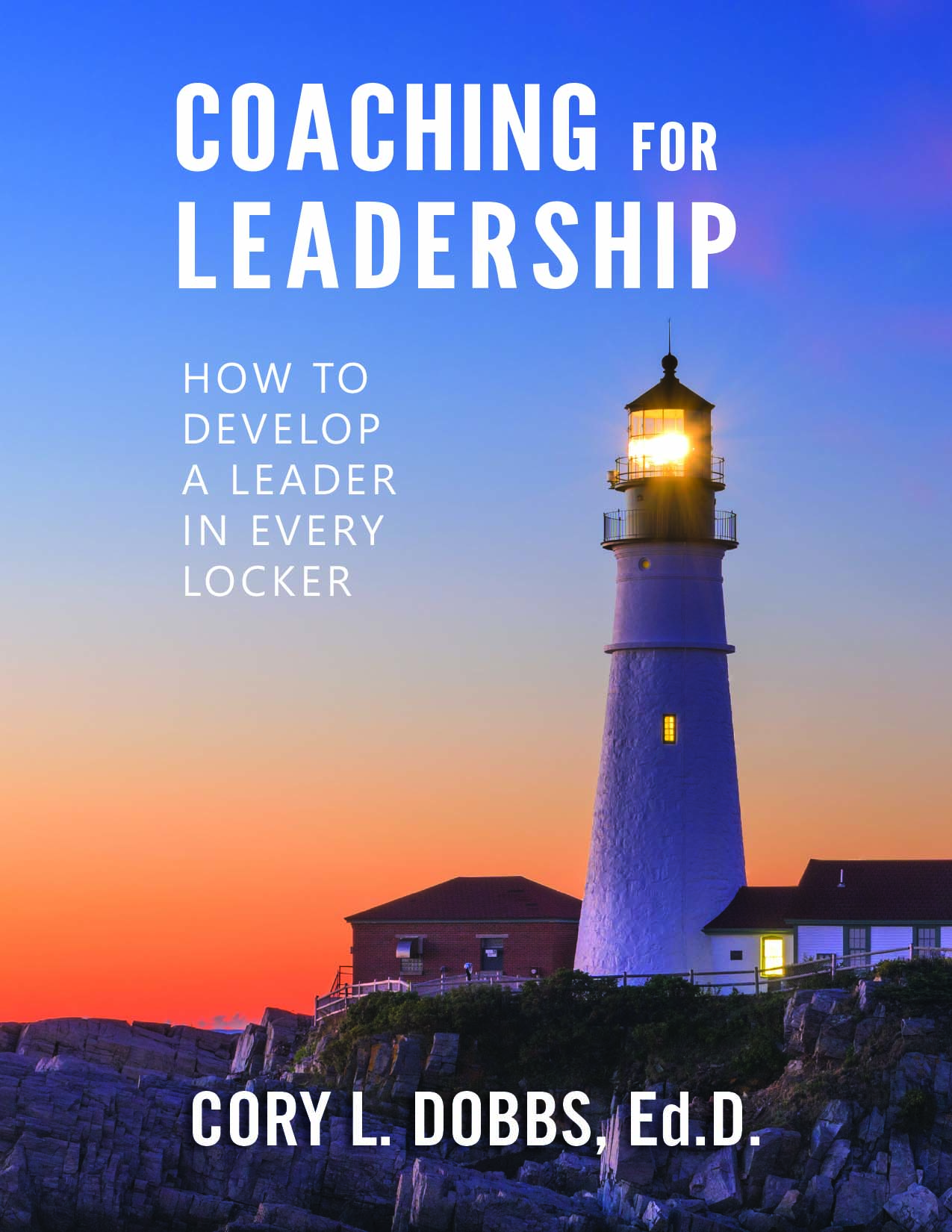
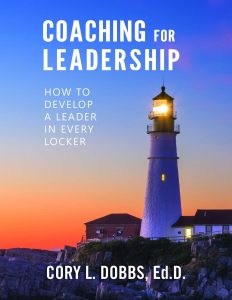
New to the Second Edition of Coaching for Leadership!

We are pleased to announce a new chapter to the second edition of the best-selling Coaching for Leadership. The chapter, The Big Shift: Unlock Your Team’s Potential by Creating Player-Led Teambuilding, connects the previous edition of this book to its origin, as well as to the future of team sports.

The new chapter sets forth a practical and applicable agenda for change and improvement. The reader is introduced to seven vital elements of change; seven shifts of traditional mental models that lead to the new core principles necessary for creating a player-led team culture. Click here for more information about Coaching for Leadership

About Cory Dobbs, Ed.D.

Cory Dobbs is the founder of The Academy for Sport Leadership and a nationally recognized thought leader in the areas of leadership and team building.  Cory is an accomplished researcher of human experience. Cory engages in naturalistic inquiry seeking in-depth understanding of social phenomena within their natural setting.

A college basketball coach, Cory’s coaching background includes experience at the NCAA DII, NJCAA, and high school levels of competition.  After a decade of research and development Cory unleashed the groundbreaking Teamwork Intelligence program for student-athletics. Teamwork Intelligence illuminates the process of designing an elite team by using the 20 principles and concepts along with the 8 roles of a team player he’s uncovered while performing research.

Cory has worked with professional athletes, collegiate athletic programs, and high schools teaching leadership and team building as a part of the sports experience and education process.  As a consultant and trainer Dr. Dobbs has worked with Fortune 500 organizations such as American Express, Honeywell, and Avnet, as well as medium and small businesses. Dr. Dobbs taught leadership and organizational change at Northern Arizona University, Ohio University, and Grand Canyon University.

Penn Decoy Slip

By Brian Williams on May 5, 2020

This video was edited by Coach Justin Brandt.

The other resources he has to share can be found at CoachJB.Weebly.com or you can follow his Instagram at @CoachJustinBrandt for daily posts.

You will need to be on a network that allows you to access YouTube to view the video.

Click the play arrow to view the video.

There is narration with the video, so please make sure that your sound is on.

You don’t have to run the play exactly as presented, but hopefully this gives you an idea for a way to get a slip and a layup when you need a score.

Seattle Storm Horns Flex

By Brian Williams on April 28, 2020

These two man quick hitter cames from the following pages of the FastModel Sports Plays and Drills Library:

Seattle Storm – Horns Flex – FastModel Sports.

Oregon – Double – DHO Concept – FastModel Sports.

You can also find out more about FastModel Play Diagramming software by clicking this link: FastDraw


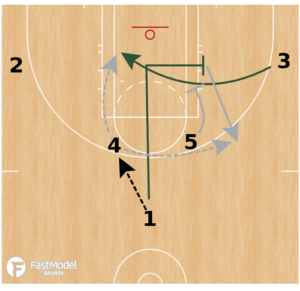
The first play was contributed by Dr. Tony Miller is the men’s assistant basketball coach at Bob Jones University in Greenville, SC


1 passes to 4

1 cuts to middle of lane to set flex screen for 3

5 sets a screen the screener down screen for 1


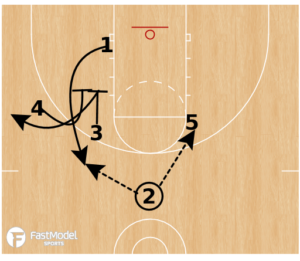
This second play was diagrammed by Andrew Lacey, Head Men’s Basketball Coach at Varina High School in Richmond, Virginia.


1 passes to 4 and cuts to the same side block

4 runs a dribble hand off with 2

3 sets an on ball screen for 2


4 and 3 set a wide double screen for 1

3 cuts off 4 to the wing after the screen

2 has the option to pass to 1 or 5 on a clear out.

3 Sideline Inbound Plays from Tennessee

By Brian Williams on April 24, 2020

These sideline inbound plays video was edited by Coach Justin Brandt.

The other resources he has to share can be found at CoachJB.Weebly.com or you can follow his Instagram at @CoachJustinBrandt for daily posts.

You will need to be on a network that allows you to access YouTube to view the video.

Click the play arrow to view the video.

There is narration with the video, so please make sure that your sound is on.

I agree, several of the screens could have been executed better. The idea behind the video is not to critique their execution, but rather to get some ideas for some offensive concepts and actions that you might be able to use.

How Do You Organize Your Coaching Ideas?

By Brian Williams on April 23, 2020

This article was written by Coach Don Sicko republished with permission. The original article appears at How Do You Organize Your Coaching Ideas?.

If you’re like me, you have great intentions to organize all your thoughts in one place with an ongoing process and then let it slip away at various times. Everyone likely keeps various files and/or master lists of offensive sets and plays, defenses, practice drills, inbound plays, philosophical concepts, scouting reports and any other number of categories.

It’s what happens after we get organized that messes us up-the day-to-day grind of our personal and professional lives. Just navigating through our busy days can be demanding enough, let alone chronicling every new thought or coaching nugget. There is always a lot of slippage when we don’t take the time to record.

If you already don’t do so, I’d like to suggest that you keep a daily written or computer journal to keep track of everything that you deem important. If you’re familiar at all with the Boston Red Sox’ right-fielder, J.D. Martinez, you know that he keeps a written journal of every pitch he’s thrown in every At Bat in every game. It’s difficult to argue with the success that he has had in the past two seasons. Obviously, there’s a lot more to hitting than knowing a pitcher’s “book” and tendencies, but Martinez”s systematic approach certainly has been significant, if for no other reason than to reinforce his own positive swing thoughts.

The number of ways to use one’s journal are infinite- game and practice notes, personnel observations, televised game notes etc. An area that I would strongly suggest that you chronicle is what I would call “situations”. In short, those situations would be ones you might come to have to later reconstruct for some reason. If you’re also like me in this regard, there have been times I haven’t had a better handle on reconstructing events and conversations when needed.

Now that you’ve kept a daily journal of your thoughts and impressions, it’s always much easier to reconstruct them for addition to your master files or lists. The chances of slippage are reduced significantly and your recorded thoughts are much easier to gather when desired or needed.

How do you keep your thoughts and ideas organized? Let us know in the comments below.

  • « Go to Previous Page
  • Page 1
  • Interim pages omitted …
  • Page 30
  • Page 31
  • Page 32
  • Page 33
  • Page 34
  • Interim pages omitted …
  • Page 288
  • Go to Next Page »

Primary Sidebar

  • Twitter
  • Facebook
  • Linkedin
coachestoolbox
personaldevelopmenttoolbox
basketballplayerstoolbox
basketballtrainer
athleticperformancetoolbox
coachingbasketball

© Copyright 2026 Coaching Toolbox

Privacy Policy