• Skip to primary navigation
  • Skip to main content
  • Skip to primary sidebar

  • Basketball Plays
    • Ball Screen Sets
    • Horns Sets
    • Man to Man Post Up
    • Man to Man Isolations
    • Backdoor Plays
    • Man to Man 3 Point Shot Plays
    • 2-3 Zone Attack
    • Baseline Inbound Plays
    • Sideline Inbound Plays
    • Combination Defense Attack
  • Drills
    • Defensive Drills
    • Offensive Drills
    • Competitive Drills
    • Passing Drills
    • Rebounding Drills
    • Shooting and Scoring Drills
    • Toughness Drills
    • Transition & Conversion Drills
    • One on One Drills
  • Blueprint
  • Practice
  • Mental Toughness
  • Skill Development
  • Offense
  • Defense
  • Store

Choosing a College

Choosing a College

By Brian Williams on March 28, 2009


Here are some other things for the recruited  student-athlete to consider:

  1. Eliminate from consideration any school that encourages you to cancel other visits.  They are afraid of  comparisons!
  2. Be skeptical of coaches or recruiters who criticize other college programs.  Their program probably doesn’t measure up.
  3. Do not choose a school because you are impressed with the recruiter.
  4. Finally, You Choose the College!  Take into consideration advice from friends, relatives, and others.  But, make the college decisions that is best for you and then make it the best decisions by working hard to successful as a student, as an athlete and as a person!

I.  Education – Academics

  1. What is the national academic reputation of the school?
  2. What is the national reputation of my major at this school?
  3. What is the student teacher/ratio in my major?
  4. What is the accreditation rating in my major?
  5. What is the degree of difficulty of school generally? of your major specifically.
  6. Do coaches emphasize academics?
  7. What is the graduation rate of scholarship athletes?
  8. Is there an academic plan for athletes?
  9. Academic Advisor and Academic Counseling
  10. Preferred scheduling
  11. Tutoring program
  12. Study table (ask for an explanation)
  13. Library and Study Areas
  14. Required class attendance
  15. Is summer school education part of the scholarship offer?
  16. Is a 5th year available if necessary to complete my degree?

II.  Head Coach –  Assistant Coaches

  1. What is the national reputation of the Head Coach?
  2. What is the national reputation of the coaching staff?
  3. What kind of reputation has the recruiter developed with your Senior High School?
  4. Do the coaches treat players as people?
  5. Do the coaches treat players as students?
  6. What is the philosophy towards handling basketball players?
  7. Will the coaching staff help me plan for my future?
  8. Job opportunities, including summer work (ask for explanation)
  9. Future placement
  10. Alumni
  11. Type/Character of head coach and position coach

III.  The Athletic Scholarship

  1. Will I be offered a scholarship during my visit?
  2. What does the scholarship cover?
  3. What is it worth in dollars and cents?
  4. How much will I have to pay myself?
  5. Ask for an explanation of the “National Letter of Intent.”
  6. Ask about a conference or league letter of intent.

IV.  The College

  1. Where is it located? ( inner city, rural, suburban)
  2. What is the distance from home?
  3. What are the campus, the dormitories, fraternities/sororities, apartments and facilities like?
  4. What are the dining facilities quality/quantity of food, training table?
  5. Spiritual, aesthetic, cultural opportunities?
  6. Quantity, quality of student body?
  7. Attitude faculty, student body, and community towards athletes in general, your sport in particular.
  8. What are the students like? What are the other players like? Do they seem to be quality people?
  9. Does the school have character and spirit?
  10. Consider the social aspect of the school.
  11. Will I fit in financially?
  12. What is the social climate of the
    school?
  13. Can I attend the church of my choice?
  14. Private, public, denominational school?
  15. Climate—weather conditions
  16. Quality of recruiting

V.  Other Things to Consider 

  1. What is the athletic tradition of the school?
  2. Are they a regular NCAA participant?
  3. Are they a
    consistent winner?
  4. Are they rebuilding?
  5. Is the head coach secure in his/her job? How long does he or she intend to be at this school?
  6. How long has
    he or she been there?
  7. Where else has he or she coached?
  8. Can I play/start as a freshman?
  9. At what position am I being recruited?
  10. What is the number of returning players, lettermen, or starters at my position?
  11. How many players are they recruiting at my position? How many do they want to sign?
  12. How many scholarships are they offering this year?
  13. What are their offensive and defensive tendencies or philosophies?
  14. What are the athletic facilities like? Fieldhouse?  Locker Rooms?  Practice Areas?
  15. Strength Program and Weight Room?
  16. What is their conference affiliation?
  17. What teams do they play?
  18. Can this program help me reach my full potential?
  19. What is the medical staff comprised of?  What is the quality of prevention and care of injuries?
  20. Doctors, trainers, medical facilities?
  21. What is the policy toward serious injury and graduation?
  22. If I sign early and am injured, do I still have a scholarship?
  23. Is there media exposure? (Press, TV, Radio)
  24. Has there been honesty and fairness in recruiting?
  25. Has there been any history of NCAA probation or
    Investigation?
  26. Are there any local kids or other friends going to the school?
  27. Alumni—job opportunity summer/after graduation.
  28. Recreation facilities—fishing, hunting, skiing, swimming, etc…
  29. Quality/type of athletes in general and your sport in particular?
  30. Is the system of play compatible to your abilities?
  31. What is their redshirt policy?

Zone Offense Principle from Coach Knight

By Brian Williams on March 9, 2009

As you probably know, Coach Bob Knight ran motion offense, so he had some flexibility as to where to put his players on offense.  I once heard him speak at a clinic about his zone offense.

One of his principles was that in his scouting against a team that played a lot of zone defense, he would decide which of the defenders in their zone defense was the weakest.  He then played his best offensive players in the area where they were most likely to be guarded by the opponent’s weakest defender.

I believe that even if you run a set or pattern zone attack, it is helpful to have your best players learn a variety of spots within that system in order to be able to have some versatility as to where you play them and are then able to adjust their spots in a game to take advantage of the weaknesses in the opponent’s zone defense.

Another scenario to think about putting a good offensive player in a specific spot against a zone is if one of the zone defenders is in foul trouble.  Even if a team goes to a zone if it gets in foul trouble, you can still create matchups that you want by placing your offensive players where you want them.  I think it is important not to get away from what you do best in your offense, but looking to create matchups against a zone is something to think about as you implement whatever you do to attack a zone.

The Coaching Toolbox has hundreds of resources for basketball coaching including basketball practice, basketball plays, basketball drills, basketball quotes, basketball workouts, basketball poems, and more!

Poise

By Brian Williams on March 1, 2009

By Deron Sorrell

Poise is an emotional peace which is seemingly inconsistent with the challenge at hand. Poise is developed rather than learned. Poise permits practice to render expected results.  Poise is nearly invisible at its strongest, but obvious to all when absent.

Poise does not improve our physical skill, but rather is the state of mind with which a performance is offered. Poise is understood by few. Poise is leased by many but owned by none. Poise is relative. Everybody has a little, but few have enough. Poise is not always passive. Poise is ready to fight, but always within the rules. Poise provides us with the ability to remain focused on our objective rather than aimlessly gazing at distractions. As our temptation to become distracted intensifies, our needed amount of poise increases. It is impossible to have too much poise.

Poise is readiness. Poise is not a fancy word for composure. Poise may choose to avoid conflict, but does not equate with passive play. Poise is more concerned with winning a game than with merely avoiding a fight. Poise is capable of an aggressive box out. Poise does not conflict with a foul that prevents a basket. Poise is capable of a crushing screen. Poise does not preclude crashing the offensive boards. Poise allows us to execute the demands of the game while maintaining an awareness of the rules and a genuine respect for the competition.

Poise lessens the impact of pressure. Poise is the buffer which prevents pressure from damaging our performance.  Poise removes all competition except the other team. Our preparation and strategy will prepare us for a particular opponent. Poise can either be a key component to winning or a major cause of defeat.

Poise is always needed. There is not a good time to be without poise. Everybody is aware that poise is needed on occasion, but few realize that it is called upon constantly.  Poise must be a great strength in order for teams to achieve greatness.

There is little, if any, correlation between talent and poise. We all can develop poise if it is perceived as important and worthwhile to do so.

Poise provides us with the opportunity to do our best.  Without poise, distractions will serve to detract from our performance. You and your teammates must develop poise in order to make any sincere effort toward achieving meaningful objectives. Anything other than our best is not acceptable. Poise is a necessary component to any pursuit within a competitive environment.

The Coaching Toolbox has hundreds of resources for basketball coaching including basketball practice, basketball plays, basketball drills, basketball quotes, basketball workouts, basketball poems, and more!

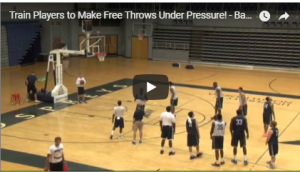
Finish the Game Pressure Free Throw Shooting Drill

By Brian Williams on February 15, 2009

This drill simulates pressure free throws at the end of a game and emphasizes the damage done by missing free throws late in a close game.

Run the drill at the end of practice to more closely simulate the mental and physical fatigue form the end of a game.

Line up the team in the lane spaces and behind the arc as they would for a free throw attempt. The shooter gets a 1-1 opportunity. Put a realistic score on the scoreboard that you would have in the final minutes of a close tournament game, whatever fits your level.

We put the score on the scoreboard at 45-44 for high school varsity with our team leading by one. If the shooter makes the shot, your team gets one point added. If the shooter misses, the opponent gets two points added. That emphasizes the importance of each miss. After one shooter is done, rotate until each player has had a chance to shoot.

If you win the game, practice ends on a positive note. If you lose, there needs to be a penalty such as running, frozen push ups, or whatever you want to use. Or, you can do the drill again until you win it’

If the game ends in a tie, then have an overtime where only the players who missed the first time shoot.

Some adjustments you can make to make the game more challenging are:

If the first shot of the one and one is missed, count it as two misses since the player does not even get to attempt the second shot. That would be 4 points for the imaginary opponent.

Start off with the score tied rather than you being ahead. That takes away from the protecting the lead theme, but if you obviously are going to get fouled with a tie game at times, especially if you attack the basket.

Start out behind by a few points to emphasize attacking the basket late in the game to get fouled and catch up with the clock stopped.

Run sprints prior to or between the free throw attempts to increase fatigue.

Some adjustments you can make to adapt this drill to make it competitive but realistic for younger level teams:

Start out with a bigger lead.

Shoot one shot rather than a one and one each time.

Each miss is only one point for the imaginary opponent.

Here is a slightly different version of the drill run by Matthew Driscoll, Head Coach at the University of North Florida. You can find out more about and see another sample from the DVD that this drill came from at this link: Competitive Shooting Drills

The drill is a You Tube video, so to be able to watch them, you will need to be able to access You Tube on the server that you are on.

Make sure your sound is on as you watch.

End of Game Clock Management

By Brian Williams on January 5, 2009

One of our clock management rules at the end of a game where we are behind is that if we gain possession at the opponent’s end with under three seconds to go and the clock is running, we call timeout immediately.  That includes after an opponent’s basket where they tie the game or take the lead. We don’t want the player who gets the ball to look at the clock, so if the player is in doubt as to how much time remains, we want them to call timeout and are not concerned if there is more time than three seconds remaining.

For instance, if there is six seconds and an open court, some players can score in that amount of time, but it the player is in doubt as to whether or not we can get a good shot in transition, we want them to call the timeout immediately.  If the ball goes through the basket, we want all players on the floor (and the coach on the bench) yelling “timeout”, making the timeout sign and moving toward the officials.

We then like to throw to half court and call timeout to set up our last second play.  For this reason, we save our timeouts until the end of the game.  I will send out a link to our favorite half court inbound play tomorrow.

If we are inbounding the ball and have to go full court without a timeout and are tied or down one or two, we like to have a play to throw the ball inside our three point arc.  The play varies depending on our personnel year to year, but we feel that if you throw the ball inside the arc, good things will happen.  We feel that more good things are likely to happen if you can throw the ball closer to the basket as opposed to throwing it in and then taking a three-quarters or half-court heave.  If you do throw long and the ball is knocked loose, it is much more dangerous to your opponent if the ball is knocked loose at your basket than at half court.

Here is an example of how throwing the ball long give you a chance, even if the defense deflect the pass.  Brownsburg (Indiana) High School trailed by one with 2.1 seconds to go in the 4A state championship last March.  By throwing the ball long, the caught a break.  In my opinion, they made their own break by being smart enough to throw the ball long rather than settle for a heave.

End of Game Long Pass

The Coaching Toolbox has hundreds of free resources for basketball coaching including basketball plays, basketball drills, basketball quotes, basketball workouts, basketball poems, and more!

Basketball Shooting Percentages

By Brian Williams on December 11, 2008

I used to look at a player’s scoring effectiveness as being ineffective if they did not score at least one point for each field goal attempted.  So, if you took 6 shots, you need to score at least 6 points or you were hurting the team.  Defensively, we felt that if we held the other team’s top scorers to less than a point a shot, we had a great chance to win.  But, I didn’t like it to measure our leading scorers because if our leading scorer took 18 shots and scored 17 points, that met the criteria, but wasn’t going to help us win games.

Here are a couple of stats that I find much more useful.  It is easy to set up a spreadsheet, or have your statisticians or managers if you have them, to set one up to calculate the following:

EFFECTIVE FIELD GOAL PERCENTAGE

In my opinion, when looking at statistics, overall field goal percentage is not a useful statistic to judge your player’s shooting efficiency since it combines both two and three point shots to calculate the percentage.  Two point percentage alone and Three point percentage will tell you how a player does at both ranges, but to get a comparison of how effective a player is who shoots mainly twos compared to a player who shoots mainly threes is the old apples to oranges comparison.

Effective Field Goal Percentage is calculated by counting each three point attempt as one and a half shots attempted since each three point shot scores one and a half times the number of points that a two point shot does.  It provides for a more level comparison.

The formula for effective field goal percentage is:

eFG% = (FGM + .5*3PM)/FGA

FGM and FGA include all shots, both two point shots and three point shots.

You could also use the formula

(2FGM + 1.5 * 3FGM)/FGA, where FGA is total field goals attempted, including 2 point field goal attempts as well as 3 point field goal attempts.

TRUE SHOOTING PERCENTAGE

True Shooting Percentage is a statistic takes into account being able to get to the line and make free throws in addition to being efficient in making two and three point shots.

The formula is:

TS% = (Points/2) / [FGA + (0.44 * FTA)]

The rationale in dividing the points by two is by doing so, it effectively makes each three point shot made worth 1.5 points.  This also makes each two free throws made equal to one two point basket made.

One free throw attempted is basically half a field goal attempt, so multiplying the FTA by .5 seems to make sense.  The reason that .44 is used is that statistical research by the NBA has taken into account the old fashioned three point play of a basket and a foul.  So, in those cases, the field goal attempt made is responsible for both the FGM and the FTA.

The first few times I looked at these, they were a little confusing (and my teaching area is math), but after looking at them and researching them, they made more sense as a measure than the traditional overall field goal percentage.

The Coaching Toolbox has hundreds of free resources for basketball coaching including basketball plays, basketball drills, basketball quotes, basketball workouts, basketball poems, and more!

  • « Go to Previous Page
  • Page 1
  • Interim pages omitted …
  • Page 280
  • Page 281
  • Page 282
  • Page 283
  • Page 284
  • Interim pages omitted …
  • Page 288
  • Go to Next Page »

Primary Sidebar

  • Twitter
  • Facebook
  • Linkedin
coachestoolbox
personaldevelopmenttoolbox
basketballplayerstoolbox
basketballtrainer
athleticperformancetoolbox
coachingbasketball

© Copyright 2026 Coaching Toolbox

Privacy Policy