• Skip to primary navigation
  • Skip to main content
  • Skip to primary sidebar

  • Basketball Plays
    • Ball Screen Sets
    • Horns Sets
    • Man to Man Post Up
    • Man to Man Isolations
    • Backdoor Plays
    • Man to Man 3 Point Shot Plays
    • 2-3 Zone Attack
    • Baseline Inbound Plays
    • Sideline Inbound Plays
    • Combination Defense Attack
  • Drills
    • Defensive Drills
    • Offensive Drills
    • Competitive Drills
    • Passing Drills
    • Rebounding Drills
    • Shooting and Scoring Drills
    • Toughness Drills
    • Transition & Conversion Drills
    • One on One Drills
  • Blueprint
  • Practice
  • Mental Toughness
  • Skill Development
  • Offense
  • Defense
  • Store

The Score Takes Care of Itself

The Score Takes Care of Itself

By Brian Williams on June 7, 2011

These are some notes from Bill Walsh’s book on leadership entitled “The Score takes care of itself.”  I think they are very worthy of consideration as you assemble and teach the standards that you expect for your basketball program.

When Walsh arrived with the 49ers, he didn’t have a timetable for a championship.  He had an urgent timetable and agenda for installing specific behavioral norms for everyone’s attitudes and actions. 

He implemented what he called his standard of performance—a way of doing things and a  leadership philosophy having to do with core values, principles and ideals that applied to everyone in the organization.  It has more to do with the mental than with the physical.

His belief is that organizational ethics are crucial to the ultimate and ongoing success of a team.   “Good talent with bad attitude equals bad talent.”

The dictates of the leader’s personal beliefs should become the characteristics of the team.  His or her philosophy is the single most important point on a leadership compass.  It is a blueprint for what should be done, when it should be done, and why it should be done.  

These  are the basic characteristic of attitude and action that Bill wanted to instill:

Bill Walsh’s Standard of Performance:

  1. Exhibit a ferocious and intelligently applied work ethic directed toward continual improvement.
  2. Demonstrate respect for each person in the organization and the work he or she does.
  3. Be deeply committed to learning and teaching which means increasing our own expertise.
  4. Be fair.
  5. Demonstrate character.
  6. Honor the direct connection between details and improvement.
  7. Relentlessly seek improvement.
  8. Show self control especially when it counts most—under pressure.
  9. Demonstrate and prize loyalty.
  10. Use positive language and have a positive attitude.
  11. Take pride in my effort as an entity separate from the results of that effort.
  12. Be willing to go the extra distance for the organization.
  13. Deal appropriately with victory and defeat, adulation and humiliation.
  14. Promote internal communicatin that is both open and substantive (especially under stress).
  15. Seek poise in myself and those I lead.
  16. Put the team’s welfare and priorities ahead of my own.
  17. Maintain an ongoing level of concentration and focus that is abnormally high.
  18. Make sacrifice and commitment the organization’s trademark.
  19. The leader must exhibit the principles, code of conduct, and behavior that he is asking others to emulate.

Process vs Result

  1. Aim for a Standard of Performance (which is absolute) vs winning (which is relative to others).
  2. “Process” of improvement leads to “result” of victory and not vice-versa.
  3. Focus on process which produces results and not on results.
  4. Promotions/wins/sales quotas are results, they do not provide information about performance. And its important to dig into performance to find truth hidden behind these results.

On organization culture

  1. Know it all bull headed people are dangerous.
  2. In an organization, its not just important for individuals to know their own role but they should be aware of roles of other people as well.
  3. Success belongs to everyone and so as the failure.
  4. Never let your colleagues down, you win with them, you lose with them. Therefore, defend them.
  5. Winners act like winners before they are.
  6. Hostile relations are toxic – one enemy does more damage than good of 100 friends. Enemies consume time, energy and attention – all limited resources.
  7. An organization emulates leader’s work ethics.
  8. A little humor is important to keep a check on stress and anxiety.

On leadership

  1. Give credit where its due, fewer things offer greater return on investment than praise.
  2. Be prepared – visualize future, think about all possible situations, prepare your responses for them in advance.
  3. Responses are temporary – Make moves to counter competitor but remember that competitor is going to come back with counter move soon, so, be prepared for that.
  4. A leader cannot be casual in any area of life, all his moves must be well thought of with great attention to details.
  5. A leader must have strength of will to carry out his decisions and to be able to stick with them in adverse situations.
  6. Focus on important problems for the organization rather than peripheral stuff (stuff which does not add to bottom line should not get too much attention).
  7. A good leader produces self-sustaining organization which functions well even in his absence.
  8. People are motivated only by their inner voice, teach a new inner voice to followers which will motivate them.
  9. The focus should be on motivating people to do “their best” rather than “crush the opponent” – though occasionally “crush the opponent” works too.
  10. Be wary of titles (“genius” in case of Bill Walsh), they haunt you later when performance goes down.
  11. Criticize people for “current” mistakes (and not the ones committed earlier). Also, give some positive feedback afterwards.
  12. When describing expectations from employees, don’t be subtle, be explicit and set the record straight.
  13. Big ears (better listener) are better than big egos – Listen, Learn, Lead.
  14. Be the leader – without the formal title (titles produces hierarchy and reduce communication)
  15. Be unpredictable – People become comfortable with predictable leaders, unpredictability/uncertainty allows a leader to prevent people from settling in comfort zone.
  16. A leader treats his people like his family members – money alone cannot motivate people for long.
  17. Teaching is important part of a leader’s life – Having a passion for teaching, expertise in the subject, being able to communicate clearly his ideas and have persistence to teach are important.
  18. The bottom 20% can determine the outcome – Ensure that they are motivated.
  19. Avoid dance of death – If the failure is imminent, don’t give in, keep fighting, lose with dignity.
  20. Tell people – “I believe in you”
  21. Don’t push people to their limits all the time, try to maintain a sustainable level of performance and keep the reserves ready for emergency.
  22.  
    You can read through a part of the book by clicking on the link below and then on the “Click to Look Inside” page you land on at amazon.com
  23. Keep superiors informed of your activities – Err on the side of over communication.
  24. Make your mentors and learn from them – A good leader is always learning.
  25. A leader aims for perfection, he does not settle for 99%.
  26. A leader focuses on performance rather than getting distracted by rumors and gossips.
  27. A leader ensures that his followers can advance their career, he does not backstab them for his personal or organizational gains.
  28. A leader succeeds by meticulous planning and not by hoping for a surprise (though the execution appears as a surprise to outside observers).
  29. When a leader makes a mistakes, he admits it and moves on.
  30. While judging a person, do not ignore the context.
  31. A pretty package cannot sell a poor product.
  32. A leader is discreet about whom he confides his secrets in, crying on wrong shoulder will have negative repercussions.

Basketball Shooting Drills

By Brian Williams on May 23, 2011

These two shooting drills came from Coach Creighton Burns’ Newsletter

Knight SHOOTING DRILL”

*How to do the drill:
1. You need three players (shooter, passer, rebounder)
2. Two balls
3. One Minute on the clock

Goal to make 15 shots out of 25 attempts

  1. The passer can only pass. The rebounder can only rebound and then pass to the passer. (I know you realize the passer passes to the shooter.)
  2. The Rebounder counts the shots attempted.
  3. The Passer counts the shots made.
  4. The drill starts with the shooter having a ball and the passer having a ball.
  5.  

  6. The shooter will move from Elbow to Elbow in the drill. (Must HUSTLE!)
  7. Their should be some type of punishment if the shooter does not get the25 attempts or the 15 makes.

*Change up to the drill. You can have the shooter go from elbow to the wing and back to the elbow. S/he should move about 12′. You may need to put a mark with chalk on the floor so the shooter will know where to shoot from. (All the other rules are the same.) (This is great for taking shots at game speed.)

________________________________________________________________

UT SHOOTING DRILL

*The Explanation is below the diagram
________________________
l                l
l      2        l
l                l
_________

1               3

“Three Man-Two Ball Shooting Three Pointing Shooting Drill”

1. 1 has a ball ready to shoot
2. 2 has a ball under the basket
3. 3 is spotted up behind the arc

*Procedure

1. The drill begins with 1 taking a shot and 2 under the basket will make a pass to 3 for a three point shot.
2. The passer (2) sprints outside anywhere behind the three point line.
3. The first shooter (1) follows his shot, rebounds, and passes to a player spotted up behind the arc.
4. The drill continues for 1 minute and each player has to make 6 three point shots. (They count their
own made shots.) (Penalty if they don’t reach 18 total makes)

*Remember this and you can do the drill. After you shoot follow your shot rebound it (missed or made) and pass to a player behind the three point line. Do not stay under the goal after you rebound your shot just sprint behind the three point line and you will get a pass from another player who has just rebounded his/her shot.

*You can shoot from the corners, wings or point area.   *If there are three players and two balls someone has to be open for a pass after you follow your shot and get the rebound.

The Coaching Toolbox has hundreds of resources for coaching basketball including basketball practice, basketball plays, basketball drills, basketball quotes, basketball workouts, basketball poems, and more!

Point Per Pass Basketball Drill

By Brian Williams on May 10, 2011

We started using this drill to improve our 3 on 3 games in our summer youth clinics, but found that it also works well in season as a practice drill or five on five drill at various grade levels in our program–including the varsity.

The drill has several objectives:

  1. Keep 3 on 3 games at lower levels from being a dribbler and 2 watchers.
  2. It emphasizes the give and go.
  3. Requires players to get open to receive a pass
  4. De-emphasize dribbling
  5. Encourages team play on offense
  6. Makes the defense play harder to stop the points for passes and guard the basket cutter.
  7. It can be used to practice a delay game offense and defending against a delay game if you don’t set a limit for the number of passes.
  8.  

Rules:

  1. Regular scoring for two and three point baskets.
  2. Every completed pass followed by a basket cut is worth one point for the offense.    It is important that only a pass followed by a basket cut counts as a point to promote cutting in our motion offense.  Pass and stand is not a point.  If we use it with our high school teams, then a pass and screen is also worth a point.
  3. (Optional) You can set a limit of no more than 7 points from passes if there is lack of attempting to get a shot.

In addition, you can teach passing to the outside hand away from the defense, meeting the pass, and other areas you want and that are appropriate for the age of the player that you are working with.

After a few days of doing this with your elementary and middle school teams, it starts to look like basketball!

The Coaching Toolbox has hundreds of resources for coaching basketball including basketball practice, basketball plays, basketball drills, basketball quotes, basketball workouts, basketball poems, and more!

Kevin Eastman Basketball Coaching Points Part 2

By Brian Williams on April 29, 2011

This is the second part of Kevin Eastman’s Coaching points. Kevin is the LA Clippers VP of Basketball Operations, former NBA Assistant and D1 Head Coach Coach Kevin Eastman. Many of the notes deal with post play.

Here is a link to the first: Eastman Part 1

I received this collection of coaching points that have been tweeted by LA Clippers Assistant VP of Basketball Operations Kevin Eastman from Phil Beckner. Coach Beckner is now an assistant at Nebraska.

I also have a sample five minute video of Coach Eastman discussing his views on skill development. Click this link to see it.

If interested, you can follow Coach Eastman on Twitter @kevineastman

********


The best in the NBA have a laser like focus & commitment to winning that also carries over to their off season improvement-it’s very serious

Skill development is a process-the player & coach have to be committed to it-both need focus & enthusiasm the entire way-development takes time

The ultimate team is a group of self motivated players that turns into a player coached team; with the structure & guidance from the staff

You get new jobs because of who people think you are; you keep that job because of who you really are; make sure you are as prepared as you can be.

Success is a process; a winning season is a process; winning teams do not get bored with the process; it’s long & requires disciplined focus

Proper form and a strong work ethic plus preparation and repetition is the formula that makes a great shooter

Being the best gets harder as time goes on so the special ones continue to work on their game. Working at your game at every opportunity is what makes a player great

Champions do not become champions on the court. They become recognized on the court.  They become champions because of their daily routine and commitment to excellence. Players do not decide their future; they decide their habits and their habits decide their future!

Being the best requires 100’s of sacrifices the public will never see-that’s why players who r in for the limelight will never be successful

It’s not easy being one of the best in a given field; it does require hard work and sacrifice; you have to earn “best”; earn “championships”

When a strong purpose teams up with great passion there’s no telling how far a group or individual can go!

Success does not come to those who merely have great dreams. Success comes to those who have great dreams and who follow through on them

Also keep in mind that we are not God’s gift 2 basketball; rather basketball is God’s gift 2 you; we are not entitled 2 this job-keep earning it

Practice habits become your game habits-your players have to be consistent w/ this if want to win-there are no “on/off switches with the best teams

Great way for players to learn about the “next level” is to listen to their current coaches & read about what players do at that next level-

All coaches – especially assistants – must be on a constant journey to learn and improve; do not allow yourself to stand still! Take action!

You can’t expect to be great if you are a part time player. Are you a 9am-5pm player or a 5am-9pm player? Guess which Kobe and LeBron are?

The only important shot is the next one; because no matter how hard you try, that is the only one you can still have an effect on!

Post players need to understand that upon catch-many times-it’s best to “pause for poise” before making a move; let the area clear & read 1st

As a coach it is important to hold yourself every bit as accountable as you hold your players; what can you do better? How can you help more?

Voices & choices; who are u listening to? These are your choices that will have an impact on your present & future; get around people who stretch you

It takes coaches many years to become experts on basketball strategies and techniques, but we expect players to master these right away?

The best way to lead is by example; players see the actions & actions often do speak louder than words; what you do will have a greater impact!

The best players do their jobs & most importantly do their jobs completely! They understand the value of executing every part of their role

Passion can overcome many shortcomings one may have on their job; but continuing to have the passion for improvement of them is most important

What makes one person’s career seem to advance further than anothers? You have to become so valuable that it’s hard not to hire you!

You advance in your career by how thorough you know and understand your craft and who you associate with; associate with people who challenge you!

“A little more” often produces a lot more; a little more focus; a little more effort; a little more sacrifice; doing a “little more”=winning.

Kevin Eastman Basketball Coaching Points

By Brian Williams on April 27, 2011

This is the first part of Kevin Eastman’s Coaching points. Here is a link to the second: Eastman Part 2

I received this collection of coaching points that have been tweeted by retired NBA Executive and Assistant Coach for the Clippers and Celtics Kevin Eastman from Phil Beckner. Kevin Eastman spent several years as an assistant to Doc Rivers with both the Celtics and the Clippers. Coach Beckner is now an assistant with Boise State.

I also have a sample five minute video of Coach Eastman discussing his views on skill development. Click this link to see it.

If interested, you can follow Coach Eastman on Twitter @kevineastman

********

Intent is great if followed by action; intent is personally debilitating if left alone as it slowly erodes confidence & the will to advance!”


What do I want and what will it take to get it? Answer these 1st. Then ask yourself: am I TRULY willing to pay that price?

One statistic all teams should keep is being “first to the floor”; when the time calls for a loose ball to be picked up–who gets there 1st?

Observation from All Star game: “the best” have insatiable need to compete and succeed! Work ethic is off the charts!

To all asst’s in any line of work: it’s not about YOU–it is about what YOU DO 2 help YOUR BOSS. Help them b successful!

Do your job and do your job completely.

People always ask me about KG–my response is always the same: he wants to be the best & do the best that he can every day! Practices & Games!

“It takes three things to be a “special” player: talent, character, and competitive fire.”

Some are satisfied with who they are. Others are consumed with who they can become. I call this group “THE BEST”

Coaching is making players do what they don’t want to do so they can become the player they want to become

“The Best” have to pay a new price every year because everyone is always trying to beat them; the best are the best because they pay this price!

Culture is 7 days a week, 24 hrs a day

The best shooters in the NBA are consumed with the fundamentals of their shot; every day-every shot; the details are there

Vets at all levels have responsibility to maintain program’s culture every day. From work ethic to off the floor decisions.

Our focus should be more on solutions then problems; problems are easy to point out; solutions are what can solve the problem; be big on solutions.

Good question to ask yourself; are you one that makes promises or commitments? Promises often are what you might do; commitments are what you will do!

Spending time working on your game is spending time working for your team

All great players are on a never ending journey to stay at the top; it’s the pride of greatness! They refuse to settle!”

The best teammates build up-not tear down; they encourage-not discourage; they help–not hinder; they walk with-not in front of teammates!

Once someone can do what you do and one more thing, you are replaceable

What you “bring” to each workout (energy, enthusiasm, effort, patience, etc.) is more important than what you “know.”

To truly get to the level you are seeking you have to give others permission to hold you accountable! It’s good to have to prove yourself!”

We all procrastinate. But remember: procrastination is one of the single biggest killers of our goals and dreams & ultimately our success!

Improvement has to be worked on every day; it can’t stay in the “wish for – hope for” stage; keep working on what moves you ahead.

Summer-3 great months. to have goals of: read 1 book/month; read 1 coaching/leadership article/day; have a “thoughts journal”-fill it with ideas

Success has a price but also a choice: the price is what it takes to earn it–it shouldn’t be easy! The choice: are you willing to pay the price?

Becoming successful is an everyday endeavor; never allow yourself to coast; discipline yourself to consistently work on becoming more

Finish–a very powerful word-must b staple of your vocabulary; not just finish plays-finish EVERYTHING YOU START in your life-never quit on yourself

Learn from the past; produce in the present; and get  to the future first; this is one of the most important keys to effective leadership!

“WILL TO WIN”: all about getting yourself to another level through sheer determination; overcoming the urge to say this is too hard/I can’t do this

Here is a link to the second part of this post: Eastman Part 2

The Coaching Toolbox has hundreds of resources for coaching basketball including basketball practice, basketball plays, basketball drills, basketball quotes, basketball workouts, basketball poems, and more!

Scramble Defense

By Brian Williams on March 30, 2011

Scramble Halfcourt Defense–Thumbs Down

Jim Larranaga, Men’s Basketball Coach Miami (Florida)

I received the notes from Coach Creighton Burns

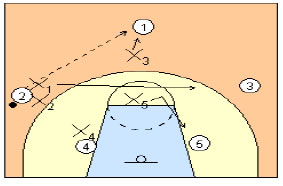
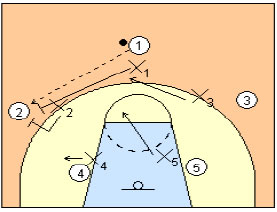
a) Thumbs down – trap the receiver of the first pass in the front court (trap down).

B) Thumbs up – trap the dribbler on the first dribble over the center line.

There are two trappers, two interceptors and a goaltender.
 

Thumbs down:

Basketball Defense

X1 follows the pass to 2 and traps down with X2.

Weak side X3 rotates up top to take away ball reversal, is the reversal interceptor (RI).

Weak side

X5 moves up to the high-post area (the next most likely pass), becomes the high-post interceptor.

(HPI, often a big). X4 is the goaltender (GT), he fronts 4. Any post-to-post screen is an automatic switch.

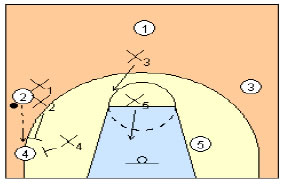
Get "3 to the ball" on every trap, the two trappers must have their three teammates get ball side and in the action, working together. Positions are the same after trapping on the wing regardless of the attacking set.

Basketball Defense

On a reversal pass it’s one trap and out. If you leave your man to go trap, you must run out of the trap to find the open man, and run to where your help comes from.

X1 rotates out to find the open man. If X5 decides to take 3 because he is closer, then X1 would go where his help came from and take 5.

Basketball Defense

However, if the other team continues to attack with a pass to the corner, trap again. X2 leaves to trap (his man made the pass). X1 is RI, X3 is still HPI, and X5 is still GT.

Basketball Defense

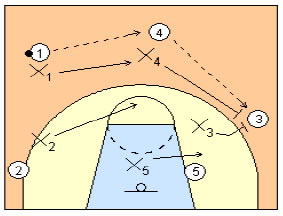
Trailer Trap (Thumbs Down)

On a secondary break, teams are usually looking to reverse the ball, not make a wing-entry pass.

Trailer trap is normally called after a time-out. X4 becomes the first trapper.

  • « Go to Previous Page
  • Page 1
  • Interim pages omitted …
  • Page 265
  • Page 266
  • Page 267
  • Page 268
  • Page 269
  • Interim pages omitted …
  • Page 288
  • Go to Next Page »

Primary Sidebar

  • Twitter
  • Facebook
  • Linkedin
coachestoolbox
personaldevelopmenttoolbox
basketballplayerstoolbox
basketballtrainer
athleticperformancetoolbox
coachingbasketball

© Copyright 2026 Coaching Toolbox

Privacy Policy