• Skip to primary navigation
  • Skip to main content
  • Skip to primary sidebar

  • Basketball Plays
    • Ball Screen Sets
    • Horns Sets
    • Man to Man Post Up
    • Man to Man Isolations
    • Backdoor Plays
    • Man to Man 3 Point Shot Plays
    • 2-3 Zone Attack
    • Baseline Inbound Plays
    • Sideline Inbound Plays
    • Combination Defense Attack
  • Drills
    • Defensive Drills
    • Offensive Drills
    • Competitive Drills
    • Passing Drills
    • Rebounding Drills
    • Shooting and Scoring Drills
    • Toughness Drills
    • Transition & Conversion Drills
    • One on One Drills
  • Blueprint
  • Practice
  • Mental Toughness
  • Skill Development
  • Offense
  • Defense
  • Store

Ballhandling and Finishing Basketball Drills

Ballhandling and Finishing Basketball Drills

By Brian Williams on January 30, 2012

These three basketball skill drill ideas came from a pdf put together by Ganon Baker.  I hope that you can find ways to use them in both your games season practices and out of season workouts.

I. Stationary Dribbling with Tennis Ball (Do each for :30 secs) NO DIAGRAM

Execute the below moves while dribbling a basketball without a tennis ball, then execute each move while dribbling a basketball and tossing a tennis ball

a. Side Jab – Toss tennis ball, execute short side fake with foot, catch tennis ball

b. In/Out – Toss Tennis Ball, make inside out move w/ basketball hand, catch tennis ball with free hand

c. Between legs – Toss Tennis ball with right hand, go between legs with left hand, catch tennis ball with left hand palm down, then repeat

d. Behind the back – repeat the above but go behind the back

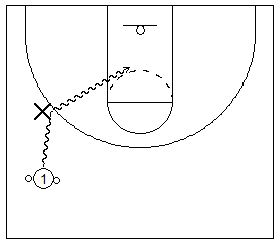
II. 2 Ball Drives (Make 10 in 1:10 seconds) (Diagrams below)

a. Drive to chair with 2 balls being dribbled, place 1 ball in the chair, take a floater

b. Now come back to chair, and take a jumper
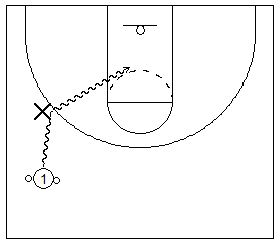
   

III. Sue Bird Drill (Make 10 in 1 minute) (Diagrams below)

a. Drive at chair execute a WNBA dribble move

i. b/w leg-cross

ii. b/w leg-behind back

iii. behind back-cross

iv. In out – cross

v. Pull up for a 1-2 step jumper

b. Come back to chair drive for a step through finish (Chair has 2nd ball on it)


The Coaching Toolbox has hundreds of resources for coaching basketball including basketball practice, basketball plays, basketball drills, basketball quotes, basketball workouts, basketball poems, and more!
Basketball Plays Tom Izzo

By Brian Williams on January 26, 2012

Here is some philosophy on special situations from Tom Izzo. I received this notes from Steve Smiley. they were originally taken by Coach Jim Ponchak at the 2010 Clinic to End all Clinics .

The Anatomy of a Timeout

Try to save timeouts in the 1st half so you can utilize them in the second half
See what your opponent is doing and think

1. What do I want to do?
2. What do I need?

NBA is a great resource if you are looking for Sideline Out of Bounds plays (SLOB’s)

• In his first two seasons at MSU, they lost 14 games by 1 to 4 points.

• Izzo reflected on what he could do to become a better coach and help his teams win those games• He took a football view to coaching his team in that there were 3 phases of the game; offense, defense, and special teams

• He felt that if they focused on Special Teams that they could gain an advantage that would help them win the close games

• Izzo views timeouts and all other dead ball situations as Special Teams

• Special Teams 1) Jump Ball 2) Timeout 3) BLOBs 4) SLOBs 5) Free Throws

• It’s not necessarily the play you run that is important, but the theory/philosophy that is important.
• Need to make sure you’re focused on what’s going on the floor every second of the game
• Aggressive approach – never relax

• Special Teams Objectives

1. Score
2. Go inside or outside?
3. Attack a player in foul trouble?

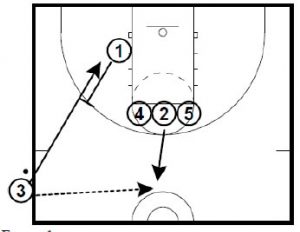
• SLOB’s – usually tries to score inside-out Here is one of his sideline inbounds plays

2 pops out middle.
3 passes to 2.
1 back screens 3


4 and 5 screen for 1.
2 dribble to wing.
1 uses double screen to get open at the top of the key.
3 continues through to block.
5 slips.
4 pops


2 can hit:

a) 3 for a post up
b) 1 for a three
c) 5 on the slip
d) 4 on the pop


12 Absolutes of Defensive and Offensive Basketball

By Brian Williams on January 23, 2012

These thoughts came from Steve Smiley.  Steve is  Head Coach at Sheridan Junior College, a former player and assistant coach for Don Meyer, and the author of the coaching site snsbasketball.com

Regardless of the style of basketball you play-full court, half court, motion offense, or a structured continuity type of offense, man defense, zone or match up, I believe there are 12 ABSOLUTES (6 defensive and 6 offensive) you need to accomplish at both ends of the floor if you wish to be successful in that phase of the game.  I believe these ABSOLUTES need to be clearly communicated to your players and they need to learn these ABSOLUTES and be able to tell you these without hesitation as they apply to your system or style of play.

DEFENSIVE ABSOLUTES

  • NO  EASY BASKETS whether in transition or the half court.  Make the opponent work and ear everything they get.
  • NO 2ND SHOTS of any kind.  Too may good defensive efforts are wasted because of failure to get the defensive rebound. This can be actually demoralizing in many situations.
  • NO UNCONTESTED SHOTS- this goes back to #1 somewhat in that we don’t want to allow easy and free looks at the basket.  Don’t allow mediocre shooters to become good ones because you don’t contest the shot.
  • NO PENETRATION into that paint/post area.  This means no penetration off the pass as well as the dribble. When the ball enters the middle of the floor and in particular the post area there are too many options available for offense. Try to limit the thins they can do by keeping it out of the middle.  If it does get in there then attack the ball and dig it out as quickly as possible.  Offensive rebounding is also a way a team can get the ball in this area and we have already said in #2 that can’t happen.
  • PRESSURE THE BASKETBALL as much as possible. #3 certainly implies pressure on the shot.  Pressure the dribble, the pass, and the catch as well in order to take the individual or team out of their comfort area.  Making the people dribble, pass or catch going away from the basket is a good rule of thumb.  How much you are able to pressure may vary from game to game or year to year depending on your personnel, but going back to #1 were the opponent must earn everything they get is critical.  Make them work!
  • COMMUNICATION kind of pulls it all together.  It lets you know that your players understand what it is you are trying to accomplish.  It creates a team cohesiveness and promotes unselfish play.  It says you are in this together and it takes everyone doing there part to be successful.

OFFENSIVE ABSOLUTES

  • BE FUNDAMENTALLY SOUND in the basic skills of the game of basketball.  This means the ability to dribble , pass, catch, shoot and rebound the ball without mistakes.  It also means to ability to cut and screen, and space yourself properly.  If you cannot execute the fundamentals of the game it makes no difference what you try to do offensively, you won’t be successful.  John Wooden has always said you need to “quickly and properly execute the fundamentals of the game.”
  • GET EASY BASKETS whenever possible.  This would apply to both transition basketball and half court basketball.  This can have a devasting effect on the opponent if you are able to get easy baskets time and time again and then they have to work to get any thing at the other end of the floor.
  • SHOT SELECTION is a critical importance.  Take the shots you want, when you want, where you want, and who you want to take them.  Players need to know their roles, accept their roles and fulfill there roles to the best of their ability.  Basketball is not an equal opportunity sport!
  • OFFENSIVE REBOUNDING can make up for a lot short comings.  Crash the boards with aggression and get at least 50% of all offensive rebounds available to you. It will have a demoralizing effect on the opponent.  Rebounding is how you win championships.
  • GET THE BALL INSIDE for the higher percentage shot.  The obvious way to get the ball inside is to feed the post.  However, driving the ball to the basket, getting into the lane area in transition, passing the ball to a cutter cutting through the lane, offensive  rebounding are other ways to get the ball inside.  All are excellent scoring opportunities that put constant pressure  on the defense.
  • MAKE YOUR FREETHROWS whenever you get to the free throw line. Many coaches make it a goal to make more free throws that the opponent gets.  There is nothing wrong with that, but regardless of whether you are able to do that or not, you have to make your free throws when you get to the line.  It’s been said that 20% to 25% of a teams scoring opportunities come at the free throw line.  This is especially true at “crunch time” of the game.

These ABSOLUTES are not met to be a system of play.  They are meant to guide your thinking as you put together your system or style of play at both offensive and defensive ends of the floor.  As I have studied and watched teams and programs play over the years, it has become apparent to me that the successful programs, regardless of “style” incorporate the above ABSOLUTES into their offensive and defensive thinking and the result has been good, sound, successful basketball.

The Coaching Toolbox has hundreds of resources for coaching basketball including basketball practice, basketball plays, basketball drills, basketball quotes, basketball workouts, basketball poems, and more!
Basketball Thoughts from Joe Ciampi

By Brian Williams on January 20, 2012

This was posted on Texas A&M Women’s Assistant Coach Bob Starkey’s Blog:  HoopThoughts.  It is a great site for basketball coaches.  If you haven’t seen it, you should check it.

Coach Starkey is a former assistant at LSU and that is where this post originated.

One of the best Match-Up Zone coaches in the women’s game is former Auburn head coach Joe Ciampi.  Joe, a member the Women’s Basketball Hall of Fame still takes the time to teach and share his thoughts on match-up play and a lot more in terms of basketball.  Here are a few notes I took when Joe visited with our staff at LSU in 2005.  They excellent if you are looking to improve the way you play zone defense but they are equally important for you to read in your attack of zone defenses:

Four Key Words To Multiple Defensive System:

DELAY…the ball coming down the floor

DEFLECT…inside passes…all passes inside 3-point arc…fingertips on the ball.

DISRUPT…offensive flow thru traps…always trap out of a timeout.

DISGUISE…Auburn played 60% Match-Up 40% man during Ciampi’s career.
Offensive thoughts vs. Match-Up

Screen Outside (Elbow Screens)

Screen Inside (Post)

Few teams screen long enough or move often enough to have success against a true match-up.

Overall defensive philosophy: Have non-shooters shoot.

Ciampi defines offensive players as “shooters” or “drivers” (non-shooters)

Multiple defensive system will test opponent’s offensive IQ

Advantage to multiple defensive system is that offense has to constantly think about how they will score.

Good defense can make more adjustments than a good offense.

Thoughts on pressing: “The can pass around us or pass over us but we don’t want them to pass or dribble through us.”

Defenses either act or react…multiple defensive systems force offenses to react.

Awareness becomes better with strength, quickness and speed.

Can run system in segments…Ciampi likes to change before half or to start the second half.

Important to have defensive goals…players want to see numbers.

In everything you do in practice, have winners and losers….anything 2/2, 3/3, 4/4 have winners and losers…assign a coach to each team…ask winners why they won and losers why they lost…important they understand what went into the process.

Assign one coach to be a “praiser” at practice.

Ciampi believes that the coach controls practice and officials control games.

Ciampi believes that coaches spend too much time correcting poor performance and not praising good play.

Excellent 5/5 defensive possession doesn’t allow a pass inside the 3-point arc…give defensive team 3 points when that happens.

Consecutive turnovers by offense — stop practice and run…place a value on the possession.

Timeout: 1 offensive thought

1 defensive thought

Give most important thought last

Assistant coaches don’t work officials…I’ve gotten better but not where I should be!

Half-time stats of importance:
…..Opponent’s FG%
…..Rebounds

Find something to praise

Extending defense forces opponents to start offense with :20 or less on shot clock — this makes offense basically work to get a shot with only 3 or 4 passes.

Ciampi has :25 on shot clock when working offense in practice…more game like.

Captain’s role is to voice and protect the coach’s opinion.

Great statement: Leadership is more important in the 22 hours off the court than it is the 2 hours on the court!!!…reason Temeka was a great leader…(Coach Meyer: “Great leaders must be accessible”)

Important for head coach to have constant dialogue with team leaders.

Ciampi charts free throws by having player make 10 in a row to start and then chart the next 10…we need to do this in the fall with volunteer free throws….Ciampi also changes free throw pairs up each week…I think this is a great idea…we can do this easily by posting on the bulletin board who their FT and shooting partner is for that week…Ciampi likes to put good FT shooters with poor ones…veterans with rookies.

Two Main Concepts for Match-Up (in this order):
…..Where’s the ball
…..Where do I belong
…..(Can be said of our man-to-man defense as well!)

The Coaching Toolbox has hundreds of resources for coaching basketball including basketball practice, basketball plays, basketball drills, basketball quotes, basketball workouts, basketball poems, and more!
Coaching Basketball Post Game Evaluation

By Brian Williams on January 18, 2012

I have always felt that it is important to evaluate a basketball game with the players prior to moving on to the next game.  If we play poorly and I am upset, I try not to say too much after the game so that I can have a chance to watch the video and look at the stats in order to have items to improve upon.  I don’t want it to be a blame session or me venting frustrations.

Click here to see a sample pdf of the POSTGAME EVALUATION SHEET that I use.

If we win, we do a cheer, I deliver some sincere praise where it is deserved, and remind that as Dick Bennett said, if we are going to improve, “We cannot accept in victory what we would not accept in defeat,” in terms of our effort, our attitude, our unselfishness, and our execution.

I have included a link to the form that I have used to copy and hand to the players when we evaluate the game with them.

Each year is different in terms of our goals, but we are a packline defense program, and a program that emphasizes, playing your role (our best scorers will take most of the shots) shot selection, and not turning the basketball over.

I have examples of what I am talking about on the pdf with the download link below.

Or, you can view it here:

(If you can’t see the pdf in a frame, refresh the page.

Loader Loading...
EAD Logo Taking too long?

Reload Reload document
| Open Open in new tab

Download [142.99 KB]

For shot selection, I use the Don Meyer shot rating system.  We rate every shot taken in a game.  4 = power shot or layup  3 =wide open shot (not a shot from beyond the 3 point arc, but any wide open shot) 2 = a decent shot 1 =bad shot 0 = turnover (Take a 3 or a 4 or you’re off the floor)

We have cards on the players lockers and they receive stickers after the game for individual performances that benefit the team:

*1.5 Points Per Field Goal Attempt (need to get to the line to get this one)
* Take a Charge
* Big Plays–making the last shot of a quarter, a great individual defensive job, or any individual efforts
that turned the momentum or was a game changing play.  This is the coaching staff’s discretion.
* 8 Rebounds
* 5 Assists
* Conventional 3 Pt Play
* Put Back (offensive rebound and basket)

As I watch the video myself or with our staff, I make notes as to the clips that I want our players to see with times so that I can forward to the clips and they don’t have to watch the whole video.

We chart deflections, blockouts, and challenged shots.  In our packline defense, the key stat is opponent’s field goal percentage, so all of these are critical to keeping that percentage low.  Examples are on the pdf that has a link below.

We break our goals into quarters, so if our goal is to hold our opponent to 44 points, then we want 11 or less points EACH QUARTER.  The same for turnovers.  8 or less per game is our goal, so we want no more than 2 per quarter.  We do go over each turnover and what can be done in the future to correct it.  That is also on the link below.

Finally, with the team that is shown in this example, our Points Per Possession was highest if we had the ball for more than 30 seconds on a possession, so I timed each possession and looked at the Possession percentage for various lengths of time.   I do not do that with every team, but this one needed that to help them play their best.

On the sheet, I have used players numbers rather than names, but use names on what I give to the players.

Click here to see a sample pdf of the BASKETBALL POSTGAME EVALUATION SHEET that I use.

Thoughts on Shooting Instruction

By Brian Williams on January 17, 2012

Thoughts on Shooting Instruction

These ideas are from Coach Tom Traynor, longtime and highly successful Pennsylvania High School Coach .  Coach Traynor passed away in 2011.
I received these notes from Creighton Burns. 

Just to share a few ideas we us teaching shooting. We emphasize form at the beginning of each session and game speed the rest the way.

We have shooting sessions at every work-out and practice usually 15-20 minutes a day in drill. We begin with Free Throws for form shooting. Next we practice our shooting arm with the ball on the shooting hand directly in front and beside the rim. Then we work off the dribble.  Each practice we make 50 shots (as a team) behind the arc while running our drive and kick drills.


Points of emphasis in our shooting that are reviewed daily are:

1.  Get the shooting hand behind the ball – Rotate thumb around the ball to put 3 shooting fingers in the middle of the ball. – Turn hand and shoulder in.

2. Elbow under the ball facilitates forearm and hand to the hoop. Provides shooting power and control. When the elbow is low its kinetic energy brings the Humerus Bone into the release and the ball is pushed upward from the elbow rather than up and out by the forearm and hand. (45 degrees)

3. Accuracy at the middle of the hoop

4. Overcome distance with complete extension of joints. Elbow extension is most important. – Don’t be ½ inch short.

5. Forming up your jump shot

6. Power the ball with the toes, ankles, knees, shoulder (lifts the ball) hand and elbow. This is the shooting motion – Kinetic movement – extra energy because of the motion of the object. Slow or feather the finishing action of the forearm and hand to control the kinetic motion of the shot. Do not overpower your shot by flipping the ball into the follow through. Finish must be natural motion.

7. Develop forearm extension. Forearm controls distance. Setting the ball over the elbow means the force will be applied by the forearm –creates an outward movement.  The Humerus creates an upward movement.

8. Key Measurement Terms:

Control – Promotes precision

Consistency – measured by FG Percentage 

The Coaching Toolbox has hundreds of resources for coaching basketball including basketball practice, basketball plays, basketball drills, basketball quotes, basketball workouts, basketball poems, and more!
  • « Go to Previous Page
  • Page 1
  • Interim pages omitted …
  • Page 261
  • Page 262
  • Page 263
  • Page 264
  • Page 265
  • Interim pages omitted …
  • Page 288
  • Go to Next Page »

Primary Sidebar

  • Twitter
  • Facebook
  • Linkedin
coachestoolbox
personaldevelopmenttoolbox
basketballplayerstoolbox
basketballtrainer
athleticperformancetoolbox
coachingbasketball

© Copyright 2026 Coaching Toolbox

Privacy Policy