• Skip to primary navigation
  • Skip to main content
  • Skip to primary sidebar

  • Basketball Plays
    • Ball Screen Sets
    • Horns Sets
    • Man to Man Post Up
    • Man to Man Isolations
    • Backdoor Plays
    • Man to Man 3 Point Shot Plays
    • 2-3 Zone Attack
    • Baseline Inbound Plays
    • Sideline Inbound Plays
    • Combination Defense Attack
  • Drills
    • Defensive Drills
    • Offensive Drills
    • Competitive Drills
    • Passing Drills
    • Rebounding Drills
    • Shooting and Scoring Drills
    • Toughness Drills
    • Transition & Conversion Drills
    • One on One Drills
  • Blueprint
  • Practice
  • Mental Toughness
  • Skill Development
  • Offense
  • Defense
  • Store

Basketball Plays Pro Loop 5

Basketball Plays Pro Loop 5

By Brian Williams on April 17, 2012

This play is run against a man to man defense and is from Creighton Burns’ newsletters.

Click this link to see a listing of all of the animated plays and diagrammed plays posted on this site:

Animated Basketball Plays

If you are interested in being added to Creighton’s newsletter, let me know and I will forward your information to him.
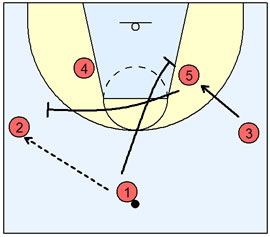


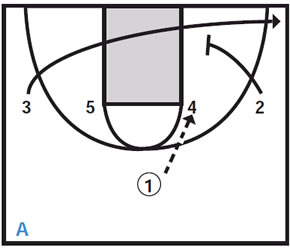
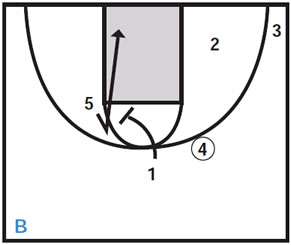
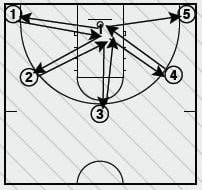
#1 enters the ball to #2 and screens for #5.

#5 uses the screen and sprints to set a ball screen for #2.

#3 moves in to get a better position to set a screen.


#2 waits for the screener( #5) to get set before driving the ball.

When #5 is set, #2 will fake baseline and drive into the middle of the lane.

As #2 starts to drive off the screen, #3 will move across the lane to form a double screen with #4

#1 moves out to the wing position.

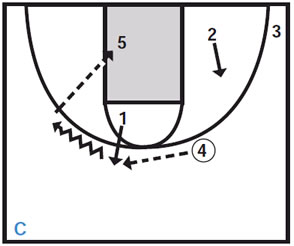
#2 will look first to score, to #5 cutting to the rim off the double screen, and then to #1 on the back side wing.
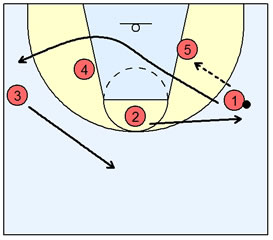
 

If #2 has passed to #1, #1 will look to #5, who should be posting hard.

If #1 passes to #5, #1 will run a “Laker cut” to the rim and then to the back side wing, if he does not receive the ball.

#2 and #3 would rotate and fill the vacated perimeter positions.
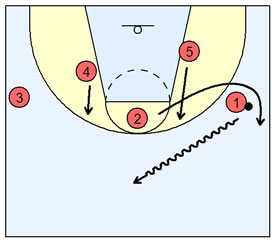
If #1 can not get the ball into #5, he will dribble out to the point.

#2 would fill the vacated wing position left by #1 and #3 would fill the opposite wing.

#4 and #5 would flash up to the high side posts.
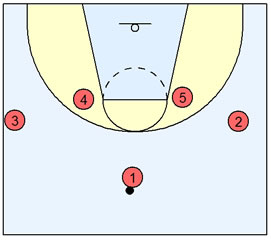


The spots have been filled and the offense is reloaded.


Point Guard Drill

By Brian Williams on April 6, 2012

The video below shows a drill to work with your point guards–or any player who drives to the basket on getting to the paint and then backing out if necessary.

The drill teaches to bounce off when there is no play to be made, then reattack–all the while the dribbler has his or her head up.

The video is 2 minutes in length.

It is a You Tube video, so make sure that you are able to access that site from the network you are on.


The Coaching Toolbox has hundreds of resources for coaching basketball including basketball practice, basketball plays, basketball drills, basketball quotes, basketball workouts, basketball poems, and more!

Basketball Plays Italy

By Brian Williams on April 2, 2012

This play is a quick hit to run against a man to man defense to post a player 1 on 1 on the low block.

This play is is a way to post a player by cutting him or her backdoor first and forcing the defense to get on the wrong side of where the feed is coming from.

It is from an old Xavier Men’s Basketball Newsletter. If you are interested in subscribing to their newsletter, you can do so at this link: Xavier Newsletter

The play is diagrammed to run for the 5 player, but you can put any player that you want to post in that spot for the play.


#1 passes to #4. #3 cuts off a screen from #2 at the right block.


#5 rejects coming off of #1’s screen and goes backdoor


#1 pops out. 4 passes to 1. 5 posts up on the left block.


Empowering Your Players

By Brian Williams on March 30, 2012

I received this in Creighton Burns’ newsletter.  It was written by:  Allison McNeil

Here are 10 things a coach can do to empower his or her athletes:

1. Create a safe/inclusive environment where every athlete is valued for what they do on the court, but more importantly for who they are and what they bring to the group. Appreciate each of your athletes for their uniqueness and the special things they bring to your team. Value the differences in your athletes and see the good in every young person you coach.

2. Allow your athletes some decision making power – on the court and off the court. There are “team” decisions and your athletes should be part of that process. On the court, at practice, use questions to engage your athletes and make them part of the decision making in game situations.

“Tell me and I will forget, show me and I may not remember, involve me and I will understand.”
Native American Proverb

3. Do not do everything for them – give them access to information and resources that they can use to help themselves now and when you are not there for them. We need to support our athletes, but we do not need to hover over them and do everything for them.

4. Encourage and reward assertiveness. Don’t shoot down your athlete’s when the show some assertiveness, it is not about controlling them it is about empowering them.
Here is a great definition of assertiveness: Asking for what one wants or acting to get what one wants in a way that respects the rights and feelings of other people.

5. Teach and encourage your athletes to think critically – to ask questions, to see things differently.

6. Teach and encourage your athletes to have a voice – to make a difference in their own lives, their community, and the world. Encourage your athletes to stand up for the things they believe in. One great way to do this is to have your team adopt an elementary school; to help at a homeless shelter; to visit a children’s hospital. You can also have your team adopt an orphanage, run for Breast Cancer, or raise money for a cause they believe in.

7. Develop independent athletes. When you do this you are increasing their self-esteem and therefore helping them to be more resilient and increasing their chances of success in basketball and in the “real world”. Your goal as a coach should be that they DO NOT depend on you!

8. Allow your athletes to express frustration and anger in an appropriate way, not bottle it up and pretend that everything is “fine” if it is not “fine”. Communication is key. Your athletes need to feel that they can express their concerns without retribution.

9. Listen to your athletes. Encourage open and honest communication – this is a skill that will help them for a lifetime of healthy relationships. There is no chance for successful relationships in life if you cannot communicate.

10. Create a safe learning environment for your athletes to take risks and Learn new things. Compliment them when they try something new, they will have more fun and improve more quickly.

The Coaching Toolbox has hundreds of resources for coaching basketball including basketball practice, basketball plays, basketball drills, basketball quotes, basketball workouts, basketball poems, and more!

Pete Carril

By Brian Williams on March 23, 2012

Here are some excerpts from former Princeton Coach Pete Carril’s book: The Smart Take from the Strong: The Basketball Philosophy of Pete Carri by Pete Carril with Dan White. By clicking on the link, you can read some excerpts from the book.

These notes originally appeared on Eric Musselman’s blog. http://www.emuss.blogspot.com/

I found them posted by Larry Ronglein on his Yahoo Basketball Coaching Group. sports.groups.yahoo.com/group/coachinghoops/

Whatever you emphasize and to the degree that you do, you get better at it. It’s results that count, and they should determine your principles. It is a mistake we all make as coaches to think there is only one way of doing something. There is not. Whatever works, works.

There’s a tendency for players to believe that because the coach is talking to someone else, they don’t have to listen. If they’re all listening, the coach won’t have to repeat the same thing to the guys who weren’t involved.

I always spent a good half-hour every day on basics. And one thing I noticed: Sometimes in an effort to shorten our practices, we cut out the basics. If we did that for a long period of time, the guys began to slip. The basics remain the key to success on every level of the game, and you can teach them.

There is a difference between teaching and coaching. When you are instructing your team about the actual game, you are teaching them, transmitting knowledge and information to them. The best situation of all is to be able to attract the best talent and be a teacher; that is what distinguishes coaches like Mike Krzyzewski, Bobby Knight, Rick Pitino, Dean Smith — although it is unfair to single them out because there are another 150 like them whose schools are not as prominent so they can’t attract the talent.

As a player, you want to be good at those things that happen a lot — that cannot be overstated. What happens a lot? You dribble, you pass, and you shoot — you want to be good at those skills. If what you are doing — what you are good at — doesn’t happen that often, then there’s no real benefit to being good at it. A wise player understands that.

Les Yellin [the former coach at St. Francis College in Brooklyn] summarized the main virtues [of players we value] as “IQ,” “EQ,” and”RQ.” IQ means what it always means — the function of intelligence. Behaving intelligently covers the whole realm of knowing what to do. EQ is energy quotient, which means having the energy to work at what you’re doing. When your EQ is good, you practice harder, play the game harder, and when it looks as though you cannot move anymore, you find a way to move some more. RQ stands for responsibility quotient. You know what to do, you have the energy or EQ, and now you have to know that whatever it is, it must be done.

I tell my guys that if they work hard every day, then they don’t have to worry about game plans, or where they play, or whom they play, or about rankings and so on. The quality of their work habits can overcome anything: praise, criticism, good or bad coaching. They have their daily behavior to fall back on.

I can check the level of your honesty and commitment by the quality of your effort on the court. You cannot separate sports from your life, no matter how hard you try. Your personality shows up on the court: greed, indifference, whatever, it all shows up. You cannot hide it.

ids are not learning the basic skills of the game because it takes too much time to teach them, because coaches and players alike want immediate results, and because the number of coaches who can and will teach you kids is declining. It is hard to teach things that take time to learn. The players themselves, when they’re young, are impatient, and they don’t want to take the time to develop other skills if they see right away they what pleases their coach, what produces immediate results like winning and success, is performing one particular function. So they don’t learn the skills, and it becomes hard for them to adjust and improve.

If a guy cannot pass, the ball stops moving. If he cannot shoot, he will always be open. If he cannot dribble, he cuts his value to the team by one third. Furthermore, if he cannot dribble, the defense will attack him. If you want to become a better dribbler, dribble. Dribble on a court, with a man guarding you. You would think that at the highest level of player — the NBA — everybody could dribble. But they can’t. It’s one of those skills we are not paying enough attention to.

No drill is any good unless it’s used in some form in the game. There is no transfer of learning. I emphasize to my guys that anything we do in practice is not a drill. If they get to thinking it’s a drill, they won’t notice it’s the same thing that goes on in the game. I have to tell them that what we’re doing in practice is exactly what happens in a game. Everything we do in practice must show itself somewhere in the game, or else we don’t do it.

Passing was the single greatest attribute of my teams over the years. A passer who can see people open is the same guy who sees where and when to screen, avoid picks, helps on defense — in other words, he can see. The passer is the same guy who knows where weaknesses are, where the drives are, and where everybody on the floor is. To score, you gotta move the ball. We pass to move the defense, and every pass counts. What I also love about passing is how much it helps to build team morale. Passing takes the tension out of a game. Passing makes everybody feel a part of the game, a part of the team. No single aspect of basketball does more to develop good team play than passing. The first thing I look for in a high school player is, Can he pass? If he can, he’s the same guys who can cut, and can defend.

If you want to learn how to shoot a specific shot in basketball, get the mechanics straight, then go out and practice hard. Once you have the right basics, you can teach yourself how to shoot. — Here’s the thing about teaching basketball: It’s just like teaching a subject in school. You stand in front of the class saying the same thing to everyone, and yet you have these differences in their ability to learn and utilize the information. The same is true in basketball. There is a limitation to what you can teach.

When a player is told what he has to do to become a better player, does he get mad at the coach, or at himself? If he gets made at the coach, he’ll never get better as a player. If he gets mad at himself, he will get better.

There’s a difference between the guys who play to win and those who play not to lose. A big difference. When you play to win, you do all of the extra things that maybe aren’t visible, but the results is that you come out on top. Playing to win [means] subordinating [your] needs to those of the team. Remember, some guys walk out of a losing game having scored 25 points and are perfectly content. If you have guys like that on your team, you’re not going to win too many games. You cannot ever forget the human equation in sports.

The essence of character is what I call mental and physical courage. Everybody has the potential for courage, but some people — because they have had to demonstrate it all their lives — are good at it, whereas others are not until the need suddenly arises and they have to learn to react. Basketball brings out the need for courage.

Everybody makes such a big deal today about team play because there’s such a scarcity of it. Greed is a reason. You have to understand the influence of greed. A player has to be selfish in the pursuit of the development of his skills, but he cannot be selfish when it comes time to blend them in with what’s good for his team.

Defense is the heart of our game. Good defense is recognizable even when you’re losing. The object of my defensive strategy is to contest every pass and shot, to force the opponent to move the ball under continuous pressure. I want the other team to play offense longer than they’re used to. Defense is not a variable. It’s a constant. Defense has to be deeply embedded in your attitude. It’s something you can do well every time — both the individual and the team. Skill is a variable. Work is not a variable. It’s an attitude. Defense is head, heart, and legs.

Nothing is more intimidating than deflecting passes. It makes a passer very tentative. I say that if you don’t use your hands, you’re committing a bigger sin and aren’t as effective defensively. My view on this is also controversial.

The truth is, you can take whatever defensive philosophy you want and reverse it and a forceful coach will make it work. It’s mostly attitude and effort that make a defense successful. But one thing — putting pressure on the ball — has more of an impact than any philosophical discussion of how to guard a man. If each player, when he guards his man, can press him, put pressure on him, you’ll disturb passes and intimidate your opponents.

Good players are always moving their legs.

The sterner the discipline, the greater the devotion.

When you’re fundamentally unsound, you inhibit the way your team can play. Poor fundamentals restrict the things a coach can teach.

Players who do not compete hard against each other because they’re afraid it will affect their friendship have trouble getting better.

I don’t like to see a guy get patted on the back for doing simple things, for doing the things he should do. You have to be able to tell a player or coach when he does a bad job that it is a bad job. You show respect by praising them when they do the things that deserve praise. They must learn the difference between what is done right and what is done wrong, and if you try to make them similar with easy praise, you’ll never succeed in teaching them the difference.

When you demand a lot, my experience has been that you get more. If you insist on less, you get thatt, too. Self-esteem comes from accomplishment, not the other way around. The more you demand, the more they give, the stronger the sense of satisfaction.

Speed follows luck and covers a multitude of sins. Wherever fast players go, they always get there faster than slower players.

Every little thing you do on offense counts. That means every pass, every cut, every screen, every dribble is part of the end result and therefore require care and concern. We try to make it simple and we work hard to make things easy.

Cut with credibility. What I like my guys to do on offense to start a game is pass and cut through the defense. The minute you do, you start to move the defense, a main goal. It also helps to identify the defense, whether it’s a zone, a combo, or a man-to-man. It is essential that when a cutter cuts through, he look for the ball. There will be no credibility to the cut unless the player executes it with authenticity, i.e., believes he might receive the ball.

Size is not the most important thing about rebounding. Knowing how to use your body, seeing where the ball is going, that’s what counts. It is not the guy who jumps the highest. The guy who jumps the highest is all alone. Jumping in a crowd is another story. Just watch guys like Larry Bird. A good rebounder plays for position, but is always attentive to the ball. You cannot lose sight of the ball. You’ve got to have some idea where the ball is going and how to prevent your man from getting it.

Solving a press. When you get pressed, there are three important things you need: First, you need someone who is good at taking the ball out — someone who can see which man is open and isn’t going to get into trouble if he gets the ball. If the guy throwing the ball in panics, or is blind, he’s going to throw the ball hurriedly, and because of where he throws it, he’s going to get the player catching it in trouble. Second, you need a player who can advance the ball to the other end of the court. Third, you have to have a scorer at the end of the press, someone who knows what to do when he gets the ball.

Make a zone run: First, you must recognize the zone: Is it a 2-1-2, 2-3, 1-2-2, 1-3-1, or some combination? Then you must remember that your decision how to attack the zone has to be based on the shot you can make. To say it another way: The shot you can make dictates your offense against the zone. The quality of your passing will determine the quality of your shot. Move the ball and move yourself so that you make the zone “run.”

Pivoting is one of the most underrated techniques and skills, and when you go to teach it, someone always asks, “Why bother?” We have to teach the player to disregard the feeling that it’s not essential, that it’s not necessary in today’s game. One reason some players disregard its importance is that they do it so easily. Generally, guys with large feet seem to have more trouble pivoting smoothly.

Fakes are like lies. The first thing I tell anyone about faking is that if you’re going to fake, your move has to look like the real thing. When you go to tell a lie, it has to be close enough to the truth to be believable. Same thing. So often, guys fake so strenuously that they telegraph the fake: Their fake looks like a fake. Young kids have to be actors and develop cunning. They shouldn’t work only on one fake; you always want to have more than one weapon. Also, if you’re wide open, don’t fake — shoot!

Conditioning: I tell my players if you play hard every time you play, you’ll be in good enough shape. Once practice starts, we work hard and that’s the best conditioning there is. Everything counts. Run hard, play hard, go after the ball hard, guard hard. Everything we do is game-condition because how you play in practice is how you’ll play in a game.

How do you know if your team has camaraderie? I can tell by the way they walk off the floor at the end of practice. You can feel their happiness vibrating; you can see how they work out together; you can watch it in the shower room — what they’re talking about, the level of excitement. There are many ways you can feel it, and it’s better to feel it than to hear it. The camaraderie practically comes out of their bodies. And you don’t feel that way when you’re losing. Losing reveals things.

A bad win is one where you score more points but they’ve outplayed, outsmarted, and outworked you. It could be a lucky win, or an undeserved win. Regardless, the point is that whatever you call it, a bad win is still better than a good loss.

A good high school coach is the salt of the earth. And when his teams are well coached, a college coach is the direct beneficiary of all his work. When players who have had good high school coaching walk on the floor in college, there isn’t much that a coach has to do. I cannot emphasize enough what it means to start with that great coach at the sixth or seventh grade who tries to get kids to do things better. Grade school coaches are the unsung heroes of this country and they’re disappearing because it takes a lot of work and constant attention. Sometimes it is too much of a sacrifice.

I don’t recruit players who are nasty to their parents. That shows they are giving less than they can give and can’t forge the bonds essential for a good team. I look for players who understand that the world does not revolve around them.

Use your assets: You have to take advantage of what you have. Marilyn Monroe and Sophia Loren did that, and we do it, too. If you have a fast team and you don’t run, you’re being stupid. And if you have a slow team, you must take the run out of the game.

There are so many things that don’t show up on the stat sheet, or in the win and loss column, that no one can explain, but you see them and they affect the outcome of games. There are hundreds of them: Players who learn how to do something just by watching compared to those who watch the same demonstration and can’t do it; who go after loose balls and come up with every one of them as opposed to someone who tries just as hard and comes up with none. How is it that one guy can deflect a pass over and over again and another cannot? Many times I ask myself the question, “Am I trying to teach this player instinct, or am I teaching him a skill?” Whether you’re trying to teach a college player or a seven-year-old, you are looking for instinct.

The most important thing that you can do is DO what you are doing well. The most important thing you can do on or off the court is to focus on what you are doing when you are doing it. When you play, PLAY. When you study, STUDY.

When I look at coaches like Tom Landry, Chuck Noll, and Don Shula, guys who were so great and maybe in later years did not remain so great, I wonder if they didn’t get a little tired. I don’t compare myself to them in terms of coaching, I just mean in terms of longevity. If you do something well enough you’re eventually confronted with the challenge of sustaining your standard of performance over a long period of time. In the last couple of years, I’ve seen a little slipping at the edges, and I’ve found myself thinking, “Whoa, you’re not doing what you’re supposed to. You let your assistants do too much coaching, you let little things slide.” You start thinking this might not be important. And you get tired: Inside yourself, you get the feeling you want to do something that you cannot do any longer.

Basketball Drills the License

By Brian Williams on March 14, 2012

This drill is from an old Weber State Mens Basketball Coaching Newsletter.

It was put together by then Weber State Assistant Coach Phil Beckner. Since then, Coach Beckner has held assistant coaching positions in the D League, with Nebraska, and now at Boise State.

Coach Beckner is currently on the staff at Boise State.

The License is an out of season shooting workout we use to challenge our guys and get them extra shots.

The players must score a 35 or better 5 times in order to get The License. Each shot made is one point.

Only players with The License are allowed to shoot three’s during the season.

You can adapt it to fit the level that you coach and the skill levels of your players.

These standards are for a Division I men’s program where 2013 unanimous choice NBA Rookie of the Year Damian Lillard played.

I would start anywhere from 28 to 30 for high schools and modify your standards as you see how your team stacks up.

license1

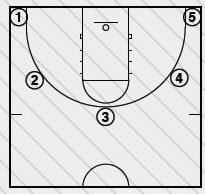
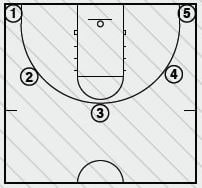
Round 1 Spot Ups: Player will start at spot 1 and move around the arc and back to shoot a total of 10 shots.

*Player is allowed to start the drill by making his first shot.

Only from spot 1 and only on this first set of 10 shots.


license2

Round 2: Cut-Into 3s:

Player will start under the basket and make a cut into spot 1 to shoot.

Player then cuts back under the basket end then to spot 2.

This is repeated for aU 5 spots, then the player will repeat the cuts starting at spot 5.10 shots total.

license3

Round 3: Transition Wing 3s:

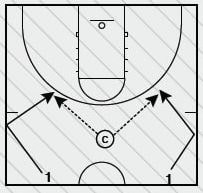
Player will start at 1/2 Court and make a cut into the wing.

Coach is in the middle to pass.


The player will shoot 5 shots in a row from the right side, then shoot 5 shots in a row from the left side.

10 shots total.

license4

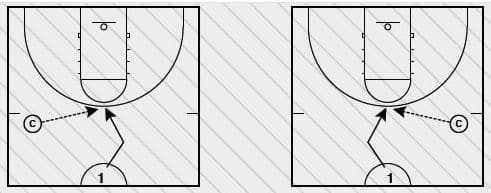
Round 4: Trail 3’s:

Player will start at halt court and shoot a trail 3 at the top of the key. Coach will pass from the side. Player shoots 5 from the right and 5 from the left. 10 Shots total.

license5

Round 5: Spot Ups

Same as Round 1 but the player does NOT start on make from spot. 10 Shots total.

  • « Go to Previous Page
  • Page 1
  • Interim pages omitted …
  • Page 259
  • Page 260
  • Page 261
  • Page 262
  • Page 263
  • Interim pages omitted …
  • Page 288
  • Go to Next Page »

Primary Sidebar

  • Twitter
  • Facebook
  • Linkedin
coachestoolbox
personaldevelopmenttoolbox
basketballplayerstoolbox
basketballtrainer
athleticperformancetoolbox
coachingbasketball

© Copyright 2026 Coaching Toolbox

Privacy Policy