• Skip to primary navigation
  • Skip to main content
  • Skip to primary sidebar

  • Basketball Plays
    • Ball Screen Sets
    • Horns Sets
    • Man to Man Post Up
    • Man to Man Isolations
    • Backdoor Plays
    • Man to Man 3 Point Shot Plays
    • 2-3 Zone Attack
    • Baseline Inbound Plays
    • Sideline Inbound Plays
    • Combination Defense Attack
  • Drills
    • Defensive Drills
    • Offensive Drills
    • Competitive Drills
    • Passing Drills
    • Rebounding Drills
    • Shooting and Scoring Drills
    • Toughness Drills
    • Transition & Conversion Drills
    • One on One Drills
  • Blueprint
  • Practice
  • Mental Toughness
  • Skill Development
  • Offense
  • Defense
  • Store

Basketball Drills Transition

Basketball Drills Transition

By Brian Williams on November 28, 2012

I found this drill on FastModel Sports Basketball Plays and Drills Library.

They have several pages with drills and plays posted by high school and college coaches.

The site has thousands of drills and plays that have been submitted by basketball coaches from around the world.

You can also find out more about FastModel Play Diagramming software by clicking this link: FastDraw

This is a way to get some variety in your drills as you work on 5/0 offense and on your transition game.


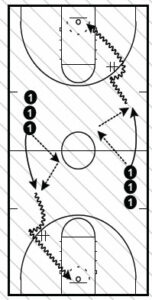
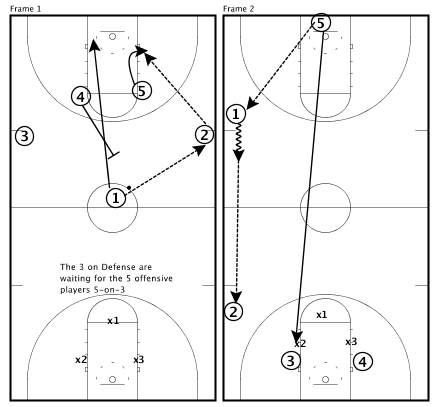
This 5-3-2-1 Push-Push Drill from Gary Colson can be used to practice running your fast break after a made basket.
Basketball Drills


Run offense against no defense.

When offense scores 5 takes it and passes it to 1 going down the sideline.

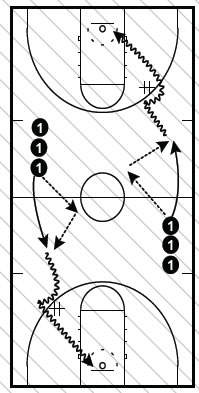
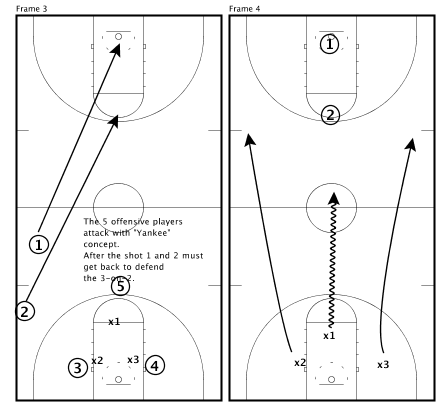
Run your secondary break into a 5 on 3 situation.


Basketball Drills


5-on-3 until they score or the defense gets the ball on a steal or rebound.

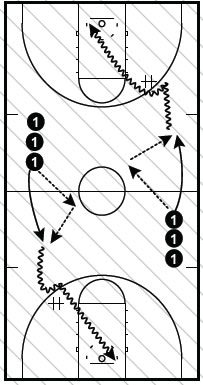
They will attack 3 on 2 which will be our 1 and 2 who transitioned back on defense.

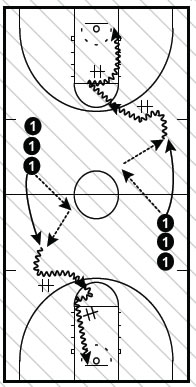
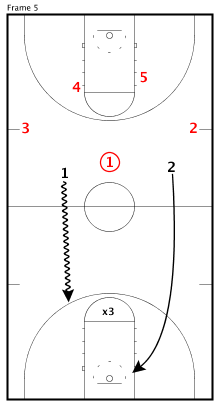
3-on-2 and whoever shoots first is back on defense vs 1 and 2.
 

Basketball Drills


We finish the (5-3-2-1) with 2-on-1.

The next 5 set up at the other end to start 5-on-0 and continue the drill



Basketball Coaching Teamwork and Motivation

By Brian Williams on November 27, 2012

These two articles were writtin by Frank Lenti, Head Football Coach at Mt. Carmel High School, but I believebvg that they are applicable to coaching basketball as well.

I found these articles on Steve Smiley’s website: SNSBasketball.com

Article 1 Motivating Young Athletes

One of the hardest parts of high school football coaching is motivating young athletes to practice. To do this effectively, the coach has to foster an understanding of the relationship between training, practice and peak performance.

He must encourage the athletes, provide structured training, and help them gain the self-discipline necessary for success and excellence on the field.

BUILDING THE COACH-ATHLETE RELATIONSHIPS

Effective motivation flows from the partnership between coaches and athletes. As coaches, we must understand our athletes as individuals and as a team ­ gain their trust and respect.

We must remember that we’re coaching people, not machines. We must teach youngsters the mechanics of a sport, but we must also assist in building their character. Showing support and interest in all facets of their lives helps build an effective coach-athlete relationship.

A good way to demonstrate such personal interest is by working out with the athletes. It will show them that you’ve been where they are, that you know it’s hard work, and that you’re willing to sweat, too.

DEVELOPING A WINNING ATTITUDE: SETTING GOALS

At Mount Carmel High School, we think in terms of attitude, motivation, performance, and success. Success is a journey, not a destination. Success is realized the moment an athlete gains a winning attitude, is motivated to set a worthwhile goal, and begins to move toward that goal.

A winning attitude is the best motivator. If athletes believe they can achieve their goals, they’ll try harder and increase their likelihood of success.

A positive coach-athlete relationship lays the groundwork for this attitude, and the setting of clear-cut goals helps establish it. Coaches should help the athletes set long-term goals and encourage them to achieve these goals through a series of short-term goals.

The incremental goals will keep motivation high, while giving the athletes an ongoing sense of achievement. Once the athlete begins developing a sense of accomplishment, he will be motivated to try even harder.

At Mount Carmel, we have our athletes write down a goal and the obstacles they anticipate in reaching it. We then identify the steps to take and the short-term achievements leading to the goal.

For example, if a football player wants to play wide receiver but isn’t fast enough, we set short-term goals to increase his speed. Each tenth of a second improvement in speed will motivate him to try even harder. If he increases his speed enough, we will give him a chance at wide receiver. If he doesn’t, we will examine why and set up a new workout schedule.

INCENTIVES AS MOTIVATORS

Incentives (material rewards for good performance) are commonly used for motivation, but may only be effective on a short-term basis. Athletes may become satisfied once they achieve rewards, such as helmet stickers or plaques, and the rewards will lose their power to motivate. We often have to increase the value or quantity of incentives to motivate players on an ongoing basis.

FEAR MOTIVATION

We do not believe that fear motivates. Fear motivation, or punishing players to “motivate” them, is only a temporary expedient. After repeated exposure to fear tactics, athletes become immune to threats, and continued punishment may destroy their desire to participate. It’s difficult to justify using fear to motivate young players.

T-E-A-M

It’s important to remember that athletes can motivate one another. We usually split the players into drill groups and score them as a team rather than as individuals. These training sessions help build team morale and make the players feel they have invested in one another. Each player has a responsibility to the team. We share the short-term goals of improving attitudes and basic skills with the long-term benefit of overall improved performance.

SUMMARY

Motivation is simply a means to an end. If we provide exposure to positive ideas over a long period of time, we will produce a successfully motivated athlete.

To summarize, this is our Mount Carmel Credo: Attitude controls motivation; motivation controls performance; performance controls success. And there’s no I in T-E-A-M.

Article 2–Building Teamwork

John Wooden, the legendary UCLA basketball coach, often said that “there are three things vital to success in athletics: conditioning, fundamentals, and working together as a team.” Of these three elements, “working together as a team” often proves to be the most elusive goal.

Teamwork is essentially an interaction of five key elements, as follows:

EFFECTIVE COMMUNICATIONS

Clear, positive communications from coach to coach, coach to athlete and athlete to athlete are essential in establishing the concept of “teamwork” and in fostering all the other basic elements of teamwork. Effective communication enables all the team members and the staff to clearly understand the team goals and work toward the achievement of the stated objectives.

As a coaching staff, we focus on two communication principles: 1) clearly and repeatedly communicating both our expectations of players as individual athletes, students, and team members, and the reasons for our expectations, and 2) remembering that effective communications is a two-way street: that is, the coaching staff must listen to the athletes, too.

WINNING ATTITUDES

All coaches know that the players with good attitudes are usually the ones who will contribute the most to the team. However, it’s not enough to inspire good attitudes in individual players: a “team attitude” is necessary in building the kind of teamwork upon which winning is predicated.

At Mount Carmel, we define a good team attitude by how well the athletes accept their roles and their responsibilities to the team. The star role is relatively easy to accept, but it is equally important for the team specialists and back-ups to understand and accept their roles and responsibilities.

Coaches should encourage this kind of attitude by setting an example: accepting all the responsibilities of their coaching position, not just the ones that they like.

TEAM EGO

Once players understand and accept their roles on the team, it is possible to take the concept of “team attitude” one step farther to “team ego.” This simply means that players must overcome their own egos for the good of the entire team.

MOTIVATION

The subordination of individual attitudes and egos cannot happen in a vacuum. The players must be given a reason to be motivated to achieve a favorable outcome for the team.

Coaches can set up a continuing system of motivation by setting long-term goals and by encouraging players to achieve them by meeting a series of short-term goals. At Mount Carmel, we also include personal and academic goals. By measuring progress in small steps, we can give each athlete an ongoing sense of achievement and keep his or her motivation high.

Athletes can also motivate one another. We usually split players into drill groups and score them as a team rather than as individuals, making the players feel they have a vested interest in each other.

DISCIPLINE

The establishment and maintenance of positive communications, team attitudes and egos, and motivation depends heavily on the final element of teamwork ­ discipline. Discipline is the glue that holds everything else together. Coaches should remember that discipline, if used fairly and consistently, is a positive force in building teamwork.

Rules are a part of discipline, although we have found that too many rules have a negative impact on teamwork. It is also important to make sure that the rules you do have are consistent with team goals, are realistic and are enforceable.

A key focus in our discipline program at Mount Carmel is developing self-discipline, which we define as “what one does when no one is watching.” We help athletes develop self-discipline through: 1) setting goals as described above, 2) clearly communicating the coach’s expectations for the players and maintaining those standards, and 3) demanding the best effort from each athlete, whether in practice, in the classroom, or in a game.

Basketball Drills Guard Out of Season Workout

By Brian Williams on November 22, 2012

This drill is from Phil Beckner. Phil has been an assistant for D-1 Men’s Programs Weber State, Nebraska, and Boise State. He also spent time as an assistant coach in the G League.

Coach Beckner had this to say about the drill:

This is a great guard/wing attack drill that allows the player to work on catching and bouncing on the move.

This drill is best with multiple players goin at once alternating lines.

Each rep begins with the player whose turn it is passing to the coach across half and receiving the ball in full stride to attack the hoop.

These drills should be done on both the right and left sides.

Also, have the players change up their finishes.

Basketball Drills

Rep 1: After receiving the ball back from the coach the player attacks the chair located on the three-point line with one dribble.

The player beats the chair with an in-n-out dribble and uses 1 or 2 dribbles to finish at the basket.


Basketball Drills


Rep 2: On the catch back from the coach the player attacks the chair with one dribble then crosses over in front of the chair to a 1 or 2 dribble finish on the other side of the basket.


Basketball Drills


Rep 3: After catching from the coach the player attacks the chair to a crossover, then with 1 dribble in between crosses over at the second chair to finish on the same side of the hoop.


Basketball Drills


Rep 4: On the catch from the coach the player attacks the first chair and crosses over, then after 1 dribble uses an in-n-out dribble to get around the second chair for a finish on the opposite side of the basket.


The Winning Attitude

By Brian Williams on November 21, 2012

What makes one person a winner and other people losers? How they think! Your self image determines your ability and your success. You will be ready mentally if you are thinking success. For instance:

A WINNER is always ready to tackle something new… a loser is prone to believe it can’t be done.

A WINNER isn’t afraid of competition… losers excuse themselves with the idea that the competition can beat them.

A WINNER makes a mistake and says, “I was wrong”… a loser makes a mistake and says, “It wasn’t my fault,” and blames someone else.

A WINNER is challenged by a problem and goes through it.. a loser does not want to face it, tries to go around it, but never gets by it.


A WINNER realizes there is no time like the present to get a job done… a loser is prone to procrastinate with the hope that things will get better tomorrow.

A WINNER thinks positively, acts positively, and lives positively… a loser usually has a negative attitude and a negative approach to everything.

A WINNER says “Let’s find out…” a loser says, “Nobody knows.”

A WINNER makes commitments… a loser makes empty promises.

A WINNER says, “I’m good, but not as good as I should be…”· a loser says, “I’m not as bad as a lot of other people.”

A WINNER learns from those who are superior… a loser tries to tear down those who are superior.

A WINNER credits his “good luck” for winning-even though It isn’t good luck; a loser blames “bad luck” for losing-even though it isn’t bad luck.

A WINNER knows how and when to say “Yes” and “No”; a loser says, “Yes, but’ and “Perhaps not” at the wrong times, for the wrong reasons.

A WINNER Isn’t nearly as afraid of losing as a loser is secretly afraid of winning.

A WINNER works harder than a loser, and has more time; a loser Is always “Too busy” to do what is necessary.

A WINNER shows he’s sorry by making up for it, a loser says, “I’m sorry,” but does the some thing the next time.

A WINNER knows what to fight for, and what to compromise on; a loser compromises on what he shouldn’t and fights for what isn’t worthwhile fighting about.

A WINNER listens a loser just waits until it’s his turn to talk.

A WINNER, would rather be admired then liked, although he would prefer both; a loser would rather be liked than admired, and Is even willing to pay the price of mild comtompt for It.

A WINNER feels strong enough to be gentle; a loser Is never gentle-he Is either weak or petty tyrannous by turns.

A WINNER feels responsible for more than his Job: a loser says, “I only work here.”

A WINNER says, “There ought to be a better way to do It,” a loser says, “That’s the way It’s always been done here.”

A WINNER paces himself; a loser has only two speeds: hysterical & lethargic.

A WINNER works hard to achieve his goals, a loser just gets by.

The Winner is always part of the answer; The Loser is always part of the problem.

The Winner always has a program; The Loser always has an excuse.

The Winner says,”Let me do it;” The Loser says;” That is not my job.”

The Winner sees an answer for every problem; The Loser sees a problem for every answer.

The Winner says,” It may be difficult but it is possible”; The Loser says,”It may be possible but it is too difficult.”

Winners have dreams; Loser have schemes.

Winners say,” I must do something”; Losers say,”Something must be done.”

Winners are a part of the team; Losers are apart from the team.

Winners see the gain; Losers see the pain.

Winners see possibilities; Losers see problems.

Winners believe in win/win; Losers believe for them to win someone has to lose.

Winners see the potential; Losers see the past.

Winners are like a thermostat; Losers are like thermometers.

Winners choose what they say; Losers say what they choose.

Winners use hard arguments but soft words; Losers use soft arguments but hard words.

Winners stand firm on values but compromise on petty things; Losers stand firm on petty things but compromise on values.

Winners follow the philosophy of empathy: “Don’t do to others what you would, not want them to do to you”;
Losers follow the philosophy, “Do it to others before they do it to you.”

Winners make it happen; Losers let it happen.

SO IF YOU, WANT TO BE A WINNER, THINK LIKE A WINNER… ACT LIKE A WINNER… AND SOONER THAN YOU THINK, YOU’LL BE A WINNER TOO!

Basketball Plays Crunch Time

By Brian Williams on November 20, 2012

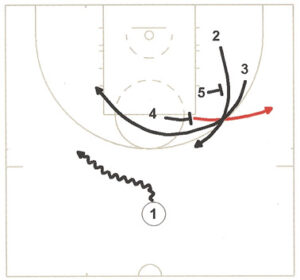
This is an idea for a play when you need a three point shot late in a game.

Even if you don’t like this play, it is a great idea to have a play that you save for “crunch time” that you don’t run at any other times, but that you know you have to go to when you need it.

There are more links below to diagrams and videosof plays to run in various situaitons and against both man to man and zone defenses.


Basketball Plays

#3 and #2 curl off of five and 4. Depending on the situation, #3 can continue the curl beyond the three point arc. Depending on the situation, and your personnel, you can have #5 turn and flare screen for #4 to get him or her to the arc. The diagram is not drawn as well as I would like, #4 should be spotting up on the arc unless moving off the arc is the only way to get the shot off.


Pick and Roll Defense Del Harris

By Brian Williams on November 19, 2012

After I sent out the video clip of an introduction to defending the side pick and roll on Friday, (Here is the 4 minute sample video link if you missed it. There is nothing to buy to see the video:

NBA defending side pick and roll

I was pleasantly surprised by one of the responses I received. It was from Del Harris, former head coach of the Lakers, Rockets, and Bucks.

He had more to add to what the video introduced and he gave me permission to post what he had written.

The remainder of this post are in Coach Harris’ words.

I think George Karl is one of the 3 great coaches in the NBA game today and thought his asst did a nice job for a 4 minute presentation. I just felt compelled to add what he did not have time to add in the event some younger coaches thought that this may be all there is to it.

This (the video link above) is a good intro into turning the wing pick and roll down and certainly no one can cover all the contingencies in 3-4 minutes. One of the basics that should be noted, though, is that the execution by the defender on the picker must be emphasized. It is not satisfactory for the defender to lay back well off of the ball action. He needs to be no more than a step and an arm length from the picker and in an excellent defensive stance. He cannot be in a standup position. He has to be able to get down and move his feet. If the ballhandler is still able to get the split or to execute the short bounce to the picker on the short roll, (often now called the pocket pass), the defender on the picker must close up to whatever it takes to prevent the split or the easy catch and shoot/drive by the picker after a pocket pass.

There are at least three things that the team defense must be ready for which emphasizes the point we make that “it takes 5 men to defend a well executed ball screen (pick/roll or pick/pop).” Of course, one is that the ball handler can pull up and shoot, so the ball defender should be close enough to challenge that shot, but if not, the picker defender must do that. Along that line the most common mistake the ball defender makes in this coverage is to get to an extreme position in turning the ball down. A good defender can make the ball go sideline by getting no more than square to the sideline as he moves up into the ball handler when he hears his teammate yell that they are turning the ball down (regardless of what they name that coverage). The coach makes a good point about the mistake of always looking back to see the picker. Even worse most players want to get next to the picker and actually screen themselves instead of moving up into the ball handler.

If the ballhandler beats both men and tries to get to the rim, the weak side low defender must attack the layup. But the most common results are the pass to the roll man and the short pocket pass to the picker in the general elbow area (15-20 feet from goal).

On the roll, the picker defender who is in a good defensive stance will try to play 2 men as long as he can (the ball and the roller). Hopefully, the ball defender will be able to catch up and get between the ball and the goal and then each thus gets back to his own man, but that does not always happen. If the picker defender sees that the ball defender will not recover, he will communicate that he has the ball and the ball defender will make a late switch to get between the roller and the ball, if possible. In any event the weak side low man must get to the roller and take him, and yell for the original ball defender to go to “p[ass off the small defender”—meaning he is taking the roller and the man must go weakside and find a man to put his body on.

Of course, one can utilize options other than the “late switch” noted here. One can rule that theball defender will continue on with the ball and trap the ball with the picker defender. The weak side low man must take the roller and, of course, the other two defenders rotate to cover the weak side low and/or outside shot areas, depending on where the fourth/fifth men might be located.

If the short pass is made to the pop man on the pick and pop move on this, it is little problem if the pop man is not a good shooter.

The defender on him can just help with the ball man and recover back to his own man, though the weak side top man at the nail should at least stunt a little at the non-shooter, but not so much as to leave his own man who is probably a better shooter.

Assuming a player will not pop unless he is an adequate shooter, then the weak side top man must rotate to the popper and the rest of the defense rotates up a man as well, with the original defender on the picker/pop man going weak side low to pick up.

Much communication is required as is the constant case in all defensive maneuvers. Regardless, of how much time a team spends on this, or any other technique for defending ball screens, a team must have a plan B, and usually a plan C as well, when playing a pick and roll team. Some teams are so adept at the pick and roll game that they run as many as two or three in a possession and 50 to 80 in a game in the NBA. In fact the pick and roll is now being over-used in my opinion and the colleges are falling right into that trap. Too much pick and roll stifles ball movement and the penetration game. By that, I mean that if a man is always running at the ballhandler and bringing another defender to the ball, there are limited options for the ball handler to see the gap for penetration to get to the basket or to get inside the defense to create inside shots or kickouts for his teammates.

In the end the best defense against the ball screens is to switch the switchable ones. If you cannot do that, you can choose for various alternatives relative to the talent of the opponents in the action and that of the defenders in it. You will want to have a trap option normally. You may want to have a more aggressive option for your athletic picker defenders and a more containing one for the slower big players.

The easy way out is to have only one way or two ways. That way you do not have to teach and coach as much and can blame it on the players for just not getting the job done. Or you can take it on yourself as coach to be able to make the proper adjustments in your game plans or during a game at at time out to throw a wrench into the action that is beating you at the time.

Multiple defense does not mean that you have to have three separate styles of man to man and 4 different zone defenses. Not at all. Being multiple means that you can prepare your team to make adjustments to defend whatever actions are beating you at the moment. You don’t ever have to use a zone or you can use a zone 100% of the time and still have a multiple defense system. Many have misunderstood the meaning of being multiple.

Del Harris, GM Texas Legends
Author, On Point -four steps to better life teams
I told Coach Harris that I as a thank you for his giving me permission to post his thoughts, I would help to spread the
word about his book “On Point.”

You can read a free sample by clicking here: On Point Sample

This is what Coach Harris had to say about the book:

“Every coach should have his point guard read my book. It came as a result of my speaking at the Nancy Lieberman
Award in Detroit in 2010. I wanted to say something that would make sense to the hundreds who would be there who were not the women’s NCAA D-1 best point guard in America, getting the award named for Hall of Fame PG and all time greatest woman player. I came up with the idea of noting the qualities in terms of abilities and attitudes that made for great point guard play. Then I showed how we all could mine those elements from within ourselves on the various Life-teams of which we are and would become a part.

The book will not only be good for the PGs to read but will absolutely make the coach a better coach. I wish I had known all that I have written when I was in my 20s , 30s or 40s. I am totally confident that what I have written is truth and it is backed up totally by biblical principles.”

Best regards and blessings to all, Del

For another sample and if you are interested in purchasing the book, you can click this link to see it on Amazon:

On Point: Four Steps To Better Life Teams

  • « Go to Previous Page
  • Page 1
  • Interim pages omitted …
  • Page 246
  • Page 247
  • Page 248
  • Page 249
  • Page 250
  • Interim pages omitted …
  • Page 288
  • Go to Next Page »

Primary Sidebar

  • Twitter
  • Facebook
  • Linkedin
coachestoolbox
personaldevelopmenttoolbox
basketballplayerstoolbox
basketballtrainer
athleticperformancetoolbox
coachingbasketball

© Copyright 2026 Coaching Toolbox

Privacy Policy