• Skip to primary navigation
  • Skip to main content
  • Skip to primary sidebar

  • Basketball Plays
    • Ball Screen Sets
    • Horns Sets
    • Man to Man Post Up
    • Man to Man Isolations
    • Backdoor Plays
    • Man to Man 3 Point Shot Plays
    • 2-3 Zone Attack
    • Baseline Inbound Plays
    • Sideline Inbound Plays
    • Combination Defense Attack
  • Drills
    • Defensive Drills
    • Offensive Drills
    • Competitive Drills
    • Passing Drills
    • Rebounding Drills
    • Shooting and Scoring Drills
    • Toughness Drills
    • Transition & Conversion Drills
    • One on One Drills
  • Blueprint
  • Practice
  • Mental Toughness
  • Skill Development
  • Offense
  • Defense
  • Store

Basketball Defense Run and Jump

Basketball Defense Run and Jump

By Brian Williams on March 25, 2013

These notes and diagrams of the run and jump press are from the University of Wahington Women’s basketball coaching Newsletter.

If you would like to subscribe, email me and I will forward your interest on to Coach Mike Neighbors,

The drills for the press are at this link

The notes are from the Run and Jump Press that is run by Coach Eddie Antrist of the University of Wisconsin-Stout

When running the press you do not need to steal the ball

If you think steal you will reach and foul
You want the offense to make mistakes
Teams that press tend to be over anxious

When starting the press you want to Pressure the ball right away.

You don’t want the ball to be thrown in quickly
Better if one of your bigger players is on the ball.
Whoever scores is immediately on the ball.
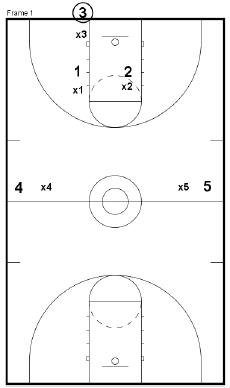
Basketball Defense


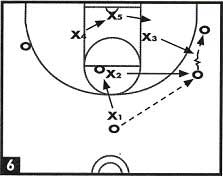
X1 and X2 do not deny the inbounds

Stay behind the offense and allow them to catch the ball.
We want them to catch the ball in front of us.
If the ball is inbounded above the FT extended we are
automatically in the Run and Jump.
If they screen we will switch.

X4 and X5 are in a side position

We do not want the ball thrown over the top.
Not a total denial, nor behind
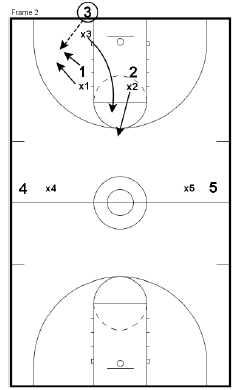
 

Basketball Defense


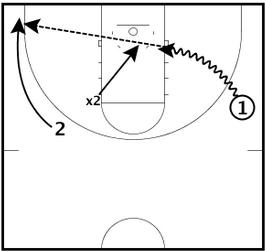
When the ball is thrown in (Frame 2) X1will put immediate pressure on the ball.

We are not worried about getting beat

Inbound defender must get below the line of the basketball into a gap position.

X2 and X3 must be on the ball side of the midline.
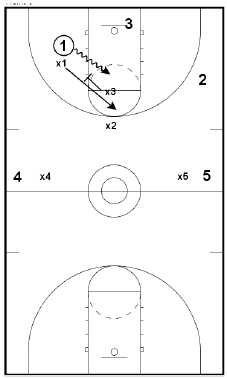


Basketball Defense

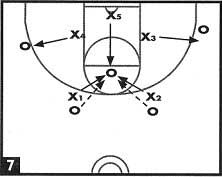
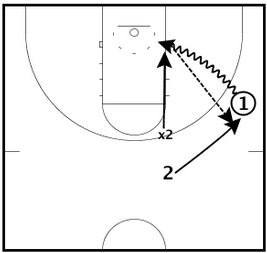
As you pressure the ball your objective is to get the ball into an uncontrolled dribble.

If they dribble to the middle we run and jump.

X1 will continue along that line and settle in the middle of the floor.

We do not want a reach and a foul.
Don’t let the offense be comfortable.
We are not thinking steal, they will throw it away.

Get high hands on every run and jump situation.

If 4 or 5 would flash to the middle, the defender must take away the flash
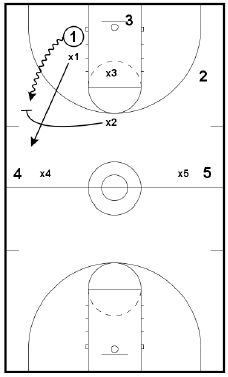
Basketball Defense


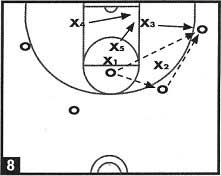
If the ball is dribbled sideline, You could run and jump with the second line defender.

The original ball defender would continue along the same line

We do not want the deep defender (X4) to jump; it makes to pass over the top too easy.
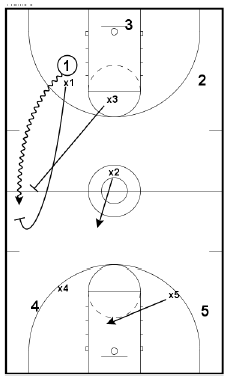


Basketball Defense


Sideline Trapping (Blue Look)

When the ball is dribbled up the sideline, we will is turn and sprint and cut the offensive player off at some point.

We will chase from behind at get a trap near ½ court.

Trap could happen all the way down the court

You don’t always know who is going to rotate. X2 could cut off the dribble while X1 traps from behind.
 

Amoeba Defense

By Brian Williams on March 22, 2013

This article focuses on the Amoeba defense as it was played by UNLV under Jerry Tarkanian,

However, the Amoeba defense was created at the University of Pittsburgh when Buzz Ridl was the coach there. He had an assistant coach named Tim Grgurich, who was later on Tarkanian’s staff and showed it to Coach Tark. Coach Ridl’s assistant Coach, Fran Webster, actually devised it..

(Thanks to Randy Nesbit and Randy White for the background on the Amoeba Defense!)

By Steve Mergelsberg [email protected]

While living in Las Vegas and coaching at Bishop Gorman High School, I had the opportunity to sit down with Tarkanian and have him explain the amoeba defense. Termed “amoeba” for the way it flexed and stretched, it allowed a perimenter defender to put man pressure on the ball-handler while the remaining four players protected their set areas on the court.

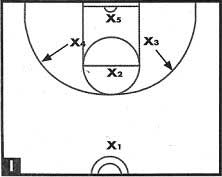
The following is the basic alignment for setting up the amoeba defense

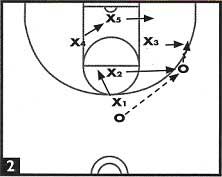
This is the setup that your defenders need to be in when the offensive team is bringing the ball up-court. XI is responsible for picking up the ball handler as soon as he or she crosses half court. Xl’s main job is to harass the ball handler, making it tough to dribble up the floor and pass to a teammate. X2 patrols the free-throw-line area looking for flash cuts to the high-post area.

The tandem of XI and X2 should be the quickest players on your team. X3 and X4 are halfway between the free-throw line and the baseline, facing on an angle toward the sideline. X5 is the “hoop defender,” the last line of defense guarding the basket. X5 stands as far back as needed to see the whole floor and must never get beat from behind.

When the ball is passed from the point to the wing, X2 charges out to play the opponent with the ball.

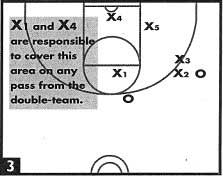
XI retreats to guard the free-throw area. When the ball handler initiates a dribble, X3 sprints out to double team with X2. X5 moves over to the block area and X4 rotates to become the hoop defender.

If the ball is passed back from the wing, X2 goes back to his or her original spot at the foul line and XI pops out to the top, back to his or her original spot.

XI and X4 are responsible for covering the shaded area on any pass from the double-team. The ball is now double-teamed at the wing. XI can either deny the point player or encourage a reverse pass from the double-team for a possible steal.

Tarkanian believed that if X2 and X3 are doing a good job of double-teaming, any pass cross court will be high enough in the air to be picked off by either X4 or XI, depending on where the pass is thrown.

Defending wing-to-corner passes.

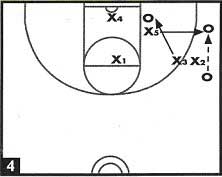
When the ball is passed from the wing to the corner, X5 comes flying out and closes out on the corner player with the ball.

When X3 sees that the ball is being passed from the wing to the corner, he or she pivots and sprints to the low-post area, in what Tarkanian called an “X-cut.” X3 fronts the low-post offensive player. The gamble here is when the corner offensive player gets the ball and X5 is sprinting toward him or her, the player with the ball will see the low-post player open, not knowing that X3 is on the way to that area.

Many times, in a panic, the corner player instantly passes to the seemingly open post player and X3 comes up with a steal. Tarkanian’s belief is that if X5 is closing out and tracing the ball, a good pass will be impossible to deliver and X3 will come up with a steal. XI and X4 are still responsible for the weak side of the floor. X2 denies the reverse pass back to the wing from the corner. Any attempt to pass to the point will be picked off by XI.

Defending Cross Court Skip passes

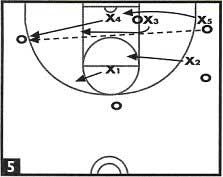
The rule on any skip pass to the other side of the floor is that the closest player covers the player with the ball.

The pass is complete from the corner. X4 would be the closest defender to the ball, so he or she would cover the receiver.

X3 goes from low post to low post and X5 would become the hoop defender. X2 retreats to the middle to provide any help that is needed and XI would deny the pass to the point.

This diagram shows the initial entry pass as seen in Diagram 2, but here you have an offensive player on the high post. In this case – just as in Diagram 2 – when the ball is passed to the wing, X2 sprints out to defend and XI drops down to play the offensive player in the high post.

This leaves the point guard alone, the theory being that he or she can’t harm you being hat far from the basket. If the offensive wing player with the ball takes a dribble, X3 comes out to defend and double-teams with X2. XI, who’s denying the high post, can anticipate a pass back to the point and go for the steal.

At this point, if the ball is passed from the wing to the corner, X5 sprints out and plays the corner player. X3 “X-cuts” and goes to defend the block area and X4 becomes the hoop defender. X4 and XI are responsible for stealing anything thrown cross court from the block area and higher. This may seem like a lot of area to cover, but Tarkanian believed that if your defenders are playing good, hard-nosed defense, the only pass that will be thrown is one high in the air that X4 and XI have a great chance for a steal.

Amoeba vs. Two-Guard Front

Some offenses try to beat the amoeba by utilizing a two-guard front.

If the offense plays a two-guard front, XI and X2 match-up with the guards. If the offensive team puts a player at the high post, X5 comes up and guards behind. This encourages the offense to make a pass into the high post, which is what you want to happen.

If the ball is passed into the high post, XI and X2 immediately double down and create a triple team at the high post. This may cause the high-post player with the ball to panic and either give up his dribble or throw an errant pass. X3 and X4 anticipate any passes into their areas and go for the easy steal.

Beating the Triple-Team

If the triple-team in the high-post area fails and the high-post player manages to get a pass to either the wing or the corner areas, your defenders react accordingly.

When the ball is passed to the wing from the post, XI retreats to the high-post area and denies the post. X2 plays the wing player and X3 denies the pass to the corner or encourages a pass and gets a trap or steal in the corner. X2 may sprint down and double-team the corner player, depending on the game situation. X4 becomes the hoop defender and X5 guards the low post.

XI, who’s playing the post, must anticipate passes to the point from the corner, the wing and cross court. This is one of the reasons why it’s critical that XI and X2 be your quickest players. XI and X2 must always be alert and have the ability to anticipate defensively. If the ball is passed to the corner from the post or wing, X3 sprints out to play the corner player, X5 drops to the low-post area and X4 becomes the hoop defender.

XI denies the post and X2 denies the pass back to the wing from the corner or encourages the pass and looks to make a steal. A pass from the corner to the point weak-side guard can be picked off by XI and taken the other way for an easy layup.

Coaching Basketball–Exposing a Thief of Team and Individual Success

By Brian Williams on March 21, 2013

This is the first part of a two-part article written by Coach Ed Schilling.

He has been the Head Coach at Division I Wright State and Pepperdine. He served as an assistant coach for John Calipari at UMass, with the New Jersey Nets, and at Memphis. He was on the UCLA staff as an assistant for four years, at Indiana for 2 years, and Grand Canyon for 4 years.

Ed guided Park Tudor (Indiana) High School to the 2011 and 2012 Indiana 2A State Championships.

Exposing a Thief of Team and Individual Success

by Ed Schilling

One of my favorite things about basketball–playing and coaching– is the friendship and comradery that develop and strengthen throughout the course of a season. Memories from the really good teams that I have been a part of are not my points per game, assists or minutes played. Those most meaningful memories are the brotherhood, the friendships, the good times in the locker room, and the joy of “going to war” together. Ask a professional athlete after he retires what he misses most, and he will probably tell you that he misses the relationships and putting on that uniform with his teammates and going to battle with those whom he has poured out blood, sweat and tears.

As great and fun as athletics can be, the joy can be stolen and the unique opportunity to form life-long friendships can be easily missed when the vision shifts from the “we” to the “me”. The goal in sharing insights from over three decades of my playing, coaching and parenting is to help max out the enjoyment, the recognition, the improvement and the winning and avoid the “thief” of these of basketball delights.

Enjoyment

“If you want to be miserable, all you have to do is be selfish.” –Joyce Meyer

“Happiness ends where selfishness begins” –John Wooden.

When playing high school basketball in Lebanon, IN, we had a team that had a blast together. We loved playing ball with each other, whether in the park in the summer or in the gym during the season. We trusted in each other and believed that we had each other’s best in mind. As a result of our trust, we were one of the best teams in the state. Although I later became a starter on Division 1 conference championship and NCAA tourney teams, I probably never had more fun and enjoyment than I did with that high school team. Perhaps the foundation of the positive experience laid in the fact that neither the players nor the parents had selfish agendas. We wanted to win and we cared about each other. I learned a significant lesson from that team—if one wants to really enjoy the basketball experience then value the other guys on the team.

By the way, those parents had a great experience too. They didn’t worry about the coaching, stats, newspaper articles, rankings or awards—they positively supported and encouraged instead of complaining and manipulating for their child’s “benefit”. I have come to the conclusion after many years in basketball, that an athlete cannot truly enjoy the basketball experience if the parents are negative at home. Players listen and absorb what the parent’s say and carry the emotion of home into the practice and games. If the parents are “killing” the other players or the coach, the player cannot help but to be impacted. The negative impact steals the joy from the game, ultimately hurting the team. When the atmosphere is positive and encouraging those attitudes are reflected in the energy, enthusiasm and effectiveness of the players.

Recognition and Promotion

“As the tide rises all the boats rise.” –John F. Kennedy

A misconception is that individual stats get players opportunities to play at the next level.  The truth of the matter is that every team has a high scorer. Scoring a lot doesn’t make or break a player’s future opportunities.

 If a player can “play”, college coaches recognize it and NBA decision makers see it.  Playing well and helping the team win ultimately produces more recognition than getting big statistical numbers.  In 1996, I was an assistant men’s basketball coach at The University of Massachusetts.  We were #1 in the country for 10 straight weeks.  Our star player, Marcus Camby, didn’t care about stats—he cared about winning.  Some games he scored a lot, other games he didn’t.  He didn’t finish with gaudy numbers, yet he was the National Player of the Year.  He made his teammates and team better and the country recognized it.  During the course of the ’95-‘96 season, nearly every player on the team had a major article or news story done on them.  Even the players who rarely got in the games got noticed for their work in preparing the starters to execute well in the games.  There were many players in college basketball that scored more and averaged more minutes, yet it was Marcus Camby who received the John Wooden Player of the Year award.

Another example of team success producing individual promotion was the University of Florida Men’s Basketball team in 2006-07.  This team won the National Championship.  The highest per game scoring average was 13.3.  So, none of them got the chance to play in the NBA right? Wrong!  All five starters were drafted and played in the N.B.A. And, get this, the sixth man on that Florida team who averaged 6.2 points a game and only 18.4 minutes a game also played in the NBA.  Yes, “as the tide rises all the boats rise.”

There are examples after examples of players getting attention and promotion because of team success.  On the other hand, if the team doesn’t win, chances are that college recruiters or NBA front office people will be skeptical of a player’s ability.  Of course, one cannot promise that when players (and parents) channel their energies into making the TEAM the best it can be, regardless of the player’s role, that everything will work out perfectly.  However, one can just about guarantee that if players (and parents) focus on personal stats and selfish agendas, promotion and recognition will be thwarted.

After decades in the basketball business, I cannot recall a single example of when a player got upset and “concerned” over numbers or minutes played where proved to be helpful to the player or to the team.

Preparation

“If you STAY ready, then you don’t have to GET ready.” –-David Dawson

The rules of the game of basketball allow only five players on the court for each team at a time; therefore, a majority of the team will be on the bench during the game.  The players who don’t get to play in the game or don’t get a lot of minutes in the games are still almost always required to be at every practice and are expected to give their best effort at the practices.  This is a challenging part of basketball.   The attitude and effort given by that “bench player” in practice will significantly impact the team’s success.  Further, the attitude and effort will significantly impact the “bench player’s” potential to do well if, and when, he gets an opportunity in the game.

I spoke previously of the ’96 Marcus Camby led UMass team.  That team got to the coveted Final Four in the NCAA Tournament.  UMass played a talent-loaded University of Kentucky team in the Final Four.  In the game, UK got off to a great start and UMass couldn’t get going and struggled most of the game.  Midway through the second half Coach Calipari looked down the bench and called Giddell Padilla to go into the game.  Now Giddell’s younger brother (Edgar Padilla) was the starting point guard, but Giddell who was a senior rarely played.  In fact, as he was checking into the game the announcer said, “ Giddell Padilla to enter the game, let’s check his stats… Giddell Padilla has no real stats!”  What people outside the program didn’t know was that Giddell challenged and competed every single day of practice and tried to beat the starting guards every minute of every practice—yet rarely did he get any time in the games.  In practice, he often out played the starters.

When Giddell got into that game he made an immediate and positive impact.  He stole the ball and took it in for a lay-up, then deflected a pass, then an assist.  All of a sudden UMass got some momentum and the crowd of over 20,000 started roaring, UMass was back in the game.  Giddell Padilla played well and actually played more in the second half of the Final Four game than he did the entire season.  How could he play so well on such a big stage?  The reason he played so well was because he competed well against the starting backcourt (which was one of the best in Division 1 that season) every day in practice. He could have been upset that his younger brother was a starter or that he deserved to play at least some minutes, but he wasn’t.  He found enjoyment in the team’s success, and he “stayed ready” to play in the game by working everyday in practice.

Well, UMass lost that close and highly competitive game to UK who became the National Champions two days later, but Giddell Padilla’s performance did not go unnoticed.  Shortly after the season, he was offered and accepted a lucrative contract to play professionally in his native country of Puerto Rico where the game had been televised.  He became somewhat of a celebrity in Puerto Rico because of one game—one game that happened because he “stayed ready” even-though his chance of actually getting in the game was doubtful at best.

By working to make those guards playing ahead of Giddell better, Giddell got better himself.  His unselfishness and consistent effort put him in a position to have an experience that positively impacted the rest of his life.

Unfortunately, I have seen the opposite happen so often when “bench players” lose their drive to practice with passion, then when their opportunity does come in the game, they perform poorly.  Further, staying focused and passionate on the bench during games is important.  If Giddell had been stretched out on the bench, not paying attention or had a sour look on his face because he wasn’t getting any playing time, it is unlikely that Coach Calipari would have put him in.  Giddell’s effort in practice for six months could have been thwarted by six seconds of bad non-verbal on the bench when Coach Cal looked his way.

Click here to read part 2 of this article

Basketball Drills Relocation Shooting

By Brian Williams on March 20, 2013

These shooting drills came from Fast Model’s Plays and Drills Library. It was contributed by Brandon Bailey–current video intern for the Boston Celtics and former graduate assistant at DePaul under head coach Oliver Purnell.

You can access the page for more Drills and Plays here: Fast Model Library

I hope these drills will stimulate your thinking as to how to break down your offensive system and the shots your players get, into their out of season workouts.


Baseline Drift

Basketball Drills

– 1 man sweeps the ball below his knees and drives to the basket

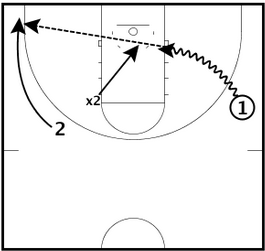
– 2 man simulates his man helping on the drive and drifts to the baseline

– 1 comes to a jump stop and passes to 2 for with his baseline hand for the shot

(NOTE: 2 man, don’t sprint to the corner. Stay in your stance and slide to the corner)

Crack Back

Basketball Drills

– 1 man sweeps the ball below his knees and drives to the basket

– 2 man simulates his man helping on the drive and drifts to the wing

– 1 comes to a jump stop, reverse pivots with his 1/2 court foot, and passes to 2 for the shot

(NOTE: 2 man, don’t sprint to the wing. Stay in your stance and slide to the wing)

Wake

Basketball Drills

– 1 man sweeps the ball below his knees and drives to the basket

– 2 man simulates his man helping on the drive and drifts to the wake

– 1 comes to a jump stop, and passes with his 1/2 court hand to 2 for the shot

(NOTE: 2 man, don’t sprint to the wake. Stay in your stance and slide to the wake)

Basketball Plays 35

By Brian Williams on March 19, 2013

This play is run against man to man defense.

I got it from a Creighton Burns’ newsletter.

If you are interested in receiving his newsletter, contact us and I will put you in touch with Coach Burns.

In his newsleter, Creighton added that for everthing he runs, if the play breaks down, his team immediately begins to run his motion offense.

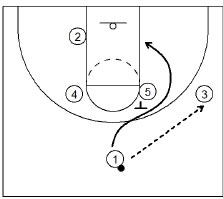
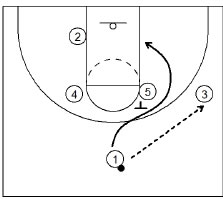
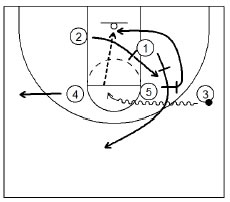
He calls the play “35” and starts it in a 1-3-1 set.


Basketball Plays

#1 enters the ball to #3, and runs a UCLA rub off the back screen set by #5.

If #1 is open on the cut to the rim, #3 can give him the ball.


Basketball Plays

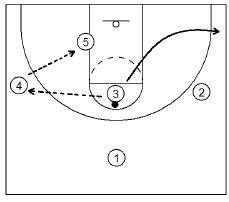
#5 will step out and set a ball screen for #3.

#3 will drive the ball into the middle of the lane, looking to drive the ball thorugh the nail hole.

#1 and #2 move to set a staggered double back screen for #5.

#3 will look for his shot first, and then to #5 rolling to the rim, utilizing the screens set by #1 and #2.

Basketball Plays

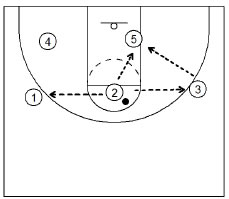
If #3 makes a pass to #4, he will cut away from the ball and fill the backside baseline corner.

#1 and #2 will fill the point and back side wing respectively.

#4 will look to get the ball to #5 who is now posting hard down in the low past area.

Basketball Plays

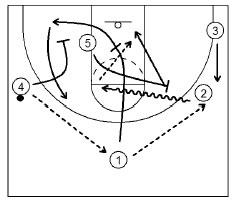
If nothing is open, #4 will start ball reversal by making a pass to #1 at the point.

#1 will swing the ball on to #2, and then cut down through the middle setting a screen for #5.

#5 will sprint and set another ball screen. This time he is going to ball screen for #2..

#2 will use the screen and drive the ball into the lane, looking first for his shot, and then the pass to #5 rolling to the rim.

As #2 drives the ball, #4 down screens for #1.

If #2 does not have a shot, or a pass to #5, he may hit #1 coming off the screen for a shot.

Basketball Plays

#3 has four options. He may have a scoring opportunity on his penetration, he may feed #5 rolling to the rim, he may hit 1 curling off the down screen, or he may throw back to #3, who has moved up to the back side wing.

If #3 gets the ball, he will look to get the ball down low to #5.

After passing the ball to either #1 or #3 on the wings, #2 will go and ball screen and the three perimeter players would start a three man weave looking to develop a scoring opportunity.

Two Minute Drill

By Brian Williams on March 15, 2013

The Two Minute Drill is one of our favorite basketball shooting drills and develops:

  1. Ability to shoot free throws under pressure
  2. Conditioning
  3. Footwork coming off of a screen or cut
  4. Three-point shooting
  5. Mental Toughness/Competitiveness
  6. Making shots under pressure

Basketball players are highly competitive people by nature; therefore it is beneficial to design baketball drills that provide an opportunity for players to compete against other players or against themselves. The competition increases the player’s enthusiasm for the basketball shooting drill and results in better intensity during the training session. The Two Minute Drill requires only one player. The players compete against themselves for their best score. However, it is extremely helpful to have someone timing the drill.

Many players practice free throws by shooting 100, 200 or possibly more in each practice session. While volume shooting is an important part of developing confidence and rhythm on free throws, this type of practice does not subject the player to the same conditions that exist while attempting free throws during a game. Pressure and fatigue are just two factors that may affect free throw percentage. To be a successful free throw shooter in games, players must be able to step to the line a make two in a row while fatigued and under pressure.

The Two Minute Drill is designed for player to do just that. Players must step to the free throw line and make two pressure free throws while fatigued.

The objective of the Two Minute Drill Game is for the player to move from level one to the highest level possible. In order to advance from one level to another, the player must make a power lay-up, a spin-and-catch intermediate shot and a three point shot.

The player must shoot until he/she has made each shot, even if s/he misses each one four times, the level is not completed until each of the three shots goes in.

After making the three-point shot the player immediately (with no rest!) steps to the free throw line to shoot a one-and-one free throw. If the player makes both free throws he/she advances to the next “level” and must again make a short shot, a midrange, and a three point shot. If the player misses a free throw he/she must remain on that level.

Once the player makes all 3 shots and validates it with a one and one, they get that “level” in the bank. The number of times they do that is the number of levels that they achieve for the drill.

The drill is timed for two minutes. The stopwatch only runs while the player is shooting shots from the field, like a game. It does not run during free throws. If there is no one to time the player can wear a sport watch to time him/herself. The timing of the drill is very significant to its effectiveness because the clock pushes the player to run hard after rebounds and to shoot shots that are more game-like. However, if no timer is available, the player must push him/herself to go hard. To make it competitive, the shooter can be limited to a total number of misses or to commit that the first missed free throw will end the game.

Players compete each practice session against the highest level they have ever achieved. They may also compete against other players by seeing which player reaches the highest level in a given amount of time.

The game may be altered to more benefit to post players. Post players may choose to substitute the three-point shots or the intermediate shots with jump hooks or other post moves. It is easy to come up with several other variations to keep the drill from becoming monotonous.

In the video, the player is shooting a stationary layup. This drill would be better served by having the layups be more gamelike. Have the player start from 10 feet away and make a dribble. Require that they shoot with their off hand. Or, require a revese layup, a Rondo move, or another finsh that you teach. If you teach floaters or runners, make that be the first shot.

Find a way to make it work for what you are wanting to accomplish.

The idea is to find a way to make the drill competitive to motivate your players to go at a gamepace.

  • « Go to Previous Page
  • Page 1
  • Interim pages omitted …
  • Page 236
  • Page 237
  • Page 238
  • Page 239
  • Page 240
  • Interim pages omitted …
  • Page 288
  • Go to Next Page »

Primary Sidebar

  • Twitter
  • Facebook
  • Linkedin
coachestoolbox
personaldevelopmenttoolbox
basketballplayerstoolbox
basketballtrainer
athleticperformancetoolbox
coachingbasketball

© Copyright 2026 Coaching Toolbox

Privacy Policy