• Skip to primary navigation
  • Skip to main content
  • Skip to primary sidebar

  • Basketball Plays
    • Ball Screen Sets
    • Horns Sets
    • Man to Man Post Up
    • Man to Man Isolations
    • Backdoor Plays
    • Man to Man 3 Point Shot Plays
    • 2-3 Zone Attack
    • Baseline Inbound Plays
    • Sideline Inbound Plays
    • Combination Defense Attack
  • Drills
    • Defensive Drills
    • Offensive Drills
    • Competitive Drills
    • Passing Drills
    • Rebounding Drills
    • Shooting and Scoring Drills
    • Toughness Drills
    • Transition & Conversion Drills
    • One on One Drills
  • Blueprint
  • Practice
  • Mental Toughness
  • Skill Development
  • Offense
  • Defense
  • Store

Basketball Plays Chicago Bulls Inbounds

Basketball Plays Chicago Bulls Inbounds

By Brian Williams on May 7, 2013

If you have an article or a play that you would like me to post, please email me.

This article was written and submitted by Jeff Haefner of Breakthrough Basketball

The play resulted in Bulls sharpshooter Marco Belinelli getting two clean looks at the basket.


Basketball Plays


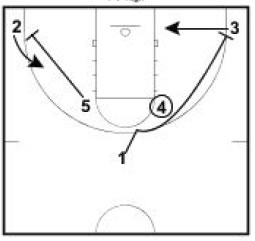
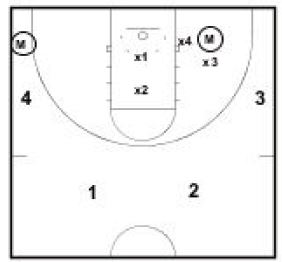
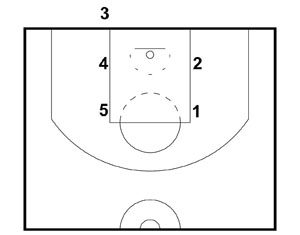
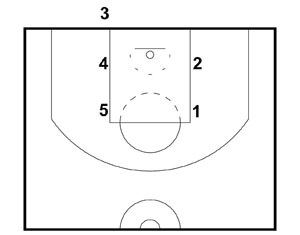
Here is the initial formation of the play.

The posts are lined up on the strong side and the guards are lined up on the weak side.


Your best shooter should be on the weak side block. Your two best screeners should be on the strong side. Your best passer should inbound the ball.
Basketball Plays


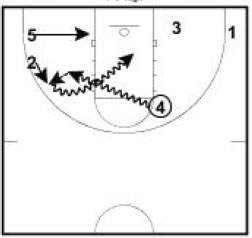
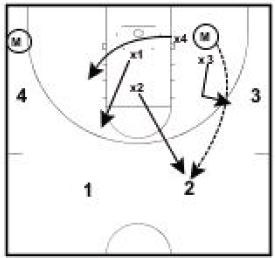
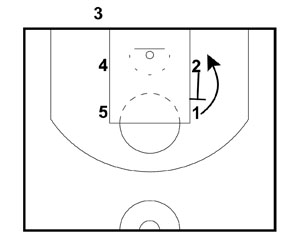
The play starts with 2 setting a back screen for 1 on the weak side.

If 1 is open, you can hit him for a lay up. But the initial option is just a decoy.
 

Basketball Plays

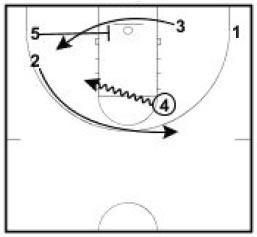
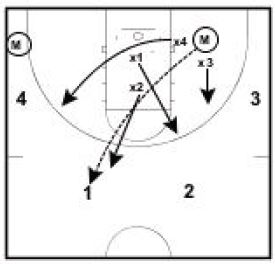
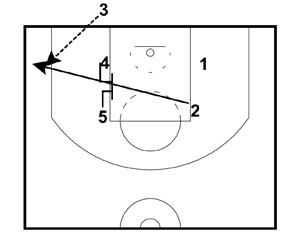
The play is actually designed for 2 to go through a “sandwich” screen to receive the inbounds pass.

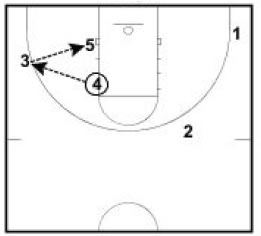
The shot can be taken from either mid range or the three-point line depending on the game situation.
 

This play is really simple but works extremely well because the initial back screen forces defenders to sink and protect the basket.

This opens up the double screen for the shooter.

Sometimes simple basketball is the best basketball. I guarantee you that your team will get a clean look if you execute this play properly.

Breakthrough Basketball has several other FREE inbounds plays to give your team the competitive edge.
Basketball Plays Wheel Stagger

By Brian Williams on May 6, 2013


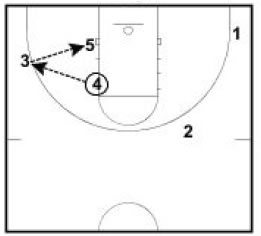
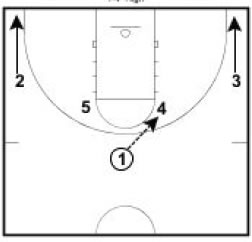
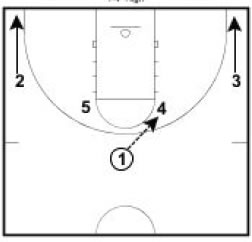
High Post entry


4 dribbles at 2 and continues the sequence.


Option 1

4 can dribble handoff with 2


Option 2

If 2 is denied, 4 will continue the handoff with 3 off the screen from 5.


3 has three options:

Attack off the bounce,
Throw back in to 5
Wait for the stagger on the baseline
for 1.


Throw back and in.


Basketball Drills 6 vs. 4 Baseline Drive Drill

By Brian Williams on May 3, 2013

This drill is from an older Arizona Basketball Coaching Newsletter.

If you are interested in subscribing to the Arizona newsletter, email your email address, name, School/Team, and coaching position to me and I will forward it to their staff.

Their newsletter includes information about their program, plays, and basketball drills for coaches.


Basketball Drills

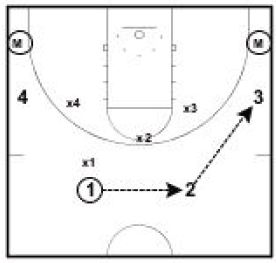
Start in a 4 on 4 shell seup with an extra offensive player in both corners.

Pass the ball from 1 to 2 to 3 then to the extra player in the corner.

The extra player drives as soon as he catches the ball.


Basketball Drills


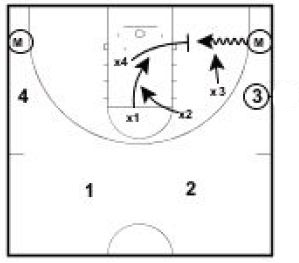
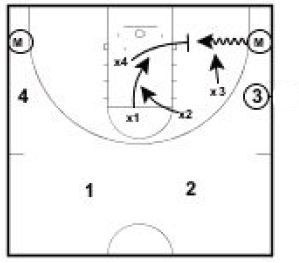
Defense rotates (following your defensive rules) to stop the driver.

You can also run a different version of this drill with 5 offense vs. 7 defense and add the post player.


Basketball Drills

Arizona’s rule is for x1 and x2 to establish a tandem.

Their terminology is “top of the eye” and “bottom of the eye”


Basketball Drills

This frame shows rotations out if the ball is passed out of the trap to player #2.

Emphasizing the rotations back to the ball and to the help positions is as important in this drill as the rotations to stop the drive.

Arizona teaches X3 to swipe at the ball to make the pass out difficult.

Basketball Drills

This frame shows rotations out if the ball is passed out of the trap to player #1.

X1 and X2 have switched players. X2 is closest to the player catching the pass out and is responsible to pick up the ball.

The expectation is to sprint on the air time of the pass and all players arrive at their new positions when the ball is caught.

Coaching Basketball Team Offense

By Brian Williams on May 2, 2013

This section has ideas for developing an offensive philosophy and system. I hope that it stimulates your thinking to come up with additional questions that can help your basketball staff to clarify ways that you can get the most out of your players.

Transition

  • Do we want to run in lanes for spacing or run random transition?
  • What do we want to get out of transition?
  • Do we want to run any secondary break actions?

Press Offenses

  • How many press offense alignments do we need?
  • How many press offenses do we need?
  • What players comprise our “good hands” team?


Man Offense

  • What motion offense (if any) best fits our team?
  • Do we want to add, subtract, or change any of our continuities?
  • Do we want to add, subtract or change any set plays?
  • Do our man offenses put us in the best position to offensive rebound as well as have defensive floor balance?

Zone Offense

  • Should we add, subtract or change any of our zone actions?
  • Should we add, subtract or change any of our zone sets?
  • Are we able to attack all types of zones and traps with our zone offense?
  • Do our zone offenses provide us with offensive rebounding opportunities as well as defensive floor balance?

Inbound Plays

  • How many different alignments do we want to use?
  • When do we want to put in each alignment? (Should we save any for late in season?)
  • Do we have a play that takes advantage of any way that the opponent may guard us? (Zone, Denial, Pack, Switch)
  • Do we have plays that take advantage of the positioning of the inbound defender?

Special Situations

  • Do we want to add, subtract or change any of our last second full court, 3/4 Court, 1/2 Court, 1/4 Court or UOOB plays?
  • How much time is needed on the clock to execute each play?
  • Do we need to make any changes to our delay game?
  • What FT plays do we run if we have to miss intentionally and need a two-point shot or three-point shot to tie?
  • When will we start to hold for the last shot to end a quarter?
  • When will we shoot the ball to end a quarter?
  • What play will we use to end the quarter?

Basketball Program Blueprint Roles

By Brian Williams on May 2, 2013

Here are some questions to use for defining the roles within your basketball team that your players will fill. I hope that it also inspires you to come up with more questions that fit your program.

One of the challenges that basketball coaches face is defining roles for our players. Then, working to keep them in those roles. Finally, working to help them improve their skills to grow within those roles.

  • What roles will each player perform on this year’s team? (This usually is, but is not always who is best in each area. Example: Our best perimeter player might also be our best post player. We may not want to put our best on ball defender in a position to pick up extra fouls until later in the game. )
  • Who will be our leaders?
  • Who will be our captains?
  • What projected playing time box should each player check?
  • The playing time box is a form that I use at the beginning of the season so that I know where each player thinks he stands–1) Start and play regularly 2) Be in the regular rotation, be on the team–no guarantee of playing time.
  • Which players will be the primary ball handlers?
  • Who will jump center?
  • Do we want our best player guarding their best player?
  • Who is our best on ball defender?
  • Who is our best at blocking out to guard their best offensive rebounder?
  • Who is toughest to shoot over?
  • Who is our best perimeter gapper? (Gapper is the term that we use for a player who is a helper in our packline defense. A perimeter gapper is a defensive player on the perimeter who is responsible to deter penetrating drives by his positioning and then helping if there is a drive.)
  • Who is our best post gapper? (Gapper is the term that we use for a player who is a helper in our packline defense. A post gapper is a defensive player on the perimeter who is responsible to deter post feeds by his positioning and then trap the post if the post player receives the ball.)
  • Who is our best low post defender?
  • Who do we want to get the most shots and where do we want those shots to come from?
  • Who are our best passers? Who are our best post feeders?
  • What positions for our offensive scheme and defensive scheme should each player learn?
  • What is our inbounder order? Under?, side?, full?, game winner? Should they all be the same?
  • What press offense spot will each occupy? Inbounder? Ball Side? Opposite? Middle? Finisher?
  • What shots can each player hit?
  • Who are our best cutters? best screeners?
  • What set play (including in bounds and zone) spots should each know?
  • Who is our designated defender/fouler if need be?
  • What is the halfback order? (Halfback is the player we send to the top of the key when we shoot. That player is then responsible for picking up the basketball in our conversion defense.)
  • What is the fullback order? (Fullback is the player we send to the volleyball attack line near midcourt when we shoot. That player is responsible for retreating to defend the basket in our conversion defense.)

Basketball Program Blueprint Individual Development

By Brian Williams on May 2, 2013

Here are some questions to use for structuring your individual development skill workouts. In addition to improvement season (April through October) skill workouts, skill development workouts should be a part of every basketball practice. I hope that it also inspires you to come up with more questions that fit your goals and objectives that will lead to ways to help your players improve.

  • How do we motivate each player?
  • What does each player do well?
  • What are the areas of concern for each player?
  • What will be his individual development workout?
  • What does he need to add to bring to our program?
  • What is the best use of the Individual Development Workout time for each player? Click the link to see some ideas for a competitive skill workout.
  • What does s/he need to be able to do in a game to help the team?
  • How are we going to track his/her progress?
  • What scoring moves does s/he have?
  • How can we improve those moves?
  • What scoring moves does s/he need?
  • How can we help him/her develop these?
  • What are the areas of growth s/he needs to make?
  • « Go to Previous Page
  • Page 1
  • Interim pages omitted …
  • Page 231
  • Page 232
  • Page 233
  • Page 234
  • Page 235
  • Interim pages omitted …
  • Page 288
  • Go to Next Page »

Primary Sidebar

  • Twitter
  • Facebook
  • Linkedin
coachestoolbox
personaldevelopmenttoolbox
basketballplayerstoolbox
basketballtrainer
athleticperformancetoolbox
coachingbasketball

© Copyright 2026 Coaching Toolbox

Privacy Policy