• Skip to primary navigation
  • Skip to main content
  • Skip to primary sidebar

  • Basketball Plays
    • Ball Screen Sets
    • Horns Sets
    • Man to Man Post Up
    • Man to Man Isolations
    • Backdoor Plays
    • Man to Man 3 Point Shot Plays
    • 2-3 Zone Attack
    • Baseline Inbound Plays
    • Sideline Inbound Plays
    • Combination Defense Attack
  • Drills
    • Defensive Drills
    • Offensive Drills
    • Competitive Drills
    • Passing Drills
    • Rebounding Drills
    • Shooting and Scoring Drills
    • Toughness Drills
    • Transition & Conversion Drills
    • One on One Drills
  • Blueprint
  • Practice
  • Mental Toughness
  • Skill Development
  • Offense
  • Defense
  • Store

Basketball Drills Driving

Basketball Drills Driving

By Brian Williams on July 10, 2013

These basketball drills were posted by FastModel’s plays and drills library. The library has hundreds of plays and drills from coaches all over the world and from various levels of coaching. You can check it out here:

Fast Model Plays and Drills Library

The Bounce off and re-attack drill diagrammed below was submitted by betterbasketball.com

The two foot layup drill was posted by Coach Tom Kelsey

Tom has been a small college head coach, winning multiple coach of the year honors. He also served as the Director of Basketball Operations for the LSU men’s basketball program. Tom spent time on the coaching staffs of Don Meyer and Mark Gottfried.

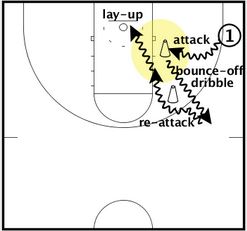
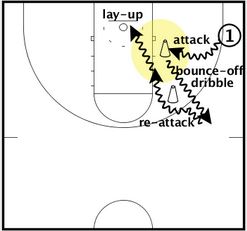
Bounce off and Re-Attack
Basketball Drills

Bounce-Off Then Re-Attack Lay-Up Pattern

Choose a dribble move and attack the middle.

Pretend help defense is in position. Instead of picking up the ball, or forcing a move, or forcing a shot, or making a bad pass, the Bounce-Off dribble allows you to withdraw and bounce away from a situation that you don’t like while still keeping your options open.

Choose a dribble move and re-attack the area that you just bounced off.

Finish with a lay-up.
Basketball Drills

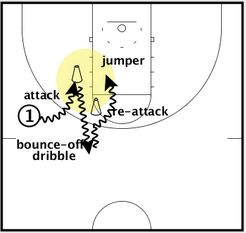
Bounce-Off Re-Attack Jump Shot Pattern

Choose a dribble move and attack the rim.

Pretend help defense is in position. Just like the lay-up drill, you’ll Bounce-Off the action because you don’t like what you see.

Now that you have space, choose a dribble move and re-attack the area that you just bounced off.

Pull up for a jump shot.

Two Foot Layup
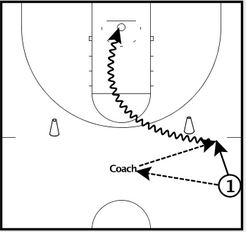
Basketball Drills

Got this drill from Duke and watching JJ Reddick. After catching the ball, crossover and get into the paint.

Objective is to get to the other side of the rim. Two foot layup allows player to get balance and protect the ball.

This is a game like drill that gives players confidence when penetrating the paint. Give them moves where they can score at the rim vs. defense.
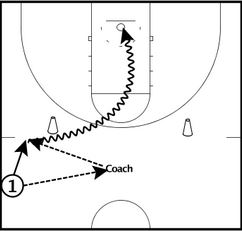
Basketball Drills

Description:

  • Crossover to the elbow. In the lane take one dribble with long hop step to create separation and make a two foot layup.
  • Work on getting to the other side of the rim for shot off the glass. Use the rim as protection from the defender.
Basketball Plays Double Away

By Brian Williams on July 8, 2013

This play is from the Arizona Men’s Basketball Newsletter.

If you would like to be added to their newsletter mailing list, please email me your

1) Name
2) Team or School
3) Coaching Position

and I will forward it on to the Arizona staff.


Basketball Plays

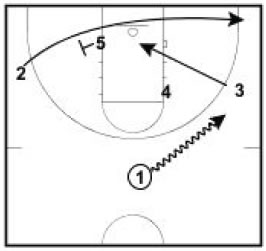
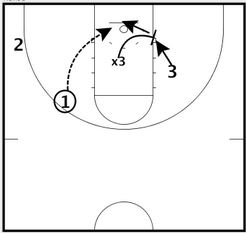
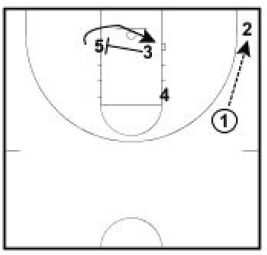
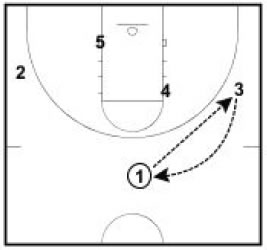
1 passes to 3. As 3 passes back to 1, 2 begins his cut of of 5 to the ball side corner.

4 will always keep his man lifted above the second dash for space during screening.


Basketball Plays

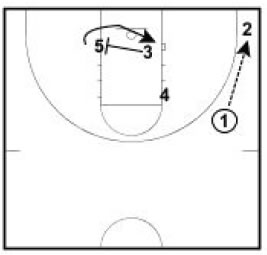
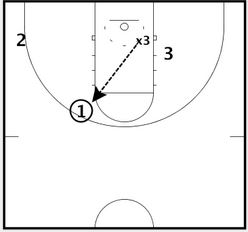
As 2 crosses 5’s shoulders, 3 begins his movement to screen 5 as 1 dribble into the action.

4 remains high to keep his man from helping on the screening action.


Basketball Plays


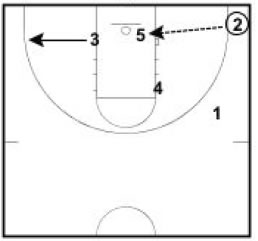
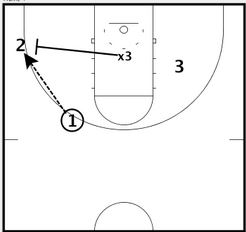
As 1 passes to 2, 3 screens 5s defender. This will appear almost as a backscreen as 5 peels off under the rim ballside.


Basketball Plays

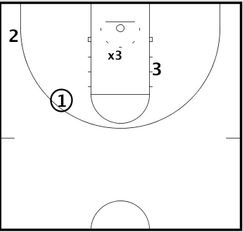
2 feeds 5, or can hit 4 if 4s man is helping on the post


Basketball Drills Competitive Defense

By Brian Williams on July 5, 2013

This drill was posted by Coach Randy Brown in Fast Model’s library.

The library has hundreds of plays and drills from coaches all over the world and from various levels of coaching. You can check it out here:

Fast Model Plays and Drills Library

Randy tweets a lot of his content. You can follow him here: @CoachRB

In this competitive defensive drill, a combination of skills are on display.

Defender must execute the following skills; vision, floor position, block out, rebounding with two hands, anticipation, close out, one on one defense.

Basketball Drills


Starting positions for the drill.

Defender is in help position relative to the ball and player he is guarding, 3


Basketball Drills

On the shot, defender blocks out 3 going for the offensive rebound. The block out must be outside the lane.

Defender must rebound the game with two hands and return pass to the shooter.


Basketball Drills

Once 1 has the ball, defender anticipates pass to 2 on the left wing.


Basketball Drills

Defender must sprint into a close out on 2 and goal is to be there on the catch to take away the open shot. If no shot, one on one from the left wing.

Goal is for defender to keep ball out of lane, contest shot, and rebound with two hands.

Many different options can be incorporated into this drill. It can also serve as a great conditioner.

It can be run as an individual or team competitive drill.

Coach Brown has a free eBook that is a great resource for basketball coaches. Click here to download a copy:

Coach RB 100 Vital Coaching Questions and Answers

He also tweets a lot of his content. You can follow him here: @CoachRB

Basketball Drills Competitive Shooting

By Brian Williams on July 4, 2013

Today’s post is 5 shooting drills that can be used in individual workouts or team practices. Some of the drills require two players, or at least a shooter and a rebounder.

Players can use these drills when working on their own without a coach. Most phones have stopwatches for players to use to time themselves.

Players can compete against each other, against a personal best, or against a team standard.

Below the drills, I have posted links to some other shooting drills that are posted here on the Coaching Toolbox.


90 Second Shooting Drill

  • 7 Spots (baselines, wings, elbows, and free throw line).
  • Partner rebounds for the shooter
  • Shooter must make 2 shots in a row from one spot before moving on to the next spot. If the shooter finishes the 7 spots before the 90 seconds runs out, start heading back along the spots.
  • Count the number of shots the shooter hits in 90 seconds.
  • Can shoot 2 or 3 point shots.

10 Shots/5 Spots

  • The drill is time for two minutes and 30 seconds
  • 5 spots (baseline, wings, and FT Line
  • Shoot 10 shots at each spot, then move to the next spot
  • Partner rebounds for the shooter
  • Record total number of shots made in the two minutes and 30 seconds
  • Rebounder is important, should take 30 seconds per spot

5 Point

  • Player has 5 points to begin the drill
  • 3 ways to do the drill.
    1) Alternate shots between baseline and wing on the right side of the floor
    2) Alternate shots elbow to elbow
    3) Alternate shots between the baseline and wing on the left side of the floor
  • Subtract one point on a made basket, add one point on a miss
  • If the shooter reaches 0 points, he or she wins.
  • If the score reaches 10 points, the shooter loses.

21 Point

  • Start with 21 points
  • Shoot all 3 point shots
  • Made basket-subtract 3 points
  • Missed shot–add 1 point
  • If the shooter gets to 0 points he or she wins
  • If the shooter reaches 30 points, he loses

[adinserter name=”Basketball in article display ad 2 rebecca”]

10 Point

  • Shooter’s score starts at 0
  • The shooter loses if she falls below 0
  • Shooter must make a 3 point shot to start the drill. Do not subtract 3 points for misses until aftter the first 3 is made.
  • Then, alternate shooting 2 and 3 point shots
  • Subtract 3 points if shooter misses a 3 point shot (except for the first 3 point shot needed to start the game)
  • Subtract 2 points if the shooter misses a 2 pointer
  • Need to reach 10 points to win the game.

Basketball Coaching Lessons from Football Coaches

By Brian Williams on July 3, 2013

This article was written by Brian Anglim. Brian has coached basketball at both the high school and college levels.

Lessons from Football Coaches

by Brian Anglim

Like most Americans I am a huge fan of American football. For years I loved my Philadelphia Eagles and have recently adopted the Maryland Terrapins as my college team. As much as I enjoy the game as a fan, as a coach I marvel at the complexity and organizational skills of football coaches. At some point I would love to serve as some sort of assistant to a great high school coach and learn the nuances of their organizational structure and managerial skills. Below I listed 15 coaching concepts that we as basketball coaches may wish to adopt.

  1. depth charts
  2. personnel packages (what is your best press personnel, what is your best press break personnel, what is your best delay game personnel, etc)
  3. team huddles (I love how they will hold hands and have a specific order in which they huddle)
  4. more specific game planning
  5. stronger audible concepts
  6. position coaches – have a perimeter coach, post coach, and I love the idea of having a point guard coach.
  7. Offense, defense, and special teams coordinators
  8. Special teams – in the basketball sense this could include SLOB (sideline out of bounds), BOB (Baseline out of bounds), time and score situations, 2 for 1 opportunities with a shot clock at the end of quarters or halves, press break, rebounding techniques on the free throw line, free three fast break, etc.  Games won by 2 or 3 points are often won by special teams.
  9. Quality control – how successful are you with each inbound play, what are your percentages rebounding defensively on the free throw line,
  10. Quarterback progressions – in a basketball sense when my point guard is leading a primary or secondary break their are a series of reads I want him to make to decide what is the best action.
  11. Terminology and verbiage – each team has specific terms to their system of play.
  12. Off season strength and conditioning programs – in the basketball world this does exist but the culture in football we see a lot more dedication to the improvement of athletic ability.
  13. Tape breakdown – I have always shown cuts of tape to prepare for games but football coaches do tons of tape (There is an article written by Coach Anglim on this topic below)
  14. Scouting – it seems that top football programs do much more scouting and do a great job of charting tendencies
  15. Teaching structure – they are very specific in offseason, preseason, and in-season teaching and training. I love the idea of going away to football camp to learn a programs system

Coaches Off Season Development Plan-Learning From Viewing Game Tapes

by Brian Anglim

We as basketball coaches expect our players to be working diligently throughout the “off season” but what do we do prepare ourselves for the season? Just as we expect our players to follow a structured off season program, we too must set goals and create a plan to achieving those goals. Watching tapes of my team and college and professional teams is a key component to my “Coaching Off Season Development Plan”. I tape a number of games throughout the year and will even convert these files into different file formats so that I can view them on my computer. I will watch these games carefully with a notepad at my side trying to find nuggets of knowledge that might help me become a better coach.

Although watching a game leisurely can be enjoyable and informative, to get the most out of game you need to also have a plan. Below I have listed 20 key points that I am looking for when I view a game.

  1. Why am I watching this game? I have teams that I watch because I am interested in something they do philosophically, for example I enjoy watching Purdue’s man defense.
  2. Where is the game being played and are there any differences in the court size? This is a big deal when I watch high school games. One of our key rivals plays in a huge gym and loves to full court press in that gym and is much more half court oriented on the road.
  3. Have I written anything else about this team? If so review those notes.
  4. Are there any players that I specifically want to be looking at? I love watching pro-players from a skill perspective. Kobe Bryant, Steve Nash, Amare Stoudamire, Pau Gasol, Ray Allen, Deron Williams, Hedo Turkoglu, and Richard Hamilton have given me absolute clinics on how to play the game.
  5. What is the strength of the team? What are they trying to accomplish offensively (post play, spacing for penetration, screening game, continuity.etc)?
  6. What are they trying to accomplish defensively (pressure, limit penetration, tempo control,etc )?
  7. Is their a standard transition plan? Secondary Break?
  8. How deep do they outlet the basketball? Do they jump outlet points on defense?
  9. What is their pickup point defensively? Do they change defenses? What signifies the change? Do they change out of timeouts? Why did they change a defense?
  10. What is their defensive conversion plan? How many go to the boards? How consistent is their board coverage?
  11. How consistent is their intensity defensively? How strong is their defensive stance off of the ball?
  12. Do they trap? Do they communicate defensively?
  13. Do they switch? Why do the switch? Do they switch and deny? How do they handle mismatched switches?
  14. How do the defend screens? How active is the screener’s defender?
  15. Do they deny any passes?
  16. How do they defend the low post (front, 3/4, behind, etc)?
  17. Do they double team post players?
  18. What is the pace of the game and how consistent are they with that pace?
  19. Are they looking to score in “out of bounds” situations or are they looking for possession? Does their inbound philosophy change based on time and score?
  20. What do they do with special situations (free throw rebounding, end of quarter and half, pressure and pressure releases, etc)?

I do not answer every one of these questions but I like to keep them in mind as I watch a game. More than anything I want to be watching the game with an open mind. There are thousands of clinics on the game out their if you are just willing to actively keep your eyes and mind open. If you want to be a great coach, you need to put the hours just as much as your players do. One final note, be sure that anything that you take from viewing other teams fits your players developmental level and your coaching philosophy.

Basketball Drills Form Shooting

By Brian Williams on July 2, 2013

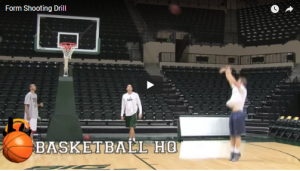
I hope this video gets you thinking about ways to add variety to your form shooting drills.

I am a big believer in doing 5 to 10 minutes of form shooting drills prior to every practice, every skill development workout, and every game night.

I also like to have a simple scoring system to both hold players’ concentration and measure progress.

I have posted some links to some other skill development drills below the video. Some of the drills are team drills and others are individual workout drills.

This is a YouTube video, so please make sure that you are on a server that allows youtube access. This drill came from basketballhq.com

Press the play arrow to see the video. I realize that the shooter travels on some of the three point shots, but I like the drill and especially the idea of shooting jump shots in close to the basket to develop shooting touch.

The video is among the basketball training videos for all levels of coaches, players, and parents that is offered by BasketballHQ. You can access their entire library with a pro membership. They offer a free 7 day trial for the membership. If you are interested, you can see more at this link: Basketball HQ

  • « Go to Previous Page
  • Page 1
  • Interim pages omitted …
  • Page 224
  • Page 225
  • Page 226
  • Page 227
  • Page 228
  • Interim pages omitted …
  • Page 288
  • Go to Next Page »

Primary Sidebar

  • Twitter
  • Facebook
  • Linkedin
coachestoolbox
personaldevelopmenttoolbox
basketballplayerstoolbox
basketballtrainer
athleticperformancetoolbox
coachingbasketball

© Copyright 2026 Coaching Toolbox

Privacy Policy