• Skip to primary navigation
  • Skip to main content
  • Skip to primary sidebar

  • Basketball Plays
    • Ball Screen Sets
    • Horns Sets
    • Man to Man Post Up
    • Man to Man Isolations
    • Backdoor Plays
    • Man to Man 3 Point Shot Plays
    • 2-3 Zone Attack
    • Baseline Inbound Plays
    • Sideline Inbound Plays
    • Combination Defense Attack
  • Drills
    • Defensive Drills
    • Offensive Drills
    • Competitive Drills
    • Passing Drills
    • Rebounding Drills
    • Shooting and Scoring Drills
    • Toughness Drills
    • Transition & Conversion Drills
    • One on One Drills
  • Blueprint
  • Practice
  • Mental Toughness
  • Skill Development
  • Offense
  • Defense
  • Store

Basketball Drills Washington Shooting 2

Basketball Drills Washington Shooting 2

By Brian Williams on November 21, 2013

These three shooting drill came from Coach Mike Neighbors.

Even if you can’t use these drills now, I think it is nice to have a large file to provide some variety to keep things fresh as the season progresses, or for summer practices/workouts.

4 Quarter Shooting

Great conditioning/shooting drill to challenge every level of shooter on your roster.

It’s also a great drill that requires no rebounder or passer.

Scoring: shots inside the paint = 1 point
shots outside paint but inside arc= 2 points
shots outside the arc= 3 points

First Quarter: Shooter has 1 minute to score 20 points
(if shooter successfully does this she advances to 2nd quarter)

Second Quarter: Shooter has 2 minutes to score 40 points

Third Quarter: Shooter has 3 minutes to score 60 points

Fourth Quarter: Shooter has 4 minutes to score 80 points

You will see there is simply not enough time to make all 1 pointers to achieve the scores, so a player must understand time/score and play to their strengths.

Drill can be done with a rebounder/passer just adjust time or score accordingly.

Sweep Shooting
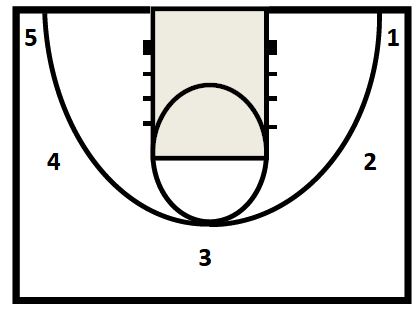
Shooter starts at spot 1. We will use cones, a basketball on the floor, or a chair to simulate a defender as available.

On the catch, the shooter sweeps the ball and goes one dribble left into a pull up 15 footer. Shooter returns to spot. Catch, sweep, attack right one dribble.

Shooter then moves to spot 2 and repeats pattern. All five spots are completed giving the shooter 10 attempts.

They get 1:00 rest. Repeat. We do 5 cycles to get to 50 attempts.

Your best mid range shooters should score in high 30s with an occasional 40 thrown in there.

This is a GAME SHOT/GAME SPOT/GAME SPEED drill.

2 Ball Shooting Drill

Two shooters, one ball. We set score at 20 or 30 or 50 or…

The shooters alternate shots getting their own rebounds and passing to
teammate.

We say that each catch must be beyond the arc. The shooter can shoot the 3, drive 1 dribble for 15-17 foot for 2 points, or drive to basket for a 1 point lay-up.

Winning team gets to stay together until someone knocks them off. If a team loses, they split up into new teams.

For a variaton you can add a third shooter and a second basketball.

You can play to different scores.

Or, you can play for a certain amount of time.
Basketball Drills Team Defense

By Brian Williams on November 20, 2013

These defensive drills are from a collection put together by Nate Hill, Assistant Boys Coach at Colonel Crawford High School in North Robinson Ohio. He has coached for 18 years from 7th grade through Varsity Head Coach.

He has also started a basketball coaching newsletter.

You can see his first edition as well as subscribe to the Newsletter at this link: Next Level 419 Coaching Newsletter

In case you have any questions or comments for Coach Hill, here is his email address: [email protected]it

I hope that these drills give you some ideas for adding variety and simulating game situations in the defensive segment of your practice. Or, they get you thinking about ways to adapt these ideas to your program.

Shell Drill “Drive”

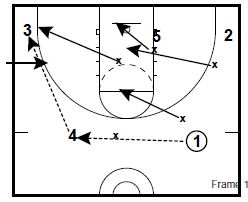
Call is used to make the offensive player drive and defense rotate. The defensive player must touch the sideline or volleyball line to give offense the advantage. Everyone must rotate and stop the ball.


“Drive” is yelled by coach, and 3’s defender must touch sideline. 3 drives and all rotate and help stop ball. Defense must talk. This can be called at any time


Stop Penetration Drill

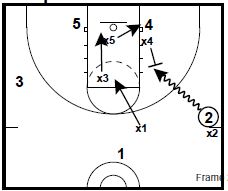
#1 – 1x starts behind 1. 4x or 5x must stop penetration. x2 or x3 must help the helper


#2: x2 starts behind 2 who drives. x4 must stop penetration. x5, x3, and x1 all must help the helper. Switch sides and alignments


Shell Drill “Trap”

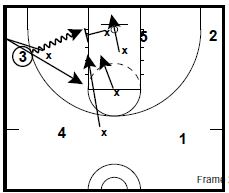
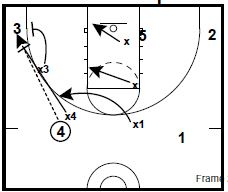
They use the “Trap” call in shell. defender whose man passes ball, goes and traps ball. Usually used in games when players cut weakside and isolate in corners


“Trap” is called. x3 and x4 go trap ball in corner. Players keep feet, trap with legs, and arms high. Other teammates look for tip,or deflection. Looking for weak pass with arms.


Basketball Coaching Team Perception Test

By Brian Williams on November 19, 2013

This post was written by Steve Smiley, Associate Head Coach at the University of Northern Coloradao. He has posted several really good articles for basketball coaches on his blog. Here is the link:

http://coachsmiley.blogspot.com

One idea as you begin your season is to do a quick “Team Perception Test.” The basic idea is to pick out anywhere from 5-15 categories (every player ranks every person in all categories, so be careful on doing too many categories, or it will take you several hrs to grade & evaluate the info). We tried one of these tests four years ago using 10 categories, and we revisited the Test this year, dropping down to the following seven categories:

  1. Who is our Toughest Player?
  2. Who is our Hardest Worker (including weight room, practice, etc)?
  3. Who is our most Vocal Leader?
  4. Which player do you want taking the last shot (our most Clutch Shooter)?
  5. Who is our Best Defender?
  6. Which player do you want taking the Free Throws at the end of the game?
  7. Who controls the locker room when the coaches aren’t there?

***Obviously, you could create a multitude of different questions that fit your team and what you’re really trying to learn from the exercise.

After creating your questions, make a grid on a spreadsheet like Excel for each question, and the entire roster named for each question, as follows:

Who is our best defender?

Name Rank
Taylor Millay
Iakeem Alston
Jeff Amazan
Tate Hilgenkamp
Fred Dure
Kaileb Rodriguez
Kyi Thomas
Josh Adeyeye
Rudolphe Joly
Abednego Lufile
Xavier Webb
Ravonn Posey
Preston Wells
Jamir Andrews

The players rank every player in every category that you choose, with 1 being the best, and in our case, 14 being the worst. After the players are done, they turn them into the coaches and we compile all of the data for each question, and we also create an overall average for each player, averaging the results of the 7 questions into one final average.

**As a side note, post players usually get drilled on these assessments, in terms of last shot, FT, etc, so take that into account when you look at the results.

After doing this in two different years (spaced out four years apart), I’ve been very pleased and surprised by the results of the exercise. As coaches, we think we know certain characteristics about our team. To get the player view, however, can either reinforce our thoughts, or if the results don’t match our perception of a category, can help us to rethink where our team is at.

I believe that the ultimate key to the exercise is to tell the players that you won’t share the results to the team, so they can be brutally honest. In my opinion, you need to be careful in using the results for the negatives, i.e. “your team views as the softest guy that we have”, etc. I do use it at times to pull a guy aside when he doesn’t take an open shot, for example, to tell him, “your team views you as one of our top 3 guys to take a shot, so be aggressive and if they’re not falling, stay confident. Your team believes in you.” I think the exercise can have a tremendous effect for the positives.

Depending upon the size of your team, it can take a significant amount of time to compile the results, but if it gives you a window into what your players are thinking, and how they view their teammates, it’s a no-brainer to try with your team.

Basketball Plays Double Stack

By Brian Williams on November 18, 2013

Coach Vonn Read has submitted several plays from his playbook series The Basketball Encyclopedia of Plays to the Coaching Toolbox.

Vonn is currently serving as the assistant Head Coach in the Women’s program at Houston.

He has also served as an assistant coach in the WNBA with the Phoenix Mercury, Orlando Miracle, and SanQ Antonio Silver Stars.

Vonn was an advanced scout for the Orlando Magic as well as The Charlotte Sting.

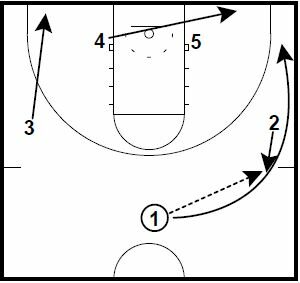
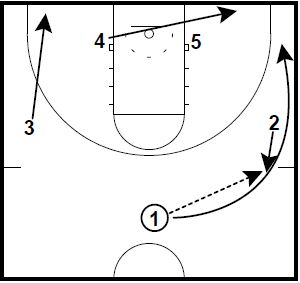
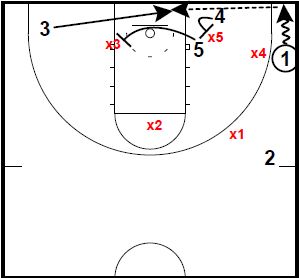
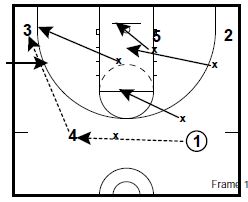
This play is designed to be Run this play against a 2-3 zone


Basketball Plays


The 1 player will pass the ball and cut to the short wing.

The 4 player will cut to the short corner. The 3 player will cut to the opposite short corner.


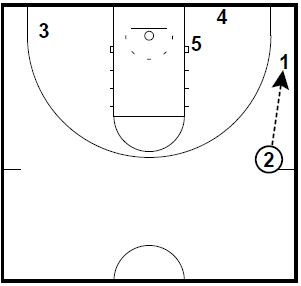
Basketball Plays


The 2 player will pass to the 1 player.

The 4 player will beg for the ball as a decoy to draw X5 out. pass to the 1 player.


Basketball Plays


The 1 player will dribble to the corner to make the seam pass on the baseline.

The 4 player will screen X5 and the 5 player will screen X3. The 3 player will sneak baseline to the rim for the layup.


Coach Read has also put together The Basketball Encyclopedia of plays. You can check them out here: The Basketball Encyclopedia of Plays or read more about the books:

Any coach looking for the latest and innovative plays from the Professional, College, or High School levels can stop looking. With a compilation of over 7,700 different plays, you will never need to purchase another basketball playbook again. These playbooks can be used as a great reference tool for years to come. This 2 Volume Book includes plays from 19 different play categories, and they are the most extensive playbooks on the market.

The Basketball Encyclopedia of Plays (Platinum Series) contains over 7,700 Plays (Both Volumes combined) from the NBA, WNBA, USBL, and College levels from someone who has worked as an Advanced Scout or Coach on each level!!! This book has been intensely compiled over the last 21 years, with plays taken from a lot of NBA Coaches (past and present), WNBA coaches, and College coaches (Men’s and Women’s) from around the country.

Any coach that is serious about improving their knowledge of the game from an X and O standpoint will benefit tremendously from these books. These Books can be used to discover New Quick hitters, add a New Package to your playbook, or develop an entire Offensive System. There are a lot of new ideas and concepts in these books to study, and the Basketball Encyclopedia of Plays can be a great resource for coaches on all levels!!! This book is definitely for those X and O junkies who are always looking to improve as a Coach.

“THE GAME IS ALWAYS CHANGING? ARE YOU?” Vonn Read

Here is the link: The Basketball Encyclopedia of Plays

Basketball Drills 2 on 2 Full Court Convert

By Brian Williams on November 15, 2013

This drill was originally posted in the FastModel Sports Basketball Plays and Drills Library

The site has thousands of drills and plays that have been submitted by coaches from all levels and from all over the world.

You can also find out more about their Play Diagramming software by clicking this link: FastDraw

This drill was posted by Drew Hanlen of Pure Sweat Basketball.

Drew is an NBA Strategic Skills Coach & Consultant that has helped over 25 NBA and NBA pre-draft players.

Drew is the Head Skills Coach for Pure Sweat and has run his internationally renowned Elite Skills Clinics in over 30 states and 4 countries over the past four years.

Basketball Drills


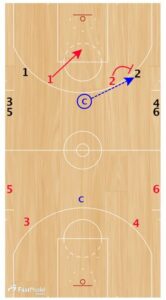
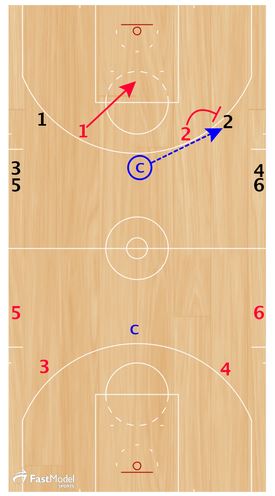
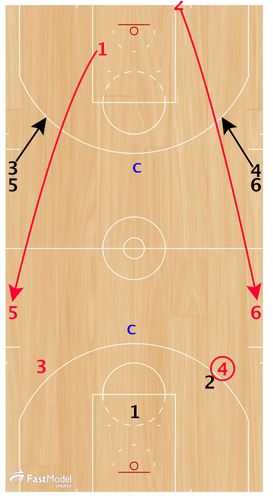
Live 2v2 in the half-court.

The Black Team starts by attacking the Red Team. Black Team vs Red Team.

Keep track of points scored for six minutes.

Loser has punishment for every point they lose by (sprints, defensive slides, closeouts, push ups, etc)


Basketball Drills


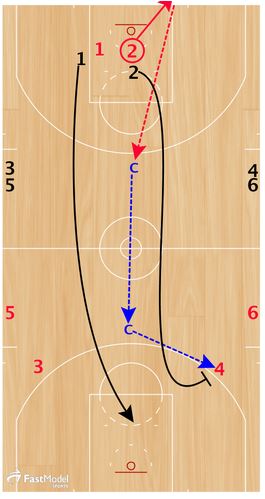
As soon as the Black Team scores or gets stopped, one member from the Red Team has to take the ball out of bounds and inbounds to the coach at the top of the key, while the Black Team players that just played offense have to sprint back on defense.

As soon as the coach at the top of the key receives the inbounds pass, he will pass to the coach on the other side of the ten second line.

Once the second coach receives the ball, he will hit either of the new players from the Red Team (3 or 4) and it will be live 2v2 against the Black Team players that sprinted back on defense.


Basketball Drills


Drill now repeats heading in the opposite direction.

Rotation is Offense to Defense. Defense to Inbound Passer. Inbound Passer and other Teammate to back of your team lines.


Basketball Coaching Championship Standards

By Brian Williams on November 13, 2013

By Alan Stein, (re-posted with permission)

Coach K doesn’t really believe in rules and he isn’t much for setting goals.

Huh? What?

Coach K believes in standards.

Powerful distinction.

Rules confine people and put them in a box. Goals are often out of our direct control.

Standards are an effective way to hold people accountable to the process necessary to achieve success.

I received a very thoughtful (and completely unsolicited) email from Matt Schweinberg, an assistant coach at Normal Community High School in Normal, IL. Matt shared his NCHS basketball program’s Iron Standards.

The four areas that NCHS focuses on are humility, listening, serving and working. These four key areas help foster leadership on the team.

BE HUMBLE

• Realize you still have a lot to learn.
• Recognize you can learn from anyone.
• Be part of something bigger than yourself.
• Team goals should be placed ahead of personal goals.
• Show empathy towards others.
• Put others’ needs ahead of your own.

Everyone leaves a legacy; what will your legacy be?

LISTEN

• Listen to what others expect.
• Listen to what others need.
• Listen to the correct people.
• Listen to develop trust with others.
• Be quick to listen and slow to speak.
• What you say should have value & purpose.

Are you listening to what others have to teach you?

SERVE OTHERS

• Make the right decisions for the right reasons.
• Contribute positively anyway you can.
• Make those around you better.
• Take initiative – look for what needs to be done & do it.
• Build up others.
• Help others to reach their goals.

Are others better off because you are here?

WORK HARD

• Work hard to determine level of success.
• Work hard academically.
• Work hard athletically.
• Work hard at your relationships.
• Work hard when no one is looking.
• Recognize the greatest out work everyone.

Do others respect the work you do on & off the court?

What standards do you have in your program?

Alan Stein
Hardwood Hustle Blog
http://www.About.me/AlanStein

  • « Go to Previous Page
  • Page 1
  • Interim pages omitted …
  • Page 209
  • Page 210
  • Page 211
  • Page 212
  • Page 213
  • Interim pages omitted …
  • Page 288
  • Go to Next Page »

Primary Sidebar

  • Twitter
  • Facebook
  • Linkedin
coachestoolbox
personaldevelopmenttoolbox
basketballplayerstoolbox
basketballtrainer
athleticperformancetoolbox
coachingbasketball

© Copyright 2026 Coaching Toolbox

Privacy Policy