• Skip to primary navigation
  • Skip to main content
  • Skip to primary sidebar

  • Basketball Plays
    • Ball Screen Sets
    • Horns Sets
    • Man to Man Post Up
    • Man to Man Isolations
    • Backdoor Plays
    • Man to Man 3 Point Shot Plays
    • 2-3 Zone Attack
    • Baseline Inbound Plays
    • Sideline Inbound Plays
    • Combination Defense Attack
  • Drills
    • Defensive Drills
    • Offensive Drills
    • Competitive Drills
    • Passing Drills
    • Rebounding Drills
    • Shooting and Scoring Drills
    • Toughness Drills
    • Transition & Conversion Drills
    • One on One Drills
  • Blueprint
  • Practice
  • Mental Toughness
  • Skill Development
  • Offense
  • Defense
  • Store

Encouragement: A Gift to Be Given

Encouragement: A Gift to Be Given

By Brian Williams on March 19, 2021

Encouragement: A gift to be given

Written and contributed by Dr. Chris Hobbs (Follow him on Twitter @Dr_ChrisHobbs)

Scott Drew is the head men’s basketball coach at Baylor University. Over the past 16 seasons, he’s won nearly 20 games per season. It’s an impressive stretch for a program that has a mediocre history and when Coach Drew arrived, was almost completely dead. If you want to read a story of persistence and comeback, read “The Leftovers” which is the story of massive scandal and homicide that rocked Baylor basketball. That is the program that Scott Drew took over. The author of the book, Matt Sayman, was one of only two players that remained in the program after the scandal and during Coach Drew’s arrival. The program was absolutely decimated with NCAA sanctions and terrible support from the local community. It was a very dark time in the life of Baylor basketball. Sayman says, ‘Coach Drew was always positive and always believed we could do the impossible.’ Those first Baylor teams under Coach Drew never actually accomplished the impossible in the win/loss column, but Coach Drew did something important. He provided the players on those teams the gift of encouragement that lasts to this day.

If you understand the intention of the word encouragement, maybe you’ll want to give the gift a little more as well.

Encouragement is to give strength or courage to another. It is the kind of expression that makes someone want to go on.

Here are a couple ways a leader can give the gift of strength and courage to someone to the people in their care…

Call when things go wrong – Over the last year or so, I’ve really tried to embrace the mantra of ‘being the kind of leader that people want around when everything is going wrong.’ An important way to do this is make sure you are actually present when things are going wrong. Often, the best way to do this is to call and talk voice to voice to someone when their world is falling apart. Pick up the phone and show up for your people when things are not going well.

Confirm why things went well – Notice the wording of this suggestion. Expressing appreciation when things go well is nice. Expressing appreciation to someone for what they did (the why) to make things go well is next level encouragement. As a leader, it is important that you give people the freedom to make good things happen and then take the time to tell them what you observed as the ‘why’ behind those good things. A team member knows why things went well but to know that it was observed and confirmed by the leader is very encouraging.

Compliment by name and task – No matter what your opinion of the Bible might be there are some excellent accounts of incredible things that we can learn a lot from. One of those accounts is of Nehemiah who returned to Israel and returned it’s economic and military stability after the Babylonians had conquered it. Nehemiah rallied a diverse and unskilled group of laborers to accomplish the incredible engineering feat of rebuilding the walls around Jerusalem resurrected in only 52 days. The historical account includes an entire chapter of Nehemiah recognizing every group of laborers by their name and the task that they completed. This is simple and powerful encouragement that I have tried to implement anytime I address a group publicly. I compliment someone on my team by their name and by the task that they have performed well for our group.

There are a lot of different ways to give the gift of encouragement. I have only listed a few of the ways that this can be accomplished. I want to encourage you to be the type of person that gives the gift of encouragement to as many people as you can.

Keep on, keepin on, friend!

BLOG BIO

‘Bite Down and Don’t Let Go’ is a collection of writings on being intentional about life in a way that produces great persistence. Read about it more here.

Dr. Chris Hobbs is an educational leader and Director of Athletics at The King’s Academy in West Palm Beach, Florida. He’s earned a few degrees and won some awards. He’s happily married to his high school sweetheart and they have three teen age children. Life is messy and complicated most of the time. You can follow him on Twitter for all sorts of inspirational thoughts and good laughs.
Villanova Trapping Philosophy

By Brian Williams on March 19, 2021

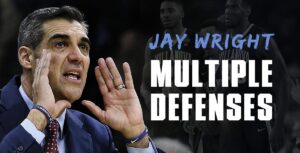
Jay Wright is currently the men’s head coach at Villanova University, a position he has held since 2001. He previously served as head coach at Hofstra University (1994–2001), leading the program to NCAA Tournament appearances in both 2000 and 2001.

Perfecting the zone defense is a difficult task to teach and to evolve. In this course, Villanova head coach Jay Wright discusses the use of the 1-2-2 zone in this clinic presentation for the NJBCA virtual clinic. Coach Wright goes over the basics of the zone and also discusses the ability to extend the zone to add additional pressure on teams. Check out a free lesson and start learning how to perfect your zone defense today.

We are providing this drill to give you ideas on how to enhance your current practice drills. The idea is not to implement it exactly as is, but rather to tweak it to make it fit your system.

There is sound with the video, so please make sure that your sound is on.

This is a Vimeo video, so you will need to be on a network that does not block Vimeo videos.

If you would like to see more information about Coach Wright’s entire presentation, click this link: Multiple Defenses

Arkansas Offensive Philosophy

By Brian Williams on March 19, 2021

University of Arkansas coach Eric Musselman shares insights into how he has designed his exciting offensive style in this clinic presentation. Coach Musselman discusses the importance of personnel, using terminology, and creating play “families” to expand your playbook. A Q/A session is also included.

We are providing this video to give you ideas on how to enhance your current system. The idea is not to implement it exactly as is, but rather to tweak it to make it fit your system.

There is sound with the video, so please make sure that your sound is on.

This is a Vimeo video, so you will need to be on a network that does not block Vimeo videos.

If you would like to see more information about Coach Musselman’s entire presentation, click this link: Eric Musselman-Offensive Philosophy


Ball Security

Play Calling

The Two Most Destructive Attitudes: Resentment and Arrogance

By Brian Williams on March 12, 2021

The Two Most Destructive Attitudes: Resentment and Arrogance
Dr. Cory Dobbs, The Academy for Sport Leadership (03/05/21)

Parents, teachers, coaches, and managers, all invest a great deal of time trying to instill attitudes they consider appropriate. The central role of each of these leaders is to guide those they lead to adopt, modify, and deploy relevant ways of thinking—which includes forming attitudes that influence desired behavior. The opposite happens as well; a great deal of time and effort is spent to correct or punish the behaviors that result from inappropriate attitudes. To the extent that leaders are able to construct preferred attitudes will determine the health of the individuals, team, and organization.

Behavior and Attitudes
Creating an environment in which trust and respect are paramount, where healthy and inspirational relationships flourish, is vital to success in today’s environment. To create this culture requires an understanding of the nuances of attitudes. An attitude is the spontaneous interplay of preexisting emotions and integrated assumptions. Furthermore, attitudes result from the neural activity of the brain, such that the “cells that fire together wire together” creating a habit of mind. And assumptions are mental models that provide structure to the sense making process. Together they generate emotional and cognitive cues that impulsively (they can agitate a person to act faster than the speed of sound) lead to behavior. In a sense, then, an attitude has two distinct fibers weaving it together.

An attitude has an immediate and enduring influence on how we see, think, feel, and what we do. And the sobering reality is that an attitude (such as “I don’t care,” or “Why are you picking on me?”) can construct itself indiscriminately with little regard to whether it is helpful, useful, neutral, or harmful. If you stop and think about it, an attitude begins as an invisible entity—an emotion or assumption embedded in the brain—that progresses into a subjective experience in which one’s perception of a person, object, or event is greatly shaped, and greatly shapes the actions one takes.

And that’s true for both positive and negative attitudes. However, despite what most people think, we (yes, you and me) struggle to “grasp” our own predisposition for holding a certain attitude. As irrational actors, we are often unaware of how our attitudes impact those residing in our outside world. Often, transgressions are small and seemingly insignificant. But they aren’t. Collateral damage abounds with disagreement, disconnection, and disengagement. Over time, attitudes harden and the relational participants become antagonistic toward each other. The hidden costs are many.
[adinserter name=”Basketball In Article Ad 1 Rebecca”]
Attitudinal Mindset
Let me unveil the two most destructive attitudes. They are resentment (“I won’t forgive or forget,” and “apologizing is not for me”) and arrogance (“You’re not worthy” and “I want what I want”). Stop for a moment and think about these two pillars of negativity. Imagine a close friend revealing resentment toward her boss. Not difficult to do. Let’s say she is asked to work overtime—and everyone else is allowed to leave early. The thoughts and feelings produced by the immediate feedback that encompasses resentment quickly wires neural circuits ensuring the brain has recorded this incident.

Your friend has now created an attitude of resentment toward her boss (and likely the boss resents the attitude of the worker too). Whenever they are in the same room, the memory of the previous “injustice” has the potential to emerge giving energy and power to an internal state of resentment. If another incident happens, it will only amplify the initial event. What makes this especially unnerving is how automatically it happens. Moreover, both parties will ultimately find out that lingering resentment is emotionally damaging and that life at work will never be the same.

And arrogance, well ego-involvement is simply a part of athletics. We all have the need to feel worthy, but the person with an unhealthy sense of self—selfish and self-centered—usually has a tough time when it comes to emotional competencies. They are unaware of how others’ respond to their actions as they yearn to be the center of attention.

[thrive_leads id=’36827′]

The trouble is that arrogance makes the individual a pawn to their emotions. The challenge for the arrogant person is that they must protect and promote themselves at the same time. For example, if they have the need to be seen as confident in order to feel worthy, they will protect themselves (“save face”) from a threat to their competence, and feel compelled to put others down while building themselves up. The more arrogant the actor, the less room there is for others.

To the extent that the arrogant person is driven by impulses to protect and promote their self-concept, they will perceive others as less worthy than themselves—this self-serving bias is rooted in one’s upbringing. Yes, it is the job of the ego to give us a sense of who we are and where we belong—a social compass with which to define and affirm our individual and collective identity. But the attitude of superiority ultimately prevents the arrogant individual from fully developing a healthy ego and an accurate view of self. For the arrogant, life is a roller coaster ride.

Action Steps
Okay, time to take action. You have work to do. Write down on a sheet of paper (old school) these two attitudes. Describe in bullet points each concept as you have seen others deploy these attitudes. Seriously, take ten minutes to “study” resentment and arrogance in greater detail by reflecting on your experiences with others. Then invest another ten minutes assessing how you can improve yourself by challenging and changing these destructive attitudes realizing you are not immune to them.

Resentment Arrogance
Won’t forgive “You’re not worthy” (Self-centered))

Won’t forget “I want what I want” (Selfish)

Plus 5 Shooting Challenge

By Brian Williams on March 12, 2021

This skill development drill is provided by Dr. Dish Basketball.

The drill is coached by NBA Shooting Coach John Townsend.

You can and should modify any of the drills to make them fit your needs or to add variety to your skill development work.

Please make sure your sound is on to see the video.

This drill is on YouTube, so you will need to be on a server that allows you to access YouTube to see the drill.

Click the play arrow so see the drill.

2 on 2 Interchange Defensive Drill

By Brian Williams on March 5, 2021

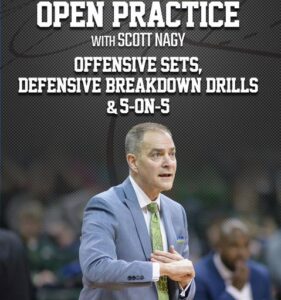
2 on 2 Interchange Defensive Drill with Scott Nagy,
Wright State University Head Coach;
2x Horizon League regular season champions (2019, 2020);
2018 Horizon League Tournament champions;
3x Horizon League Coach of the Year (2018, 2019, 2020);
former South Dakota State University Head Coach;
3x Summitt League Champions

Scott Nagy has taken the Horizon League by storm in the last several years. This inside-look into a Wright State practice will show you exactly why he has won Coach of the Year honors for the last three years in a row! You will gain insight into Wright State’s offensive style of play in addition to how players are developed on both ends of the floor through breakdown drills

We are providing this drill to give you ideas on how to enhance your current practice drills. The idea is not to implement it exactly as is, but rather to tweak it to make it fit your system.

There is sound with the video, so please make sure that your sound is on.

This is a Vimeo video, so you will need to be on a network that does not block Vimeo videos.

For more information about Inside Basketball Practice with Coach Scott Nagy: Offensive Sets, Defensive Breakdown Drills & 5-on-5, click here: Inside Basketball Practice with Coach Scott Nagy

  • « Go to Previous Page
  • Page 1
  • Interim pages omitted …
  • Page 18
  • Page 19
  • Page 20
  • Page 21
  • Page 22
  • Interim pages omitted …
  • Page 288
  • Go to Next Page »

Primary Sidebar

  • Twitter
  • Facebook
  • Linkedin
coachestoolbox
personaldevelopmenttoolbox
basketballplayerstoolbox
basketballtrainer
athleticperformancetoolbox
coachingbasketball

© Copyright 2026 Coaching Toolbox

Privacy Policy