• Skip to primary navigation
  • Skip to main content
  • Skip to primary sidebar

  • Basketball Plays
    • Ball Screen Sets
    • Horns Sets
    • Man to Man Post Up
    • Man to Man Isolations
    • Backdoor Plays
    • Man to Man 3 Point Shot Plays
    • 2-3 Zone Attack
    • Baseline Inbound Plays
    • Sideline Inbound Plays
    • Combination Defense Attack
  • Drills
    • Defensive Drills
    • Offensive Drills
    • Competitive Drills
    • Passing Drills
    • Rebounding Drills
    • Shooting and Scoring Drills
    • Toughness Drills
    • Transition & Conversion Drills
    • One on One Drills
  • Blueprint
  • Practice
  • Mental Toughness
  • Skill Development
  • Offense
  • Defense
  • Store

Developing Off Hand Finishing Skills

Developing Off Hand Finishing Skills

By Brian Williams on December 19, 2013

This article was written by Brian Anglim. Brian has coached basketball at both the high school and college levels.

Developing Off Hand Finishing Skills

by Coach Brian Anglim

In my last article I discussed the idea of instituting a rule of only allowing strong hand finishes during the season. The conclusion I came to is that players would have to earn an “off-hand finishing license”. If they did not show competency prior to the start of the competitive season, they would be limited to using only their strong hand. This would not be a punishment rather an motivator and a sacrifice for the betterment of the team.

In my evolution as a basketball coach, I have drawn greatly upon my study and work as a personal trainer. I have gotten into the fitness world (and I have been bit by the crossfit bug) and it has given me some fascinating insight into developing basketball players. One thing we will do with a training client is developing different phases or cycles in which we focus on certain areas of development and build upon each of these cycles to allow a client/athlete to peak at a certain time. I think this concept has tremendous value in the basketball world. I would break weak hand development down to four phases for an athlete that has not earned their “off-hand finishing license”. Having a long term view of skill development can allow you to put the teaching pieces together in the most efficient manner.

Phase One: In Season

In an effort to maximize practice time I would not work directly on weak hand finishing. To get to a high level of success it would require a great amount of practice time that might be better used in other areas. However I firmly believe that in-season practice has to still be centered around long and short term skill development. I would work on foundational skills that would lead to weak hand development but not work on them directly.

In the personal training world we put a lot of emphasis on the warm up. Although most people see it as a period of injury prevention and it is, it also is a time to practice and refine movement. We would use this time to perfect the key movement patterns that we would later be attacking with heavy weights. Those 5 to 10 minutes might seem like a waste, but those 5 to 10 minutes happen before every training session. Over time they build upon one another to eventually lead to mastery.

Let’s say that I have 60 basketball practices a year, if I dedicate 15 minutes to a warm up that is 15 hours of practice time. If I take 4 minutes of those 15 minutes to develop hand coordination, fingertip control, and concentration skills over a period of a season and a players career it will have tremendous impact. To me the opening of every practice should contain some combination of the following drills

Ball slams – slamming the ball from one hand to the other, this warms the hands up and improves getting that hand around the ball which is crucial to controlling it. It helps with catching the ball and encourages getting the hand around the ball with the fingertips.
Spins, flips, and flops – this are the classic drills where we spin the ball around our waste, slam it between our legs, or flip it from one hand to the other. These drills might seem basketball campy to you but to me there are crucial to long term development (and have tremendous benefit to younger players). They develop that fingertip and manual coordination. They also push players to move their hands quicker .
Two ball dribbling – I have a lot of two ball dribbling drills that I need to create a video of, I love these as they develop coordination with the weak hand, refinforce rotating the hand to different position on the basketball, and develop hand quickness.

If these drills were executed at the start of ever practice with maximum intensity (intensity is key) you will see great improvement in there ball handling and hand quickness throughout the season and their career. These drills also develop the manual coordination with the weak hand that will later allow us to naturally finish plays.

Phase II – Off Season Finishing Skill Training

This would be in the early parts of the pre-season, here we would work on different finishes with both hands with no defense or contact. We would work on different finishes depending on the age and skill level of a player. For a young player it might be speed layups, for an older player we might look into reverse layups with the inside or outside hand, and advance players (at smaller players especially) we would work on running hooks and floaters with either hand.

Phase III – Off Season Game Drill Training

Once we have shown competency in a skill session, we want to add contact and other variables to increase the difficult of the finish. Such things would include contact from coaches, managers, or blocking dummies. We might add other ball skills with the finish, for example a chair such that we have to execute a change of direction move. We also encourage players to use these finishes in our scrimmage and summer league games.

I am also a big believer in creating situations that lead to natural applications of skills, for example a 2 on 1 fast break drill versus a shot blocker. This gives you tons of reps against a shot blocker from a variety of angles, thus giving us constant variance that we would find within the game.

Phase IV – Evaluation

After watching your player execute finishes in drill situations, live, and controlled scrimmages, we can evaluate their skill level and determine its viability.

These 4 phases would allow you to create a yearly plan for an athlete, but think even longer term than that. We often have players for a career, map out a 4 year plans for your players to maximize their development. If you have the end in mind the importance of building that strong foundation becomes apparent.

If you are interested in more quick tips I encourage you follow me on twitter at CoachAnglim. As always , I love feedback. Drop me a line at [email protected]
Basketball Drills 3 on 3 Defense and Rebounding

By Brian Williams on December 18, 2013

Anytime your drill involves less than 5 on 5, it takes away help and congestion and forces the defenders to be more accountable.

3 on 3 drills are a good way to do that.

Today’s post involves 3 3 on 3 defensive drills from a collection put together by Nate Hill, Assistant Boys Coach at Colonel Crawford High School in North Robinson Ohio.

He has coached for 18 years from 7th grade through Varsity Head Coach.

Coach Hill has provided several drills and has been generous enough to allow me to post them on the site.

He has also started a basketball coaching newsletter.

You can see the newsletters as well as subscribe to the Newsletter at this link:

Next Level 419 Coaching Newsletters

In case you have any questions or comments for Coach Hill, here is his email address: [email protected]it

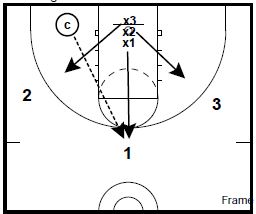
3 Player Closeouts

basketball-drills-3-on-3-defense1

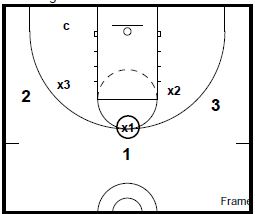
Drill starts with 3 defenders in a line under basket, and coach has a ball.

Coach can pass to any player.

Top man in line must find ball and close out under control with 2 high hands.

basketball-drills-3-on-3-defense2

x2 and x3 must communicate and find other players.

Off ball defenders must be in help, denial, or gap positions.

After the 1st stop, top man goes to back of line, and the team must get 3 stops to get out of the drill.

Drilling the habit for players not taking the basketball to close out to their gap or denial positions (depending on your style of defense) when rotating out of a trap or a help and recover is an essential defensive fundamental skill. It is not a skill that players pick up on their own without developing the habit through repetition in the defensive fundamentals portion of practice.

3 Player Team Rebounding

basketball-drills-3-on-3-defense3

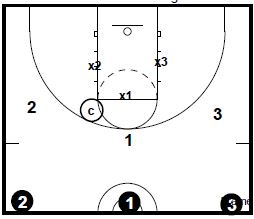
3 teams of 3.

Rules: every defensive rebound = 1 point, offensive rebound go to defense.

Defense must start with 1 foot in the paint, and each defensive player must touch offense.

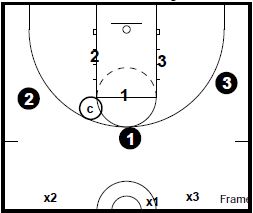
basketball-drills-3-on-3-defense4


Team must secure rebound the ball inbounds.

1st team to get 3 defensive rebounds wins.


Defending Specific Actions

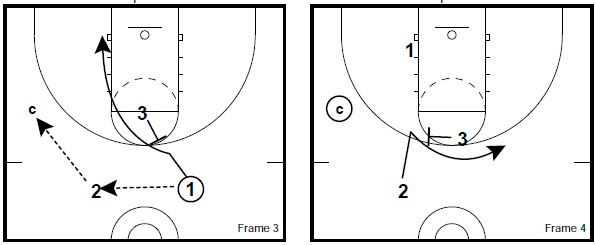
The following 4 frames are an example of a specific offensive actions to defend. The key is to select the movements that your opponents use in their offensive schemes. Defending the specific cuts and screens that your toughest opponents run throughout your entire season of practices is more effective than only working on those movements the night before you play.

Having the offense run specific sequences helps to make your 3 on 3 drills more gamelike and less like a summer 3 on 3 tournament.

Come up with your own list of what you need to defend for the teams on your schedule and work on defending them with your defensive rules. The following four frames are a place to start.

basketball-drills-3-on-3-defense5

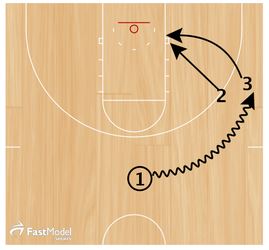
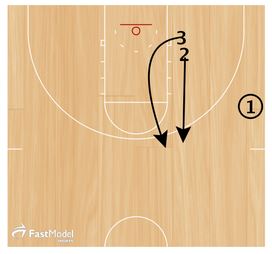
Flex action: back screen, down screen.             Down screen, cross screen. 1 down screens first, then screens for 3.

basketball-drills-3-on-3-defense6

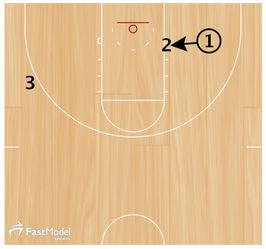
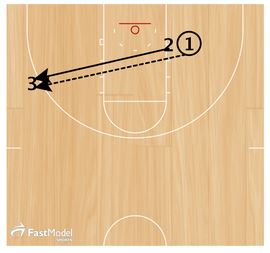
Princeton Action: Backscreen / flare screen       Princeton Action: Flare screen

Basketball Drills Friar Finish

By Brian Williams on December 17, 2013

This video is a transition drill used by Bob Hurley. The Coach in the video running the drill is Andy Toole of Robert Morris.

Make sure your sound is on as you watch.

I have tested this video delivery method in this new website platform that I have converted to for several browsers and Operating Systems.


Friar Finish Drill

Click the play arrow to see the video.

You can also click the link to see more information about or to purchase the entire DVD “High Energy Drills for Building Competitive Practices” with Coach Toole Friar Finish Drill

Basketball Plays Arizona On Ball Screens

By Brian Williams on December 16, 2013

Scroll below to see the on ball screen actions.

This play is from the Arizona Basketball Coaching Newsletter..

If you are interested in being added to their mailing list, email me your:

1) Name
1) School or Team
2) Coaching Position

and I will pass it on to the Arizona staff.


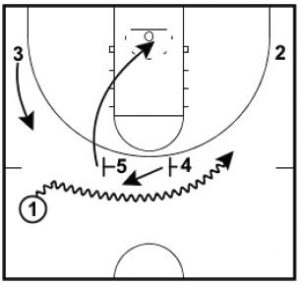
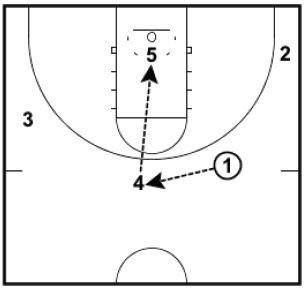
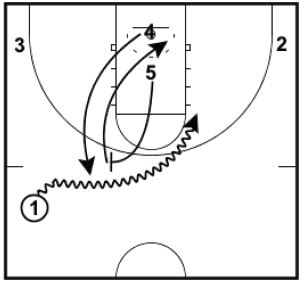
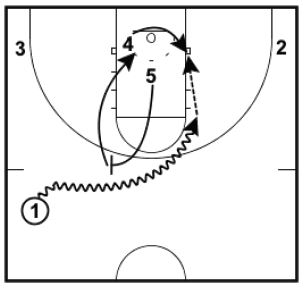
Double High Ballscreen

Basketball Plays
Basketball Plays

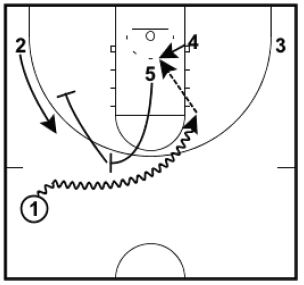
High Ballscreen Roll Replace

Basketball Plays

Basketball Plays

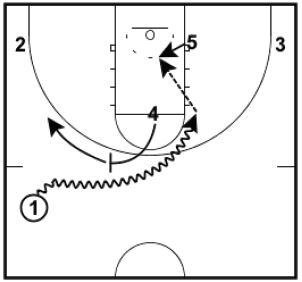
High Ballscreen Duck In

Basketball Plays

Basketball Plays

arizona-ball-screen7

Basketball Drills Defensive Position Check

By Brian Williams on December 13, 2013

This basketball drill was posted by FastModel’s plays and drills library. You can modify it to fit the movements that your players defend frequently and use it either in spring and summer workouts or during in season practices.

The FastModel library has hundreds of plays and drills from coaches all over the world and from various levels of coaching. You can check it out here:

FastModel Sports Basketball Plays and Drills Library The site has thousands of drills and plays that have been submitted by basketball coaches from around the world.

You can also find out more about FastModel Play Diagramming software by clicking this link: FastDraw

This drill was posted by Tom Kelsey. Coach Kelsey is the Director of Basketball Operations for the LSU men’s basketball program. He has been a small college head coach, winning multiple coach of the year honors.

He has also spent time on the coaching staffs of Don Meyer and Mark Gottfried.

Good drill to get your players into a defensive stance and in a proper position from different spots on the floor. Can use in individual workouts, pre-practice and pre-game warmups. Can make the drill competitive by using players in the position of the coach. Also, have teams compete against each other while still working on the fundamentals.

basketball-drills-position-check1

Coach or player starts with the ball at the top of the key.

First step is to deny the wing pass. As you begin working this drill emphasis placed on positioning and stance.

When players become more advanced, pick up the pace and make everything game speed.

basketball-drills-position-check2


2nd step is to deny the post as the ball is being dribbled toward the wing.


basketball-drills-position-check3


3rd step is to deny the Zipper cut up the FT lane.


basketball-drills-position-check4


4th step is to drop into helpside as offense goes to the opposite wing.


basketball-drills-position-check5


5th step is to come over and take a charge on offense driving to the basket.


basketball-drills-position-check6


Coach or player with the ball can push the ball into the chest of the defender to imitate an offensive player out of control.


basketball-drills-position-check7


Offensive will make a skip pass to opposite wing. Defender quickly gets up and closes out on the wing.


12 Simple Yet Significant To Dos for Leaders

By Brian Williams on December 12, 2013

This article was written by Jeff Janssen, founder and president of the Janssen Sports Leadership Center

Jeff directs cutting-edge Leadership Academies for high school and college coaches and  all across the nation including North Carolina, Pittsburgh, Illinois, Yale, Baylor, Wake Forest, and Winston-Salem State.

His site has several other useful articles for coaches and team leaders.  Here is the link:  Coaches Championship Network

Student-athletes of all ages often wonder, “What can I do to be a better leader?”

Fortunately leadership opportunities abound and present themselves on a daily basis. While they may be subtle, leaders are usually given at least a dozen opportunities to demonstrate leadership every single day.

These leadership opportunities are rarely available in the form of dramatic, rousing, “win one for the Gipper” type speeches, but most often present themselves in simple, yet significant interactions on a daily basis.

There’s a quote we often use in our Leadership Academies by Helen Keller that drives home the value of these seemingly trivial, yet critical leadership moments. She said, “I long to accomplish great and noble tasks, but it is my chief duty to accomplish humble tasks as though they were great and noble. The world is moved along not only by the mighty shoves of its heroes, but also by the aggregate of the tiny pushes of each honest worker.”

Most emerging leaders erroneously view and define leadership as the mighty shoves reserved only for the heroic captains of the team. In actuality, however, it’s the tiny pushes of leadership that happen more frequently and have the greatest impact over time.

To help your emerging and existing leaders recognize, value, and act on the many tiny opportunities to lead every day, I have created a simple 12-point checklist. I encourage you to go over the checklist with your leaders to show them just how simple leadership can be – yet how profoundly powerful the aggregate of these 12 daily leadership actions can be on your program.

12 SIMPLE YET SIGNIFICANT DAILY TO DO’S FOR LEADERS

1. Be the hardest worker at practice today. Without fail, one of the quickest ways to impact a team is with your own work ethic. Choose to be one of the hardest workers on your team today. Not only does it set the tone for the work ethic of your program, it is also one of the best and quickest ways to enhance your leadership credibility with your teammates and coaches.

2. Be a spark of energy and enthusiasm today. Let your passion for the sport shine through today. Spread a contagious energy and enthusiasm amongst your teammates. Think about how lucky you are to be able to play and compete. Remember back to when you were a young child and reconnect with the joy you played with back then. Make your sport fun again for yourself and your teammates.

3. Model mental toughness today. Because your teammates will look to you under pressure, adversity, and stress, be sure to model mental toughness today. Bounce back quickly after errors to show your teammates how to respond to negative situations. Maintain your poise and optimism despite any mistakes you might make so that your teammates can trust and rely on you to get them through the tough times.

4. Connect with a teammate today. Leadership is all about relationships. Invest the time to build and strengthen the relationships you have with each of your teammates. Inquire about their day, challenges, and goals. Make a special and ongoing effort to get to know every athlete on your team, not just your friends and classmates. The relationship building you do each day will pay off immeasurably down the road.

5. Compliment a teammate today. Be on the lookout for teammates who are contributing to your team. Call out a teammate for making a hustle play, pushing through a weight workout, recovering quickly from a mistake, getting an A on an exam, etc. Praise the actions and attitudes you want to see repeated. As Mother Teresa once said, “Kind words are short and easy to speak but their echoes are truly endless.”

6. Challenge a teammate today. Challenge at least one of your teammates today. Positively push them and yourself to make the most of your workout. Make a friendly wager to see if they can be successful at least 4 out of 5 times in a drill. See if you both can improve your times in conditioning. Offer to stay after to help if there is anything they want to work on. Good leaders consistently invite, inspire, and sometimes implore others to greatness.

7. Support a teammate today. Odds are, at least one of your teammates is struggling with something today – it could be a performance slump, a rocky romantic relationship, a disagreement with a coach, an unglamorous role, struggling with a class, or a sick family member. Good leaders are consistently on the lookout for teammates who might be struggling and are ready to offer an ear to listen, an encouraging word, a pat on the back, or a shoulder to cry on.

8. Constructively confront negativity, pessimism, and laziness today. As a leader, have the courage to constructively confront the negativity, pessimism, and laziness that will crop up on your team from time to time. Instead of fueling the fire by joining in or silently standing by, be sure to refocus your teammates on solutions rather than dwelling on and complaining about the problems. Left unchecked, these problems can quickly grow to distract, divide, and destroy your team.

9. Build and bond your team today. Team chemistry naturally ebbs and flows throughout the course of the season. Take the time to monitor and maintain your team’s chemistry. Let your reserves and support staff know how much you appreciate them. Stay connected and current with each of the natural sub-groups on your team. Douse any brush fires that might be occurring and continually remind team members about your common goal and common bond.

10. Check in with your coach today. Invest the time to check in with your coach today. Ask what you can do to best help the team this week. Find out what your coach wants to accomplish with today’s practice. Also discuss if there is anything your coach is concerned about regarding your team. Discuss your collective insights on your team’s chemistry, focus, and mindset. Work together to effectively co-lead your team.

11. Remind your team how today’s work leads to tomorrow’s dreams. It’s easy to get bogged down during your season with monotonous drills, tiring conditioning, and demanding workouts. Remind your teammates how all the quality work you do today gives you a distinct advantage over your opponents. Help them see and even get excited about how today’s hard work is a long-term investment in your team’s goals, rather than just a short-term hardship or sacrifice.

12. Represent yourself and team with class and pride today. Leaders have the awesome privilege and responsibility of representing their teams. Take advantage of this opportunity by representing your team with class and pride today. Hold a door open for someone, sit in the front rows of class and actively engage in the discussion, say please and thank you, dress in respectful attire, etc. These tiny pushes represent you and your team with class and distinction. And they ultimately set you up for a lifetime of respect and success.

Great leaders willingly invest the time and effort to engage in these 12 leadership actions on a daily basis. In applying these principles, leaders build strong relationships, keep their team on track, and enhance their credibility.

Encourage your emerging leaders to take advantage of at least 7-9 of these actions on daily basis. Your veteran leaders should be looking to capitalize on 10 to all 12 of these opportunities.

And as a coach, I encourage you to go back and look at all 12 again as well. The 12 leadership behaviors are things that you could and should be doing on a daily basis too. Be sure that you too take advantage of these 12 tiny pushes of leadership that will ultimately make a huge impact on your team.

This article was written by Jeff Janssen, founder and president of the Janssen Sports Leadership Center

Jeff directs cutting-edge Leadership Academies for high school and college coaches and all across the nation including North Carolina, Pittsburgh, Illinois, Yale, Baylor, Wake Forest, and Winston-Salem State.

His site has several other useful articles for coaches and team leaders. Here is the link: Coaches Championship Network

  • « Go to Previous Page
  • Page 1
  • Interim pages omitted …
  • Page 206
  • Page 207
  • Page 208
  • Page 209
  • Page 210
  • Interim pages omitted …
  • Page 288
  • Go to Next Page »

Primary Sidebar

  • Twitter
  • Facebook
  • Linkedin
coachestoolbox
personaldevelopmenttoolbox
basketballplayerstoolbox
basketballtrainer
athleticperformancetoolbox
coachingbasketball

© Copyright 2026 Coaching Toolbox

Privacy Policy