• Skip to primary navigation
  • Skip to main content
  • Skip to primary sidebar

  • Basketball Plays
    • Ball Screen Sets
    • Horns Sets
    • Man to Man Post Up
    • Man to Man Isolations
    • Backdoor Plays
    • Man to Man 3 Point Shot Plays
    • 2-3 Zone Attack
    • Baseline Inbound Plays
    • Sideline Inbound Plays
    • Combination Defense Attack
  • Drills
    • Defensive Drills
    • Offensive Drills
    • Competitive Drills
    • Passing Drills
    • Rebounding Drills
    • Shooting and Scoring Drills
    • Toughness Drills
    • Transition & Conversion Drills
    • One on One Drills
  • Blueprint
  • Practice
  • Mental Toughness
  • Skill Development
  • Offense
  • Defense
  • Store

Spain Pick and Roll

Spain Pick and Roll

By Brian Williams on September 9, 2021

The Spain Pick and Roll is a new variation of the Pick & Roll that has taken the NBA (and other basketball levels) by storm this year. 

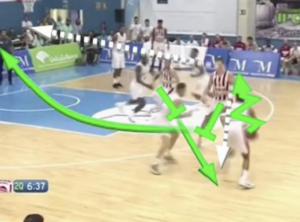
The Spain pick and roll occurs when a screen is set for the ball handler, then a third player sets a screen on the player defending the man rolling to the rim. 

A normal pick and roll is used to create a two-on-one advantage — adding a third player essentially turns it into a three-on-two. 

The Spain pick and roll is being used in many different wrinkles & series because it is very hard to defend.

The back screen is one of the hardest screens to guard in the game of basketball — it causes most teams to just switch even if it creates a mismatch.

The Horns entry into Spain pick and roll 1-5 is a simple action that requires great spacing. The action starts with a flare over the top and then the action is right into the Spain pick and roll.

Horns Entry into Spain P/R 1-5

(Click image to play Video)

Defending the Spain pick and roll is hard enough. This action allows for 2 Double Spain pick and rolls within the same action.

All 5 players are involved in this set — which causes the defense to stay on their heels defending multiple actions. 

Double Spain Pick and Roll (All 5 Players Involved)

The Spain pick and roll creates a defensive nightmare. 

In a regular pick and roll, the defense only guards the ball handler and the screener while the other defenders are in help position. 

The Spain pick and roll adds another offensive player in the equation and adds one of the hardest screens to defend. 

These clips were taken from Coach Luka Bassin’s Spain Pick and Roll Video Course.

The complete course is available here

If you’re interested in seeing more from Coach Luka Bassin then you can find more courses below:

The Most Popular Xs & Os in European Basketball

Zone Offenses from International Basketball

Back Screen ATO Plays

Box +1 – Winning Defense for ALL Levels



Radical Reorientation: An Intense Approach to Student-Athlete Well-Being

By Brian Williams on September 9, 2021

The number one priority of every coach, player, and administrator is building the team’s culture—not winning. And if you get that right, most of the other stuff—such as tactical precision, selfless behavior, teamwork intelligence, and mental toughness—will happen as a natural by-product of the culture created by the team. This is how culture works: players and coaches create each other. The challenge of shaping a team’s culture is that culture is shaped by behavior and likewise, behavior is shaped by culture.

However, most players are blind to teamwork dynamics. The result is team culture of the high-performance variety is more elusive than most of us care to believe. But it’s true. It is very likely your culture is nothing spectacular. To understand changing culture you must engage “leverage points.” Figuring out where to start is far from straightforward; it depends upon where your team is and where you want to go. Sounds simple enough, it’s not. So where might you begin?

In short, a good place to start—a leverage point—is to seek out whatever creates toxicity. So what is the most pernicious poison of culture building? Playing time. Every student-athlete wants more playing time. On the one hand student-athletes are quick to declare “all in” on the team thing. Yet, on the other hand, the world says take care of number one—and student-athletes are all in here too. In the spacious context of self-interest, one can self-justify what one does in the interest of the team. From the perspective of the student-athlete, the needs and wants of the individual player need to be met by some type of desired compensation. Simply said, if a student-athlete pays the price of time, effort, and energy—contributing to the development of the team, they’ll expect to get something in return.

The line that separates the individual’s self-interest from the team’s self-interest is blurred; it’s difficult to see where one begins and the other ends. We know they overlap, spill-over, and interrelate, yet do not know exactly what form the mixture of these two driving forces will contribute to the team’s culture. However, learning how to navigate this messy terrain will help coaches, players, and teams to see more and do more. If done right, the navigation of the messy terrain will give you a new way of looking at the pernicious problem of playing time.
[thrive_leads id=’36827′]
The greatest and highest reward for one’s effort and toil is not what one gets for it, but who one becomes by it. This small, but potentially seismic shift in perspective—a radical reorientation—is filled with a profound sense of promise and possibility. The rewards are undeniable. Toiling for others on the team is noble, and unites the team. Participation on a team provides comfort and community. By being a part of something bigger than one’s self student-athletes gain meaning and worth. The athlete’s toil and inner struggle are never in vain if the goal is well-being; accessing a higher level being, and redirecting and reshaping one’s inner experience so that they have the freedom of choice on who they want to become.

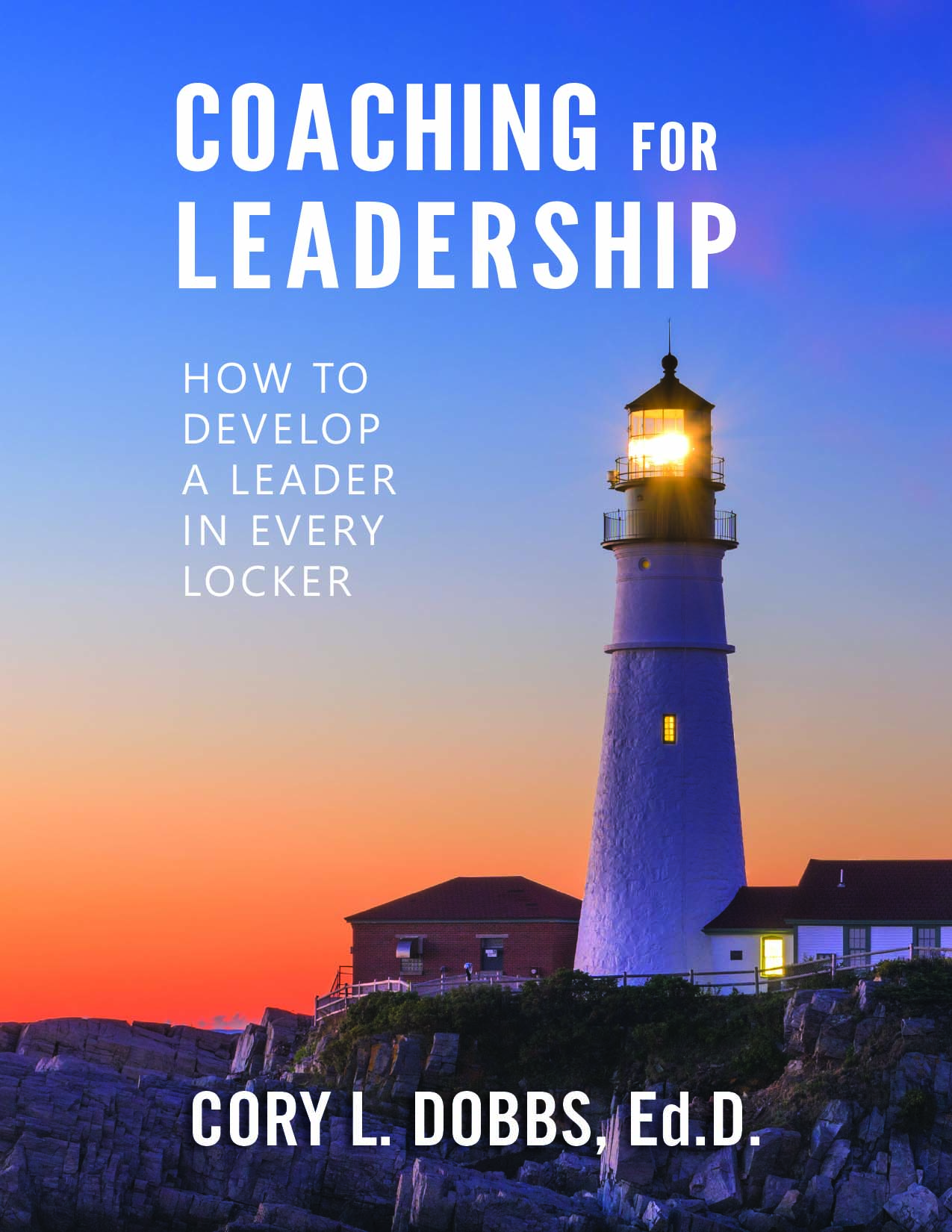
New to the Second Edition of Coaching for Leadership!

We are pleased to announce a new chapter to the second edition of the best-selling Coaching for Leadership. The chapter, The Big Shift: Unlock Your Team’s Potential by Creating Player-Led Teambuilding, connects the previous edition of this book to its origin, as well as to the future of team sports.

The new chapter sets forth a practical and applicable agenda for change and improvement. The reader is introduced to seven vital elements of change; seven shifts of traditional mental models that lead to the new core principles necessary for creating a player-led team culture. Click here for more information about Coaching for Leadership

About Cory Dobbs, Ed.D.

Cory Dobbs is the founder of The Academy for Sport Leadership and a nationally recognized thought leader in the areas of leadership and team building.  Cory is an accomplished researcher of human experience. Cory engages in naturalistic inquiry seeking in-depth understanding of social phenomena within their natural setting.

A college basketball coach, Cory’s coaching background includes experience at the NCAA DII, NJCAA, and high school levels of competition.  After a decade of research and development Cory unleashed the groundbreaking Teamwork Intelligence program for student-athletics. Teamwork Intelligence illuminates the process of designing an elite team by using the 20 principles and concepts along with the 8 roles of a team player he’s uncovered while performing research.

Cory has worked with professional athletes, collegiate athletic programs, and high schools teaching leadership and team building as a part of the sports experience and education process.  As a consultant and trainer Dr. Dobbs has worked with Fortune 500 organizations such as American Express, Honeywell, and Avnet, as well as medium and small businesses. Dr. Dobbs taught leadership and organizational change at Northern Arizona University, Ohio University, and Grand Canyon University.


Lindsay Whalen Star Shooting Drill

By Brian Williams on August 19, 2021

This skill development drill is provided by Dr. Dish Basketball.

This drill from WNBA Champion Lindsay Whalen

You can and should modify any of the drills to make them fit your needs or to add variety to your skill development work.

Please make sure your sound is on to see the video.

This drill is on YouTube, so you will need to be on a server that allows you to access YouTube to see the drill.

Click the play arrow so see the drill.

3 Drills to create an Elite Rebounder

By Brian Williams on August 17, 2021

Coach Jamy Bechler’s teams have consistently been among the nation’s elite when it comes to rebounding, including 2014 when his team set a national record for having a +19.9 rebound margin. 

Coach Bechler has coached at the NCAA Division I, II, III and NAIA levels, as well as both men and women during his coaching career. 

He was one of the youngest NCAA head coaches in the nation when he took control of his first program at the age of 27 years old.

Toughness & desire are the common traits of a great rebounder; however, Coach Bechler teaches that there is skill and techniques involved.  Here are three drills from his rebounding library that can help you create elite rebounders. 


#1) Half Court Hustle Drill

Coach Bechler explains that “Hustle” is a major ingredient to Offensive Rebounding. 

The Halfcourt Hustle drill is designed to get the rebound and score as fast as possible.

The rebounder cannot leave half-court until the ball leaves the shooter’s hands. This will create a more game-like situation. 

Ideally, the rebounder should catch the rebound before the ball hits the floor. Coach Bechler explains that in practice there is a punishment if the ball hits the floor. 

During the drill, the whole team should be yelling “rebound” so everyone on the court knows that a shot was taken. 


#2) Hit and Get Drill

Coach Bechler’s Hit and Get drill is designed to make contact with the offense using the forearm and then retrieving the ball. 

The drill is designed with three offensive players with a pad on the perimeter. The three defenders are lined up with each one of the pads. 

Each defender sprints to the pad and hits them with the forearm stopping the offensive player from running in for the rebound. The defensive player should not extend the forearm to avoid the foul. 

After hitting, the player turns and sprints toward the rebound exploding off the ground ready to catch with two hands. 


#3) Tug of War Drill

Tug of War is a one on one toughness drill where you see who wants the ball the most.

The drill is designed to simulate fighting over a loose ball, rebound, or a jump ball. 

The rules of the Tug of War drill is a coach holds the ball and each player has a hand on the ball. 
As soon as the coach releases the ball the two players compete for the basketball. 
The loser of the Tug of War has a punishment at the end of the drill. 
 

Thank you to Coach Bechler for sharing these three drills.

They’re part of his 18 drill Championship Rebounding Course which can help create habits to become a better defensive, offensive & free-throw rebounding team. 

If you would like to learn more about Coach Belcher’s complete course click here

If you’re looking for more ways to become a better rebounder please see more courses below:

Offensive Rebounding by UCLA Assistant Darren Savino

Randi Peterson: Rebounding by Better Basketball

Beyond IQ: How Grit and Reflection Can Change the Way You Coach

By Brian Williams on August 3, 2021

Beyond IQ: How Grit and Reflection Can Change the Way You Coach

Angela Duckworth has been one of the leading researchers and voices on the topic of “grit” –something  she defines as “perseverance and passion for long-term goals.”  Duckworth has found that grit can be a powerful predictor of academic achievement and, of course, physical accomplishments.  She considers grit to be the behavioral and psychological ability of one to weather adversity and stay the course—willing to persevere in the short term for the longer term outcomes.  In her findings, she argues that achievement is not just a matter of raw intelligence or physical giftedness.  She suggests grit matters a great deal in all that we do. So the question arises can grit, through the practice of reflection, enhance coaching ability to reflect on events, relationships, and performance?


Several years ago a group of researchers were interested in understanding the importance of reflection to the processes of adult learning and leadership.  In their paper, “Learning by Thinking: How Reflection Aids Performance,“ the researchers reveal the importance of deliberate reflection to learning and leading through a series of experiments.


The researchers worked with small groups through a multi-week training program.  They broke the subjects into three groups.  First, they had a “reflection” group; they asked this group to spend the final 15 minutes of each day reflecting on what they had learned. The Second group was given the task of “sharing.”  This group spent 15 minutes reflecting, and then shared their thoughts with a peer for 5 minutes.  The third group, the control group, did not engage in any reflective activity.
[thrive_leads id=’36827′]
The results aren’t surprising. The participants in the reflection group performed 22.8% better than the control group while the participants in the sharing group experienced a similar advantage over the control group participants. However, think for a moment about the work that you and your coaching staff do daily. What does the nitty-gritty look like?  Do you and your staff miss out on learning opportunities—those that will only emerge in the course of reflection?  Can you set aside 15-20 minutes for reflection and when possible include sharing in your coaching conversation?  Doing so will make your daily experience more productive and build confidence, individually and collectively, in learning by reflection.

Reflection is a powerful learning mechanism, so make time for deliberate conversation and reflection.  Reflection is an important coaching activity. Reflection is a skill that can be learned, developed, and practiced. If you want a sustainable advantage, take advantage of coupling learning by doing with intentional reflection.

New to the Second Edition of Coaching for Leadership!

We are pleased to announce a new chapter to the second edition of the best-selling Coaching for Leadership. The chapter, The Big Shift: Unlock Your Team’s Potential by Creating Player-Led Teambuilding, connects the previous edition of this book to its origin, as well as to the future of team sports.

The new chapter sets forth a practical and applicable agenda for change and improvement. The reader is introduced to seven vital elements of change; seven shifts of traditional mental models that lead to the new core principles necessary for creating a player-led team culture. Click here for more information about Coaching for Leadership

About Cory Dobbs, Ed.D.

Cory Dobbs is the founder of The Academy for Sport Leadership and a nationally recognized thought leader in the areas of leadership and team building.  Cory is an accomplished researcher of human experience. Cory engages in naturalistic inquiry seeking in-depth understanding of social phenomena within their natural setting.

A college basketball coach, Cory’s coaching background includes experience at the NCAA DII, NJCAA, and high school levels of competition.  After a decade of research and development Cory unleashed the groundbreaking Teamwork Intelligence program for student-athletics. Teamwork Intelligence illuminates the process of designing an elite team by using the 20 principles and concepts along with the 8 roles of a team player he’s uncovered while performing research.

Cory has worked with professional athletes, collegiate athletic programs, and high schools teaching leadership and team building as a part of the sports experience and education process.  As a consultant and trainer Dr. Dobbs has worked with Fortune 500 organizations such as American Express, Honeywell, and Avnet, as well as medium and small businesses. Dr. Dobbs taught leadership and organizational change at Northern Arizona University, Ohio University, and Grand Canyon University.


NBA Shooting Warm Up Shooting Progression for Distance with John Townsend

By Brian Williams on July 9, 2021

This skill development drill is provided by Dr. Dish Basketball.

The drill is by NBA Shooting Coach John Townsend.

In this warm up shooting progression, NBA Shooting Coach John Townsend demonstrates a great way to specifically warm up for distance shooting.

In this progression, John focuses on 3 drills:

1. High Start
2. High Quick
3. High Quick / Regular Alternate

As John emphasizes, a big part of this warm up is your hand placement and establishing a solid base to ultimately incorporate into game situations.

Whether you’re working with a Dr. Dish or not, this is a great progression to try out before starting your shooting workout.

Please make sure your sound is on to see the video.
This drill is hosted on YouTube, so you will need to be on a server that allows you to access YouTube to see the drill.

Click the play arrow so see the drill.

  • « Go to Previous Page
  • Page 1
  • Interim pages omitted …
  • Page 14
  • Page 15
  • Page 16
  • Page 17
  • Page 18
  • Interim pages omitted …
  • Page 288
  • Go to Next Page »

Primary Sidebar

  • Twitter
  • Facebook
  • Linkedin
coachestoolbox
personaldevelopmenttoolbox
basketballplayerstoolbox
basketballtrainer
athleticperformancetoolbox
coachingbasketball

© Copyright 2026 Coaching Toolbox

Privacy Policy