• Skip to primary navigation
  • Skip to main content
  • Skip to primary sidebar

  • Basketball Plays
    • Ball Screen Sets
    • Horns Sets
    • Man to Man Post Up
    • Man to Man Isolations
    • Backdoor Plays
    • Man to Man 3 Point Shot Plays
    • 2-3 Zone Attack
    • Baseline Inbound Plays
    • Sideline Inbound Plays
    • Combination Defense Attack
  • Drills
    • Defensive Drills
    • Offensive Drills
    • Competitive Drills
    • Passing Drills
    • Rebounding Drills
    • Shooting and Scoring Drills
    • Toughness Drills
    • Transition & Conversion Drills
    • One on One Drills
  • Blueprint
  • Practice
  • Mental Toughness
  • Skill Development
  • Offense
  • Defense
  • Store

Basketball Plays: H Stack

Basketball Plays: H Stack

By Brian Williams on April 13, 2015

This week’s X and O post is a man to man quick hit from North Carolina State Graduate Men’s Graduate Assistant Ben Asher in the FastModel Sports Basketball Plays and Drills Library

The site has thousands of drills and plays that have been submitted by basketball coaches from around the world.

You can also find out more about FastModel Play Diagramming software by clicking this link: FastDraw


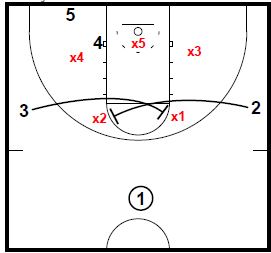
H Stack

basketball-plays-h-stack1


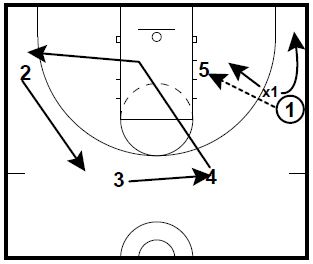
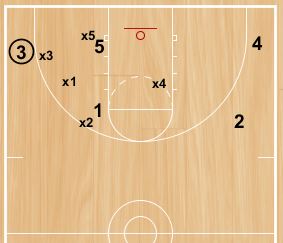
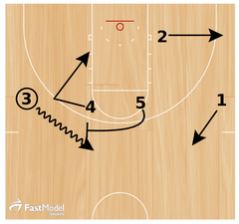
3 can pop out on either side and use 4 or 5 to get open.

2 will go opposite of side 3 pops to.
 

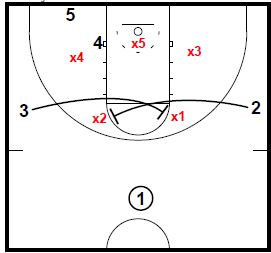
basketball-plays-h-stack2JPG


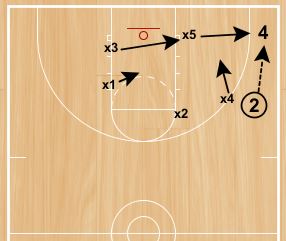
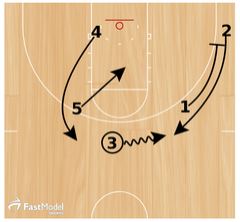
Option 1: 3 will dribble hard toward the baseline.

On his dribble, 4 and 5 set a stagger for 2.

3 can finish at the rim or pivot back to find 2 off the stagger.
basketball-plays-h-stack3JPG


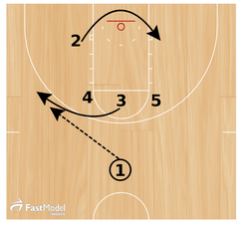
Option 2: 4 and 5 can set a shocker screen where 4 slips and 5’s screen is used.

5 will roll and 4 will come back up to replace.
 

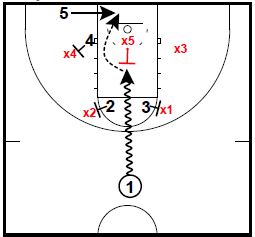
basketball-plays-h-stack4JPG


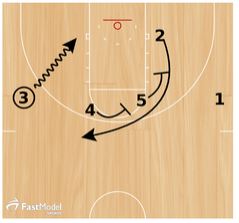
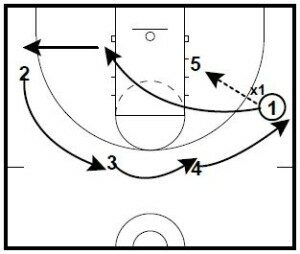
Frame 4: As 3 comes off the ball screen from 5, 1 sets a pindown screen on 2 in the corner.

3 can :

A. turn the corner hard to drive it.
B. Hit 5 on the roll.
C. Hit 2 off the pindown. or
D. Throwback to 4 on the roll and replace action.
 

Coaching Basketball Feed and Space

By Brian Williams on April 9, 2015

Here are some thoughts for teaching players to space after the ball is passed to the low post.

These 3 options are from Trey Watt’s eBook on the “Versatile Swing Offense.”

It is a part of this week’s eBook bundle along with the Encyclopedia of Packline Defense.

Regardless of what offensive system you employ, you might be able to use these ideas, or use them for thoughts to develop feed and space rules that best fit your team.

You can find out more about the eBook bundle: at this link: Packline Defense and Swing Offense.

Diagrams created with FastDraw

On POST FEEDS we use 3 options:

feed-space1

OPTION 1: CUT TO CATCH

The wing that feeds the post cuts thru, “CUTTING TO CATCH” and the other perimeter players will fill the next spot.

NOTE: this option is used versus teams that are playing tight and not digging in on the low post.

Here 1 feeds the post and cuts.
4 comes to ballside slot
3 comes to ballside alley
2 moves form alley to slot.

feed-space2

OPTION 2: CORNER AND DIVE

NOTE: This option is usually used against teams that try to dig in on the post with the ball side defenders.

1 will feed the post and go to the corner
The next player, 4, will dive to the rim and out.
3 will move over to the ballside ALLEY
2 will move from SLOT to ALLEY

feed-space3

OPTION 3 SPLIT CUT

Run this option if your player in the 4 spot is a shooter. It can be any player and not a traditional “4.”

Here 2 will feed 5 and screen at the elbow for the next guard.
4 will move to the elbow and read his defender.
Here 4 comes out, so 2 willl dive to the rim.
3 and 1 will move up.

These 3 options are from Trey Watt’s eBook on the “Versatile Swing Offense.” It is a part of this week’s eBook bundle along with the Encyclopedia of Packline Defense.

You can find out more about the eBook bundle: at this link: Packline Defense and Swing Offense.

Basketball Drills 2v1 Continuous Box Transition

By Brian Williams on April 8, 2015

This transition drill is from Drew Hanlen’s Transition Drill Book.

Drew is an NBA Strategic Skills Coach & Consultant that has helped over 25 NBA and NBA pre-draft players.

Drew is the Head Skills Coach for Pure Sweat Basketball.

He has run his internationally renowned Elite Skills Clinics in over 30 states and 4 countries over the past several years.


2v1 Continuous Box Drill

basketball-drills-box-2v1

Players will be divided into two teams. One player from the Red Team will start in the paint on defense and another player from the Red Team will start on the angle, as an outlet.

Two players from the Black Team will start at half-court with the basketball.

Behind them will be two players from the Red Team. Behind them will be two players from the Black Team. You can have as many teams of two as you want, but make sure there are an even amount of Black Team groups and Red Team groups.

Offensive players will attack the defender and try to score in the 2v1 situation. Offensive players are allowed two passes to attempt a shot. One shot per possession.

basketball-drills-box-2v12

Offensive player that shoots (or turns the ball over) must sprint and touch inside the center circle, and then sprint back on defense, while the defender must secure the rebound or get the made field goal out of the net and then outlet the basketball to their teammate at the angle.

If the defender gets a steal, they can quickly outlet the basketball to their teammate at the angle as well. As soon as the player receives the outlet, they will advance the basketball to their teammates that are ready to attack at half-court. The offensive player that did not shoot will rotate to the outlet line at the angle.

Continue this rotation until one of the teams scores 12 baskets.

Coaching Basketball Leadership Lessons

By Brian Williams on April 7, 2015

Bob Starkey’s blog is one of my favorite coaching blogs. He has several year’s experience in both men’s and women’s Division I programs. y is an assistant coach for the LSU Tigers women’s basketball team. He served as an assistant under head coach Gary Blair at Texas A&M from 2012 to 2021. You can see all of his post here: Hoop Thoughts

There was a leadership quote from Vince Lombardi on one of his leadership posts.

“Leadership is not just one quality, but rather a blend of many qualities; and while no one individual possesses all of the needed talents that go into leadership, each person can develop a combination to make him or her a leader.”

With that thought in mind, here is a list of some of the takeaways that I have collected from Coach Starkey’s posts on leadership that have resonated with me. I hope you find a few that have value to you as well!

Coach K

“They say, ‘You can’t teach an old dog new tricks.’ Coach K is breaking that cliché. He’s an old dog for sure, but he looks young on the sideline. He has a lot of passion and intensity, but he’s not so rigid that he doesn’t evolve and change with the way kids are today and the way the game is played today.” He’s coaching differently today than he did 20 years ago.

“I’m sure he’s still stubborn about some deep-rooted, hard-core philosophies that he has,” Christian Laettner said. “I’m sure he delivers those messages to the kids very strictly and very stubbornly. In other ways, he has to be willing to change, be willing to give in and relent, and relate with these young players today.”

Dean Smith

All great leaders know you can’t just talk about good character; you have to live it. To become an extraordinary leader, you must build your own personality skills. This comes first. You must be what you want your followers to become.

Effective leaders build themselves fundamentally. They develop healthy personality characteristics. They love people, care about them, are interested in them, and enjoy interacting with them.

They learn to work well with all kinds of people.

The greatest leaders I’ve known are absolutely devoted to their people. There’s no way to fake it. They put their people in the center of their thinking. They treat their employees with dignity and respect, and they don’t embarrass them or berate them.

A leader won’t accomplish much, or even be happy, unless he or she is willing to compete. Leaders should love competition and not be stifled by it. They must give everything they have to achieve their personal and companies’ goals, as long as it’s done with honesty and integrity and within the rules. Good leaders enjoy putting themselves on the line.

Modesty is also a trait of good leaders. They accept criticism and understand their limitations.

It’s the people who bring the same great effort to work effort to work every day who don’t burn out.

Self-discipline: Managers must work until they finish a project. That means having the patience to repeat things until they are done correctly. Usually it’s the dreary 5 percent of the wrap-up that’s the hardest.

Concentration: You must stay in the present and focus on each task, one at a time. Don’t jump ahead to another problem before you finish with the one at hand.

Good leaders love sharing credit for success and understand why it’s important.

John Maxwell Self Evaluation Questions for Leaders

Am I Investing in Myself? This question probes your commitment to personal growth.

Am I Genuinely Interested In Others? It’s essential to regularly question your motives. There’s a fine line between manipulation and motivation. The former moves people for personal benefit, while the latter moves people for mutual gain.

Am I Taking Others to a Higher Level? This question has to do with mission. As a leader, you’re in the people development business. Fulfilling your mission depends upon lifting the performance of those you lead. By adding value to those you lead, you’re investing in men and women with the potential to multiply your influence exponentially.

Am I Taking Care of Today? How you treat today speaks volumes about your likelihood of success. In fact, if I spent one day observing your priorities, behaviors, and interactions with people, then, with about 90% accuracy, I could let you know your leadership potential. Why would I be so certain in my judgment? Because I’ve learned that the secret of your success is determined by your daily agenda.

Various

Have a thoughts and notes journal that you keep just for you. -Dick Bennett

Don’t wrestle in the mud with a pig because you both get muddy and the pic likes it. Don Meyer

Successful people leave clues for us to study. Don Meyer

Without question, one of the main things a leader must do if forge a set of principles and goals that excite and inspire those that he/she leads. I also believe that big part of that is allowing the followers to be a part of that process in deciding why they are doing what they are doing. Bob Starkey

“I’m not remotely interested in being just good.” Vince Lombardi to Green Bay Packers during his first meeting with the team after being named the new Packer Coach. And, in just a few words, he simply yet eloquently set the standard for his team and organization.

“Our veteran players, have been very consistent in how they prepare and go about the games. Then, it’s an easy model for the younger players to follow.” Mike Matheny

Being a true leader means thinking long term and committing to your people even after they’re no longer part of your effort. That means offering mentorship and opportunities for them to grow. As a coach, I would tell our student-athletes that I was going to be their coach for four years but for the rest of their lives. I take great pride in my relationships with my players after college and I think it makes our relationships better during. From Leadership Lessons from the US Army.

There is a correct way to correct. It doesn’t need to be demeaning. You don’t want the corrective instruction lost in your tone. Bob Starkey

Basketball Plays Mustang Inside Screens

By Brian Williams on April 6, 2015

A quick hitter to run to get the ball inside against a 2-3 zone defense.

Houston Women’s Assistant Coach Vonn Read has submitted several plays from his playbook series The Basketball Encyclopedia of Plays to the Coaching Toolbox.

You can also see more of his plays in the Related Posts links at the bottom of this post.

Vonn has also served as an assistant coach in the WNBA with the Phoenix Mercury, Orlando Miracle, and San Antonio Silver Stars.

He was an advanced scout for the Orlando Magic as well as The Charlotte Sting.


Mustang Inside Screens

Diagrams created with FastDraw

basketball-plays-mustang-inside-screens1


This is a Great Lob Set for your 5 Player or best athlete.

The 2 and 3 players will cut in and set inside screens on the top 2 defenders in the Zone.

basketball-plays-mustang-inside-screens2


The 1 player will drive the middle gap after 2 and 3 set the screens. On the dribble by the 1 player, the 4 player will set a screen on X4 to seal the back line defender.

X5 will step up to stop the ball, creating the space for the lob pass to the 5 player!! The pass does not have to be for a dunk. It can be for a catch and lay up.

Coach Read has also put together The Basketball Encyclopedia of plays. You can check them out here: The Basketball Encyclopedia of Plays or read more about the books:

Any coach looking for the latest and innovative plays from the Professional, College, or High School levels can stop looking. With a compilation of over 7,700 different plays, you will never need to purchase another basketball playbook again. These playbooks can be used as a great reference tool for years to come. This 2 Volume Book includes plays from 19 different play categories, and they are the most extensive playbooks on the market.

The Basketball Encyclopedia of Plays (Platinum Series) contains over 7,700 Plays (Both Volumes combined) from the NBA, WNBA, USBL, and College levels from someone who has worked as an Advanced Scout or Coach on each level!!! This book has been intensely compiled over the last 21 years, with plays taken from a lot of NBA Coaches (past and present), WNBA coaches, and College coaches (Men’s and Women’s) from around the country.

Any coach that is serious about improving their knowledge of the game from an X and O standpoint will benefit tremendously from these books. These Books can be used to discover New Quick hitters, add a New Package to your playbook, or develop an entire Offensive System. There are a lot of new ideas and concepts in these books to study, and the Basketball Encyclopedia of Plays can be a great resource for coaches on all levels!!! This book is definitely for those X and O junkies who are always looking to improve as a Coach.

“THE GAME IS ALWAYS CHANGING? ARE YOU?” Vonn Read

Here is the link: The Basketball Encyclopedia of Plays

Maximizing Talent & Controlling Tempo

By Brian Williams on April 3, 2015

Multiple Zone Defenses–The Key to Maximizing Your Talent and Controlling Tempo

Presented by Will Rey, Head Coach Northridge Prep, Chicago.

His program’s three keys to maximizing your talent and controlling tempo are shot selection, minimizing turnovers, zone defense.

The “Zone Problem” in Basketball

  1. Zone defense is often not respected by coaches
  2. Coaches spend less time on zone attack
  3. Players don’t like to play against it

The “Zone Advantage in Basketball”

He uses these points to sell his players on the effectiveness of what they do.

  1. NBA doesn’t allow zones. The league that is most concerned with scoring points does not allow it which should at least be food for thought as to the effectiveness of zone defense. Editors note from Brian: My interpretation of Coach Rey’s statement is that even thought the NBA does allow zone defenses, they are not true zone defenses due to the defensive three second rule. Coach Rey is a very knowledgeable basketball coach and he does know that zone defenses are legal.
  2. Time. It doesn’t require as much time to teach zone defense because there are less movements and actions that opponents run against zone defense.
  3. Zone Defenses are counterintuitive to the way players see the game and train during individual skill development workouts and drills.
  4. Hard to Simulate it is difficult for opponents to prepare to play against in a few days what we have been working on for four years (seniors), three years (juniors)

Their results show that their multiple zone defenses are difficult to score against and they foul very little–another key to maximizing talent–keeping their players out of foul trouble and in the games.

What You Should Prepare for if you decide to become a “zoner”

When you play zone defense, you need to be prepared to receive criticism and you will get it. You will hear things like:

You are a compromiser
Your teams are soft
You are a “non-purist”
You are not teaching the game

Foundational Stones of their Zone Defenses

They need to work on, drill, and practice these defensive areas each day

  1. They can get to three point shooters.
  2. They have inside position for defensive rebounding.
  3. Good defense begins with good offense–shot selection and minimizing turnovers. The two parts of the game must be compatible within your system.
  4. Their players and coaches are committed to a system of multiple zone defenses.
  5. Northridge does not play zone, they teach it!
  6. If they are going to lose, they want to make the unknowns beat them. They emphasize scouting reports and shot charts for where the opponents individual players are most effective from.
  7. Air is not the enemy, don’t guard air!  Guard the basketball, the box, or the elbow

Zones they play

23 slide
31 (1-3-1)
1-2-2
Combination 1-3 plus a chaser
Triangle and Two

Execution of their defenses

  • Cover the elbows and boxes. If no one is there now, they will be coming.
  • Teaching phrase, “Ball comes, I come”
  • Guarding a skip pass is a three player operation

Teaching the 2-3 Slides

Diagrams created with FastDraw

will-rey2


9 offense, 5 defense, cover 1 pass at a time, then make the next pass.

They bump their forwards as little as possible.


will-rey3
Defend the post 3/4 around on the baseline side.

Fronting the post is an in game adjustment.

X1 is the plug position and plays facing the ball with his back to the top of the key. He is positioned to keep the ball out of the post.

X2 is the wedge and is just above the high post.


will-rey1
The three players involved in guarding the skip pass in the diagram at the left are:

x5 moving to guard the ball side block
x2 moving to guard the ball side elbow
x4 is the defender closing out on the basketball

They teach to closeout with one hand on the basketball and the other hand in the next passing lane.
The helpside forward must be aggressive and fearless. His focus is on covering the skip pass when it is made and weakside rebounding.  He plays a step off the midline.

The coverage for when the ball is passed to the corner

will-rey4

Other actions they work to cover every day.

  • Swing-Swing-Corner (perimeter swing pass, perimeter swing pass, then pass to the corner)
  • Swing-Swing-Shot
  • Skip pass-Corner
  • E”merge”ncy (Merge on the basketball when it goes inside or to the elbow)


PGC/Glazier Basketball Clinics is a preferred partner of The Coaching Toolbox

  • « Go to Previous Page
  • Page 1
  • Interim pages omitted …
  • Page 158
  • Page 159
  • Page 160
  • Page 161
  • Page 162
  • Interim pages omitted …
  • Page 288
  • Go to Next Page »

Primary Sidebar

  • Twitter
  • Facebook
  • Linkedin
coachestoolbox
personaldevelopmenttoolbox
basketballplayerstoolbox
basketballtrainer
athleticperformancetoolbox
coachingbasketball

© Copyright 2026 Coaching Toolbox

Privacy Policy