• Skip to primary navigation
  • Skip to main content
  • Skip to primary sidebar

  • Basketball Plays
    • Ball Screen Sets
    • Horns Sets
    • Man to Man Post Up
    • Man to Man Isolations
    • Backdoor Plays
    • Man to Man 3 Point Shot Plays
    • 2-3 Zone Attack
    • Baseline Inbound Plays
    • Sideline Inbound Plays
    • Combination Defense Attack
  • Drills
    • Defensive Drills
    • Offensive Drills
    • Competitive Drills
    • Passing Drills
    • Rebounding Drills
    • Shooting and Scoring Drills
    • Toughness Drills
    • Transition & Conversion Drills
    • One on One Drills
  • Blueprint
  • Practice
  • Mental Toughness
  • Skill Development
  • Offense
  • Defense
  • Store

Basketball Poems A Champion Believes & The Competitor

Basketball Poems A Champion Believes & The Competitor

By Brian Williams on April 21, 2015

A Champion Believes

By Jeff Smith
Former University of Dayton Women’s Basketball Asst Coach
Poem was written in 1990 prior to Notre Dame MCC Conference
Tournament game. UD lost in final seconds to the national power.

Sometimes we stand in awe,
Of the foe of the critics tout,
Never realizing our full potential,
‘Cause our hearts are full of doubt.
The greatest preparation is meaningless,
If the heart is not part of the plan.
So don’t even step inside of the lines,
If you don’t believe we can!

Skill is an important commodity,
Essential to every endeavor.
But champions are not always the more skilled,
Or more agile, strong, or clever.
The champion is made of characteristics
Vital to all he achieves,
But he stands apart, because in his heart,
The Champion simply believes.

The Competitor

By: Jeff Smith

Former University of Dayton Women’s Assistant
Currently Head Boys Basketball Coach Madison High School
(Middletown, Ohio)

He is a fearsome sight
To each opponent who sees
The fire in his eyes,
The bloodstains on his knees.
He’s five foot seven, or six foot nine
Night in, Night out, – he’ll lay it on the line.
A half-step slow or Tim Hardaway quick,
The one who plays when physically sick.

Hustle is his talent,
His trademark in the sport,
He garners every loose ball,
That falls upon the court.
The headlines my elude him,
The writers misspell his name,
He doesn’t care, he loves to play,
With great passion for the game.

The tenacity of a pitbull,
The exuberance of a pup,
When you come to play this guy,
You’d better “lace ‘em up.”
The second and third effort,
Help secure the bound,
He preserves the one point victory,
As he hears the buzzer sound.
Sweat drenched hands extend skyward,
Winning is the way he lives,
He wipes his face and smiles,
Knowing he had nothing left to give.
Coaching Basketball: The Truth About Positive Self Talk

By Brian Williams on April 20, 2015

This article was written by Lindsey Wilson. Lindsey is the Co-Founder of Positive Performance Mental Training Zone. Lindsey played basketball at Iowa State and then played professionally overseas.  She has been teaching, writing and speaking about mental training for the last 6 years. As a former collegiate and professional basketball player, Lindsey now takes her passion for mental training to thousands of young athletes and to universities in the Pac12, SEC, ACC, and beyond.

The Truth About Positive Self-Talk

By Lindsey Wilson

There’s a lot out there about positivity and the importance of having a positive mindset: talking to yourself positively, talking to your kids positively, even talking to your pets positively. (Groan… Yes, it’s a thing!)

All this positivity can be a bit much.

And that’s saying a lot, especially coming from someone like me who’s a BIG believer in the power of the glass-is-half-full mentality. The complication with positivity is that it can be hard to distinguish what is actually helpful and what is just, well, fluff.

That’s why I want to talk specifically about self-talk today because, in my opinion, self-talk serves as the basis for so many things in our lives: our beliefs, our outlook, our confidence, how we interact with others, and much, much more. But, I don’t just want to talk about self-talk alone; I also want to dive into the research behind it to make sure this isn’t just another ‘positive self-talk is great’ article. Yay!

Seeing as our focus is athletics, I want to specifically analyze the research looking into the relationship between self-talk and performance. Basically, my big question is:

Is teaching athletes positive self-talk worth it?

So, here we go! This is what I found:

  • Positive self-talk can improve confidence.
  • Positive self-talk does positively affect performance.
  • Self-talk effects motor skill performance more than cognitive performance.
  • Self-talk is best scripted ahead of time and practiced.
  • Research shows there are differences in what type of statements you should say at different times, but…
  • What works for each person is fundamentally a matter of personal preference.
  • Addressing yourself by name or ‘you’ is found to be more powerful than ‘I’ statements.
  • Self-talk should focus on what you should do rather than what you should not do.

First, before we can talk about self-talk in depth, we need to establish a solid definition. More specifically, we need to be able to answer the following questions:

  1. What IS self-talk?
  2. What different types of self-talk are there?
  3. Are there types that are more helpful in certain situations than others?

These questions get really specific, really fast, so let’s start with a basic overview of self-talk and go from there.

Defining Self-Talk

The Mayo Clinic defines self-talk as “the endless stream of unspoken thoughts that run through your head… [that] can be positive or negative.” Furthermore, “[i]f your thoughts are mostly positive, you’re likely an optimist — someone who practices positive thinking.”

Positive thinking, therefore, is the result of positive self-talk, and those can offer multiple health benefits, such as increased life span and increased immunity.

The Mayo Clinic then gives us examples of both positive and negative self-talk:

Putting Positive Thinking Into Practice

Negative self-talk


Positive Self Talk


I’ve never done it before. It’s an opportunity to learn something new.
It’s too complicated. I’ll tackle it from a different angle.
I don’t have the resources. Necessity is the mother of invention.
I’m too lazy to get this done. I wasn’t able to fit it into my schedule, but I can re-examine some priorities.
There’s no way it will work. I can try to make it work.
It’s too radical a change. Let’s take a chance.
No one bothers to communicate with me. I’ll see if I can open the channels of communication.
I’m not going to get any
better at this.
I’ll give it another try.

The Mayo’s cover-all rule: “Don’t say anything to yourself that you wouldn’t say to anyone else.”

Simple enough right? Not so fast. Let’s dive into this a little deeper…

TYPES Of SELF-TALK

Research shows there are 4 specific categories of performance-based self-talk:

  • Calming/relaxing (“Take a deep breath.”)
  • Instructional (“Bend your knees.”)
  • Motivational (“Yes! Come on, let’s go!”)
  • Focus (“Don’t think about anything. Just concentrate.”)

This list got me paying attention. Why? Because these categories are all so different. Even for myself, I can see one type of statement working in a certain situation and not working in another. (Leaving the research aside for a moment, this is where I encourage athletes to build up self-awareness and to practice what works with some trial and error.)

But, back to the research…

WHAT TO SAY, WHEN

In Perspectives on Psychological Science[i], a journal of the Association for Psychological Science, researchers at the University of Thessaly did a meta-analysis on 62 research studies on self-talk. Their analysis revealed that, not only did self-talk improve sports performance, but different self-talk cues work differently in certain situations.

Here is what they found:

    • Instructional self-talk (i.e. “Elbow-up”) is most helpful for tasks requiring fine skills or for improving technique.

Motivational self-talk (i.e. “Give it your all”) seems to be more effective in tasks requiring strength or endurance, boosting confidence and psyching-up athletes for competition.

It is a matter of personal preference or what works for each person; but generally, it is advised that self-talk is positively rather than negatively phrased and focuses on what you should do rather than on what you should avoid…”
Antonis Hatzigeorgiadis, researcher at the University of Thessaly

A SMALL TRICK

According to an article in Journal of Personality and Social Psychology[ii], a researcher by the name of Kross and his associates at the University of Michigan did an experiment with one small caveat: participants would either use the word ‘I’ or ‘You/[their name]’ when addressing themselves with their self-talk.

This is what the experiment looked like:

Kross asked volunteers to give a speech. Catch: they were only given five minutes of mental preparation. During the five minutes, he told some to talk to themselves and to address themselves as ‘I’. For the rest of them, their five minutes was spent using ‘you’ or by addressing themselves in the third person (using their own names).

At the close of the study, this is what Kross found:

  • People who used ‘I’ said things like ‘Oh, my god, how am I going do this? I can’t prepare a speech in five minutes without notes. It takes days for me to prepare a speech!’
  • People who used ‘you’ or their own names said things like, “Ethan, you can do this. You’ve given a ton of speeches before.”

Positive self-talk effects your everyday life.  Clearly, the people who used ‘you’ or their names sounded more rational and less emotional—perhaps because they were able to get some distance from themselves.

Truly, it sounds like they are coaching themselves.

SELF-TALK CAN INFLUENCE RESULTS!

Research done out of Waseda University in Japan[iii] shows again that motor skills especially are greatly affected by self-talk. The results of their research show that positive self-talk improved physical performance by 11%.

Their research was based around a simple balancing exercise. Students completed the exercise then were given 30 seconds to rest before completing it a second time. In between the sets, students were told to pay attention to their self-talk. Some students reported having negative self talk; others reported positive self-talk; still another group reported using a combination of positive and negative self-talk.

The results were shocking.

Students that reported using positive self-talk exclusively during those 30 seconds were able to hold their balance a full second longer than those who used exclusively negative or had a mix of both negative and positive self-talk.

The positive self-talk resulted in an average balance time of 9.29 seconds, while the other two groups averaged out at 8.29 seconds. This is more than an 11% increase in performance, really close to the proven 15% increase in athletic performance we see with Positive Performance’s mental training.

CONCLUSION

Based on the above findings it’s obvious that teaching athletes how and when to use positive self-talk—that is, using positive self-talk appropriately—is not only a good time investment, but a worthwhile one.

While talking about positive self-talk can seem merely warm and fuzzy, research shows that it is a powerful, actionable tool in achieving one’s peak performance. And, based on our own work with athletes, here are some simple best practices for self-talk education:

6 TIPS FOR EFFECTIVE POSITIVE SELF-TALK

  • Self-talk should be practiced ahead of time (outside of competition).
  • While there are best practices, the focus should be less about negative/positive, or good/bad self-talk, and more about what is PRODUCTIVE for athletes in certain situations.
  • Individual preferences are okay.
  • Self-talk should be focused on what should be done, rather than what should be avoided.
  • Different situations might call for different types of self-talk.
  • It is difficult to turn off self-talk. For most people, self-talk is going to happen, for the good or the bad, regardless of whether you work on it. Knowing that, you may as well make the monologue in your head helpful… and positive!

Here’s to athletes everywhere, using self-talk as a tool to find their peak performance every time they step onto the playing field.

P.S. Want to pump up your performance even more? Click HERE to learn about our Competition MasteryTM training and get a FREE sample training.

REFERENCES:

[i] Girodo & Wood, 1979; Goodhart, 1986; Mahoney & Avener, 1977; Van Raalte et al., 1994; Weinberg, 1985

[ii] Kross, E., Bruehlman-Senecal, E., Park, J., Burson, A., Dougherty, A., Shablack, H., Bremner, R., Moser, J., & Ayduk, O. (2014). Self-talk as a regulatory mechanism: How you do it matters. Journal of Personality and Social Psychology.

[iii] Belief in Self-Talk and Dynamic Balance Performance.Kaori Araki (Waseda University, Japan), Joseph K. Mintah (Azusa Pacific University), Mick G. Mack, Sharon Huddleston, Laura Larson, and Kelly Jacobs (University of Northern Iowa).

Coaching Basketball Program Building Insights

By Brian Williams on April 17, 2015

I received a couple of emails this week with some thoughts on program building that I have included in today’s post.

ATTRIBUTES OF SUCCESSFUL HEAD COACHING

By Will Rey, Head Coach, Northridge Prep (Niles, IL)

Coach Rey just completed his 38th year in coaching and 11th season at Northridge Prep.  Other coaching stops have included Head Coach at Loyola (Chicago) University and D1 Assistant at Evansville and Wright State.  You can follow him on Twitter @coach4character

1. Have a “vision of greatness” for each individual you coach.

a. Work to bring out the best in each player as a person first – believe in each individual and his innate goodness.
b. Convince each individual that he is capable and worthy of doing great things in life.
c. Build relationships based on trust and honesty.
d. Talk often about things outside of basketball – family, personal interests, etc.
e. The team will reach its potential if the best players trust and believe in you.

2. Build “humble confidence.”

a. Begins with knowing the truth about yourself and your need for others.
b. Comes through work and preparation.
c. Collective confidence is greater than individual confidence – draw strength from each other.

3. “Team unity” can and must be developed over the course of a season.

a. Get individuals to buy in to one team vision that is greater than each individual.
b. Team unity is hard to define; but, we intuitively recognize it when we see or experience it.

4. Hold players “accountable.”

a. Be fair, firm, and consistent.
b. Be exacting and demanding in your attention to details.

5. “Know your system” and “teach it well.”

a. Have strong convictions about how to play and sell your system to your players.
b. Defense is the backbone of our program, but offensive skills will determine our ultimate success.

I received the rest of the notes in this post from Mayville State University Women’s Basketball Coach Dennis Hutter. www.coachhutter.com.

  • Wooden’s 3 Rules for Leadership from players
    1. Have to be the hardest worker
    2. Take care of stuff off the floor
    3. Leave all else to the coaches
  • Leadership starts at the top – no leadership at the top – program is in tough shape.
  • Expect Greatness,Inspect for Greatness,Accept only Greatness
  • You want to try and go from “Good to Great”, because good is the enemy of great.
  • On a good team 1-2 players do the “dirty jobs”. On a great team ALL the players do the “dirty jobs”
  • A good friend tells you what you what you need to hear, not what you want to hear.
  • Four Types of Coaches and players
    1. Unconscious/Incompetent – don’t know that they don’ know. Completely clueless!!
    2. Conscious/Incompetent – knows that they don’t know. Beginning of wisdom is not knowing –
    Proverbs – they hang around good coaches and players.
    3. Conscious/Competent – Anal coaches and players – coaches always have good team, but not great
    teams
    4. Unconscious/Competent – they know and it flows, spontaneous – they don’t know how good they
    are, so they keep getting better.
  • BE THANKFUL FOR TOUGH TIMES – “necessity is the mother of invention” – You come up with something, because you have to.
  • Plan, Prepare, Practice & Play like you just lost your last game.
  • Never sacrifice toughness and attitude for size and quickness – Jim Tressell
  •  Teach your leaders how to lead through -Individual Meetings &-Team Meetings
  • Think about what principles and ideas guide you as a leader.
  • Warren Buffet looks for three things when hiring somebody: 1. Work Ethic 2. Intelligence 3. Character The first two, without the third one, will kill you!!!
  • It takes time and experience to be good at your craft.
  • Eric Musselman’s 10 Points of Leadership

1. People follow the leader first, and the leader’s vision second.
2. Trust is the force that connects people to the leader and the vision.
3. Leadership is not just about what you do, but who you can inspire, encourage and empower others to do
4. A leader brings out the best within others by sharing the best within themselves.
5. Just because you are driving the bus, doesn’t mean you have the right to run people over – RESPECT
6. Rules without Relationships leads to Rebellion
7. Lead with optimism, enthusiasm and positive energy. Guard against pessimism and “weed out” negativity.
8. Great leaders know they do not have all the answers.
9. Leaders inspire and teach their people to focus on solutions, not complaints.
10. Great leaders know that success is a process, not a destination

  • Thoughts on the “Stretch Four” Concept

1. Duke Basketball’s most successful teams have had an outstanding stretch four on their team.
2. Use the stretch four a lot like the “queen” is used in chess, they are permitted to do anything, and are not assigned a specific role.
3. Extending forwards gives you a chance to hide your lack of size or speed while capitalizing on what they do well.
4. “Screen/Roll” your “4” in transition, to further stretch the defense.
5. Our best post defense, is constant hard pressure on the ball from the perimeter.
6. Coaches should not stand in the way of a player’s development.

  • There can be no happiness if the things we believe in are different from the things we do.
  • Comet Women’s Basketball Program Mission Statement: “Daily we must build the individual effort and collective pride and attitude of being a part of the Mayville State Women’s Basketball Program through love built around relationships.”
  • Four Characteristics of a good basketball player:
    1. Commitment
    2. Toughness (Physical & Mental)
    3. Communication (Verbal & Non-Verbal)
    4. Leadership
    5. Goal Oriented

  • Coach Hutter’s Personal Purpose Statement: “Positively impact people through my relationships and interactions with people through my faith in Jesus Christ.”
  • 6 C’s of a Great Player:
    1. Character – Who you are as a person
    2. Compete – ALL THE TIME
    3. Close – Practices/Games/Season
    4. Communicate – Effectively
    5. Connectivity – Connects with every teammate to get the very best out of them.
    6. Coachability – Effort/Attitude
  • C & C Concept – “Correct/Compliment
    -Correct – Immediate to help retain
    -Compliment – later – note/text message – allowing them to go back and read again.

Coaching/Leadership Thoughts

  • Success is usually the result of team cohesion and leadership. If the players can work together and develop into leaders, they will play better on the court.
  • While approaches to program turn arounds may vary, all coaches agree that building a “winner” from scratch is less about X’s and O’s and more about leadership.
  • If you are taking over a struggling program, you have to sell kids on your long-term vision and the ability to be a foundation of something big
  • If coaches do not believe that they can be the best, it will hinder their progress.
  • Coaches need to understand the types of players they have, so they will know how they will respond to things.
  • It is so important that the coaches model the same commitment level as what they are asking for out of their players.
  • When players have a routine, they perform better, because they know what to expect

Basketball Plays Izzo ATO

By Brian Williams on April 16, 2015

3 Options for a quick hitter from the Michigan State Playbook that you can run after a timeout or save to run late in a tight game. If you run this type of “Iverson Cut” clear out already, then hopefully this will give you something to add if the defense takes that away.


MSU Zipper Option 1

Diagrams created with FastDraw

basketball-plays-izzo1


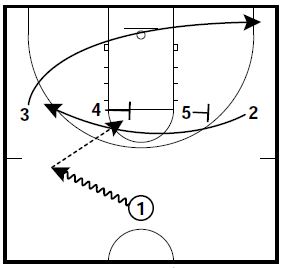
4 and 5 set a cross screen for 2.

2 comes over the top to the left wing.

3 cuts backdoor to the right wing.

1 dribbles to the left wing and then passes 4 after 2 cuts by him.

5 cuts to the basket. 4 passes to 5.

MSU Zipper Option 2

basketball-plays-izzo2


4 and 5 set a cross screen for 2.

2 comes over the screens to the left wing.

3 backdoor cuts to the right corner.

1 dribbles to the left wing.

After 2 passes 4 over the top of the screens, 1 passes to 4.

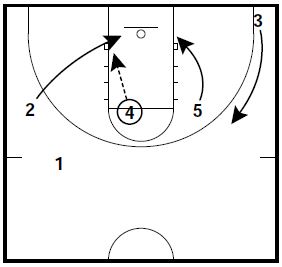
basketball-plays-izzo3


2 backdoor cuts to the basket.

4 passes to 2 on the back cut.

5 dives to the right low block for the offside rebound.

3 slides up to the right wing.

MSU Zipper Option 3

basketball-plays-izzo4


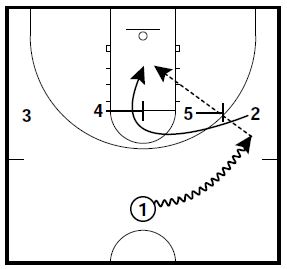
4 and 5 sets a cross screen for 2.

2 comes off 4’s cross screen and curls to the basket.

1 dribbles to the right wing and passes to 2.


These 3 options are from Tom Izzo’s Michigan State Playbook which is a part of the 10th Anniversary eBook Special 

10 Thoughts for Beginning Coaches

By Brian Williams on April 15, 2015

I found this on Alan Stein’s Stronger Team Blog. It was originally written by Coach Jim Burson (www.JimBurson.com).

Preface: Having coached for 40 years and looking back to those beginning times, I wish that I had had an article that would warn me of some of the pitfalls that were ahead of me.

However, at the time, I am pretty sure I wouldn‘t have read it and if I did, I would have thought that none of it applied to me.

However, I think these thoughts can be useful for any coach.

1. Not every player will be interested in every practice.

No matter how much experience you have or how great you are at teaching, you will encounter times in the gym when players are just not interested. Don‘t give in to the temptation to scold or yell. Instead, try changing your tone of voice. Try moving around. Try both. You can even switch from talking to a physical activity, like a scrimmage. The process of the scrimmage may increase the players‘ understanding and, possibly, their level of interest. Teach them anyway.

2. If a practice is going badly, stop and regroup.

Even if you have planned a detailed practice and have a clear goal in mind, if your approach is not working – for whatever reason – stop! Regroup and start over with a different approach, or abandon your planned practice entirely and go on to something else. Afterward, be honest with yourself as you examine what went wrong and make plans for the next day. Do it. Do it right. Do it right now.

3. Coaching will get better.

Maybe not tomorrow or even next week, but at some point, as you keep at it, your job will get easier.

Do you remember your very first practice? Were you nervous? Of course. So was I. See how much your coaching has already improved? By next year you will be able to look back on today and be amazed at how much you have learned and how much more easily you do your job. The dawn alleviates.

4. You do not have to say yes to everything.

Do not feel that you must say yes each time you are asked to participate. Know your limits. Practice saying, ―Thank you for thinking of me, but I do not have the time to do a good job with another commitment right now. Of course, you must accept your responsibility as a professional and do your fair share, but remember to be realistic about your time. Learn to say no.

5. Not every player or parent will love you.

And you will not love every one of them, either. Those feelings are perfectly acceptable. We coaches are not hired to love players and their parents. Our job is to teach players and, at times, their parents as well. Players do not need you to be their buddy. They need a facilitator, a guide, mentor, a role model for learning and for character. Give them what they need.

6. You cannot be creative every day.

When those times happen, turn to outside resources for help. Coaching books, teaching guides, clinics, professional organizations such as high school associations and the NABC are designed to support you in generating well-developed practices. When you come up with your own effective and meaningful practices—and you will – be sure to share your ideas with other coaches, both veterans and newcomers to the profession. Sit at the feet of Masters.

7. No one can manage classes, students, players, recruiting, media and – oh, yes, coaching – all at the same time and stay sane.

A little multi-tasking can be good, but you must know your limits. Beware of burnout. Remember #4.
A little learning is a dangerous thing – drink deep.

8. Some days you will cry, but the good news is that some days you will laugh.

Learn to laugh with your players and with yourself. Patience is a great virtue.

9. You will make mistakes. That’s life, and that’s how you learn.

You cannot undo your mistakes, but berating yourself for them is counterproductive. If the mistake requires an apology, make it and move on. Mistakes are life. Life is not a game. No one is keeping score. Put down the beating stick.

10. This is the best job on earth.

Stand up straight. Hold your head high. Look people in the eye and proudly announce, ― I am a basketball coach. You make a difference.

Alan Stein
Hardwood Hustle Blog
http://www.About.me/AlanStein

Basketball Drills Fatigue Shooting

By Brian Williams on April 14, 2015

This video is one of the great resources available from basketballhq. They have several more videos as well as basketball coaching resource articles.

This drill is a good “gut-buster” to use at the end of a shooting workout. It is physically demanding. It also forces players to shoot under the pressure of making three in a row. Having to make consecutive shots to complete a drill is one of the best ways to put mental pressure on a shooter.

Matthew Graves is the Head Coach at Indiana State. He was an Assistant to Brad Stevens and a player at Butler prior to taking the job at South Alabama. Coach Graves was the top assistant for both Championship game runs that Butler made in 2010 and 2011. He is currently serving as an assistant at Xavier.

Please make sure your sound is on to see the video.

Click the play arrow so see the drill. The drill is a You Tube video, so you will need to be able to access You Tube to see the drill.

Basketball Drills Nuggets Fatigue Shooting Drill

Depending on the needs of your program, you could shoot closer shots or require only two consecutive makes then build up to three consecutive made three point shots.

Note: At the end of the video, Coach Graves says that the goal is to complete the drill in 30 minutes. What he meant to say (and did say at the start of the video) is the goal is to complete it by shooting less than 30 shots.

  • « Go to Previous Page
  • Page 1
  • Interim pages omitted …
  • Page 157
  • Page 158
  • Page 159
  • Page 160
  • Page 161
  • Interim pages omitted …
  • Page 288
  • Go to Next Page »

Primary Sidebar

  • Twitter
  • Facebook
  • Linkedin
coachestoolbox
personaldevelopmenttoolbox
basketballplayerstoolbox
basketballtrainer
athleticperformancetoolbox
coachingbasketball

© Copyright 2026 Coaching Toolbox

Privacy Policy