• Skip to primary navigation
  • Skip to main content
  • Skip to primary sidebar

  • Basketball Plays
    • Ball Screen Sets
    • Horns Sets
    • Man to Man Post Up
    • Man to Man Isolations
    • Backdoor Plays
    • Man to Man 3 Point Shot Plays
    • 2-3 Zone Attack
    • Baseline Inbound Plays
    • Sideline Inbound Plays
    • Combination Defense Attack
  • Drills
    • Defensive Drills
    • Offensive Drills
    • Competitive Drills
    • Passing Drills
    • Rebounding Drills
    • Shooting and Scoring Drills
    • Toughness Drills
    • Transition & Conversion Drills
    • One on One Drills
  • Blueprint
  • Practice
  • Mental Toughness
  • Skill Development
  • Offense
  • Defense
  • Store

Basketball Plays: Sideline Inbounds

Basketball Plays: Sideline Inbounds

By Brian Williams on November 1, 2015

These two NBA Sideline Inbound plays are featured posts in the FastModel Sports Basketball Plays and Drills Library.

You can also find out more about FastModel Play Diagramming software by clicking this link: FastDraw

Note: The numbers are to distinguish between the 5 different players on the floor, not to say that you have to put a traditional “5” player (i.e. center or post player), or a traditional “4” player (i.e. power forward) in those spots if you run the play. If you need a 3 point shot, at the end the game, IMO it is better to put 5 players who are dressed for the game that give you the best chance of accomplishing that.

Note #2: The purpose of this post is not to say that you should run this exact play.

But, I hope it does motivate some discussion and thinking among your coaching staff as to how you can possibly incorporate some of the actions in this play to your team’s end of game situations, or as to what you can do to counter teams that switch everything at the end of the game in this situation.

Many of the players have changed teams. The point of the post is to give you ideas on ways that you can put your players in positions to be successful.

OKC End of Game SLOB

This play was contributed by former Florida Graduate Assistant and current Fort Myers High School Boys Assistant Kyle Gilreath.

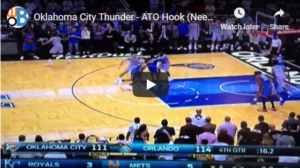
Billy Donovan drew up this ATO with under 10 seconds remaining as the Oklahoma City Thunder trailed by 3 at Orlando. If you’ve followed Coach Donovan for years, you know he loves screen the screener actions for his best players.
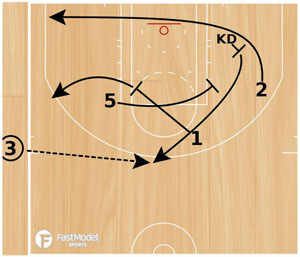
basketball-plays-okc

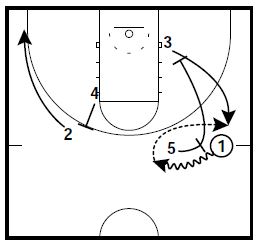
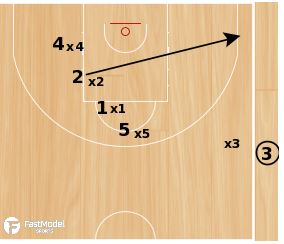
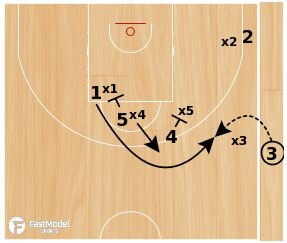
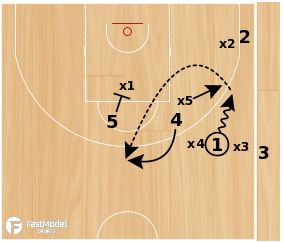
Durant screens 2 (Augustine) to the corner as 1 (Westbrook) screens 5 (Adams) into a pindown for Durant.


Cleveland SLOB Back DHO Quick 3

The plays were submitted by Jon Giesbrecht. Jon is currently an assistant coach with the University of Winnipeg Men’s program. Jon is also an assistant coach with the 17U Male Provincial team for Team Manitoba (Includes National Championship 2013-14).
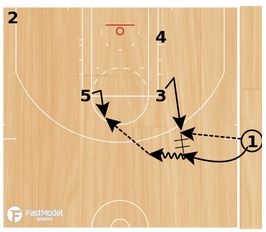
baketball-plays-cleveland-ato1

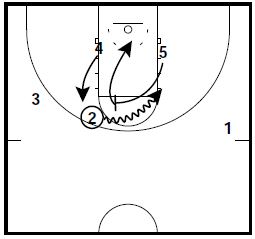
3 gets open, 1 passes to 3.

1 cuts off 3 and receives dribble hand off.

1 dribbles to get better angle to pass to 5.
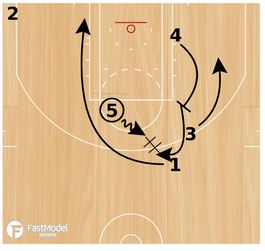


baketball-plays-cleveland-ato2

1 cuts off 5 for a fake handoff.

4 sets back/flare screen for 3.

4 receives guard get for 3pt shot from 5.
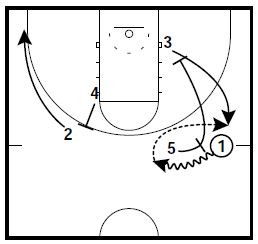
 

Basketball Plays 2 Virginia Sets

By Brian Williams on October 29, 2015

Here are a couple of sets that Virginia uses as a complement to their Blocker/Mover Offense.

These plays are a part of this week’s featured eBook bundle.

You can see more information about what is included in this bundle by clicking this link: Virginia Playbook and the Encyclopedia of Packline Defense

My intent for all of the Xs and Os that I present on the site is that you might take parts of the actions from these sets and apply them to your personnel and your philosophy.


Roll into Step Up Flare

Diagrams created with FastDraw

basketball-plays-uva1
1 comes off side ball screen from 5

5 veer screens for 3 to perimeter

4 clears 2 to the weak side corner with a flare screen
(In the diagram, the angle of the flare screen is not correct. Screeners back should be to the corner)

1 comes of the ball screen and throws back to 3 on the wing

basketball-plays-uva2


3 dribbles at 1 who gets a flare screen from 4


Step Up, Roll & Replace

basketball-plays-uva3

Forces 2s defender to guard 2 screening actions before fighting through a ball screen

1 passes to 4

4 passes to 3

5 screens 2 through lane

basketball-plays-uva4


2 sets UCLA back screen for 4

2 pops out

3 passes the ball to 2


basketball-plays-uva5


5 sets ball screen for 2

5 rolls to rim

4 replaces on the perimeter


You can see more information about what is included in this bundle by clicking this link: Virginia Playbook and the Encyclopedia of Packline Defense

Basketball Drills: Tennessee Rebounding Drills

By Brian Williams on October 23, 2015

These rebounding drills are with former Tennessee’s women’s coach Holly Warlick

These are You Tube videos, so you will need to be able to view You Tube videos on the server you are on. At times schools will block You Tube.

Make sure your sound is on as you watch. Click the play arrow to see the video..

I like the idea of having the rebounding team look to push the ball on offense after securing the rebound to make your rebounding drills more game-like.

If you are interested in learning more about the entire DVD that this sample came from, click this link: Competitive Rebounding, Defense & Transition Drills . Anyone who purchases anything from the store receives one of my basketball coaching eBooks as a bonus. Just email me and let me know which one you would like to receive!

Numbers Rebounding Drill

5 offensive rebounders outside the three point arc. They are numbered 1 through 5.

3 defenders with 10 toes in the paint.

Coach calls 3 numbers and those 3 numbers from the perimeter offensive rebounders crash the offensive glass.

Scoring system is

1 point for a defensive rebound and a dribble to half court in 2 seconds
2 points for an offensive rebound, if they score the offensive rebound, it is another two points
1 bonus point for 3 rebounds in a row

Play to 10 with the same groups on offense and defense until one team wins.

To start the drill, keep the offense stationary, to make the drill more challenging, have the offense move before the assistant coach calls a number.

If you are interested in learning more about the entire DVD that this sample came from, click this link: Competitive Rebounding, Defense & Transition Drills . Anyone who purchases anything from the store receives one of my basketball coaching eBooks as a bonus. Just email me and let me know which one you would like to receive!

Covenants for Teams and Coaches

By Brian Williams on October 21, 2015

Covenants for Teams and Coaches

Scott Rosberg

Last week I wrote about “Intentionally Creating Your Culture.” (Click here for a link to that post) In that post I talked about the concept of “Core Covenants” that Proactive Coaching’s Bruce Brown discusses in his booklet “First Steps to Successful Teams” – www.proactivecoaching.info. Today I am going to talk in a little more detail about covenants. Core Covenants could also be called “Guiding Principles” or “Team Standards” or “Program Values” or any other moniker that indicates a similar concept. The reason why we like “Core Covenants” is because “covenant” is a stronger, word. As I said last week, a covenant is a binding agreement where action is visible. There is a similar concept here to a promise. However, promises come more from the world of distrust, so people feel the need to say something along the lines of “I promise that I will fulfill this obligation.” But covenants are based on trust. For instance, when two people get married, they enter into a covenant with one another. The sacred wedding vow is a covenant.

The biggest key to a covenant, though, is the second part of the definition – you can see it in action. Covenants are only as strong as the actions associated with them. When teams establish covenants, if they are merely making statements about what they want to be known for, but they are not willing to follow through and “live” those covenants through their actions, it is worse than not having covenants at all. Teams without covenants (standards) are certainly a problem; but teams that claim they have standards but do not live by those standards are hypocritical, and they are living a lie.

Establishing covenants and then living by those covenants can be one of the most important things that any team does, for it sets a tone for the season. It says, “This is who we are. This is what we stand for. Because of that, this is what you will see from us.” When all members of a team buy in to the covenants that have been established, it is an extremely powerful force in helping a team become all that it is capable of becoming. In essence, team members are saying, “I commit to living my life the way that we as a team have decided we need to live in order to be the best we can be.”

There are all kinds of things that can make up a team’s covenants. However, we believe that the best covenants are behavior covenants. While certain physical and mental skills and traits are important and have their place on teams, when it comes to establishing your team’s standards, it is best if you focus on behavioral characteristics that every member of the team can uphold and live in their daily actions. The beauty of these kinds of covenants is that they are a choice that every team member can choose to live by. They require no specific physical skill, no highly developed mental capacity to perform them. They just require that players make the choice to commit to them.

For example, if a team decides to adopt “Work Habits” as a covenant, they are saying that “we will work extremely hard all the time.” Many teams that adopt this covenant will often use the phrase “100%-100% of the time” as an “action statement” about work habits. They are saying, “To be on this team, you must give 100% effort, 100% of the time.” This is where the second part of the definition for a covenant comes into play – you can see it in action. Team members are saying that “if you watch us, you will see our team giving maximum effort at all times.” They will often then give some specific examples – going full speed on all sprints, not just on the first couple; touching all lines on all sprints; pushing oneself and one’s teammates as hard as possible in practice and in the weight room; diving for loose balls; and many more.

This concept of Work Habits is a choice. Every player, from the best player on the team to the player who gets the least amount of playing time, can make the choice to work his hardest at all times. The beauty of the concept is this – when your best players physically are also the best workers and best teammates, you have a chance to have a great team because the maximum potential and capability of your best can be realized. Unfortunately, too often we find the best players on teams don’t fall into the best worker and best teammate class. These teams rarely, if ever, achieve all that they could because the players with the most physical talents hold back, and so the team does not achieve its potential.

When it comes to establishing and then living your covenants, choose to create behavior covenants for your team that everyone can commit to. Then work on them throughout the year to keep them in the forefront of everyone’s mind. You will be amazed to see how hard your players will work to become the best they are capable of becoming when they have a direction in which to go that they have total control over.

For an in-depth look at instilling covenants in your programs to create an outstanding team culture, check out Proactive Coaching’s DVD Captains & Coaches’ Workshop, or better yet, have one of us out to do a Captains & Coaches’ Workshop for your teams. For more information go to www.proactivecoaching.info.

Do you have covenants for your team? If so, what are they? If not, what would you like your team to be known for? Leave a comment or go to my website – www.coachwithcharacter.com – and leave a comment below this same post.

About the Author of this Article

Scott Rosberg has been a coach (basketball, soccer, & football) at the high school level for 30 years, an English teacher for 18 years, and an athletic director for 12 years. He has published seven booklets on coaching and youth/school athletics, two books of inspirational messages and quotes for graduates, and a newsletter for athletic directors and coaches. He also speaks to schools, teams, and businesses on a variety of team-building, leadership, and coaching topics. Scott has a blog and a variety of other materials about coaching and athletic topics on his website – www.coachwithcharacter.com. He can be reached by email at [email protected].

Scott is also a member of the Proactive Coaching speaking team. Proactive Coaching is dedicated to helping organizations create character and education-based team cultures, while providing a blueprint for team leadership. They help develop confident, tough-minded, fearless competitors and train coaches and leaders for excellence and significance. Proactive Coaching can be found on the web at www.proactivecoaching.info. Also, you can join the 200,000+ people who have “Liked” Proactive Coaching’s Facebook page at www.facebook.com/proactivecoach. Scott can also be reached through Proactive Coaching at [email protected].

Basketball Plays: Warriors SLOB Need 3

By Brian Williams on October 19, 2015

This play to get a three point shot came from the FastModel Sports Basketball Plays and Drills Library.

You can also find out more about FastModel Play Diagramming software by clicking this link: FastDraw

The play was submitted to FastModel by Andreas Barthel.

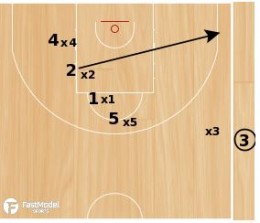
The idea of the play is to use it at the end of a game when you need a 3 point basket.

It is a triple decoy play that forces numerous switches.

Note: The numbers are to distinguish between the 5 different players on the floor, not to say that you have to put a traditional “5” player (i.e. center or post player), or a traditional “4” player (i.e. power forward) in those spots if you run the play. If you need a 3 point shot, at the end the game, IMO it is better to put 5 players who are dressed for the game that give you the best chance of accomplishing that.

Note #2: The purpose of this post is not to say that you should run this exact play. But, I hope it does motivate some discussion and thinking among your coaching staff as to how you can possibly incorporate some of the actions in this play to your team’s end of game situations, or as to what you can do to counter teams that switch everything at the end of the game in this situation.

Warriors SLOB Need 3

warriors1


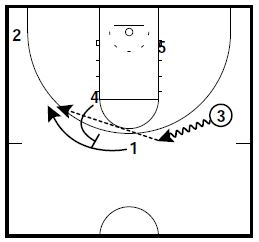
2 cuts to the ball side corner.


warriors2


4 uses a staggered screen set by 1 and 5.

The design is to force the first switch between X4 and X5.


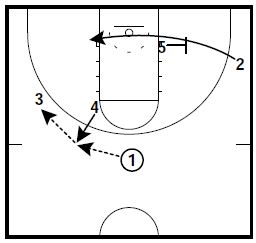
warriors3

1 then comes off a down screen by 5.
Looking to create a second switch between X1 and X4.

4 turns and screens X5 which prevents x5 from executing a third switch with X4 (Barnes) who is forced to trail 1 (Curry)

3 (Iguodala) passes the ball to 1 (Curry)

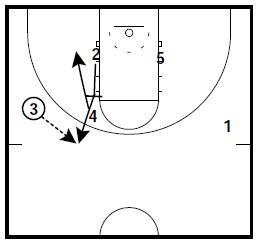
warriors4


1 begins to drive the ball away from the screening action to force X5 to help.

5 screens X1.

4 pops out for the 3 point shot.

Coaching Basketball The Notebook of Champions

By Brian Williams on October 16, 2015

The bullet points in the post are taken from Ryan Renquist’s “The Notebook of Champions” Building Success One Victory at a Time (Eighth Edition) for his team at Walsh High School in Walsh, Colorado.

I have also included a download link at the bottom of this post if you are interested in seeing his entire notebook.

Perhaps these thoughts will give you some inspiration to modify these and make them your own for your team.

“Life is like a basketball, it just keeps bouncing up and down.”

“I’ve got a theory that if you give 100 percent all of the time, somehow things will work out in the end,” Larry Bird

What Do I Want in a Player?

I want a player who is willing to make a commitment to being as good as he can be each time that he plays.

I want a player who is willing and ready to do what has to be done to make a positive contribution in the most difficult of games.

I want a player who competes in each game as though there is nothing he will ever do that will be more important.

I want a player who more than anything, wants our team to be the very best that it can be.

Is this too much for me to demand of you?

Is this too much for you to demand of yourself?

One of the most important benefits of sport’s participation is the relationships that are formed. Players make lifelong relationships with their teammates, coaches, managers, fans, opponents, and everyone who helps manage the games (maintenance crews, scorekeepers, bus drivers, athletic directors, principals, superintendents, and even the referees). In today’s technological world, networking is very important. Through sports participation, athletes have a far greater network than those who do not participate.

WE PLAY HARD: We give maximum effort at all times and in everything we do. We take charges, and are eager to dive for a loose ball.

WE PLAY SMART: We know our assignments and make wise decisions.

WE PLAY TOGETHER: Five people working together can achieve much more than five people working independently.

WE PLAY AGGRESSIVE: The most aggressive team will get more of the calls and win the game.

WE COMMUNICATE: We make eye contact with each other whenever someone is talking. We talk at all times when we are on the floor.

“Good talent with bad attitude equals bad talent,” Bill Walsh

The average American will meet 10,000 people in their lifetime. If we each change the lives of 10 people, and they change the lives of 10 people, and they all change the lives of 10 people, and so on, in 5 generations, the 30 people in our family will have changed the lives of 300,000 people. Lives can be changed anywhere, and by anyone. Admiral William H. McRaven, Commander, Navy Seal

The Wolf Inside Submitted By: Cullen Hair, 2012

An old man is telling his grandson about a fight that is going on inside himself. He said it is between two wolves.

One wolf is evil: anger, envy, sorrow, regret, greed, arrogance, self-pity, guilt, resentment, inferiority, lies, false pride, superiority, and ego…

The other wolf is good: joy, peace, love, hope, serenity, humility, kindness, benevolence, empathy, generosity, truth, compassion, and faith…

The grandson thought about it for a minute, and asked his grandfather, “Which wolf wins?”

The old man simply replies, “The one I feed.”

Attitude

By: Charles Swindoll

The longer I live, the more I realize
the impact of ATTITUDE, on life.
ATTITUDE, to me, is more
important than facts.
It is more important than the past,
than education, than money, than
circumstances, than failures, than
successes, than what other people
think or say or do.
It is more important than
appearance, giftedness or skill.
It will make or break a
company… a church… a home.
The remarkable think is we have a
choice every day regarding the
ATTITUDE we will embrace for that day.
We cannot change our past… we
cannot change the fact that people
will act in a certain way.
We can not change the inevitable.
The only thing we can do is play
on the one string we have, and that
is our ATTITUDE…
I am convinced that life is 10%
what happens to me and 90% how
I react to it.
And so it is with you…
We are in charge of our
ATTITUDES.

Humility:

In basketball, we can value a player for his speed, shooting ability, or how he jumps. But, ultimately, it’s the humble superstar that most guys seem to admire and want to emulate. Humility is a quality worth desiring.

If we are really humble, after a game you won’t be able to tell whether we’ve won or lost. Or whether people are saying nice things about us or criticizing us. A truly humble person is constantly deflecting praise to their teammates and recognizing others for their efforts.

Many of our losses are designed to humble us and shape us into the people we want to be. We have to let those times do their work on us.

Chuck Tanner, the manager for the 1979 world champion Pittsburgh Pirates, said, “You have to play everyday like it’s Opening Day.” In baseball, it is easy to get excited about opening day. The stands are packed. The locker room is filled with optimism about the upcoming season. We have to capture that Opening Day Enthusiasm and release it before every practice and every game.

Click this link to download the entire Notebook of Champions

  • « Go to Previous Page
  • Page 1
  • Interim pages omitted …
  • Page 139
  • Page 140
  • Page 141
  • Page 142
  • Page 143
  • Interim pages omitted …
  • Page 288
  • Go to Next Page »

Primary Sidebar

  • Twitter
  • Facebook
  • Linkedin
coachestoolbox
personaldevelopmenttoolbox
basketballplayerstoolbox
basketballtrainer
athleticperformancetoolbox
coachingbasketball

© Copyright 2026 Coaching Toolbox

Privacy Policy