• Skip to primary navigation
  • Skip to main content
  • Skip to primary sidebar

  • Basketball Plays
    • Ball Screen Sets
    • Horns Sets
    • Man to Man Post Up
    • Man to Man Isolations
    • Backdoor Plays
    • Man to Man 3 Point Shot Plays
    • 2-3 Zone Attack
    • Baseline Inbound Plays
    • Sideline Inbound Plays
    • Combination Defense Attack
  • Drills
    • Defensive Drills
    • Offensive Drills
    • Competitive Drills
    • Passing Drills
    • Rebounding Drills
    • Shooting and Scoring Drills
    • Toughness Drills
    • Transition & Conversion Drills
    • One on One Drills
  • Blueprint
  • Practice
  • Mental Toughness
  • Skill Development
  • Offense
  • Defense
  • Store

Coaching Basketball: Winning Priorities

Coaching Basketball: Winning Priorities

By Brian Williams on December 7, 2015

This article was written and submitted by retired High School Coach Dave Millhollin.

I have included more information about his coaching career at the end of the article.

Caoch Millhollin has contributed several insightful articles to the site. You can find links to more of them at the bottom of this post under the “Related Posts” tab.

If you would like to contact Coach Millhollin, email me and I will put you in touch with him.

Authors notes about ‘Winning Priorities.’

It is not difficult for Coaches and Basketball Analyzers to come up with practical or philosophical lists or outlines like the one you are about to read. For each of the practical and philosophical priorities this article proposes; coaches must have numerous essential drills and activities to teach and reinforce each concept. In addition to drills and activities; coaches must dedicate time to explain, teach, re-teach and solidify each priority. Players must intellectually understand each concept.

Then comes the physical activity of teaching, drilling and reinforcing each priority in practice. After that comes the correction and re-teaching process and eventually the most important phase; team and individual player BUY IN. What you want is for your “Priorities or Philosophical” list to reflect how your players perform on the court. We used to call it “Philosophy in Action”. The process is not easy, but I believe the pursuit is worth it and it will help to infuse “purpose” and “identity” into your team.

WINNING PRIORITIES

  • HANDLE DEFENSIVE PRESSURE AND PRESSES
    • COMMIT NO TURNOVERS, ESPECIALLY LIVE BALL TURNOVERS
    • QUALITY OFFENSIVE EXECUTION AGAINST PRESSURE
  • DEFENSIVE CONVERSION:
    • MAKE OPPONENTS TAKE LOW % SHOTS
    • DEFENSIVE REBOUNDING
    • APPLY NECESSARY PRESSURE
    • PLAY GOOD “TEAM” AND “INDIVIDUAL” DEFENSE
    • DO NOT FOUL
  • OFFENSIVE CONVERSION
    • HIGH % SHOT SELECTION: +55FG%
    • GET THE OFFENSIVE REBOUND AND SCORE THE PUT-BACK
    • HIGH % FREE THROW CONVERSION: +75FT%
    • THE GOAL IS TO: SCORE EVERY OFFENSIVE POSSESSION!

The key is to get extremely good at the above priorities. 

Players need understand what each priority actually is; they need to understand how each priority will help to bring about winning and how important it is to become proficient in the execution of each priority. Players need to understand what their PERSONAL individual responsibilities are in relation to each priority. (THEY NEED TO UNDERSTAND THEIR ROLES)

Coaches need to learn what things they can do and say in order to train their teams to become good at each priority; this includes both physical and mental training with repetition and reinforcement.

Most coaches don’t realize that they may frequently say things and do things that actually reinforce poor execution of one or more of the above priorities, for example; allowing players to take bad shots or miss shots during a fast break drill without correction. 

Remember;

“In a player’s mind, anything that is not corrected is perceived as acceptable.”  As far at the priorities go, you must correct every thing that is not acceptable and reinforce every thing that is acceptable in order for your players and your team to become proficient at executing the priorities, therefore winning more games!

WINNING PRIORITIES (EXPANDED)

HANDLING PRESSURE AND PRESSES IS ESSENTIAL IN ORDER TO BE SUCCESSFUL.  SO THE FIRST PRIORITY IS FOR ALL PLAYERS TO HAVE THE INDIVIDUAL AND TEAM SKILLS NECESSARY TO DEAL WITH PRESSES AND PRESSURE IN ORDER TO GET THEIR TEAM INTO ITS OFFENSIVE SETS.  PLAYERS MUST ALSO HAVE THE SKILLS TO HANDLE HALF COURT DEFENSIVE PRESSURE.

THE NEXT PRIORITY IS DEFENSIVE REBOUNDING.  BECAUSE MOST TEAMS DO NOT TAKE GOOD SHOTS, IT IS ESSENTIAL THAT TEAMS TAKE ADVANTAGE OF REBOUNDING THEIR OPPONENTS MISSED SHOTS, THEREFORE GIVING THEIR OWN TEAM A POTENTIAL ADVANTAGE BY TAKING BETTER SHOTS WHEN IT IS THEIR TURN ON OFFENSE.  ALL PLAYERS MUST UNDERSTAND WHY DEFENSIVE REBOUNDS ARE SO IMPORTANT.  EACH PLAYER MUST POSSESS THE PROPER TECHNIQUES FOR DEFENSIVE REBOUNDING.

GOOD DEFENSIVE REBOUNDING TEAMS PLAY TEAM DEFENSE IN A MANNER THAT PRODUCES LOW % FIELD GOAL ATTEMPTS BY THEIR OPPONENTS; THEY DO NOT ALLOW OPPOSING TEAMS TO GET GOOD SHOTS.  THEY KEEP THEIR OPPONENTS OFF THE OFFENSIVE GLASS AND OFF FREE THROW LINE!

THE NEXT PRIORITY IS SHOT SELECTION.  THIS CAN BE THE SINGLE MOST IMPORTANT AREA OF THE GAME.

ALL PLAYERS NEED TO POSSESS THE ABILITY TO SCORE AND EACH PLAYER MUST UNDERSTAND HIS INDIVIDUAL SHOOTING ROLE; UNDERSTAND WHEN AND FROM WHERE SHOTS SHOULD BE TAKEN AND WHO THE COACH WANTS TAKING THOSE SHOTS – THIS IS ESSENTIAL FOR EACH PLAYER TO UNDERSTAND.

  HERE IS THE TYPICAL GAME SCENARIO FOR TEAMS THAT DO THE ABOVE THINGS WELL:

  • ON DEFENSE; THEY WORK HARD TO PLAY INTENSE DEFENSE WITHOUT FOULING, THEY DON’T GIVE THEIR OPPONENT GOOD SHOTS AND THEY REBOUND THEIR OPPONENT’S MISSED SHOTS
  • ON OFFENSE; THEY HANDLE THEIR OPPONENT’S DEFENSIVE PRESSURE AND GET INTO THEIR OFFENSES WITHOUT TURNING THE BALL OVER.  THEY GET THE SHOTS THEY WANT AND THEY SHOOT A SIGNIFICANTLY HIGHER FIELD GOAL % THAN THEIR OPPONENT
  • THEY WIN (AGAIN)

“WINNING” DOESN’T HAPPEN ACCIDENTLY!!

© Dave Millhollin 2018

About the author of this article, Coach Dave Millhollin In fourteen years at Ponderosa High School, Coach Dave’s teams won 260 games (.665). From 2000 through 2009 Ponderosa won 207 games over a ten year stretch which included four SVC Conference Championships and two CIF Section final four appearances. Over his 27 year Boys Varsity Coaching career, Coach Dave posted 391 wins, produced 20 college basketball players and was named SVC Coach of the Year four times. At Ponderosa, Coach Dave’s teams were #1 in California in team defense five times and in 2008 Ponderosa was the top defensive team in the Nation among shot clock states. Over Coach Millhollin’s last five seasons (2005-6 through 2009-2010; 136 games) Ponderosa averaged a composite 50% total field goal percentage, 58% two point field goal percentage and 32% three point field goal percentage. Since retiring from High School coaching in 2010, Coach Dave has been actively involved in coaching Jr High level School and AAU teams as well as and running instructional basketball clinics from the primary grades through the College level.
Using NCAA’s Greatest Games to Practice Situations

By Brian Williams on December 6, 2015

This idea for using some of the NCAA tournament’s greatest games came from John Carrier’s Basketball Coaching Blog. If this way of practicing special situations doesn’t fit your needs, I think it is worthwhile to come up with your own end of game situations and practice them a couple of times each week.

Written by John Carrier.

This was a topic I THOUGHT I blogged about before, but when I looked back I hadn’t. So here it is.

As coaches we want our players to understand late game situations. It’s a must in good coaching. But how do we do it? There are a lot of ways, but one way I like is having a “Greatest NCAA Tournament Games Day” to teach late game situations, and basketball history.

This is a really simple concept. On a bunch of notecards, write down situations from great NCAA games or great NCAA comebacks. One team picks a card (they are the team that is behind). They play out the last 30s-3 min of the game. The length of time depends on the game that you are playing out. The players go on the floor and play the game as the two teams. After they play it out, you show them the video clip (if available), or tell them really happened. Below is an example of one we’ve used.

UNC vs. Georgetown 1982

Gerogetown Up 62-61
Georgetown playing a packed in 1-3-1
35 seconds left.

Have the players play the game out. Then after they are done, show them what really happened. Then use it to address some specific late game situations.

Opponent is playing zone – what shots and how to attack it to get a shot.
How to handle the other team scoring to go ahead late.
How to handle us scoring a basket to go up late.

Last year when I did this it was the BEST thing we did all year. The players loved it and BEGGED to do it again. It was well worth the half of practice we invested. This year I might do one every day over a few weeks, to keep the excitement. Either way I hope you can use it to add value and excitement to your practices.

Xavier 4 Minute War

By Brian Williams on December 6, 2015

This post is from an old Xavier Basketball Coaching Newsletter when Chris Mack was at Xavier. You can see their archives and subscribe at this link.

Even though high school teams don’t have media timeouts, you can still incorporate the idea of four minute segments in games and in practices. I think scrimmaging in four minute segments helps players stay focused and it also gives you more changes to practice your end of quarter or end of half situations several times in a practice.

At Xavier, we want our players to play with great passion. We are constantly looking for ways to motivate our players to commit to our system and reach their maximum potential. One way in which we have challenged them is with the concept of the 4-minute war.

We want our players to play with energy and intensity for the entire game. We motivate our players to put forth maximum effort for a focused period of time. With the 4-minute war, we divide the game into ten four-minute segments. After each segment, there is a media timeout (approximately every four minutes) in which the team has an opportunity to rest for a minute and refocus on the next segment.

Each segment is a “mini-game” within the game, and it is referred to as a “war” to characterize the type of effort that is required to excel at the highest level. Our goal is to win each 4-minute war. We chart the results on the bench, and we communicate them with our team at every timeout. The 4-minute wars allow us to provide some measurable feedback about our execution and effort over each segment of the game.

Throughout the course of the season, we can evaluate the tendencies of which segments our team plays well and which segments we have lapses.

We use the 4-minute war concept as a way to focus our team on playing the “Xavier Way.” We want to improve the execution of our system in every game. We want our players to play with the mentality that every possession counts, and that every possession needs to be played with a high level of intensity. Furthermore, we want to play our way regardless of the score at any particular time in a game.

If we are winning by several points, we do not want to let down and allow our opponent back into the game. We want to dominate by continuing to develop proper habits. If we are struggling in a game, our disposition is not to change what we do. Rather, we believe in trusting the system, and our challenge is to get our players to play harder with what we do. By breaking the game into 4-minute wars, we focus on the process of playing
our system throughout the entire game.

There are a number of ways that we incorporate the 4-minute war concept into our practices. First, scrimmage segments are played as 4-minute wars. We want our players to compete every second at a high intensity, and we want them to be conditioned in a way where they play in game-like conditions (i.e., play for four minutes, rest for a minute, and play again). These scrimmage segments also enable us to cover a variety of situations in our practices. A second practice idea is that we play “One Possession Games” in practice. We will have a jump ball to begin the game, and the first team to score wins (losers run). The purpose of this drill is to emphasize the importance of each possession and the value of the ball. We might spread a few of these games in throughout a given practice.

Combination Guard Scoring Drill

By Brian Williams on December 3, 2015

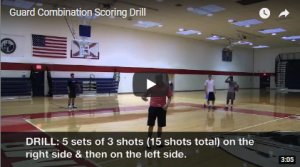
This drill called Combination Guard Scoring Drill is among the thousands of resources for both coaches and player available from basketballhq. They have several more videos as well as basketball coaching resource articles.

Please make sure your sound is on to see the video.

Click the play arrow so see the drill. The drill is a YouTube video, so you will need to be able to access YouTube to see the drill.

The coach in this post is Darnell Archey, former Butler player and Assistant Coach, and currently the head coach at the University of Mobile.

If you use this drill, you will want to include the types of actions that lead to shots in your offensive system.

In this drill, the 3 types of shots the players take are

1) Ball Screen Read (You can change the read for each of the five shots, or make the same read on each shot. In this example, they are reading as though the defense is icing the ball screen.

2) Dribble Hand Off

3) Screen the screener action (You can run this from other spots on the floor where you run sts actions)

15 shots on the right side (5 shots from each of the 3 actions), then 2 free throws, and 15 shots on the left side of the floor.

Combination Guard Scoring Drill

Coaching Basketball Offensive Thoughts and Concepts from the Best

By Brian Williams on December 1, 2015

This post contains quotes collected by Texas A&M Women’s Assistant Bob Starkey on offensive philosophy. His Hoop Thoughts Blog should be on your regular reading list for basketball coaches.

You may agree or disagree with the thoughts, but the purpose for the post is as food for thought to help your staff clarify your thoughts for this year’s team.

It is not the system, but the execution of the system, that counts. -Tex Winter

Run a play out of timeout that is a wrinkle of your normal offense and your players will be able to execute it. –Doc Rivers

Shot discipline and role identification go together. Coach K

Encourage team play — achieve results through cooperation and unselfish effort on the part of every player. –Dean Smith

Spread defense allows you to get offensive rebounds. -Brendan Suhr

If you had two things, and only two things, you could have a decent offense. They are good shot selection and spacing. –Kevin O’Neil

Maintain spacing: Is your team maintaining spacing on the 3rd side of the floor after 2 reversals. –Rick Majerus

You have to win inside regardless of your post game. –Jim Crews

Cutting is the most important way a player can contribute to our offense. –Bob Knight

The habit of watching a teammate’s defender when making a pass should be developed. –Clair Bee

The toughest thing to guard is a great shooter that screens. -Roy Williams

Don’t do drills in practice that don’t represent a portion of your system. -Gary Williams

The key to posting is do your work BEFORE you catch the ball. –Don Meyer

My emphasis is not on running an offense…it is on teaching my team offense. We want players who can play offense, not run an offense. -Coach K

Repetition is the key to success — doing what you have to do over and over and always doing it right. -Pete Carrill

The best attitudes in the world won’t help win ball games if they’re not accompanied by a fundamental competence in the game. -Dr. Jack Ramsay

I am literally a fanatic of spacing. –Tex Winter

Shot selection – I’ll stop practice and ask how many of you liked that shot? -Roy Williams

Play the Man on Offense…Play the Ball on Defense. -Coach Knight

We don’t ask any kid to do something he is not capable of doing. Don’t put players in roles that they can’t be successful. -Jim Crews

If you don’t have anything to complain about, you can always complain about screening. -Jim Crews

Bad shooters are always open. -Pete Carril

It is an axiom of basketball that the better a player screens, the better the chance of a good close shot for the screener. –Pete Newell

The toughest thing to defense is movement and the toughest movement to defend is screening. -Coach K

In all my years of coaching, I have never been successful using somebody else’s plays. Vince Lombardi

Offense is spacing…spacing is offense. –Chuck Daly

The best drills work on both offense and defense at the same time. -Bob Knight

Only take shots that have over a 50% chance of going in. -Bob Knight

Concentration leads to…Anticipation, which leads to…Recognition, which leads to…Execution, which leads to …Completion.-Bob Knight

Defensive Closeout Drills

By Brian Williams on November 30, 2015

These diagrams represent closeout drills posted the FastModel Sports Basketball Plays and Drills Library.

You can also find out more about FastModel Play Diagramming software by clicking this link: FastDraw

All of these drills were submitted by Dennis Hopkins and were presented by coaches at the Basketball Coaches Association of Michigan Coaches Clinic.

IMO, closing out is one of the defensive skills that players and teams execute a lot over the course of a game.

I also believe that it is good to have several ways to drill that skill so that you provide some variety in your reps.

Take these ideas and add your rules and schemes to make the drills fit for your team.

Kim Barnes Arico Closeout Drill

Head Women’s Coach University of Michigan

kba-closeouts1

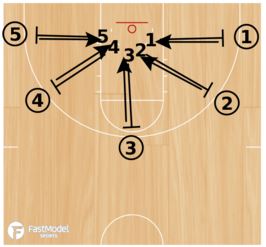
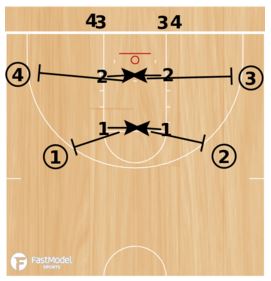
All 5 players closeout the ball position on the perimeter.

1. Closeout stutter step with hands up.
2. Drop step to stop drive.
3. Step back with hand up.
4. Box out
5. Retrieve the the ball and jump for rebound.
6. Closeout to the next player on the perimeter.

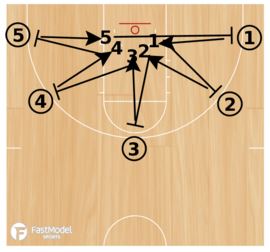
kba-closeouts2

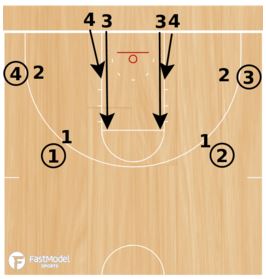
All 5 players closeout the ball position on the perimeter.
1. Closeout stutter step with hands up.
2. Drop step to stop drive.
3. Step back with hand up.
4. Box out
5. Retrieve the the ball and jump for rebound.
6. Closeout to the next player on the perimeter.


John Beilein Defensive Breakdown Drill

beilein-breakdown1

Head Men’s Coach University of Michigan

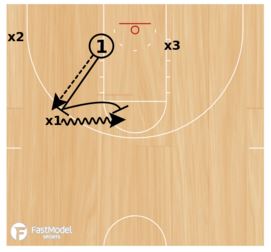
Guard starts with the ball in the lane and begins the drill by rolling the ball out to the perimeter wing.

1. Closeout properly with choppy steps and hands high. Mirror the ball.

2. The guard ties to drive to the middle. Defender walls the ball handler.

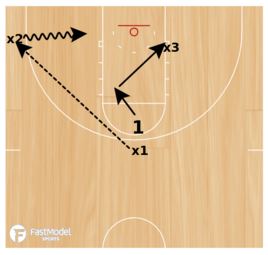
beilein-breakdown2

1. On the pass to the corner the defender quickly positions himself in help side defensive position.

2. On the drive by the corner, he must block out the weak side post.


Stan Van Gundy Closeouts

van-gundy-closeouts1

1. Players in the lane are foot fire position with feet.

2. When coach yells touch they touch hands and close out to the ball.

3. Players defend with feet and mirror the ball with their hands.


van-gundy-closeouts2

1. When coach yells touch and the players close out, the players in line step to the elbows and blocks and start foot fire. They foot fire until coach yells touch.

2. Players release from defending the ball when coach yells touch to the group following them.


  • « Go to Previous Page
  • Page 1
  • Interim pages omitted …
  • Page 136
  • Page 137
  • Page 138
  • Page 139
  • Page 140
  • Interim pages omitted …
  • Page 288
  • Go to Next Page »

Primary Sidebar

  • Twitter
  • Facebook
  • Linkedin
coachestoolbox
personaldevelopmenttoolbox
basketballplayerstoolbox
basketballtrainer
athleticperformancetoolbox
coachingbasketball

© Copyright 2026 Coaching Toolbox

Privacy Policy