• Skip to primary navigation
  • Skip to main content
  • Skip to primary sidebar

  • Basketball Plays
    • Ball Screen Sets
    • Horns Sets
    • Man to Man Post Up
    • Man to Man Isolations
    • Backdoor Plays
    • Man to Man 3 Point Shot Plays
    • 2-3 Zone Attack
    • Baseline Inbound Plays
    • Sideline Inbound Plays
    • Combination Defense Attack
  • Drills
    • Defensive Drills
    • Offensive Drills
    • Competitive Drills
    • Passing Drills
    • Rebounding Drills
    • Shooting and Scoring Drills
    • Toughness Drills
    • Transition & Conversion Drills
    • One on One Drills
  • Blueprint
  • Practice
  • Mental Toughness
  • Skill Development
  • Offense
  • Defense
  • Store

Defending NBA Pick and Roll

Defending NBA Pick and Roll

By Brian Williams on January 28, 2016

These are some of the notes on defending the pick and roll that Zak Boisvert posted on his Pick and Pop Basketball Coaches Site.

They are notes he took from Steve Clifford, Head Coach of the Charlotte Hornets.

Editor’s note from Brian. You won’t be able to use everything in these notes, but I hope you can pick up some terminology and a few teaching points that will help you defend the pick and roll

With shot clock change, things he would recommend to college coaches
1. ¾ court pressure
2. Down side pick & roll

To beat the best, we are going to have to be able to defend multiple pick & rolls in one possession. Our 4-men need to be able to do more than one coverage. We need to have that flexibility.

Regardless of the level you’re at, switch everything that you can. We start every shoot around with switching groups (“Who can switch versus these guys? 1-3? 1-4?”) We will switch every pick and roll that will not result in a significant matchup problem. “Anything you can switch, I would switch.”

We will start most games going under ball screens. We go under more ball screens than anyone in the NBA. With veteran players, you can manipulate ball screen coverages between different offensive players. Take advantage of
guys that aren’t range shooters. Going under will limit rotations and roll baskets.

Advantages of Downing Side Pick and Rolls

1. Keeps ball out of middle
2. Slows ball movement
3. Forces offense to execute at a higher level

-Pick & Roll defense starts with controlling the ball (can’t give up initial separation).

3 elements of Pick and Roll Defense

1. Coverage (2 guys on the ball)
2. Protection (3 guys off the ball)
3. Recovery (Rotations Back)

In our “Down” we are personnel driven and will adjust the distance how much the big guy comes out on the coverage. Al Jefferson drops, Marvin Williams will come all the way out to a step and a half off the ball. Let players play to their instincts and their strengths.

This big can’t give up dribble arounds. Can’t let the ball get to the baseline or to the middle of the floor.
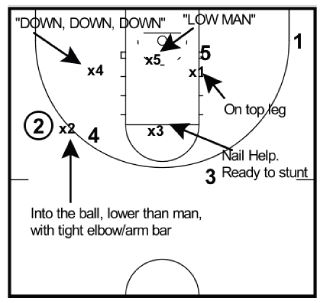
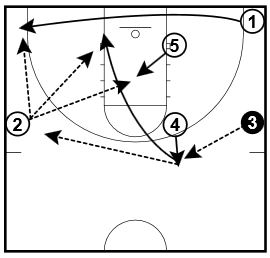
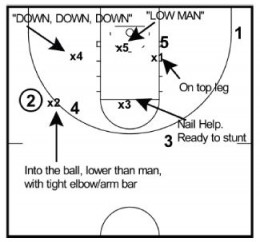
CaptureYour goal is to stay out of rotations as much as you can so you don’t spread out your defense more than you have to (remains compact) and limit how much you need to stunt. Exceptional on ball defenders will do this.

Diagrams created with FastDraw

Talk to your “Low Man” about reading the roll. If there is no roll (like on a non-aggressive throwback to the screener), he can kick the weak side corner defender out (off the weak side big’s top leg/body) so the defense can stay organized and not be more spread than it has to.

On-ball defender: no middle stance already, I move into the ball with tight elbow, lower than the offensive player. Pursuit to get back in the play (as handler dribbles away). Activity level on the ball (disrupt/contest every pass—
over us or around us).

Screener’s man: varies depending on personnel how deep you are. On pass back to screener, we go inside/out to keep the ball out of the middle of the floor.

Nail defender: slightly inside the nail. The closer the screener pulls to the elbow, the more I am going to inch over (is also dependent on who he is). If the screener rolls, we’ll stand him up with a bump and force him down to
the “Low Man.”

Limit your stunts early in the game. Make him make a couple and then we’ll get more aggressive. Since becoming a head coach, Clifford is much more conservative with his stunts from the nail defender. He will live with the screener hitting jumpers. If you over-stunt, you get burnt on the second side of the floor because you’re overextended.

When there’s a roll, we blitz.
• Why? Because the roll will suck in our defense.
• If we don’t have ball pressure in our blitz, the ball-handler will zip it
to the weak side of the court on us as we’re sucked in on the roll.
• Coverage hears “roll” by the nail defender, they blitz.

There can’t be a “Down” call without a “Low Man” call. There should never be a pick & roll run where there’s not
two calls (“Down”/”Low Man”). If not, you’ll give up baskets to the roll man. Even if it’s not the correct rotation/protection scheme, by having a low man you disallow the #1 basket that kills ball screen D: roll-man
layups. Even if it’s not perfect, if you get a low man, you give yourself a chance to rotate out of it (rather than giving up a roll man layup). No matter the defensive coverage, there needs to be a “Low Man.”

With our pick & roll D, our talk comes from our bigs. With our DHO defense, the talk comes from the guy guarding the cutter.

When your man cuts through to the weak side, you go through slowly and with vision of the ball.

Here is a link to the entire article and to download it as a pdf if you are interested.
Arizona 2-3 Quick Hitter

By Brian Williams on January 27, 2016

2 quick hitters to run against a 2-3 zone. One to get a corner 3 and one with several options to finish.

The plays are from Scott Peterman’s Ultimate Zone Offense Playbook.

The Playbook contains 123 plays versus zones.

Diagrams created with FastDraw

Arizona Throw Back

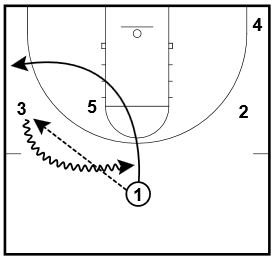
basketball-plays-arizona-zone1

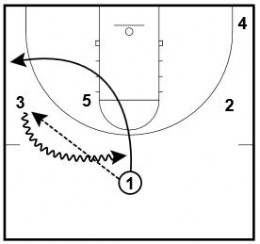
1 passes to 3 and cuts to the left wing.

3 dribble to the top of the key.


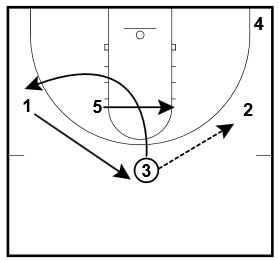
basketball-plays-arizona-zone2

3 passes to 2 and cuts to the left wing.

5 slides to the right elbow.

1 cuts to the top of the key.


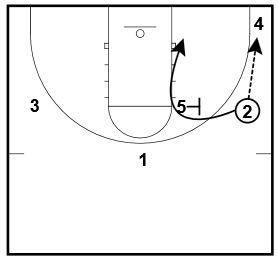
basketball-plays-arizona-zone3

2 passes to 4.

5 sets a screen for 2 who cuts to the right low block.


basketball-plays-arizona-zone4

4 dribbles out of the corner taking the low defender with him.

2 sprints to the corner.

4 passes to 2.


Same Side

basketball-plays-same-side1

1 passes to 3 and cuts to the right side corner.


basketball-plays-same-side2

1 cuts from the right corner to the left corner.

4 pops out to the top of the key.

3 passes to 4.

4 passes to 2 then cuts to the left side low block.

5 steps into the middle of the lane as a scoring option.

2 can pass to 1, 4, or 5 or could skip back to 3.

The plays are from Scott Peterman’s Ultimate Zone Offense Playbook.

The Playbook contains 123 plays versus zones.

Developing Leadership Capacity

By Brian Williams on January 26, 2016

Developing Leadership Capacity

The Context and Culture Make a Difference in Developing Your Team Leaders

By Cory Dobbs, Ed.D.

It didn’t dawn on me that there might be anxieties and risk involved in team learning until I put a few work teams at a Fortune 100 company under a microscope. To say the very least, what I observed was a wide-range of defensive and protective processes which ultimately closed off the team’s members from learning and instead created a variety of dysfunctions anchoring the team’s collective efforts in the harbor of mediocrity.

As a result of this work I decided to take a closer look at how student-athletes learn in a team setting, and in particular how the context influences the perceived risk involved in learning to lead one’s teammates. Upon closer inspection it became obvious that many of the risks involved in team learning in the corporate world are mirrored in the athletic world. Likewise, learning to lead in a team environment is risky business.

So, how do you get student-athletes to learn together? There are no simple answers. However, knowing that the context greatly affects learning is a step in the right direction if you’re serious about your players learning how to lead.

Leadership Development and Psychological Safety

When a student-athlete takes on a leadership role it’s important to understand that he or she will learn primarily through trial and error (which is why I firmly believe in deliberate practice—scrimmage—as a way to reduce perceived risks). If a student is learning physical geography he or she will learn in private with no one else aware of his or her mistakes. However, learning to lead in a team setting requires learning by trial and error in interpersonal interactions. Learning this way is certainly not learning in private and the consequences of actions always involve one’s teammates. Therefore, team leaders perceive risk in appearing ignorant and or incompetent in front of their peers.

Because most student-athletes have little experience at leading, which includes making mistakes in front of teammates, such fears as embarrassment and rejection are always present. And many student-athletes are reluctant to take actions or to speak up or speak out for fear that their actions may be held against them by teammates. To neutralize such fears it’s in your best interest to create a psychologically safe environment.

Let’s start with what I mean by psychological safety. It is a shared belief by all team members that the team is an environment where everyone has a sense of confidence that others will not embarrass, disrespect, disregard, or punish someone for taking action or speaking up or speaking out. All members understand that a supportive learning environment is necessary to build a psychologically safe team context.

The central idea is that a psychologically safe team environment will produce higher performing team learning and team leadership. Expressed as a formula it looks like this:

formula

At the heart of the growth of a team leader is the leader as a learner, the learning process, and the context which together form the cornerstone of leadership development. Always keep in mind that the team leader is engaging in learning a new mind-set as well as a new skill-set. That is, the student-athlete as a team leader is undergoing a tremendous transformation and that is why creating a psychologically safe environment is necessary.

Creating a Psychologically Safe Learning Environment

Years ago, during a seminar the late Peter Drucker asked an elite group of executives “How many of you have deadwood in your organization?” referring to those employees that had retired on the job. The hands of every one of the high-profile CEOs went skyward. He then asked “Were they that way when you brought them into your organization?” The implication was obvious, if they were then the leader was at fault for hiring them, and if they weren’t then something inside the organization “caused” the employee to basically give up on improving and become organizational deadwood. The point is that the context has a much more profound effect on how people behave than most leaders
realize.

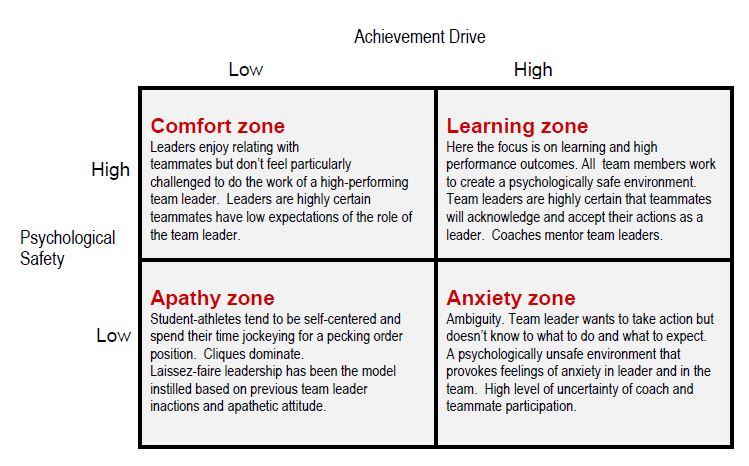
The question, then, is what can you do to create a psychologically safe environment for team leaders learning to lead? The first step is to understand your team environment as it is and how it interacts with the internal achievement drive of your team leaders. To do this, use the model below.

matrix

Hopefully the matrix above can provide a window into your current team context and how it is affecting the development of your team leaders. Psychological safety is an important component of creating an effective learning space for you and your team. The purpose of this brief article is to provide an introduction into the practice of developing a team leader’s capacity to lead through the process of team learning. When you involve all members of the team in the learning of leadership you’re more likely to create an effective learning environment.

Let me issue a quick reminder that leadership is a social influence process in which team leaders work to motivate or persuade teammates to achieve specific individual and team goals. As such, the norms, beliefs, and values that emerge from team member interactions will create team dynamics that will influence the social structure and social processes that will either enhance or inhibit team learning. Your goal as the chief architect of the environment should be to create a psychologically safe learning zone.

Ultimately, you have more to do with a team leader’s learning to lead—or not learning—than you probably thought you did. If you’re not growing team leaders, then it’s likely the problem is not the seed, it’s the soil.

“Tell me and I’ll forget. Show me and I may remember. Involve me and I will care.” -Your Student-Athlete The world of coaching is changing. In Coaching for Leadership you’ll discover the foundations for designing, building, and sustaining a leadership focused culture for building a high-performance team. To find out more about and order Sport Leadership Books authored by Dr. Dobbs including Coaching for Leadership, click this link: The Academy for Sport Leadership Books

About the Author

A former basketball coach, Cory’s coaching background includes experience at the NCAA DII, NJCAA, and high school levels of competition. While coaching, he researched and developed the transformative Becoming a Team Leader program for student-athletes. Cory has worked with professional athletes, collegiate athletic programs and high schools teaching leadership as a part of the sports experience and education process. Cory cut his teeth as a corporate leader with Fortune 500 member, The Dial Corp. As a consultant and trainer Dr. Dobbs has worked with such organizations as American Express, Honeywell, and Avnet.

Cory has taught a variety of courses on leadership and change for the following universities:

Northern Arizona University (Graduate Schools of Business and Education)

Ohio University (Graduate School of Education / Management and Leadership in Sport)

Grand Canyon University (Sports Marketing and Sports Management in the Colangelo School of Sports Business)

Consecutive Free Throws Drill

By Brian Williams on January 25, 2016

This video of a free throw shooting drill is with Delta State University Head Men’s Coach Jim Boone.

The drill is a You Tube video, so to be able to watch them, you will need to be able to access You Tube on the server that you are on.

Make sure your sound is on as you watch.

In my opinion, having your players shoot for streaks is a good way to put pressure on your free throw shooters in practice.

The shooter’s goal in the drill is to make 3 in a row. After they make 3 in a row, they report to the scorekeeper

The team goal is to make 100 sets of 3 in a row in 5 minutes. If you don’t like using a set amount of time, you can give them a specific number of times to attempt three in a row. That way you could allow them to use their normal free throw routine.

Coach Boone has won almost 500 games as a college coach. This drill is from his Coaches Clinic DVD which you can find out more about and see more samples from, at this link: Jim Boone Coaches Clinic

Click the play arrow to see the drills.

Refocus Your Focus: Real Stats

By Brian Williams on January 21, 2016

This post was written by Bert DeSalvo and reprinted with permission from his Basketball Coaching Blog, Expressions from the Hardwood

Editor’s Note from Brian Williams, the Coaching Toolbox. I like the emphasis this article puts on determining what types of traditional stats and analytics that your team could benefit from and focusing on those. I also believe in measuring the process of going to the offensive glass and block outs as a part of evaluating your rebounding.

My third takeaway from this article is that you have to use context when evaluating your stats. I had a friend who played for a very successful coach. After one game, he got on his team hard because they had been outrebounded by their opponent by three rebounds. Their team had gone 6 for 15 from the free throw line, which was way below their season free throw percentage. He realized that had they made 4 more free throws that their opponents rebounded, they would have won the rebound battle by one. As coaches, we have to be careful and think clearly

Refocus Your Focus: Real Stats

Bert DeSalvo, @CoachDeSalvo

I recently read a great article by Gabe Kapler, former MLB player and Minor League Manager, on how current MLBers need to reexamine how they are looking at their individual performance. This reevaluation has to do primarily with looking at statistics differently.

In the article Kapler suggests that “Players simply need to stay in ‘baseball school,’ pay attention, keep an open mind and evolve with the decision makers.” Quite profound.

As a basketball coach, I started thinking is our profession thinking outside the box regarding statistics?

As basketball coaches (aka ‘decision makers’) and teachers, we tend to have that favorite stat that we always are interested in and focus on. For some it is field goal percentage, for others it is 3pt field goals attempted. Others have a defensive charts that tally deflections, shot clock violations, etc. The possibilities are endless and probably depend on our personal basketball journey (prior coaches, favorite teams/coaches, clinics, etc.).

For instance, I have known coaches at halftime or the end of the game, who go right to the rebound margin to see how the team was rebounding in a particular game.

The problem for me was that this statistic was most often very skewed. The reason why I believe this was because sometimes this category was very sporadic from game-to-game.

Were we really this good, average or bad on a game-to-game basis? Possibly. Was the team were were playing either this good, average or bad on a game-to-game basis? What about the eye test? Makes you wonder if there is a better way to evaluate such a common statistic such as rebounding.

Well surely the opponent and their personnel matters. However, these up and down statistics were usually a direct result of something else I thought.

I found that some factors that gave the stats a slanted may have been: the opposing team was not pursuing the ball on the defensive or offensive end very well, the ball bouncing was our way (or not), we were simply taller or short than our opponent, there were lots of turnovers which limited shot attempts, or the fact that one team had one of the premier rebounders in the conference/nation who covered up many of his/her team’s rebounding deficiencies.

These factors among many others, are the reasons why I believe that the rebounding margin was not necessarily a true reflection of how well a team actually rebounded. I believe that rebounding margin has as much to do with other factors and not necessarily only rebounding technique, which is a better indicator of true rebounding prowess.

Whether you agree with my conclusion or not, as a Head Coach I never really focused on total rebounds (although that is important and locks up your defensive possession) but rather rebounding technique, i.e. defensive blockouts and offensive pursuit.

My definition of a ‘defensive blockout’ is making contact on each shot by the opposing team while I defined an ‘offensive pursuit’ as having our players taking at least three steps towards the offensive glass.

The result is much more process oriented rather than results oriented. As long as we were making contact or crashing the offensive glass, good things were bound to happen. That was much more of a better indication of our rebounding effort and general skill level than the rebounding margin.

Of course in the flow of the game it is very difficult to gauge defensive blockouts and offensive pursuits with limited staff. However, observant assistants and head coaches can surely get a gauge on the team’s overall effort level during the game (i.e. “Eye Test”) and use film after the game to get a more definitive number to present to the players.

Although getting these numbers are much more time consuming than merely getting a stat sheet from an SID, it will undoubtedly give coaches and players a more accurate glimpse into what is actually occurring on the court. This is important to be able to emphasize any aspect of the game and will reinforce the coaching staffs message. Remember film never lies.

Moreover, each player may get rated on a percentage during the course of a game or practice on how many times they actually execute what coaches are stressing in their program (i.e. in regards to rebounding technique Player A makes contact 70% of the time on defensive end). This is another great tool that can have a true impact on your program by showing your players how being accountable can have impact on teammates, how practices are conducted, morale of the team and ultimately the outcomes of games.

In addition, focusing on statistics for each team in the same category (i.e. rebounding technique), coaches may be able to get an even more analytic view of which team is more disciplined in certain areas of the game.

As Kapler reminds us, coaches too must be thinking of how to evaluate. For instance, if Coach A only sends three players to the offensive glass, while Coach B sends all five players, the number of course will be skewed in favor of Coach B’s squad. However, creative forethought can balance out these variables that coaches use based upon their program’s x and o philosophy.

Kapler continues, “imagine a husband taking out the trash everyday and feeling pretty good about handling his obligation. Meanwhile, his wife thinks, ‘I wish that lazy bum would wash the dishes once in a while!’ If expectations aren’t discussed regularly, they become mismatched. And we are in that place now in baseball.”

Likewise, basketball coaches must be sure to communicate with their players of how they will be evaluated so there is no ambiguity or questioning of what the coaching staff feels is important in their program. This will give the players a feeling of confidence that the know what is important, what will be stressed and how that will relate to playing time. It is the foundation to building accountability in any legitimate program.

Just as important, the coaching staff must come up with the appropriate innovative metrics of how to accurately evaluate their team so they are getting an accurate measure of whatever statistic they wish to emphasize.

About the Author

Bert DeSalvo formerly served as the Head Women’s Basketball Coach at Southern Connecticut State University (NCAA DII – NE-10 Conference). During his one season at the helm 2014-15 season, SCSU tallied more overall wins and had the 5th (out of 15) best record in the conference (picked last in preseason poll). The Owls also earned a first round bye in the post-season conference tournament.

Prior to leading the SCSU program, DeSalvo was owner of Full Court Consulting, a firm which served a variety college and high school coaches throughout the country. DeSalvo also is a regular contributor on multiple blogs including his own, Expressions from the Hardwood.

DeSalvo coached previously as the top assistant for the women’s basketball program at Division II Clarion University for two seasons. DeSalvo joined the staff in 2011-2012 after a four-year stint as the head coach and assistant director of athletics at Penn State-Beaver. DeSalvo started the PSU-Beaver program from scratch in January 2007 and led the Lions to a 99-26 (.792) record in his tenure at the school while qualifying for the United States Collegiate Athletic Association (USCAA) national tournament in all four seasons. DeSalvo led Penn State-Beaver the Lady Lions averaging 26 wins per season his last three campaigns. He was named the PSUAC Coach of the Year after the 2008 campaign and earned the Beaver County Hall of Fame Recognition Award as Women’s Basketball Coach of the Year in 2008, 2009 and 2010.

Prior to leading the Penn State-Beaver program, DeSalvo was an assistant women’s coach at Division III MacMurray College from August 2006 to January 2007. He also spent a season as a men’s assistant coach at NCAA Division I Maryland-Eastern Shore in 2005-2006 and was the girls’ varsity head coach at Chariho High School (RI) during the 2004-2005 season. He also has experience as a junior varsity, middle school and AAU coach.

DeSalvo has coached a number of professional players, All-Americans and All-Conference members during his career. DeSalvo has a career record of 113-41 (.734).

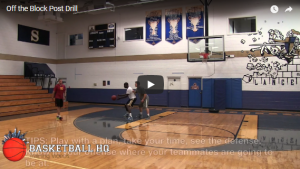
Off the Block Post Drill

By Brian Williams on January 19, 2016

These two drills, Off the Block Post Drill and Up and Under Post Drill are among the thousands of resources for both coaches and player available from basketballhq. They have several more videos as well as basketball coaching resource articles.

Please make sure your sound is on to see the video.

Click the play arrow so see the drill.

The drill is a You Tube video, so you will need to be able to access You Tube to see the drill.

Even if you don’t agree with the teaching points or philosophy in the drill, it is important to work with your post players on what you want them to do if they do catch the ball off the block.

The coach in both videos is Chris Capko.

At the time the videos were filmed, he was on the USC staff. He is currently an assistant at Florida International.

Off the Block Post Drill

Up and Under Post Drill

  • « Go to Previous Page
  • Page 1
  • Interim pages omitted …
  • Page 132
  • Page 133
  • Page 134
  • Page 135
  • Page 136
  • Interim pages omitted …
  • Page 288
  • Go to Next Page »

Primary Sidebar

  • Twitter
  • Facebook
  • Linkedin
coachestoolbox
personaldevelopmenttoolbox
basketballplayerstoolbox
basketballtrainer
athleticperformancetoolbox
coachingbasketball

© Copyright 2026 Coaching Toolbox

Privacy Policy