• Skip to primary navigation
  • Skip to main content
  • Skip to primary sidebar

  • Basketball Plays
    • Ball Screen Sets
    • Horns Sets
    • Man to Man Post Up
    • Man to Man Isolations
    • Backdoor Plays
    • Man to Man 3 Point Shot Plays
    • 2-3 Zone Attack
    • Baseline Inbound Plays
    • Sideline Inbound Plays
    • Combination Defense Attack
  • Drills
    • Defensive Drills
    • Offensive Drills
    • Competitive Drills
    • Passing Drills
    • Rebounding Drills
    • Shooting and Scoring Drills
    • Toughness Drills
    • Transition & Conversion Drills
    • One on One Drills
  • Blueprint
  • Practice
  • Mental Toughness
  • Skill Development
  • Offense
  • Defense
  • Store

Free Throw Golf Shooting Drill

Free Throw Golf Shooting Drill

By Brian Williams on February 17, 2016

These shooting drills are from Matt Monroe’s former Hoops Roundtable site.

Modify these drills to fit what types of shots you get from your offense and that fit the shots that your players take in games including adding in 3 point shots to the drill.

You could add an element of a time limit or change the scoring so that players are competing against each other or against a scoring standard.

Diagrams created with FastDraw


Free Throw Golf Drill
reavis-ft

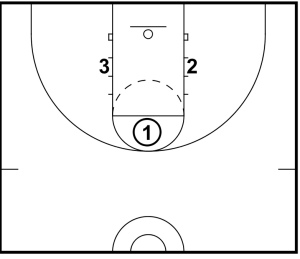
Jason Dycus, Head Girls’ Basketball Coach, Naperville North High School (IL):

There are 3 or 4 players at a basket.
Put three minutes on the clock.
Each person shoots one free throw and rotates.
Each time someone makes a free throw, one point goes in the bank.
The first person to miss add the score in the bank to their score (for example, if three people make a free throw in a row and the fourth person misses, the fourth person now adds 3 points to their score).
The player with the lowest score wins.

Cougar Shooting Drill
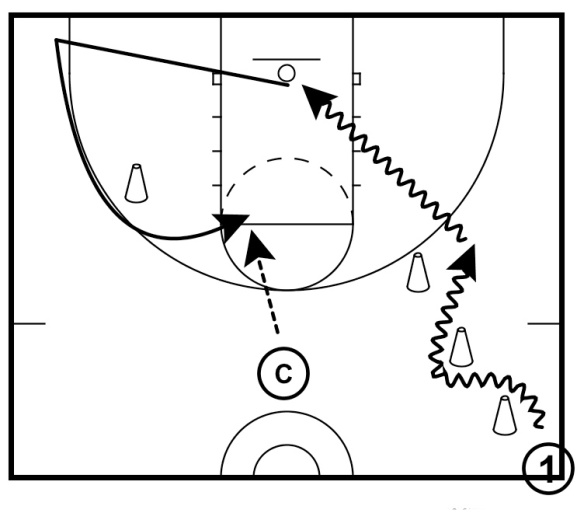
cougar-shooting-drill

In my opinion, the cones are not there to simulate defenders. They are there to show your players where to work on their dribble move. I believe that players need to develop skills before they can use them against a live defense.

#1 dribbles through the cones using various change of direction moves and attacks the basket.
After taking a shot, the player widens out to the corner and cuts hard off the cone simulating a cut off of a screen.
Coach passes the player the ball for a shot.

Utilize various moves on the first and second legs of the drill: Power finish, Shot-fake finish, Floaters, Runners, Reverse lay-up, Jump shot, Pull-up jump shot, Step-back move, Step-back counter move, Inside hand finish, Hips across lay-up, Spin move, Up and under move, Ginobili move, or any other move that you need to incorporate.

Plus 4, Minus 4 Shooting Drill
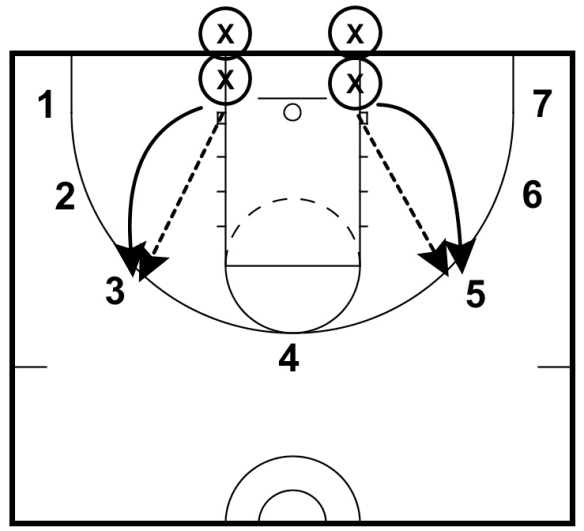
plus-4-minus-4-shooting

Jim Harrington, former Head Boys Basketball Coach, Elgin High School (IL):

Use the 7 spots on the floor that are shown in the diagram.

Player flips the ball out and get hind the ball (circle it)
You get +1 for a made field goal and -1 for a missed field goal
Play until you get +4 or -4 total.
Use or incorporate all moves (shot fakes, catch and shoot, cross/onside step, etc.)
2 Zone Quick Hitters

By Brian Williams on February 17, 2016

These two zone quick hitters are from Scott Peterman’s Ultimate Zone Offense eBook.

It is one of the featured playbooks available as a 4 playbook for $35 bundle.

If you are interested in finding about more about the bundle opportunity, click here: 4 playbooks for $35

If you are interested in finding out about the individual playbook, click this link: Ultimate Zone Offense Playbook

Diagrams created with FastDraw


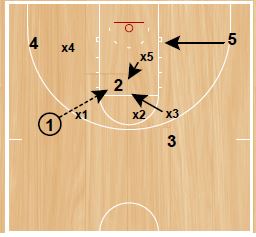
Gonzaga Guard Through

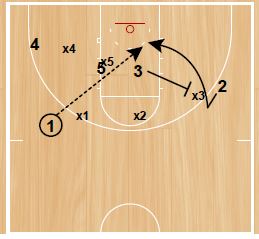
basketball-plays2

1 passes to 2.

2 passes to 3.

2 cuts below 5 to the left corner for an overload.

1 cuts to the left slot.


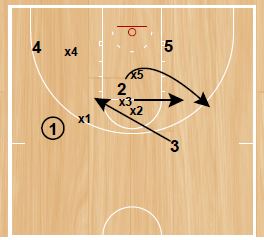
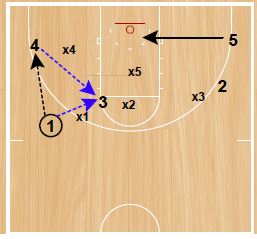
basketball-plays3

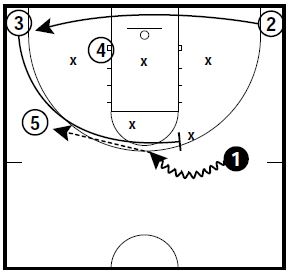
3 passes to 1.

1 dribbles to the right side.

2 cuts off 5.

4 sets a down screen for 2 and then slips to the middle.

2 cuts to the right wing for shot if 4 is covered.

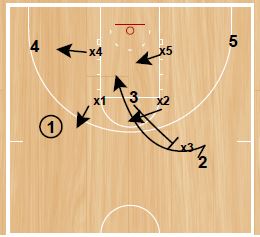
Memphis Quick

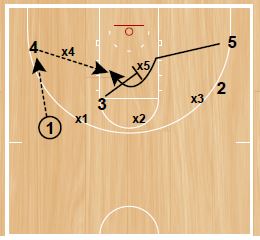
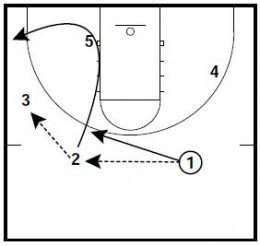
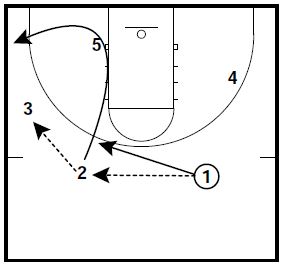
basketball-plays1

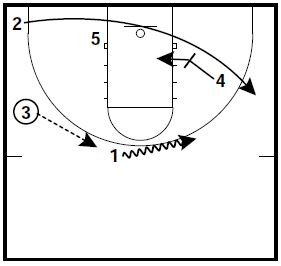
3 comes up to set a ball screen on the top right zone defender.

1 comes off the ball screen and draws the second top defender.

5 slides down the three point line for a three point shot. (This does not have to be a traditional “5 man” You can put any of your personnel in any of the spots that fit you best.)

2 cuts to the left corner. If the left side defensive forward in the zone picks up 5. 2 should be open. If the middle defender takes 2, 4 will be open momentarily.


These two zone quick hitters are from Scott Peterman’s Ultimate Zone Offense eBook.

It is one of the featured playbooks available as a 4 playbook for $35 bundle.

If you are interested in finding about more about the bundle opportunity, click here: 4 playbooks for $35

If you are interested in finding out about the individual playbook, click this link: Ultimate Zone Offense Playbook

A Season of Significance

By Brian Williams on February 16, 2016

Guest post from Scott Rosberg

Basketball seasons are winding down all across the country. This is a time of great excitement and anticipation, as teams prepare for their post-season tournaments with dreams and goals of an eventual state championship. However, it is also a time of reflection for coaches and athletes alike.

Late in a season we sometimes play the “coulda’, shoulda’, woulda’” game and wonder what might have been had we done things differently. Or we look back and think how glad we are that we chose to do things the way we did them, for they produced many of the results we desired when we started our seasons a few months ago.

One key area for coaches to focus on is impact. What kind of an impact did you have on your kids and your teams? As you come to the end of your season and you look back on all that happened, can you say that you helped create an experience for your kids that was worthwhile and significant? What will your seniors look back on and say their final experience playing in your program was like? What can you do with your teams in the future to ensure that they will always remember their senior season in the best way possible?

While there is not too much you can do at this point in your season to create an entire season’s worth of significant moments of impact, you can still do some things to help your kids make the last few weeks special. First, focus on doing just that. Help them to have the best weeks of the season right now. Of course, scoreboard success will help with this, but scoreboard success is something you have very little control over. A few things that you do have control over are your practice and game preparation, your focus on character and sportsmanship, and how you treat your kids.

Prepare for your practices and games in a manner that keeps things fresh for your players, while maximizing your time and all that you have put in this year. Try running new drills that work the skills you most want to have them prepared for. For games though, this is the time to “let them play.” You have taught and worked with them all season to be able to perform and compete at a high level at this time of year. Don’t overload them with too many new things (something I have done all too often!). However, this is also a great time to throw in a new wrinkle or two in order to have some extra “arrows in the quiver” and to help them feel like they have an extra advantage over their opponents.

Also, make sure you continue to emphasize good character and sportsmanship. Just because the stakes are higher doesn’t mean we can slack off on being accountable to our standards at this time. In fact, it is precisely in more pressure-packed, emotional moments that we need to be our best selves. Coaches always talk about wanting to “play our best at the end of the year”; we should also be our best when it comes to character and sportsmanship.

Finally, make sure you continue to work to provide your kids a great experience. By changing a couple routines up, you can keep things fresh. If you don’t have games until the weekend, consider giving them Monday off, or make it a day for watching game film and having a pizza party. Then get back to practice on Tuesday-Thursday.

You must also keep treating your kids in the most positive way possible. Check in with them and make sure they are feeling good about the final push to the end. Keep them motivated and excited to be part of the program. Inspirational messages and quotes can continue to provide great insight and meaning. Help them see the light at the end of the tunnel is near, and it is time to make the absolute most of their time together.

Remember that your seniors are going through some emotions that the other players are not dealing with, so help them to navigate through the end of their high school career in your sport. Every year I have told my seniors to “Pack every moment with everything you have because you won’t believe how quickly it is going to go. You want to make sure you can look back on the season and say, ‘I’m so glad I did …,’ instead of ‘I wish I would have…’”

Before you know it, your season will be over. What are you doing to make the most of your last few weeks together with your team? I would love to hear some things that you do to close out your season with your teams that help make it memorable. You can leave your comment on our Facebook page.

Also, this is the start of Senior Nights and End-of-Season Banquets. My newest booklet, Senior Salute, written for coaches and parents to give to their senior athletes on Senior Night or at End-of-Season Banquets, has seven team themes that have been prevalent in their athletic lives and will be part of their future lives: Character/Integrity, Trust, Passion, Toughness, Accountability, Teamwork, and Success, with many quotes supporting each theme. The inside front cover is set up for you to write a personal note to your senior athlete. You can get Senior Salute for $6.00 each or a 10-pack for $50.00, plus shipping! To take a sneak peek at the “Introduction and First Theme,” or to order Senior Salute, just click here.

About the Author of this Article

Scott Rosberg has been a coach (basketball, soccer, & football) at the high school level for 30 years, an English teacher for 18 years, and an athletic director for 12 years. He has published seven booklets on coaching and youth/school athletics, two books of inspirational messages and quotes for graduates, and a newsletter for athletic directors and coaches. He also speaks to schools, teams, and businesses on a variety of team-building, leadership, and coaching topics. Scott has a blog and a variety of other materials about coaching and athletic topics on his website – www.coachwithcharacter.com. He can be reached by email at [email protected].

Scott is also a member of the Proactive Coaching speaking team. Proactive Coaching is dedicated to helping organizations create character and education-based team cultures, while providing a blueprint for team leadership. They help develop confident, tough-minded, fearless competitors and train coaches and leaders for excellence and significance. Proactive Coaching can be found on the web at www.proactivecoaching.info. Also, you can join the 200,000+ people who have “Liked” Proactive Coaching’s Facebook page at www.facebook.com/proactivecoach. Scott can also be reached through Proactive Coaching at [email protected].

3 on 2 to 2 on 1 Transition Breakdown Drill

By Brian Williams on February 15, 2016

Submitted  by Coach John Kimble
CoachJohnKimble.com

Retired high school and college coach

Follow him on Twitter @CoachJohnKimble

This post was originally written for Winning Hoops

INTRODUCTION

As in the majority of the drills, coaches should try to make the drills as “game-realistic,” as competitive, and as time-efficient as possible. Coaches should want to incorporate some offensive concepts and philosophies for one group of players to work on as another group within the drill works on developing specific defensive skills. This drill philosophy provides offensive as well as defensive teaching and practice during the same drill.

This drill can be a very effective breakdown drill for specific players to work on their particular transition responsibilities and assignments both defensively as well as offensively. This drill can be set up primarily for the two most important players in a team’s defensive transition—the two defenders that are to be first in getting back on defense. Every player should work on these two defensive positions because any player can end up in one of those particular positions. While not disregarding the other players in this drill, the two players that should be the first main focal points of the coaching staff’s attention are the initial two offensive players that will quickly become the two defenders that are in transition offense to defense. They are players X1 and X2 in the following diagrams.

The next focus is on the three offensive transition players that initially started on the defensive end. They are players O1, O2 and O3. During the next phase of the drill, the defensive focus is changed to the lone defender that goes back to the defensive end. This could be either O1, O2 or O3. During the same phase of the drill, the offensive focus is centered on X1 and X2 as they come down the floor in a 2-man offensive fastbreak.

If an offensive team shoots, misses, and surrenders a defensive rebound; there are two assigned positions for the first two defenders who are to get back on defense to protect their basket. If the offensive team loses possession of the ball via a turnover, there are no definite defensive transition assignments–it is simply imperative that the offensive team’s basket is immediately protected, regardless of who gets back first. That is the main reason that all players should be placed in these two positions with this drill.

THE INITIAL “3-ON-2” PORTION OF THE DRILL

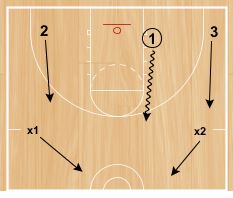
Diagram 1
Diagram 1

The drill can be set up with two defensive players (X1 and X2) starting the drill by literally being seated near the offense’s sideline hash-mark, and three offensive players (O1, O2, and O3) in lines that start on the offense’s baseline. The ball is advanced via dribbling and/or passing with the three offensive players staying in their three wide lanes as quickly as possible to attack their basket. The two defenders must quickly scramble to their feet and then sprint back to defend their basket. (See Diagram 1)

Diagrams created with FastDraw

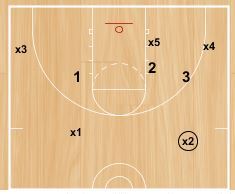
Diagram 2
Diagram 2

A more game-realistic method of starting the drill is to have the three offensive players (X3, X4, and X5) start in a “3 on 3” defensive alignment against three other players (O1, O2, and O3), with the potential two transition defenders (X1 and X2) making one or two passes before one of the other offensive players attempts to shoot and (intentionally) miss. The original three defenders (soon to become offensive players–O1, O2, and O3) work on boxing out, securing the rebound, and running  a three-man fastbreak in the three lanes. The two original offensive players out in the front of the offense (X1 and X2) sprint back as quickly as possible, communicating loudly on whom is to become “Ball-Man” and whom is going to become “Basket-Man.” The dummy offensive players (X3, X4, & X5) step off the court and get ready to step into the roles that O1, O2, and O3 currently are playing. (See Diagram 2)

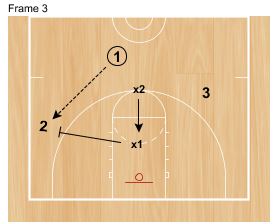
Diagram 3
Diagram 3

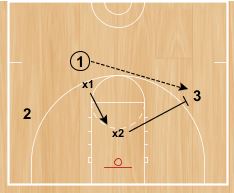
The first defender that gets back (X1 or X2; X1 in Diagram 2) settles in near the dotted circle in the middle of the lane and yells “Basket!” The second defender (X2 in the same diagram) that hustles back settles in the lane and cautiously approaches the dribbler as far out as the top of the key, by yelling “Ball !” The “Ball-Man” (X2) stops the dribble penetration of the dribbler, while the “Basket-Man” (X1) protects both low-post “blocks” and takes both the first and second perimeter passes made to either wing and then back to the center of the court. Therefore, when the offensive team passes the ball to either wing, the “Basket-Man” (X1) rotates out to defend the ball, while the original “Ball-Man” (X2) drops quickly down the lane to protect the basket. (See Diagram 3)

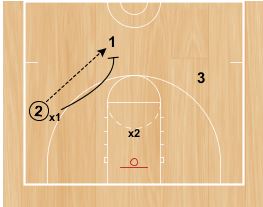
Diagram 4
Diagram 4

If the ball is passed from the wing back to the point, the original “Basket-Man”—X1 (who has defended the “Wing-Pass” — the first pass) would then defend the “Reversal Pass” also. This allows the original “Ball-Man”—X2, who has dropped down to protect the basket, to remain low to continue protecting both “blocks” and the basket. (See Diagram 4)   To explain the rotation and the coverage in a simple manner, coaches should use the phrase, “The first ‘Ball-Man’ must stop the ball and the first ‘Basket-Man’ has the first two perimeter passes!”

Major Points of Emphasis for the Defense

Diagram 5
Diagram 5

If the ball is centered up and then passed again from the top of the key to the wing on either side, the current “Basket-Man” (X2) would again come out to take the next two perimeter passes, with the current “Ball-Man” (X1) again dropping quickly to protect the basket. (See Diagram 5) The major points of emphasis for the two defensive players (X1 and X2 in Diagrams 2 thru 5) are:

  • Make sure that there is absolutely no question or doubt whom has taken the “Ball-Man” responsibilities and that the other defender has taken the “Basket-Man” assignment. (Diagram 2)
  • “Ball Defenders” (X2) must prevent dribble penetrations and drives to the basket and encourage the offense to pass the ball as often as possible–the more passes the opponents make, the more chance of a turnover and the more time the defense has bought to allow other defensive teammates to get back to help defend the basket. (Diagram 3)
  • After the “Ball-Man” (X2 in Diagram 3) has stopped dribble penetration and influenced a pass to either wing, he must quickly drop to the weakside block area, as if he were defending a backdoor cut. That is, he would turn his back on the ball and face the weakside block area where O3 would most likely cut, looking down his extended right arm for the ball.
  • The original “Basket-Man” (X1 in Diagram 3) should take the first and the second perimeter pass.
  • Both defenders should remember that once the ball is centered back up, the new “Basket-Man” (X2 in Diagram 4) again has the “next two perimeter passes.”

The phrase used in teaching this part of the defensive transition is “Solidly build the defense starting from the basket and then build it out to the dribbler.”

Major Points of Emphasis for the Offense

The major points of emphasis for the three offensive players (O1, O2 and O3 in Diagrams 2 thru 5) are:

  • The two wing players (O3 on the left and O2 on the right in Diagram 2 thru 5) should sprint out and get ahead of the ball, while constantly looking for the pass.
  • When the cutting wings hit the free throw line extended, each should plant off of their outside foot, and slash-cut directly to the basket.
  • The offensive team should try to keep the ball in the middle and get down the floor as quickly as possible, but under control.
  • The dribbler (O1) should not anticipate that the defense will stop the dribble penetration and if not stopped, they should then attack the basket until someone does stop them.
  • If and when the defense does stop the ball, that ball-handler should make a solid jump-stop and look to make a bounce-pass (below the outstretched arms of the defenders) to one of the cutting teammates.
  • All offensive players should avoid offensive fouls as a result of out-of-control dribbling.
  • If the ball is passed into a wing area to a player who is not driving (O2), that passer (O1) should then follow the pass a few steps to shorten the length of the potential return pass. (Diagram 4)
  • All offensive players should remember to “take what the defense will give you” and not force the action.

THE “2-ON-1” PORTION OF THE DRILL

Diagram 6
Diagram 6

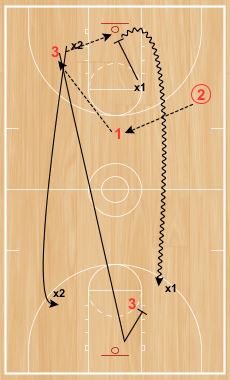
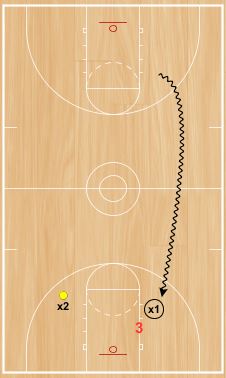
When the three offensive players (O1, O2, & O3) lose possession of the ball because of a made shot, a missed shot, or a turnover; either the shooter or the player who committed the turnover must turn and sprint back to protect the far basket by himself. The original two defenders (X1 & X2) would then sprint back and run a two-man offensive fastbreak against the new lone defender. (In this case, the lone defender is O3).

The new lone defender works on his defensive techniques as a solo defender against the two offensive opponents trying to score an easy basket against his transition defense.

Major Points of Emphasis for the Defense

The major points of emphasis for the lone defensive player (O3 in both Diagrams 6 and 7) are listed below. The lone defender should:

    • Get back to protect his basket as quickly as possible.
    • Not worry or sulk about the missed shot or the turnover.
    • If possible, sprint into the lane and then turn around in the path of the dribbler with a wide and sideways stance, facing the receiver that is without the ball. In this manner, the defender has discouraged the dribbler from driving all the way to the basket. Being in this specific position-location, the defender has encouraged the dribbler into taking a jump shot or to pass the ball to the seemingly open teammate. Being in the sideways stance allows the defender to quickly rotate to the open man, when and if the pass is made. Coaches should use the phrase, “Physically you are here, but mentally you are there” to describe the “cat and mouse” game the lone defender must play with the two offensive opponents. (See Diagram 6)
    • Slash at the new driver (if the pass is made to the open player—X2) at an angle so that he would go behind the driver and go for the block with his belly facing toward the back of the driver and his right hand going for the ball. This body position will allow the defender to avoid the light contact and foul. Coaching staffs should not encourage cheap-shots or dirty play; but they should tell their defenders that if they are going to foul, to foul in a clean manner so that the offensive opponent cannot get the shot off. They could use the phrase, “No cheap shots, but no touch fouls!”
Diagram 7
Diagram 7
  • Look to draw an offensive foul before a shot is taken.   If the offensive charging foul is not called, a turnover might be caused or the worst case scenario might be that a blocking foul could be called. But that isn’t as bad as a two-shot shooting foul for the opponents
  • Coaches should constantly remind the lone defender that he is at a numerical disadvantage, and that he is trying to “just buy his teammates some time.” The more passes and dribbling he can influence, the more time it would give his teammates to arrive back to help him “defend the gold—the basket.” Encourage the defender to be aggressive, but NOT to go out and attack the dribbler. This saying can be used frequently, “Remember that you have something that the bad guys want–our basket. You have something to protect, so stay at home and protect it.”

Major Points of Emphasis for the Offense

The major points of emphasis for the two offensive players (X1 and X2 in Diagrams 6 and 7) are:

  • Both players should sprint quickly down the floor as quickly as possible, under control and looking for defenders as well as the basketball.
  • Both should stay widely apart to prevent the one defender from being able to guard both of them,
  • Offensive players should not make a decision too early on what they are going to do with the basketball-they should have an idea-but read the defense and take what the defense will give to them.
  • Offensive players should remember that “rebounders jump while passers stay on the ground”—offensive players should not leave the ground to pass and get lured into an offensive foul, especially when there is an offensive numerical advantage.
  • Offensive players should look to make bounce passes to teammates that are close to the basket, because those type of passes are more difficult for defenders to deflect or intercept.

After one shot or turnover, the “2-on-1” action is over. Then quickly begin to set up the next “3-on-2” scenario, and the drill continues without any interruptions. (See Diagram 7)

This drill works on specific techniques for the defensive transition as well as the offensive transition. Offensive fundamentals such as passing, catching, dribbling, running, shooting, and quickly getting back on defense are incorporated in this drill on a fast paced full-court scale. Defensive fundamentals such as stopping dribble penetration, guarding the ball, reacting to passes, defensive box-outs, defensive rebounding, and quick and immediate full court offensive transition. For both groups, there is a certain level of physical conditioning in running full court sprints.

SUMMARY

This drill is a unique way to break down techniques and concepts to both teach and review to all players concerning offensive and defensive basketball. Defensively, a coach must be able to teach and coach his players to prevent the opposing teams from getting any easy points. They must instill the philosophy “That if a team is going to score on us, they must have to work to earn those points!” Conversely, successful offensive teams are teams that know how and are able to score a few easy points in each and every game to counter the tough defenses that they will eventually face somewhere in their season.

The drill allows for players to be able to run and jump and cut loose with a lot of energy. It can be a helpful conditioning drill, but also a motivational and inspirational way to start off a practice with all of the movement and structured freedom that can be incorporated into the drill.

And as in all of the drills, it combines both offensive and defensive fundamentals and basics into the same fluid and time-efficient drill; making it an invaluable teaching and evaluating tool for coaches.

About the Author

Coach Kimble was the Head Basketball Coaching position at Deland-Weldon (IL) High School for five years (91-43) that included 2 Regional Championships, 2 Regional Runner-Ups and 1 Sectional Tournament Runner-up. He then moved to Dunlap (IL) High School (90-45) with 2 Regional Runners-up, 1 Regional, 1 Sectional and 1 Super-Sectional Championship and a final 2nd Place Finish in the Illinois Class A State Tournament. He was an Assistant Basketball Coach at Central Florida Community College in Ocala, FL for 1 year before becoming Offensive Coordinator and then Associate Head Coach for 3 additional years He then was the Head Basketball Coach at Crestview (FL) High School for 10 years, averaging over 16 wins per season.

He has had articles published in the following publications such as: The Basketball Bulletin of the National Association of Basketball Coaches, the Scholastic Coach and Athletic Journal, Winning Hoops, Basketball Sense, and American Basketball Quarterly. He has also written and has had five books published along with over 25 different DVDs by Coaches Choice and Fever River Sports Production.

See him on Twitter @CoachJohnKimble and his Web Page “www.CoachJohnKimble.com”

Triple Baseline Box and 1 Attack

By Brian Williams on February 14, 2016

This set to attack a box and 1 defense was contributed by Coach Bert DeSalovo.

Coach DeSalvo has served as the Head Women’s Basketball Coach at Southern Connecticut State University (NCAA DII – NE-10 Conference).

Prior to leading the SCSU program, DeSalvo was owner of Full Court Consulting, a firm which served a variety college and high school coaches throughout the country. DeSalvo also is a regular contributor on multiple blogs including his own, Expressions from the Hardwood.

He coached previously as the top assistant for the women’s basketball program at Division II Clarion University for two seasons, was the head coach and assistant director of athletics at Penn State-Beaver, was an assistant women’s coach at Division III MacMurray College was as a men’s assistant coach at NCAA Division I Maryland-Eastern Shore, and was the girls’ varsity head coach at Chariho High School (RI) during the 2004-2005 season.

He also has experience as a junior varsity, middle school and AAU coach.

Diagrams created with FastDraw

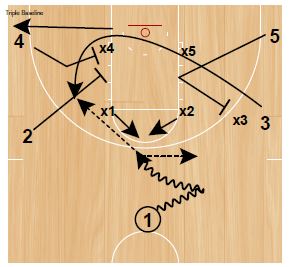
triple1

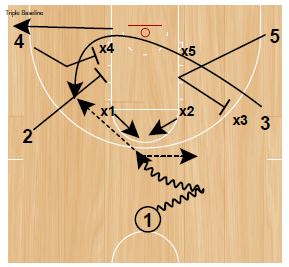
1 dribble to 3 to key action.
5 fakes flashing to the middle and backscreens for 3
3 sprints to opposite block area
4 screens x4
2 screens x4 or x3 chasing 3
3 curls or bumps to the corner depending if x3 piggybacks the screen or comes over the top
1 passes to 3
 

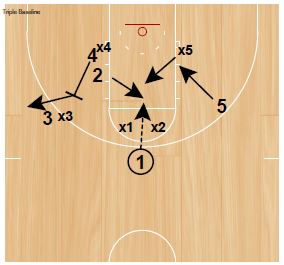
triple2

If 3 is covered, 3 spaces behind 3pt line
2 splits and flashes to the middle
4 backscreens x3 for 3
If two catches in the middle, 5 dives to the block to create a 2 on 1 vs. x5
If x4 helps on 2/5 (2 on 1), 4 can pop to the wing that 3 vacates for a 3pt shot

Box Special Box and 1 Attack

By Brian Williams on February 14, 2016

This set to attack a box and 1 defense was contributed by Coach Bert DeSalovo.

Coach DeSalvo has served as the Head Women’s Basketball Coach at Southern Connecticut State University (NCAA DII – NE-10 Conference).

Prior to leading the SCSU program, DeSalvo was owner of Full Court Consulting, a firm which served a variety college and high school coaches throughout the country. DeSalvo also is a regular contributor on multiple blogs including his own, Expressions from the Hardwood.

He coached previously as the top assistant for the women’s basketball program at Division II Clarion University for two seasons, was the head coach and assistant director of athletics at Penn State-Beaver, was an assistant women’s coach at Division III MacMurray College was as a men’s assistant coach at NCAA Division I Maryland-Eastern Shore, and was the girls’ varsity head coach at Chariho High School (RI) during the 2004-2005 season. He also has experience as a junior varsity, middle school and AAU coach.

Diagrams created with FastDraw

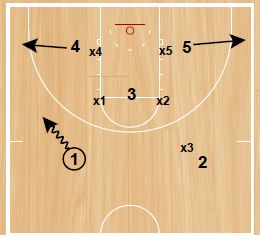
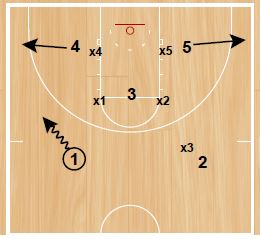
box-special1

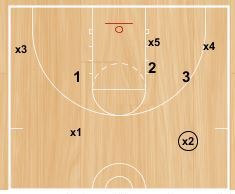
Begin in 2-1-2 alignment,

If x3 is defending 2, 1 dribbles away from 2 4 and 5 flex to respective corners


box-special2

x1 and x4 step up to defend 1 and 4.

3 sets a backscreen on x3 for 2, who cuts to the middle.


box-special3

1 looks for 2 in the lane.

2 makes a play or finds 5 cutting to the rim if x5 gives help.


box-special4

If 2 is not open, 2 clears thru and back to the wing x3 recovers to 2.

3 now flashes to elbow area after screening for 2.


box-special5

1 can pass to 3 with 5 diving once x5 commits.

or

If 1 already passed to 4 before 3 finished the cut, 4 can enter to 3 with 5 diving once x5 commits to 3.


box-special6

If 3 is covered, 3 can screen away for 5 who walks down then sprints off the screen

4 or 1 enter to 5.


box-special7

If x5 covers 5 well:

3 sets a back screen for x3

2 goes to the rim for a lob

(If lob is not there, 4 can screen x4 and 2 sprints to near side corner for a 3pt shot

  • « Go to Previous Page
  • Page 1
  • Interim pages omitted …
  • Page 129
  • Page 130
  • Page 131
  • Page 132
  • Page 133
  • Interim pages omitted …
  • Page 288
  • Go to Next Page »

Primary Sidebar

  • Twitter
  • Facebook
  • Linkedin
coachestoolbox
personaldevelopmenttoolbox
basketballplayerstoolbox
basketballtrainer
athleticperformancetoolbox
coachingbasketball

© Copyright 2026 Coaching Toolbox

Privacy Policy