• Skip to primary navigation
  • Skip to main content
  • Skip to primary sidebar

  • Basketball Plays
    • Ball Screen Sets
    • Horns Sets
    • Man to Man Post Up
    • Man to Man Isolations
    • Backdoor Plays
    • Man to Man 3 Point Shot Plays
    • 2-3 Zone Attack
    • Baseline Inbound Plays
    • Sideline Inbound Plays
    • Combination Defense Attack
  • Drills
    • Defensive Drills
    • Offensive Drills
    • Competitive Drills
    • Passing Drills
    • Rebounding Drills
    • Shooting and Scoring Drills
    • Toughness Drills
    • Transition & Conversion Drills
    • One on One Drills
  • Blueprint
  • Practice
  • Mental Toughness
  • Skill Development
  • Offense
  • Defense
  • Store

Pre-Season Strength and Conditioning Drills

Pre-Season Strength and Conditioning Drills

By Brian Williams on July 28, 2016

These skill development drills are from Scott Peterman’s Skills Development Notes Collection.

The main purpose of sharing these drills is to get you thinking about ways that you can modify the drills that you use.

These notes are from Alan Stein.

Structured warm-up

1. Skipping while tapping ball to belly button then to back
2. Same as above but with ball side to side over shoulders; running forward then backwards
3. Same as above but now twisting with the ball side to side as they run forward then backwards
4. Shuffle steps with ball to belly then to back
5. Same as above with ball side to side over shoulders; change direction they face at half court
6. Same as above but now twisting with the ball side to side with shuffle steps; change direction they face at half court

Box Drill

1. 1 leg hoping over line to elbow
2. Shuffle
3. Back peddle with hands high
4. Quick feet over baseline up and back over line.

*Don’t ever walk by a teammate without showing love.

Dynamic Flex

1. Knee to chest then rotate leg out
2. Foot to butt opposite hand straight in the air
3. Touch floor opposite leg up behind you
4. Groin stretches

*There are only 2 Choices

1. Work Hard
2. Don’t Work Hard
There is no middle ground

Tennis Ball Warm-Up

1. Roll ball out, run 3 circles around it before it stops rolling pick up ball and run back.

2. Toss 1 ball out once players gets it he needs to find the other ball that was tossed behind him.

3. 2 ball drop; teaching reaction time. Catch before second bounce. Must catch three then switch.

4. 2 ball drop with back turned. Players turns on vocal cue, “ball”. Don’t make it easy; make it tough so that your teammates get better. Challenge each other.

5. 2 ball dance; tossing balls while moving all over the court. Players catch them then return them to teammate. Must catch on 1 bounce then can advance to no bounce. Do for 1 minute.

6. 2 ball drop with hands on top of teammates. Player drops ball and teammate must catch before it hits floor.

7. 1 ball drop with hands on ears or behind back. Teammate call out what hand to use.

Slider Disks/Plates (Can use simple wax paper plates instead of spending big $ on expensive Sliders)

Slider Disks/Plates (Can use simple wax paper plates instead of spending big $ on expensive Sliders)

1. Standing slide-lunges
*Note: Always hold the ball like a player except on picture day
2. Push up position; circle plate around outside of body.
3. Same as #2 except bring knee to chest then opposite across
body and back to start.
4. On back one leg in the air, butt off the ground and slide (on plate)
other leg under butt.

*Note: Push step vs. step slide
Stated that physiologically the push step puts less strain on the groin area and is easier and quicker.
Something to think about. How much do we actually step-slide on defense? I think maybe it looks good when you have a great defensive guard working the point guard all the way down the floor.

Core Series:
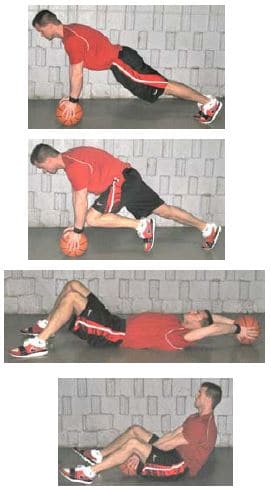
Capture2

1. Ball plank for 1 minute then bring knee to chest.
2. Wood Choppers: on your butt slam ball into floor between legs and above your head for 1 minute.
*Be comfortable being uncomfortable, that’s how you improve.
3. Lateral bounds: push off back foot and land in a 1-2 stop.


Finishers

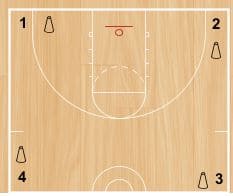
Corner Series:
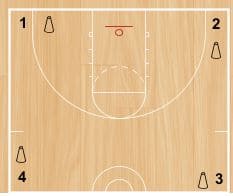
Capture

1. 4 players line up in each corner behind the cones set up.
2. Sprint to first cone then back pedal back to start
3. Same to second cone and back
4. Then sprint to next corner.
5. Done when everyone is back at their starting sport.
6. Can mix up what they do around cones or on sprint to next corner (shuffles, back pedals, sprints, etc.)

Competitive Shuffle

1. 4 players line up outside the free-throw lane.
2. They will make about 2 ½ slides to the other side of the lane
3. Then 1 good cross over run back to starting point
4. They should go 5 times up and back
5. The winner is out and you go again
6. Make it competitive and the intensity goes through the roof

4 Corner Circle

1. 4 players line up at the “4 corners” of the jump circle at mid-court
2. Coach calls out “1”, “2”, or “3”
a. 1 is sprint to your corner and back
b. 2 is sprint to slap the backboard and back
c. 3 is shuffle to sideline and back
3. Players on the sideline should echo calls
4. Coach can mix up calls such as “1,3,2,11,3,2”

Clean the Lane

1. 5 tennis balls in the key with 1 player
2. Players are lined up around the key
3. The player in the key’s job is to get all of the tennis balls out of the key (can’t throw the balls all over the
gym)
4. The players outside the key are constantly recovering balls and rolling them back into the key.
5. If the player in the center cleans the lanes then the guys outside have some consequence.
6. If the player doesn’t clean lane then guy in center has 10 pushups; or whatever.

This week’s eBook bundle contains 3 eBooks:

2011 NCAA Tournament Coaches – Basketball Skill Development
2012 USA Olympic Team Basketball Drills
130 Ways to Improve Your Program’s Attention to Detail

You can find out more information about the bundle at this link:
Skill Development Bundle

Skill Development Drills Part 2

By Brian Williams on July 27, 2016

These skill development drills are from Scott Peterman’s 2011 Skills Development Notes Collection.

The main purpose of sharing these drills is to get you thinking about ways that you can modify the drills that you use.

This week’s eBook bundle contains 3 eBooks:

NCAA Tournament Coaches – Basketball Skill Development
USA Olympic Team Basketball Drills
130 Ways to Improve Your Program’s Attention to Detail

You can find out more information about the bundle at this link:
Skill Development Bundle

Man in the Hole Drill (Matt Painter Purdue)
Defensive toughness

1. Play 1 on 1 full court
2. The defender must stay on the court for 3 trips up and down
3. The offensive player changes with every possession
4. The defender must try to make the offensive player change directions in the back court and also stop the offensive player from scoring
5. You can force players to concentrate on moving their feet in any individual or team defensive drill by having them hold tennis balls in their hands while playing defense.

36 Second Drill

Diagrams created with FastDraw

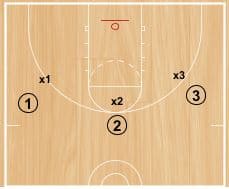
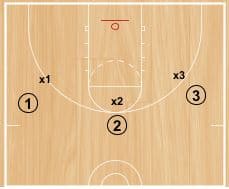
Capture

1. 3 pairs of players, each pair has 1 ball
2. Must stay in their lanes
3. The dribbler must try to penetrate to the basket 
and then pull back and attack again
4. Rotate the defenders to the right every 12 seconds


4 on 4 half ­court
To work on the skill of getting open

• Coach inbounds the ball
• Offense scores by making passes
• 2 minutes (half on offense/half on defense)
• Defense scores by touching the ball (1pt) or turnovers (2pts)
• Allow the offense 2 dribbles
• Cannot pass to the same player that passed to you
(Note: this eliminates give and go and that is up to you if you want to allow that in the drill. Not allowing players to pass to who passed to them promotes movement away from the ball)
• Pass, cut, screen, and fill open perimeter spots within your offensive system and rules.
• Can have the defense switch to teach and practice getting open against switching defenses.

Validating Your Drills

If you have an individual drill with a set standard for completion, have the player shoot a free throw to “validate the win.” They have to make the free throw for the win to count.

For team competitive drills or scrimmages, you can either validate the win with one player shooting a free throw, or you can have each player on the winning team shoot a one and one free throw opportunity. Set a standard for the number of free throws that must be made to validate the win. For example, if there are 5 players on the team, the squad must make a total of 7 free throws with each player shooting a one and one.

This week’s eBook bundle contains 3 eBooks:

NCAA Tournament Coaches – Basketball Skill Development
USA Olympic Team Basketball Drills
130 Ways to Improve Your Program’s Attention to Detail

You can find out more information about the bundle at this link:
Skill Development Bundle

Coaching Basketball: Practice What Wins

By Brian Williams on July 26, 2016

These are some of the notes presented by Tyler Coston at this past spring’s PGC/Glazier Basketball coaching Clinic in Chicago.

Practice What Wins

There is no excuse not to examine every aspect of your practice and why you do what you do.

Transition and change is the thing that happens most in games.  Not just transition from offense to defense and defense to offense, but from ball side to helpside, during an offensive possession, a player is a cutter, a screener, a rebounder.  Basketball is a game where the players current responsibilitites are changing.

Most games are won in transition.

That is why Tyler believes in ending everything in practice with a transition

Pick 3 things that you want your team to be great at to develop a clear and narrow focus.

For Tyler’s teams his three things are toughness, shot selection, and hard to score on

The three things are not the same for every team.  Each team’s system of play is unique. Pat Riley did closeouts every practice.  The Seattle Storm does not help or rotate on defense, they stunt.

Technique on closeouts–lean in the direction of the drive you want to take away, hands up and form a diamond with index fingers and thumbs.  Take away 2 of 3 things (drive left, drive right, shot) and battle to take away the 3rd.  He works on angles of closeouts and technique at least 2 or 3 minutes each practice.

The three games within the game, offense, defense, rebounding

He believes that everyone has the same chance for every rebound

One season, he had a team that needed to become a better rebounding team.

He instituted a rule in every practice and every skills training session.  If the ball hit the ground on a missed shot, they ran.  Someone had to rebound it before it hit the ground.

He did a survey and found that 72% of the rebounds in his team’s games were 2nd touch rebounds.  He used that to instill not giving up on the rebounds.  Even if the percentage isn’t that high in your team’s games, why wouldn’t you use that to motivate players to be tenacious rebounders?

Tyler assigns rebounding roles to his players:
Chaser–They don’t block out, they just go after the ball.  These are players who are guarding the players on the other team who get back to defend transition when the shot is taken and don’t look to offensive rebound
Eraser–They block out, but hold their blockout and don’t pursue the basketball
Spacer–They use the chuck and go (get the ball) rebounding technique

They wedge under the basket rather than blocking out right at the basket

It is not only what you do in practice, but more importantly, how you do it.

Their motto is that they are going to do everything with more energy and higher standards

Coaches must constantly be asking themselves, what can I do to create a competitive advantage for my team?

Here is an example from Carlton University in Canada

They play “Lock Left” defense

They force the opponent to enter the ball to the left on every possession

The player guarding the dribbler forces the ball to be dribbled to the left side

They guard in an open pack line stance to force left dribbles

All defenders to the right of the ball deny one pass away so that they don’t allow the ball to be revesred.

They full front on ball side post ups

That idea might not work for your team, here are some ideas that you might use to find your way to give your team a competitive advantage:

What do most of the teams in your league do?  Can you do the opposite of that?

Can you do intentional cross matching with who your players guard to give you a window of oppourtunity for an advantage in transition as your opponent scramble to find their matchup?

Can you find ways to win the foul game?  Stan Van Gundy practices getting fouled on drives, ball screens, rebounding, and by taking charges.

Can you double team bad post players and create turnovers?

Basketball is often beautiful chaos, good looking layups nver won a game, practice layups the way your players will shoot them in games.

Most of the game is played in chaos, so find ways to practice that so your players are ready

Most players make between 20 and 30 “mistakes” per game including turnovers, missed shots, errors in judgement, etc… (Maybe you can come up with a description other than mistake)  Elite athletes take 7 to 10 seconds to return to their concentration and flow after each mistake.  Your athletes probably take longer.  If you can get them to recover much quicker than your opponents recover from theirs, that gives you a competitive advantage.

The Key to Creating High Performing Teams

By Brian Williams on July 25, 2016

by Stephanie Zonars, LifeBeyondSport

At the What Drives Winning Conference, Florida softball coach, Tim Walton, referenced a TED Talk by business leader, Margaret Heffernan.

In it, she cites research by evolutionary biologist who studied productivity using chickens. William Muir devised an experiment to find out what would make chickens produce more eggs.

Chickens live in groups, so he selected an average group and left it alone for six generations.

Then he created a group from chickens that were individually the most productive— “super chickens.” With this group he selected only the most productive from each generation for breeding.

His findings?

After six generations group 1 was doing fine. Healthy chickens and increased egg production.

After the same time span, only 3 chickens in group 2 were still alive—they had pecked the rest to death.

The highly productive chickens in group 2 only achieved their success by suppressing the productivity of the rest.

Heffernan’s contention is that we tend to run organizations, teams and even countries using the “super chicken” model—one in which success is achieved by choosing superstars and by giving the most talented or brightest individuals all the resources and power.

And the result is the same as with the chickens—aggression and dysfunction and ultimately inhibited team productivity.

You’ve seen this with sports teams built on the uber-talent of a few athletes.

There’s nothing wrong with having elite athletes on your team. But if you don’t find a way to create strong cohesion between ALL team members, you diminish the team’s ability to reach its full potential.

What can help you develop that kind of team cohesion?

Heffernan shares another study done by MIT researchers in which groups of volunteers were given tough problems to solve.

They found that the most successful groups were not those with 1-2 members with exceptionally high IQs, nor the groups with the highest aggregate IQ.

The highest performing teams had three commonalities:

1       they showed high social sensitivity (empathy) to one another

2      they gave relatively equal time to each other (no one dominated the group and no one passively rode along—all participated)

3      they had more women on them 🙂

The researchers learned that social connectedness separated the best performing teams from the rest. [Tweet That!]

Heffernan teaches that social connectedness naturally results from a culture of helpfulness where individuals understand that they don’t need to know or be everything, because they are around people who are good at giving and receiving help.

It’s an environment where, when things get tough, individuals have social support and know who to ask for help.

But a culture of helpfulness won’t happen unless people get to know one another.

In other words:

get to know each other → culture of helpfulness → social connectedness

All this together is called social capital.

And social capital—the reliance and interdependence that builds trust—is the key to creating high performing teams.

It requires time to develop social capital. It doesn’t develop with a one-hit-wonder like a retreat or team building workshop at the beginning of the season.

Don’t get me wrong—that helps! It’s just not enough.

One company, for example, synchronized coffee breaks so that employees had time to get to know one another.

The result? Profits increased by $15 million and employee satisfaction saw a 10% rise.

That didn’t happen overnight, but it happened.

The time you invest in creating opportunities for your team members to get to know one another is not a waste. It’s an investment that will reap rewards!

Avoid super chicken syndrome by making time this summer to collect ideas and develop a plan for offering ongoing opportunities for your team members to get to know one another next season.

What motivates people is the bond, loyalty and trust they develop between each other. What matters is the mortar, not just the bricks. —Margaret Heffernan

Margaret Heffernan: Why it’s time to forget the pecking order at work

The Key to Creating High Performing Teams appeared first on Life Beyond Sport


About Stephanie Zonars

Stephanie Zonars helps coaches build and maintain winning team cultures through her business, Life Beyond Sport. Teams at Penn State, Notre Dame, West Point and over 60 other schools have built stronger trust, communication and teamwork through her workshops. Stephanie spent three years on staff with the Penn State women’s basketball team, assisting the team to back-to-back Big Ten Championships. She’s also the author of three books. For more tips on leadership and team culture, visit LifeBeyondSport

Post Play Notes

By Brian Williams on July 23, 2016

These notes on post play are from Dennis Hutter, Head Women’s Coach at Mayville State.

Three types of game all teams should have:

  1. Perimeter game
  2. Intermediate game
  3. Lane game – post play

Post Play Thoughts:

-Whether you are a fast paced team or a team that slows the pace down, you have to have the ability to get the ball to the block

-You can have great post play without great size – Posting up guards is an option

-Easiest way to “loosen up” a defense is to consistently make them defend the ball on the block

-A great post player always has the ability to have two defenders defend them

  1. Double team from away from the ball after the catch
  2. Fronted post with backside helpside defenders

-We want our post players shooting 55% from the floor – where they catch the ball and operate their low post game is

a BIG part of this shooting percentage.

-All offenses should be built from the inside/out – that starts with a great “lane game” – Post Play

-Defenses are also built inside/out – Post players have to work even harder because of this concept

-Five characteristics of a great Post Player

  1. Head – The ability to learn – Shows great patience
  2. Heart – The desire to learn – Plays with great energy and toughness, not afraid of contact
  3. Hands – Ball Security is number one thing when ball is passed into the post
  4. Feet – Always fighting with their feet – footwork is the key to a great seal
  5. Ability to Score the Ball – finishes well around rim with both hands, can make FTs

-Post players need to E.A.T. every day – Effort, Attitude, Toughness

-Great post players sometimes need to show great patience – They let the ball find them, instead of always looking to find the ball

-Play SLOW in the post before and after receiving the ball – USE YOUR HEAD AND READ DEFENDER

-Great perimeter players make great post players – Dean Lockwood

-Play BIG in the post

-Not tall – But Wide & Strong

-Not High, Higher, Highest – But Low, Lower, Lowest

Four Keys to Being a Great Post Player:

  1. Getting Open –Proper Post Stance

-There are two types of offensive post players:  Stationary Post Players & Mobile Post Players

-There are a few different ways that you can get open in the post – you always want to try and get open in your scoring area. A few ways you can get open in your scoring area are as follows:

  1. Seal In – Proper Post Up – seal the defense into the lane
  2. Seal Out – Seal defender out of the lane for a “hi/lo” post feed
  3. Set Up for the Lob – Against a fronting defender
  4. Cutting – Cutting into an area to receive ball
  5. Rim Runs – Post Player runs the middle of the floor in transition offense
  6. Offensive Rebounding – Treat very shot like a pass and “go get the rebound”

-Focus on a Proper Post Stance when trying to get open:

-Post up in an athletic stance – with bent knees and bent elbows

-Wide Base, Low Hips & High Hands

-“Lower and Wider is Better” – The player that wins, is the player that is lower and wider

-Wide enough base that you have great balance, but are still quick

-“Sit Into Your Game”

-Great Balance – Keep head back and in between knees – Keep a still head (baseball hitter)

-DEMAND the ball with your voice and also with your position

-Make contact with defender and move them back a step – “Own your spot on the floor”

-Two ways to create and make contact with your defender

  1. Step over the top of defender
  2. Pin & Spin Technique

-Push hands out, so you can see the backs of your hands

-Take up as much space as you can in the post –take up space with your base and your wide hand placement

  1. Staying Open

-Keep your feet between your defender and the ball

-Stay light on your feet –Boxer Mentality

-Fight with your feet all the time

-Constantly show your #’s to the ball – Don’t turn your body and become “skinny”

-If the ball can’t see your numbers, you are not open

-Make and MAINTAIN contact through the entire seal – LOSE THE CONTACT/LOSE THE SEAL

-Keep your hands high – limits offensive foul calls and also allows to be ready to receive ball

-“Talk to the ball” – Where do you want the ball fed from????

-Great post players are always thinking one pass ahead – set up defender to seal to the ball

-One defender should not keep you from receiving the ball

-Always try to get both paint and angles when sealing in the post

-Four reasons to release your seal of the defender:

  1. Go catch a pass
  2. Up against a 3 seconds in the lane call
  3. If you get out of your scoring area
  4. On any dribble penetration
  1. Receive the Ball Safely

-Catch the Ball with your eyes, feet and hands

-Ball security is number one thing when ball is passed into the post – Catch the ball!!!!

-Catch, Chin & Look Middle – Play Slow in the Post

-Exception to this is if you have a direct angle to rim on post catch

-Block & Tuck Concept on every catch – Block the ball and quickly tuck the ball under your chin

-Catch the ball with a “piece of the paint”

-Catch with two feet in the post – Jump stop as you catch the ball

-Allows you the ability to use either foot as your pivot foot

  1. Scoring Simply

– A great post player is efficient with BOTH HANDS around the rim

-Try to score with limited amounts of dribbles – no dribble moves are the best “Sweet”

-Get the ball up on all shots – contact on the shot, shortens your shot

-Three Point Plays are the ultimate goal – Absorb the contact and score the ball – TOUGHNESS

-“Scoring Simply” means getting all of your work done before the ball arrives – just like a great shooter

-“Less is More” in the post

-Too many post moves = too little production in the post

-You should have one “go to” move and one “counter” move in the post

-Great post players have one signature move in the post

-Finish closer to the rim, than where you caught the ball

-Shot Fakes in the Post:

-2 Inch vertical shot fake – no elongated shot fakes – short quick fakes

-“Take it up, Keep it up” – Don’t bring ball back down after shot fake – CHIN

Basketball Plays: 2 Guard Front

By Brian Williams on July 20, 2016

These 2 plays with a 2 guard front were diagrammed by Wes Kosel and are included in this week’s eBook featured bundle.

These plays came from the NCAA Top Offensive Minds Playbook along with the 2 Guard Front Playbook.

You can find out more about that two eBook bundle at this link: Top NCAA Offensive Minds & 2 Guard Front Playbooks

Diagrams created with FastDraw


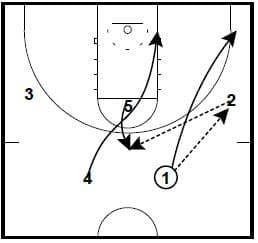
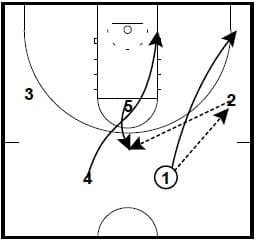
Michigan Wolverines Reverse

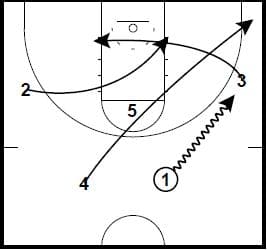
basketball-plays-michigan1

1 passes to 2 and cuts to the corner.

4 cuts to the block.

5 steps out and gets the ball.


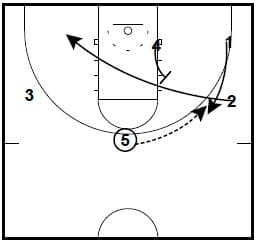
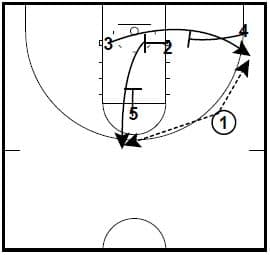
basketball-plays-michigan2

2 cuts off of a shuffle screen from 4.

5 turns and reverses the ball to 1.


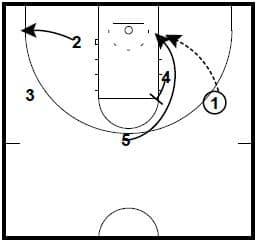
basketball-plays-michigan3

5 cuts off of a back-screen from 4.


Stephen F. Austin

basketball-plays-sfa1

1 dribbles to the right pushing 3 into the lane.

4 cuts to the corner and 2 to the block.


basketball-plays-sfa2

3 runs off of a staggered screen from 2 and 4 to the corner.

5 sets a down screen for 2.

These plays came from the NCAA Top Offensive Minds Playbook along with the 2 Guard Front Playbook.


  • « Go to Previous Page
  • Page 1
  • Interim pages omitted …
  • Page 114
  • Page 115
  • Page 116
  • Page 117
  • Page 118
  • Interim pages omitted …
  • Page 288
  • Go to Next Page »

Primary Sidebar

  • Twitter
  • Facebook
  • Linkedin
coachestoolbox
personaldevelopmenttoolbox
basketballplayerstoolbox
basketballtrainer
athleticperformancetoolbox
coachingbasketball

© Copyright 2026 Coaching Toolbox

Privacy Policy