• Skip to primary navigation
  • Skip to main content
  • Skip to primary sidebar

  • Basketball Plays
    • Ball Screen Sets
    • Horns Sets
    • Man to Man Post Up
    • Man to Man Isolations
    • Backdoor Plays
    • Man to Man 3 Point Shot Plays
    • 2-3 Zone Attack
    • Baseline Inbound Plays
    • Sideline Inbound Plays
    • Combination Defense Attack
  • Drills
    • Defensive Drills
    • Offensive Drills
    • Competitive Drills
    • Passing Drills
    • Rebounding Drills
    • Shooting and Scoring Drills
    • Toughness Drills
    • Transition & Conversion Drills
    • One on One Drills
  • Blueprint
  • Practice
  • Mental Toughness
  • Skill Development
  • Offense
  • Defense
  • Store

Coaching Basketball: Princeton Offense Philosophy

Coaching Basketball: Princeton Offense Philosophy

By Brian Williams on September 21, 2016

These statements are from the Princeton Hybrid Offense eBook.

Whether or not they fit your beliefs and players, I hope that they will at least prompt you to clarify in writing what your beliefs are. It will clarify things for everyone in your program and allow you to be more specific and efficient in your planning and use of practice time.

This week’s featured eBook bundle is the Princeton Hybrid Offense eBook along with the Comprehensive Ball Screen Playbook eBook. You can see their descriptions at this Link: Princeton Hybrid Offense and Ball Screen Playbooks

Princeton Offensive Philosophy

We believe that one basic formation in the half court followed by different options will be the most successful style of play for us. The first thing we want to do after a defensive rebound is to push the ball to see if we have an advantage. Anytime we have a good shot in transition, we want to take advantage of our numbers. A good shot for us means a lay-up or an open shot for a very good shooter. We want to get to the foul line through hard drives and cuts because that is where games are won and lost.

Our half court offense is designed to take advantage of the most difficult defense to play against – half court pressure man to man. This type of defense forces most offenses out of what they want do and breaks down most offenses into one on one play. Our offense is superior for the following reasons:

· We are able to use our quickness to get to the basket and the foul line
· From our 2-3 high set we are able to attack any kind of half court trap without adjusting our alignment
· We are difficult to scout because we don’t call out plays
· We move without the ball and force teams to match our physical conditioning
· We have an open attack where anyone can score rather than specific plays for only a few players
· We only have to learn one position and focus on execution instead of remembering set plays
· We will improve as our shooting, passing, and execution improves
· It relies on mental quickness, fundamentals, and shooting – 3 things we can control
· We don’t have a primary PG because anyone of our players can bring the ball up to start the offense

We believe our offensive attack incorporates the following principles of offensive play:
1. Drive to the basket (Fouls)
2. Inside out game (three point shot)
3. Pass/Cut opportunities
4. Penetrate and pitch
5. Single screens
6. Screens on the ball
7. Screens on the screener
8. Slipping screens
9. Backdoor cuts
10. Curl cuts
11. Feeding the post
12. Movement with the ball in the post
13. Offensive rebounding position
14. Taking weakside help away
15. Defensive balance
16. Organized team play

Princeton System of Play

Our core three beliefs in priority are:
1. NO TURNOVERS
2. Great Shot Selection
3. Contain the Basketball

Basic Philosophy of Play

1. If you can pass, dribble, and shoot well, you will always dictate to the defense what they do. If you can’t and are not fundamentally sound, they will dictate what you do.
2. You must be able to dribble, pass and shoot, screen and cut – ON THE MOVE UNDER PRESSURE. The quality of your passing determines the quality of your shots! You must dribble with a purpose and the other four players must read the dribbler.
3. Think change of direction–think five players high. Five players must work together.
4. There is a counter for everything the defense does. Do the opposite of what the defense is doing. Must read the defense–are they playing hard or soft–any denial cut backdoor.
5. Think layups and three point shots in that order.

6. Don’t run to the ball!
7. Hit the cutter with a bounce pass (it is OK to use one hand passes). The offense is about hypnotic cuts, passes and hand offs. Timing and cutting are essential to establishing flow and success for the offense.
8. This offense is more about cutting than screening. Move to open spaces. When you screen don’t just screen, screen- and read each situation.
9. CUT CREDIBLY -look for the ball where you are coming open–then get back outside to perimeter as quickly as possible.
10. STAND JUDICIOUSLY – Float to open spot and occupy your man. Have fingers up and butt down, think ball in air feet in air.
11. Five players must work together. UNSELFISHNESS is more important than brains–must couple this with discipline.

This week’s featured eBook bundle is the Princeton Hybrid Offense eBook along with the Comprehensive Ball Screen Playbook eBook. You can see their descriptions at this Link: Princeton Offense and Ball Screen Playbooks
Choking the Post Defensive Drill

By Brian Williams on September 19, 2016

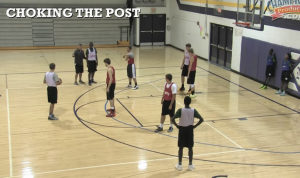
This post contains videos of two defensive drills from Matt Woodley.

He is a former assistant for Tony Bennett when Coach Bennett was at Washington State.

Make sure your sound is on as you watch.

All videos are YouTube videos.

Make sure that you are on a server that allows YouTube access.

Even if you don’t play a pack style of defense, I hope the videos give you an idea or two as to how you can clarify and teach the system that you play.

You can make adjustments to the rules and requirements of the drill that fit your team.

If you are interested in finding out more about the DVD that the video sample came from, click here:

The Secrets of the Pack Line Defense

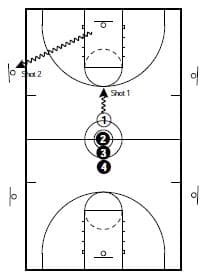
Choke the Post Drill

2 on 2 Positioning Drill

In addition to the 2 on 2 drill, Coach Woodley explains a second drill near the end of the video (3:45 mark) he explains a third drill that he calls 3 on 3 freeze.

If you are interested in finding out more about the DVD that the video sample came from, click here:

The Secrets of the Pack Line Defense

5 Ways Players Can Lead Themselves in Practice

By Brian Williams on September 17, 2016

This post was written for PGC Basketball by Graham Maxwell, Assistant Men’s Coach at Emmanuel College.

I hope you can find a few items to share with your players in one way or another.

This blog post is specifically for those athletes who want to be the best they can be as players and leaders. If you want to be an effective leader it is crucial to first lead yourself.

Learning the following five habits to lead yourself in practice will not only earn the trust of your teammates and coaches but it also will give you confidence in yourself.

WORK ON YOUR GAME OUTSIDE OF PRACTICE

I know this says specifically for practice but I couldn’t let this one slide. If you want to be your best in practice you have to work outside of practice. The best shooters and ball handlers are not made because of the shots or dribbles they take in practice. They are the best at what they do because of the work they put in when nobody is watching. You will never be a great basketball player if you only work on your game during practice. It is also true that if you want to be the best leader possible you have to work on being leader outside the practice facility. You don’t earn the trust of teammates by just showing up and having good practices. You have to put in the work outside of the gym.

Great players are the best at what they do because of the work they put in when nobody is watching.

CHANGE YOUR VIEW TOWARDS PRACTICE

I have been around players long enough to know that the majority of their thoughts surrounding practice is negative. I was once a player too. I know practice at times was not the most fun thing to attend. If you want to lead yourself in practice, you have to change your initial thoughts about it. Instead of saying, “ I have to go to practice” start saying “I get to go to practice.” It takes you from a place of negativity and complacency to a place of appreciation and opportunity. So I challenge you to start viewing practices as privileges and opportunities.

Read More: 4 Ways to Have the Most Fun Playing Basketball

HAVE 1 MAIN OBJECTIVE FOR EACH PRACTICE

Every single day, you should know what you want to get better at during practice. If you are unsure on what your focus should be, ask your coach. Ask them how you can improve as a player, leader, or teammate. Your coach determines your playing time so what he or she values is a good indicator of what you need to work on.

For example, let’s say I have had difficulties turning the ball over in our games. More specifically, my passes keep being deflected or stolen. My next practice(s) will be focused on completing passes. In every drill and every scrimmage, I am going to be the best passer on the team. No turnovers. Nothing high or low. Only goldilocks passes. If I really want to challenge myself, I will tell a teammate my practice goal so they can hold me accountable.

Every single day you should know what you want to get better at during practice

CLICK TO TWEET

After practice, I made sure to have a thoughtful evaluation of my goal. If I tried to focus on 20 things to improve, during practice, then by the end I would have gotten better at none of them. Focus on one aspect of your game and grow that during your practice time.

IS THE PRACTICE BETTER WITH YOU THERE?

Be honest with yourself and ask “is practice better because I am here?” If practice is not better because you are there figure out why and fix it.  Are your teammates better because you are there? If not, fix it. Do not be disengaged with what is going on around you. Great leaders do not have the luxury of minding their own business.

Take it a step further and ask yourself, “is this drill better because I am in it?” Great leaders and great players are constantly aware of their surroundings. Be aware of what is happening in practice good or bad. Special leaders and special players hold themselves accountable for their environment. If practice could be better or they are not enhancing their environment they do not fade into the background and blame the coach or a teammate, they accept the challenge and fix it.>

Great leaders do not have the luxury of minding their own business

CLICK TO TWEET

VISUALIZATION AND IMAGINATION

A great way to lead yourself in practice is to have a game-like mentality. If you go through the motions in practice, there is a good chance you will not be as sharp for the games. If you throw lazy passes in practice or you have a nonchalant approach why do you expect a different result in the games?

If you throw lazy passes in practice, why do you expect a different result in the games?

CLICK TO TWEET

Always imagine anything you do you are playing against the toughest opponents you will face all season. When you are on the sidelines, waiting to jump into the drill, visualize yourself making the right reads on defense or making the right decision on offense.

When those plays happen in a game you want your mind to think it is second nature. So use your imagination to practice the plays you will make in a game and visualize your success. Remember, “In times of most extreme pressure you revert back to your most deeply held habits”. You want your habits to be thought of and visualized so much that a game is actually easier than practice. Put pressure on your self in practice so the pressure of a game won’t throw you off. The best way to practice championship like pressure is to visualize it.

Read More: How to Play in a National Championship

I hope you can take these five keys and put them into practice as soon as you can. Not only will these habits benefit you now as players they will also spill over into your every day life. The more belief you have in yourself the more everyone else will believe in you as well. To be a leader of others you must first lead yourself. Don’t let practice be an excuse for you not lead yourself.

To learn more about PGC Basketball, including additional training tips and videos, you can visit their YouTube Channel

Basketball Drills: Multi-Purpose Drills

By Brian Williams on September 15, 2016

Some drills that you can use in several ways: Warm-up, Shooting, Passing/Catching on the move, or at the end of practice for Conditioning/Competitions/Toughness

These drills are from Coach Justin Remington, Assistant Women’s Basketball Coach at San Bernardino Valley College.

Coach Remington is also a basket instructor for PGC.

His Twitter feed is @Coach_JRem

I have a link at the bottom of the post for you to access the entire pdf of his Favorite Practice Drills.

Diagrams created with FastDraw


Full Throttle Shooting Drill

throttle-shooting1

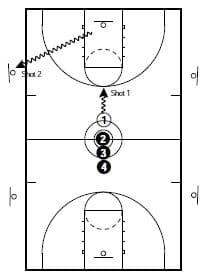
Everyone on the team has a basketball and start at half court. Each player will take the same shots.

1st person dribbles hard to the TOK and takes a TOK three pointer (second person waits until the ball is rebounded before they go and take same shot, each person on the team follows suit) (Shot 1).

Once player gets a rebound they go to the basket to the left for a right handed layup (Shot 2).

throttle-shooting2

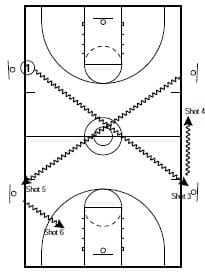
Player speed dribbles across the court (push the ball ahead of you, limit your dribbles) for a left hand layup (Shot 3)after rebound player sprints to the right side basket for a short corner (or corner three pointer) shot (Shot 4). Player gets rebound and speed dribbles diagonally for a bank shot above the block (or a reverse layup depending on what you want to see that day) (Shot 5).

The last shot is a wing 15 footer or a wing three pointer (depending on what you want) (Shot 6) (have players go through these 6 shots two or three times and count their makes and report their makes to you after the drill)

Editor’S Note. You could turn this into a team competition by seeing how many the team can make in a specific amount of time.

Relocation Layups

You could change the shot to a 3 jump shot, have someone at the basket to contest the layup, or change the type of finish to add another level of difficulty to the drill or for some variety.

relocation1

This is a timed drill, Put two minutes on the clock and select an amount of layups you want to see made. Players do not reach it they get a sprint added under TEAM FOULS (to be run later in practice)

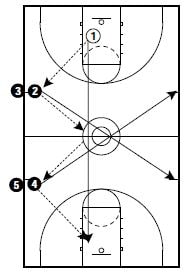
1. Team lines up on sideline as shown

2. Player with basketball under the rim throws the ball off glass and outlets to 2

3. Player 1 runs the lane, player 2 passes back t o player 1 and cuts diagonally across the floor to the opposite sideline

4. Player 1 passes ahead to 4, 4 passes it back to 1 who will shoot the layup

5. Player 4, after the pass back to 1, will cut diagonally across the floor (as shown)

relocation2

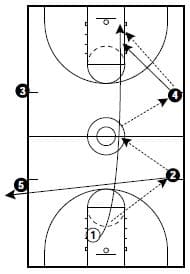
1. Player 1 gets rebound and outlets to 2

2. Player 2 passes back to player 1 and sprints across the court and gets into line behind 5.

3. Player 1 continues and passes ahead to 4

4. 4 passes back to Player 1 and follows player t o the basket to get rebound

5. Player 1 finishes and Player 4 rebounds and goes back the other way to repeat the process.

Coach Remington has a 54 page pdf assembled with Moreno Valley’s Favorite Practice Drills. You can access it by clicking this link: Moreno Valley Practice Drills

Basketball Plays Michigan 25 Down

By Brian Williams on September 14, 2016

These 2 Plays were run by John Beilein when he was at Michigan.

They are from the NCAA Top Men’s D1 Coaches Playbook assembled by Gibson Pyper.

I like the concept of having a counter to your set plays to be able to call.

The NCAA Top Men’s D1 Coaches Playbook is combined with the 2 Guard Front Playbook as a $25 2 Playbook (Digital eBook) Bundle.

You can find out more about the bundle by clicking on this link: Top NCAA Offensive Minds & 2 Guard Front Playbooks

Diagrams created with FastDraw

Michigan 25 Down Chicago

25-down1

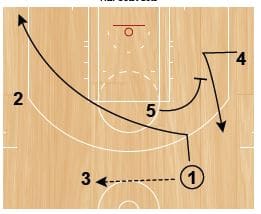
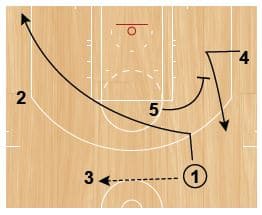
1 makes a guard to guard pass to 3 and then cuts to the corner.

4 receives a screen from 5.


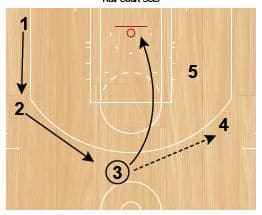
25-down2

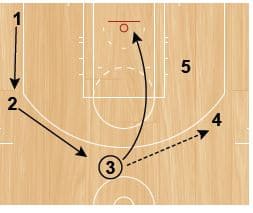
3 passes to 4 and basket cuts.

1 and 2 make fill cuts.


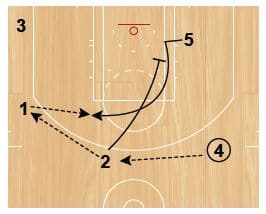
25-down3

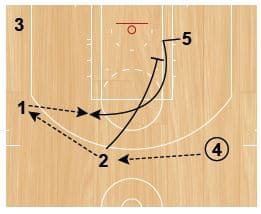
4 passes to 2 and 2 reverses the ball to 1.

After making the pass, 2 makes a cut to screen for 5.

5 cuts just above the elbow.

1 passes to 5.

2 spaces to the far corner.

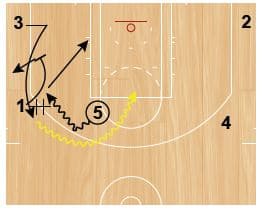
25-down4

1 down screens for 3.

3 takes a dribble hand off from 5 and attacks the middle.

1 spaces and 5 rolls.


25 Down Hand Off Backdoor

25-down5

1 makes a guard to guard pass to 3 and then cuts to the corner.

4 receives a screen from 5.


25-down6

3 passes to 4 and basket cuts.

1 and 2 make fill cuts.


25-down7

4 passes to 2 and 2 reverses the ball to 1.

After making the pass, 2 makes a cut to screen for 5.

5 cuts just above the elbow.

1 passes to 5.

2 spaces to the far corner.

25-down8

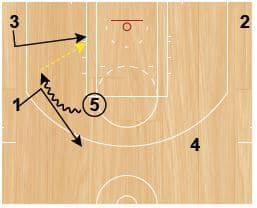
5 fakes a dribble hand off to 1 and then hits 3 cutting backdoor.


These plays are from the NCAA Top Men’s D1 Coaches Playbook assembled by Gibson Pyper.

The NCAA Top Men’s D1 Coaches Playbook is combined with the 2 Guard Front Playbook as a $25 2 Playbook (Digital eBook) Bundle.

You can find out more about the bundle by clicking on this link: Top NCAA Offensive Minds & 2 Guard Front Playbooks

Bill Walsh on Teaching and Player Development

By Brian Williams on September 13, 2016

These notes on Bill Walsh’s Philosophy are from Bob Starkey’s Basketball Coaching Blog, hoopthoughts.blogspot.com.

Coach Starkey said, The following comes from one of the absolute best coaching books I’ve every read, Finding the Winning Edge by Bill Walsh. I agree that it is one of the best coaching books I have read as well.


Drive the players to concentrate. Be assertive in your insistence that they focus on the task at hand.

Individualize your teaching approach to fit certain individuals, when necessary. Give extra time to those players who need it.

Be as precise as possible when teaching. Always use the system’s terminology as a common language.

Be patient, but demanding. Require your players to adhere to proper techniques at all times.

Teach the skills progressively. Adhere to a systematic methodology of teaching that allows the players to improve and enhances their level of confidence in your competence and professionalism.

Keep your finger on the pulse of the situation. Be alert to the intensity level of the players. Be sensitive to signs of those factors which can affect the learning curve. Never overlook the fundamental reality of the teaching axiom, “quality repetitions are the mother of all learning.”

Keep the meetings quality, not quantity, oriented. Use a variety of learning tools to enhance the learning environment and to help stimulate the players’ level of concentration and focus.

Demonstrate the highest level of knowledge about the subject matter being taught.

Teach the players in a professional manner. Unless you’re trying to elicit a specific emotional response from your players, refrain from screaming and demonstrative behavior. Keep in mind that such behavior seldom, if ever, enhances the learning curve particularly if the subject matter involves technical information.

Evaluate the players’ performance on a daily basis to ensure that they are progressively mastering the techniques required to perform the tasks they are assigned in an effective and efficient manner.

Rapidity is the essence of war; take advantage of the enemy’s unreadiness, make your way by unexpected routes, and attach unguarded spots.

Another teaching technique that has proven to be very effective is to have players emulate the techniques and actions of other athletes. For example, if players watch videos showing Jerry Rice run a particular pattern in a certain way, you (as the head coach) can single out and stress particular coaching points, by using Rice as the case in point.

All factors considered, players tend to respond more favorably to an actual visual representation of a particular teaching point than to tan abstract illustration of that point drawn up on a chalkboard or written up in a playbook. This learning technique is typically referred to as “modeling.”

“Win the war, then win the fight.”

And, a few more notes from Bill Walsh on Decision Making

A big part of coaching is the ability to make decisions.  When you think about it, coaches have numerous decisions that they must make on a daily basis.  All are relevant to our programs though certainly some are more important than others.  Here is a great list of thoughts in regard to decision making from Bill Walsh from his book “Finding The Winning Edge.”

-One of the main attributes a leader must have is the ability to discriminate from what is often contradictory information. In this matter, it takes a thorough understanding of the situation and of the sources of information to act effectively.

-Decision making involves more risk and responsibility than any other managerial activity. The work of problem analysis and evaluation can be delegated to others in the organization, but the responsibility for decision making is ultimately assigned to one individual. Choosing among various alternatives often demands courage and moral judgment, as well as intelligence.

-Effective decision making is vital to the growth of any organization.

-Toward that end, there is a series of questions that you should address when making a decision, including:

  • What difference does it make what course of action you decide to adopt?
  • Do you have sufficient information to fully analyze the issue/matter under consideration?
  • If you are lacking essential information, do you know how to get it?
  • How critical to implementing your decision is its acceptance by those who will be affected by it?
  • To what degree does the commitment of others to your decision depend on their active participation in the decision-making process?
  • Is everyone affected by your decision in general agreement with its basic objectives?
  • To what degree will those who will be affected by your decision disagree over possible alternative solutions?
  • Do the individuals involved in your decision have the capability to implement the decision as planned?

– An educated guess is just as accurate and far faster than compiled errors. – George Patton

You can click the link below to find out more about the book:

Bill Walsh: Finding the Winning Edge

  • « Go to Previous Page
  • Page 1
  • Interim pages omitted …
  • Page 109
  • Page 110
  • Page 111
  • Page 112
  • Page 113
  • Interim pages omitted …
  • Page 288
  • Go to Next Page »

Primary Sidebar

  • Twitter
  • Facebook
  • Linkedin
coachestoolbox
personaldevelopmenttoolbox
basketballplayerstoolbox
basketballtrainer
athleticperformancetoolbox
coachingbasketball

© Copyright 2026 Coaching Toolbox

Privacy Policy