• Skip to primary navigation
  • Skip to main content
  • Skip to primary sidebar

  • Basketball Plays
    • Ball Screen Sets
    • Horns Sets
    • Man to Man Post Up
    • Man to Man Isolations
    • Backdoor Plays
    • Man to Man 3 Point Shot Plays
    • 2-3 Zone Attack
    • Baseline Inbound Plays
    • Sideline Inbound Plays
    • Combination Defense Attack
  • Drills
    • Defensive Drills
    • Offensive Drills
    • Competitive Drills
    • Passing Drills
    • Rebounding Drills
    • Shooting and Scoring Drills
    • Toughness Drills
    • Transition & Conversion Drills
    • One on One Drills
  • Blueprint
  • Practice
  • Mental Toughness
  • Skill Development
  • Offense
  • Defense
  • Store

Preparing for End of Game Situations

Preparing for End of Game Situations

By Brian Williams on January 16, 2017

This post is reposted from Bob Starkey’s Basketball Coaching Blog, hoopthoughts.blogspot.com.  

I have been re-reading some stuff given to me some time ago from Mike Neighbors, now the Head Coach at the University of Arkansas.

I came across a great passout from Mike and Kevin McGuff (Ohio State) on End of Game Situations and thought I’d pass it on.  Do you have a strategy for End of Game Situations?  How much thought have you gave it?  The thing I respect about Mike and Kevin is that they are detailed in their approach to all phases of the game.  Here are their thoughts on EOGs:

Why is END OF GAME SITUATIONS even a topic for a clinic when we all as coaches know that the first possession after tip-off, or the third possession after the 8:00 media, or the 43rd possession of the game all have the same point value potential?

It’s because everything gets magnified at the END OF THE GAME. Pressure seems greater. Emotions run higher. Coaches have to talk louder in timeouts because everyone in the crowd has stopped text messaging and is now laser locked onto the action. Referee’s huddle and make sure they are all on the same page. The number of in game distractions increase.

It as become evident to me that the teams who are BEST at EOG’s are teams that throughout the course of the game have treated every single possession with the same respect as the very last ones. These teams appear to be oblivious to any of the mentioned distraction and repeatedly execute game winning situations when the pressure is the greatest. They display a composure that others don’t. Their coach has a control that others don’t. Their players demeanor is consistent. They are in character. As a result THEY WIN more than they LOSE!!

Once you establish that approach it is still imperative that you have a plan for implementing and executing. That is where we come up with the D.I.E.

D– Develop your philosophy
  I– Implement you strategy
E– Execute your tactics

DEVELOP YOUR PHILOSOPHY:

You can attend clinics, buy books, look on-line, or steal from others but to be successful your EOG Philosophy has to be YOURS!!! My grandpa always said “You can’t sell what’s not yours” and he was right. If you don’t believe in it, your players won’t and you’ll LOSE more than you’ll WIN. So utilize all the resources you can to think through as many situations as possible then MAKE THEM YOURS!!!

SOME PHILOSOPHY THINGS TO CONSIDER:

Are you going to foul on the floor ahead by three points? Does it depend on the time left? Is that time 8 seconds? Is that time 5 seconds?

Are you going to get the ball in your best players hands or use that player as a decoy for option #2? Do you work in practice as if your first option has fouled out already?

Are you going to take a quick two point shot then foul if down three with a certain amount of time?

Are you going to miss a FT on purpose with a lead to force opponent who is out of time outs to rebound and hit a last second shot?

Are you going to run plays that your players already know or draw something up? Are you going to run a “dork” play?

Are you a go with the stats coach? Are you a go with your gut coach? Are you depends-on-the-situation coach?

Are you going to switch all screens? Stay on and play 1-on-1 defense? Trap a ball screen? Change defenses out of the time-out? Show a defense play another defense?

Are you going to put a big player on the inbounds passer or play centerfield?

And the countless other situations that we encounter at the end of game.

IMPLEMENT YOUR STRATEGY

Now that you have your philosophy, you must implement the strategy with your players and your team. This is where you determine which players on your rosters can perform certain skills… who can throw it the length of the floor, who can catch that pass, who can dribble from end-line to endline in five seconds, who can create their own shot, who can throw a lob pass at the rim, who can simply inbound the ball safely.

This is how you are going to teach the skills necessary to be successful when pressure and distractions are at their highest level… will you devote time in practice to these situations, will you turn on the PA system to simulate crowd noise, will you stop practice in the most stressful moment and work on an EOG.

This is the plays the you are going to call or the defenses you are going to play to win games in the last few minutes… beg, borrow, steal from the best, find ones that have worked

Some great EOG things I’ve stolen from various coaches:

Throwing tryouts… A coach stood at one end of the court and let players try to throw balls to hit them. Whoever could, was their long throw-in girl.

Set the shot clock to various times and see who can go score 1-0, 1-1, 2-0, 3-0 etc.

Team worked on saving the ball to their own basket and keeping the ball in play as the clock ran down

Keep away in working on not allowing a team to foul ball handler

Dribbling the ball to various spots on the court to call timeouts

Loose ball scramble to work on creating held ball situations and NOT creating held ball situations

EXECTUE YOUR TACTICS

Now that you have a philosophy and a strategy, it is time to EXECUTE your tactics to win the game.

Your very first thought should be that HOW you say what you are going to say is just as (if not more so) important as WHAT you say!!! Your demeanor and your tone will be directly reflective of how your team will perform.

Are you talking to them in the same manner?

Are you on the same spot on the floor as you normally are for timeouts?

Are you using a wipe board or not?

Are your assistants scrambling and frantic in your ear?

Are the subs in their ’normal’ huddle mode? (if it’s not how you successfully practiced it, then don’t expect them to perform in the game)

Do you have a method for knowing the number of fouls on each team, who has the possession arrow, have you pointed out in the various arena’s where the game/shot clocks are located?

Do YOU know the situation?
3 on 3 Drill Series

By Brian Williams on January 15, 2017

These drills were contributed by Marc Skelton, Head Coach for Fannie Lou Hamer Freedom High School in the Bronx, NY to the FastModel Sports Basketball Plays and Drills Library.

You can also find out more about FastModel Play Diagramming software by clicking this link: FastDraw

Coach Skelton said this about the drill series:

A great drill that simultaneously improves your team and individual players offensively and defensively is a series of 3 on 3 drills.

Offensively, we work on dribble hand-offs, cuts, shooting, passing, catching, screens, and timing.

Defensively, we work on communication and the different ways to defend screens.

I also like this drill because it helps to reduce turnovers.

As with any drill that you see anywhere, if you do feel that you can use it in your program, you should adjust it to fit what you are looking to teach and improve.

3 on 3 Drill Series

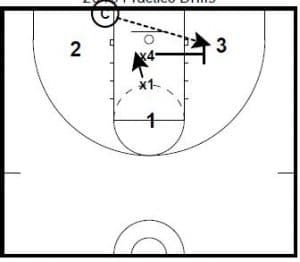
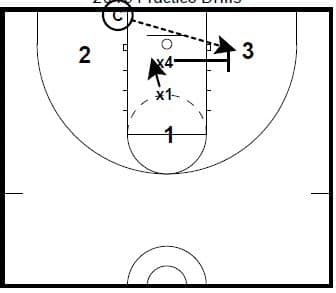
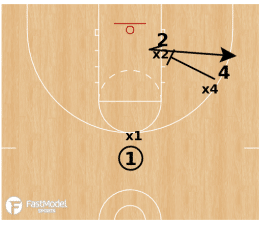
A great drill to help reduce turnovers is a modified 3 on 3 (3 dribbles maximum).

It is a great drill with lots of options.

This one is called “3 on 3 down”.

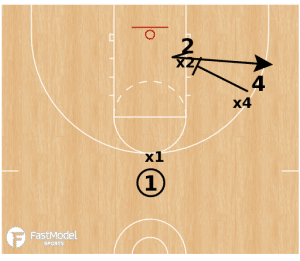
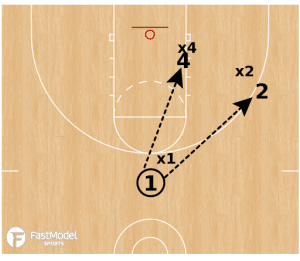
Offense is only allowed to score on pin down screens.

Wings work on using the screen.

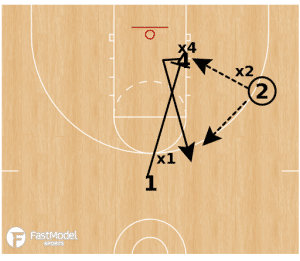
The screener works on sealing after he sets the screen.


If the first option is not open 1 sets a down screen for the 4.

Lots of skills are built upon on this drill; moving without the ball, proper screens, what to do after setting a screen and timing, which gets lost in most offseason training.

Also defenses learn how to read the offense.

They can switch, stay, hedge. It forces the offense to get creative.

The next game is “3 on 3 UP”.

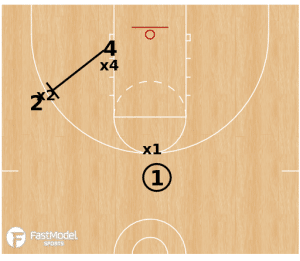
This game like “3 on 3 down” allows the offense only to score on back screens.


You can create lots of options from this simple game.

– “3 on 3 high” offense can only score from the high post.

– “3 on 3 GO” offense can use backdoor cuts and dribble handoffs

– 3 on 3 BLUE” Offense has to use a pick and roll to score

-“3 on 3 ORANGE” Offense has to use a pick and pop to score


Close Quarters Rebounding Drill

By Brian Williams on January 10, 2017

A rebounding drill from Coach Justin Remington, Assistant Women’s Basketball Coach at San Bernardino Valley College.

Coach Remington is also a basket instructor for PGC.

His Twitter feed is @Coach_JRem

I have a link at the bottom of the post for you to access the entire pdf of his Favorite Practice Drills.

The drill is not game-like, but in my opinion it does simulate inside defenders moving to establish defensive positioning and then having to get rebounding position when a shot is taken.

Hopefully you can tweak it in a way where it can be added to your drillbook.

Or, it can be used as a new drill here in the second half of the season.

There are several ways that you can make the drill competitive: Split into 2s, 3s, split the team into two teams, you stay in on defense until you get 3 rebounds in a row, a point per rebound, see which pair can get the most consecutive rebounds.

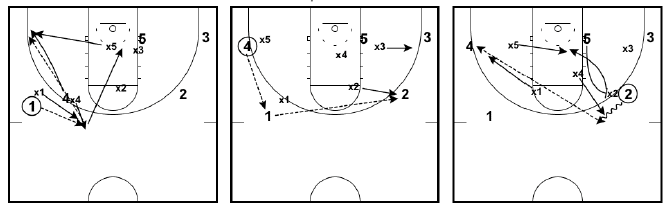
Close Quarters Rebounding Drill

Diagrams created with FastDraw

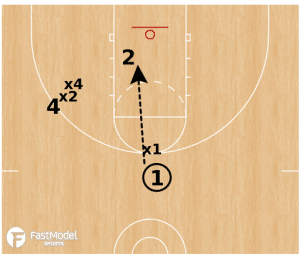
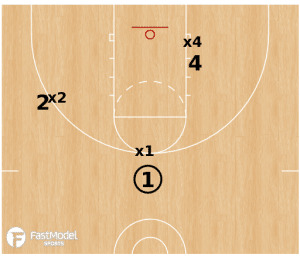
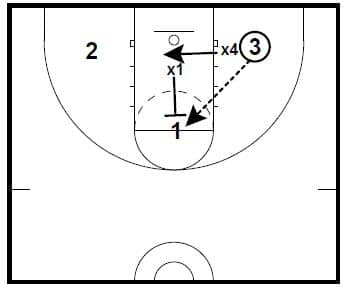
Coach starts with ball under the basket.

x1 and x4 chop their feet until the coach passes to any of the 3 offensive players…

x1 and x4 play scramble defense together as 1, 2 and 3 pass the ball to each other…

Coach yells SHOT and offense shoots and defense MUST go and BLOCK OUT two of the three players


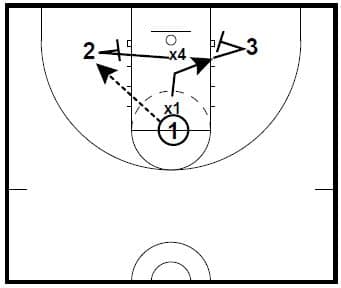
1 passes t o 2

x4 is trying t o get out t o him/her

x1 is dropping ball level

coach yells SHOT

2 shoots

x4 and x1 box out

Coach Remington has a 54 page pdf assembled with Moreno Valley’s Favorite Practice Drills. You can access it by clicking this link: Moreno Valley Practice Drills

3 2 3 Competitive Shooting Drill

By Brian Williams on January 8, 2017

This competitive shooting drill is among the thousands of resources for both coaches and player available from basketballhq.

They have several more videos as well as basketball coaching resource articles.

This drill is coached by Ryan Panone.

I encourage you to think about the best way to tweak the drill before using it so that it will offer the most benefit for your players.

Even as you are first implementing it, you may need to continue the adaptation process of making some adjustments so that the drill contributes to the improvement of your players.

Make sure that your speakers are on to hear the narration and that you can access YouTube to see the video.

Click the play arrow to begin each video.

3 2 3 Competitive Shooting Drill

Brad Stevens Notes

By Brian Williams on January 5, 2017

University of Maine Men’s Assistant Coach Zak Boisvert has assembled some notes from Brad Stevens at the 2016 Brayden Carr Coaches Clinic. The Brayden Carr Foundation is a non-profit charitable organization that works to raise money for children with seizure conditions. The charity was established by Rhode Island assistant coach Jim Carr and his wife Natalie after their son died tragically in May 2011. You can find out more about the charity at this link.

He has an outstanding site with posts on various coaching topics at www.pickandpop.net

His You Tube channel has several videos with various types of man to man plays, zone sets, and inbounds plays. You can subscribe to receive an update when he posts a new video Zak Boisvert You Tube Channel

You can follow him on Twitter at this link: @ZakBoisvert

Brad Stevens, Boston Celtics

-All coaches are bound together. It’s a brotherhood and we should always be looking to help one another.

-I spent 13 years at Butler University in Indianapolis and it was the greatest learning experience I could have ever asked for.

-I went to Butler as a volunteer support staffer and quickly learned that I knew nothing. They taught me so much more than I thought there was to know.

-Look at the things you do and ask why you do it. Is it the best way or the way you’re used to doing it? Are we doing it because it’s the right way or because we think we’re supposed to be doing it that way?

• Adjusted shoot around time because his players liked it more later in the day.

-I learned the importance of running a condensed, efficient practice. He worked so hard to create a practice plan that covered what needed to be covered, but was as concise as possible to be respectful of his players’ time.

• Abraham Lincoln: “I apologize for the length of this letter. I did not have time to write a short one.”
• The importance of rest & recovery: clear mind, fresh legs.

-As a coach, you are what you emphasize.

-Your first meeting with the team is incredibly important.
• What is important to winning?
• Dominate effort plays.
• Get good shots.

-You will make tweaks to your systems. You will run different stuff from year-to year, but there should be a certain amount of absolutes built into your philosophy that you won’t/can’t budge on.

-Vitally important as a coach: Perspective and balance. Your health/family/wellbeing is more important than the next game. I encourage all coaches to read the Urban Meyer piece on Bleacher Report entitled, “I’m Not the Lone Wolf.”

-I love watching football coaches. Their ability to get 100 people on the same page with tempo is astounding.

-Books I recommend:
1. Grit (Angela Duckworth)
2. Legacy (James Kerr)
3. Mindset (Carol Dweck)

-James Kerr (Legacy): Successful leaders look beyond their own field to discover new approaches, learn best practices and push the margins.

-Don’t focus on trophies, focus on getting better.
• Get rid of the emotional roller-coaster that comes with fixating on results.
• Fall in love with the pursuit.

-Our goal is a championship. Anything less would be disrespectful to the organization we represent. While that’s our goal, we’re focused on the process and getting better.

-We crafted our entire defense (& recruiting philosophy) over how we hedged pick & rolls.
• Hard hedged all ball screens.
• The way we taught defense started with the hedge.
• We recruited to the way we defended. We wouldn’t recruit bigs that couldn’t move.

-By the way…If you’re more athletic and can switch everything, throw everything else out. Switch everything and enjoy winning.

-We created chaos with the athleticism of our bigs’ hedging. We were elite defensively when our guards were athletic too (Shawn Vanzant, Ronald Nored) and could get into the ball and direct/impact it.

-The science of the hedge:
• Hand on screener’s back.
• Parallel with the sideline / perpendicular with half court line.
• 2 hard steps up the court.
• Listening for guard’s “Back” call as he moved underneath you.

• Running back to the lane and being directed by the guys positioned in help.

-As we hedge that side pick & roll, the other 3 defenders move into a zone—no longer matched to a person.
• We’re “Muhammad Ali-Ready.” On our toes, ready to pounce.
• Ready to fly out.
• Know who the player you’re closing-out to and what they do. That’s the importance of personnel awareness in scouting. Because of how often we’re zoned up on the weak side, you need to know the strengths of everyone on the other team, not just your match up.

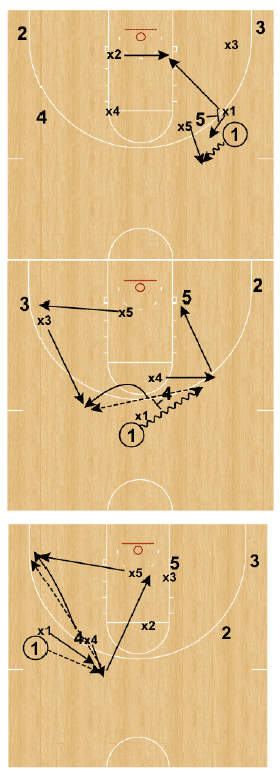
Diagrams created with FastDraw

-Versus a spread pick & roll, our “Ultimate Helper” on the roll is the weak side corner defender (rather than the single-side bump guy).

If the single-side bump (x3) gets pulled in on 5’s roll, it’s too easy of a play for the offense to throwback to 3 on a lift.

 “Ultimate Helper” meets the roll in front of the charge circle. In this scenario, x4 would start inching out as the ball is being dribbled at him and would take the first pass to the weakside (either to 2 or 4).


-Will rotate to a great pick & pop on a middle pick & roll


-Versus the shooting 4-man on a side ball screen: “X Switch.”


-Drill: defense x’s the first side ball screen. Offense skips it to the corner off the second ball screen. X1 takes the first pass out.

-“Contain Blitz” concept:
• Guard: don’t get beat corner.
• Both: don’t get split middle.
• On pass, big can leave.
• Make sure the pass out has to be made over outstretched arms.

-At Butler, we wanted to be absolutely chaotic on the ball. We wanted to utilize the athleticism of our bigs.

-Every time in which I thought we were really bad defending the pick & roll at Butler, I would go back and watch the tape and I’d always end with the same conclusion, the two guys on the basketball weren’t good enough/didn’t create enough chaos.

-Weakside nail defender: we don’t want you on the nail (we’re pulled too far over that way). We just want them thinking you’re at the nail.

-The first aspect of a closeout is to do so knowing the tendency of the man you’re closing out to. Is he a shooter? Non-shooter? Baseline rip & go guy?

-We ideally want to hear the pick & roll coverage 3 times by our bigs, but we know it doesn’t always work that way.

-4-on-4 Drill: The four offensive players stationed around the perimeter swing the ball around. The coach calls out one of the defensive players’ names and he sprints to touch half court and sprints to come back into the play. As soon as the coach calls the defensive player’s name, the drill becomes live (offense trying to get a layup).

-In disadvantage situations, what are our priorities?
1. Basket
2. Ball
3. Great Shooter

-Think about who is in your area (that you might be closing out on) in a disadvantage situation. We’re taking away layups and we’re stopping the ball. Ultimately what we want is a jump shot taken by the worst shooter on the court.

-A game great plan can do the job for all 40 minutes in the college game. In the NBA, the great players will expose your game plan, no matter how good it is. You have to have your adjustments and contingency plans.

-Good players will beat good pick & roll defense.

-I cannot stress how important it is to know the opposing team’s personnel. If guys want to call that analytics, sure, I’m into analytics.

-Whose call on “Veer” (late switch)? Out of convenience, it’s the guard’s call. He knows when he’s beat.

ICEing the Pick & Roll

-Because of the extra space inside the 3-point line in the NBA (compared to college), the onus really falls on the guards in your ICE.

-Guards:
• Straddle leg
• Win foot race with the ball
• On dribble pick-up, 2 hands high to deflect or delay the pass.

-Bigs:
• The higher you can be, the better (but only to an accurate level of your mobility).
• BIG inside hand low taking away the pocket pass to the screener rolling versus the ICE.
• Dropping appropriately and returning when pass is made or the guard squares the ball up.

You can read the remainder of the notes and also download a pdf at this link: Pick and Pop Brad Stevens Clinic Notes

San Antonio Spurs Pin Dribble Hand Off Action

By Brian Williams on January 4, 2017

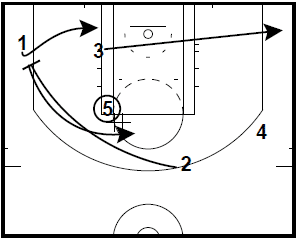
These two plays are from Scott Peterman’s New San Antonio Spurs Mid Range Offense eBook Playbook.

Diagrams created with FastDraw

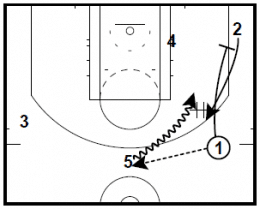
Pin DHO Weak Option

1 passes to 5 then screens down for 2.

2 cuts up to get a DHO from 5.


2 drives middle as 3 screens for 4 then screens for 1.


If 4 gets it, he looks to DHO with 1 in the corner.


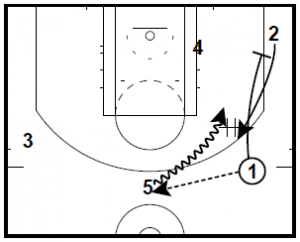
Pin DHO Weak Post

1 passes to 4 then screens down for 2.

4 gives 2 a dHO as 1 cuts to the opposite side off of 3.


If 5 gets it, 2 cuts over to screen for 1.

If 1 back cuts, 2 loops back for a hand off from 5.


  • « Go to Previous Page
  • Page 1
  • Interim pages omitted …
  • Page 102
  • Page 103
  • Page 104
  • Page 105
  • Page 106
  • Interim pages omitted …
  • Page 288
  • Go to Next Page »

Primary Sidebar

  • Twitter
  • Facebook
  • Linkedin
coachestoolbox
personaldevelopmenttoolbox
basketballplayerstoolbox
basketballtrainer
athleticperformancetoolbox
coachingbasketball

© Copyright 2026 Coaching Toolbox

Privacy Policy