• Skip to primary navigation
  • Skip to main content
  • Skip to primary sidebar

  • Basketball Plays
    • Ball Screen Sets
    • Horns Sets
    • Man to Man Post Up
    • Man to Man Isolations
    • Backdoor Plays
    • Man to Man 3 Point Shot Plays
    • 2-3 Zone Attack
    • Baseline Inbound Plays
    • Sideline Inbound Plays
    • Combination Defense Attack
  • Drills
    • Defensive Drills
    • Offensive Drills
    • Competitive Drills
    • Passing Drills
    • Rebounding Drills
    • Shooting and Scoring Drills
    • Toughness Drills
    • Transition & Conversion Drills
    • One on One Drills
  • Blueprint
  • Practice
  • Mental Toughness
  • Skill Development
  • Offense
  • Defense
  • Store

Filing Cabinet

Basketball Coaching Great vs. Destructive Teams

By Brian Williams on March 14, 2013

This article came from the University of Washington Women’s Newsletter.

If you would like to subscribe, email me and I will forward your interest on to their staff.

Great Teams

“Prepare for every game like you just lost your last game.” – Lon Kruger

There is a difference between readiness and preparation; readiness doesn’t get it done. You must prepare – Marine boot camp philosophy

“Treat people nice, even when they don’t deserve it.”

Have Positive Captains


– Work hard
– Take care of things on the floor
– Let the coaches take care of everything else

Have Great Team Attitudes

– Listen to each other
– Are courteous
– Say what they feel, but watch how they say it.
– Don’t talk behind each others back
– Don’t put each other down

Have players and coaches who accept and appreciate their roles on the team.

Work on skill development.

Share ownership in both victory and defeat.

We before Me Attitude

– Trustworthy
– Disciplined
– Unselfish
– Help teammates up
– Know roles

Push each other in practice to better prepare each other for the next game.

Self Destructive Teams

Your Four Toughest Opponents

– Negative attitudes in your program
– Injuries
– Illness
– Ineligibility

“What is your attitude?”

“What do others perceive as your attitude?”

Have loss the love of the game.

Are not willing to practice everyday, especially when times are tough.

Lose track of their short term and long term goals. – What are the team’s goals?

Are more concerned with individual goals than the team goals.

– Who is starting the game?
– Whose name is in the paper?
– Who gets more playing time?

Lack leaders who will lead by example.
– “Can talk the talk but WON’T walk the walk”

Criticize teammates ”Run each other down rather than lift each other up”

Are not coachable

When you are not getting better each day, you are telling your teammates that you don’t care OUR team.
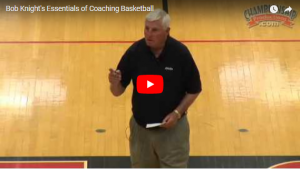
Basketball Coaching Bob Knight

By Brian Williams on March 13, 2013

I recently read the book, “The Power of Negative Thinking” by Bob Knight. I have listed some of my takeaways from it on this post. If you are interested in finding out more about the book or reading a sample, you can do so on the Amazon web site by clicking on the book cover below.

  • Coach Knight states that “I’m not arguing for being a strict negativist, for always seeing the dark side, always expecting failure. That is not the intent of the book. Being alert to the possible negative in any situation is the very best way to bring about positive results.
  • Paying attention to the potential downside is a difficult but essential quality for achieving long-term success
  • Ignoring or failing to spot potential hazards in advance makes failure all the more likely.
  • Planning beats repairing.
  • Good planning avoids the need for fixing up a project that plowed ahead without thought about potential pitfalls.
  • We need to at least consider how our next move could produce an unexpected chain reaction down the line.
  • Most basketball games are not won, they are lost.
  • When preparing for a game look at ways you can lose. Most have nothing to do with the opponent, but what needs to be correced about our own execution to keep from beating ourselves.
  • Ask each season in each game: “What vulnerabilities do we have?” “What can we do to minimize them, get around them, or to survive them?”:
  • Ask yourself ” How do you eliminate the wasted energy, and unnecessary mistakes to build a cohesive and a successful team that can play within its strengths?”
  • Victory favors the team making the fewest mistakes.
  • Mistakes he sought to eliminate were poor ballhandling, bad shots, slow recovery from offense to defense, bad fouls and poor foul shooting, for blocking out, uncoordinated defense.
  • If you play with passion you are more likely to play with precision.
  • The difference is not that the winner wanted it more than loser did.
  • Discipline is recognizing what has to be done, doing it as well as you can do it, and doing it that way all the time.
  • The power of negative thinking comes into play by recognizing, addressing, and removing the obstacles to winning.
  • Have a plan to recover after a loss, to learn from a loss, to eliminate those things that caused the loss.
    • Bad calls injuries or unusual occurrences are not the reason for losses mistakes are.
    • The mark of success or failure in handling victory is what happens the next timeout
    • Don’t let the upcoming game take away what you earned the last game.
    • The greatest victory is eliminated by lack of follow-up.
    • Success is a grind, its perseverance, it is operating at a high level of performance on a constant basis.
    • You cannot be distracted by last night . The first job that we have today is putting yesterday aside to be remembered later. Tony LaRussa
    • Eliminating ideas that are no longer relevant is essential to growth and achievement
    • Part of the art in coaching is changing the game plan when necessary.
    • Leadership is getting people out of their comfort zone.
    • Asking questions is the essence of learning
    • There isn’t always a right way and wrong way that there’s usually a higher percentage way.
    • Players need to recognize what they can do in games and good as they can at it. Recognize what they don’t do well now, but that they can do well with work. And finally recognize what they cannot do now or and will never be able to do.
    • Coaches Need to think about why they won in a similar way that they think about why they lost.
    • The guy who knows all going into a game usually forgets it all in the face of the crisis.
    • Pardon one offense and you encourage the commission of many.

    Click the play arrow and make sure your sound is on to watch the video. If you are interested in learning more about the basketball coaching DVD that this sample came from, click this link: The Essentials of Coaching Basketball

Basketball Coaching Fueling Performance

By Brian Williams on March 5, 2013

By Alan Stein, Stronger Team Blog (re-posted with permission)

Last week I had an unparalleled opportunity to spend 48 hours in Houston, Texas as a member of an exclusive Gatorade Sports Science Institute Basketball Task Force. It was an honor to take part and a thrill to meet and learn from some of the brightest minds on the planet regarding nutrition, hydration and performance enhancement.

I wanted to share some of the highlights of what I learned from the speakers:

If you want to gain muscular size and/or muscular strength, you must consume adequate protein after your workouts.

Your body can only use approximately 20 grams of quality protein in one meal, so taking in less is inadequate and taking in more is unnecessary for muscle growth.

You should aim to take in 20 grams of quality protein every 4-5 hours for the 24 hours following your workout (with the first 30 minutes after you workout being the most important).

Chocolate milk or an appropriate recovery shake are perfect for post workouts.

Age appropriate strength training is extremely beneficial for youth and adolescents because the body’s connective tissue finishes developing by age 17 (NOTE: not muscle development, connective tissue development).

As bodyweight increases (primarily in the form of body fat), the occurrence of injury increases.
Proper nutrition isn’t just about fueling your body. It is also about fueling your mind. Can you make correct game speed decisions when you are fatigued? You can’t play if you can’t think.

Nutritional success depends on your ability to plan ahead and prepare.

“A proper diet can’t make an average player elite. But a poor diet can make an elite player average.”

Recommend daily protein requirements for elite level athletes: 1.3-1.8 grams of protein per KG of bodyweight

Dehydration impairs cognition and mental readiness.

As little at 2% dehydration will (negatively) affect performance.

How do you know if you are dehydrated?

o You are thirsty

o Your urine is dark yellow

o You see a slight drop in normal body weight

Main causes of cramping:

o Fatigue

o Electrolyte deficiency

o Dehydration

The most underrated recovery technique to aid in max performance is sleep!

Teenagers need 9-10 hours of quality sleep (very few every get that).

Checklist for quality sleep:

o You fall asleep within 30 minutes

o You sleep through the night with minimal interruptions

o You feel refreshed upon waking up

How to get quality sleep:

o Keep your room cool, dark, and quiet

o Remove all electronics (computers, phones, TV’s, etc.)

o Have a consistent routine (certain bed time, etc.)

Naps are an excellent way to aid in rest and recovery:

o Do NOT nap within 2 hours of a game (you will feel groggy)

o Do NOT nap after 4pm (it will throw off that night’s sleep)

o Do NOT nap longer than 30-45 minutes

I hope you found these nuggets as helpful as I did. Just following the basics when it comes to proper nutrition, hydration and rest & recovery can play a huge role in your performance on the court.

Train hard. Fuel smart.

Alan Stein

http://www.About.me/AlanStein

They’re Called Coach

By Brian Williams on February 27, 2013

This is old enough that it is written in the masculine gender. Certainly, it applies to both men and women who coach…

This was written by Bill Libby as a preface to his book about coaches. Thanks to Coach Mike Smith for that information!

He’s called a coach and it’s a different job. There is no clear way to succeed. One cannot copy another who’s a winner, for there seems to be some subtle secret chemistry of personality that enables a person to lead successfully and no one really knows what it is. Those who have succeeded and those who have failed represent all kinds.

They are young, old, experienced, they are soft, tough, good natured, foul tempered, proud and profane. They are articulate and even inarticulate. Some are dedicated and some casual. Some are even more dedicated than others. Intelligence is not enough, and dedication is not enough.

They all want to win, but some want to win more than others and just wanting to win is not enough. Losers almost always get fired, but winners get fired also. He is out in the open being judged publicly for six or seven months out of the year by those who may or may not be qualified to judge him. Every victory and every defeat is recorded constantly in print. The coach, this strange breed has no place to hide. He cannot just let the job go for a while or do a bad job and hope no one will notice as most of us can. He cannot satisfy everyone, seldom can he even satisfy very many, and rarely does he even satisfy himself. If he wins once, he must win the next time also.

They plot victories-, they suffer defeats; they endure criticism from within and without; they neglect their families, they travel endlessly and they live alone in the spotlight surrounded by others. Theirs may be the worst profession in the world. It’s unreasonably demanding, poor pay, insecure, full of unrelenting pressures and I ask myself: Why do coaches put up with it? Why do they do it? I’ve seen them fired with pat phrases such as, “Fool”, “Incompetent”, or “He couldn’t get the job done”.

I’ve wondered about that, having seen them exalted by victory, and depressed by defeat. I’ve sympathized with them having seen some broken by the job and others die from it. One is moved to admire them and to hope that someday the world will understand them; this strange breed they call coach.


You can read more from this book by clicking the cover above and to the left and then arriving at Amazon.com then click on the cover where it says “Look Inside.” Or you can click the link below.

The Coaches

Winning is Giving

By Brian Williams on February 22, 2013

From our basketball poems file… We have more basketball poems, prose, basketball quotes, and inspirational articles in our FILING CABINET.

Winning is giving your best self away
Winning is serving with grace every day
You’ll know that you’ve won when your friends say it’s true.
“I like who I am when I’m around you.
You look for the best in the others you see
And you help us become who we’re trying to be.”

Winning is helping someone who’s down
It’s sharing a smile instead of a frown.

It’s giving your children a hug by the fire
And sharing the values and dreams that inspire.

It’s giving your parents the message “I care.
Thanks, Mom and Dad, for being so fair.”

Winners are willing to give more than get
Their favors are free, you’re never in debt.

Winning is giving one hundred percent
It’s paying your dues, your taxes, your rent
It’s trying and doing, not crying and stewing.

Winners respect every color and creed,
They share and they care for everyone’s need.

The losers keep betting that winning is getting
But there’s one law that they keep forgetting
And this is the Law you can live and believe
The more that you give, the more you’ll receive!

Pressure

By Brian Williams on February 14, 2013

By Deron Sorrell

Pressure is not easily defined. Pressure takes many forms. It can be both created by circumstance or self–imposed. Pressure is not discriminatory, but often affects people differently.

Pressure is equally a deadly enemy and a best friend. Pressure is impossible to avoid while pursuing excellence.

An awareness with regard to pressure is essential in order to achieve championships. What does pressure mean to you?

Pressure could be a parent who wants you to score more points or take more shots. Pressure can be your own desire to earn more playing time. Pressure can be attempting a free throw in the closing seconds of a tight game. Pressure can be shooting your only shot of a season with a twenty point lead. Pressure can be never taking a shot. Pressure can be attempting to dribble while being guarded by somebody seemingly quicker than you. Pressure can be an inability to utilize your off hand. Pressure can be missing your first four shots. Pressure can be losing more games than you win.

Pressure can be a packed gym. Pressure can be an empty gym. Pressure can be meeting your own expectations. Pressure can be effectively surpassing the expectations of others. Pressure can be bad officiating. Pressure can be expecting to win. Pressure can be fearing defeat. Pressure can be a winning streak. Pressure can be a losing streak. Pressure can be anywhere at any time. Pressure can be everywhere at once.

Successful people do not learn to overcome pressure, but rather to utilize it. The only way to avoid pressure is to willingly sacrifice our desire to succeed. For example, a student who has no care or concern with regard to graduation would effectively avoid feeling any pressure upon taking an exam. Avoiding pressure does not generate success, but rather effectively guarantees failure. How can we utilize pressure?

The keys to performing within a pressure packed environment are preparation and toughness. Preparation involves developing both necessary skills and a thorough understanding as to what is expected. Toughness means being ready, willing, and able to muster a complete effort without being aware in advance of an outcome.

Toughness is putting forth our very best and accepting whatever the consequences. While pressure is capable of defeating most preparation and toughness, there are a very few exceptions. These exceptions are often referred to as champions. Are you prepared and tough enough, or has pressure conquered you?

  • « Go to Previous Page
  • Page 1
  • Interim pages omitted …
  • Page 15
  • Page 16
  • Page 17
  • Page 18
  • Page 19
  • Interim pages omitted …
  • Page 25
  • Go to Next Page »

Primary Sidebar

  • Twitter
  • Facebook
  • Linkedin
coachestoolbox
personaldevelopmenttoolbox
basketballplayerstoolbox
basketballtrainer
athleticperformancetoolbox
coachingbasketball

© Copyright 2026 Coaching Toolbox

Privacy Policy