• Skip to primary navigation
  • Skip to main content
  • Skip to primary sidebar

  • Basketball Plays
    • Ball Screen Sets
    • Horns Sets
    • Man to Man Post Up
    • Man to Man Isolations
    • Backdoor Plays
    • Man to Man 3 Point Shot Plays
    • 2-3 Zone Attack
    • Baseline Inbound Plays
    • Sideline Inbound Plays
    • Combination Defense Attack
  • Drills
    • Defensive Drills
    • Offensive Drills
    • Competitive Drills
    • Passing Drills
    • Rebounding Drills
    • Shooting and Scoring Drills
    • Toughness Drills
    • Transition & Conversion Drills
    • One on One Drills
  • Blueprint
  • Practice
  • Mental Toughness
  • Skill Development
  • Offense
  • Defense
  • Store

Conditioning

Defensive Agility drills for the Pre-Season

By Brian Williams on October 7, 2018

By Jon Sanderson MS,CSCS,MSCC,USAW1,TPI,NASM-CES

Head Strength & Conditioning Coach-Michigan Basketball

Below are 3 really effective agility drills that emphasize Defensive movements.

When doing these drills emphasize with your athletes to stay low in defensive stance and to explode from cone to cone.

I would recommend doing these drills prior to any traditional conditioning drills (i.e. lane drills, 17’s, conditioning ladders etc.)

Diagrams created with FastDraw
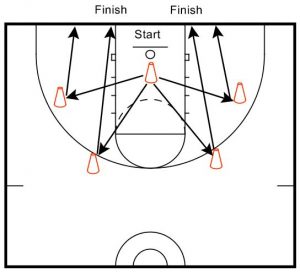

Defensive Close out Drill
– Start in the middle of the lane and closeout to cone #1 and slide to baseline.

Reset in the middle of the lane and proceed to Cones #2-4.
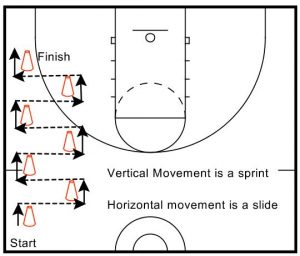


Cone Defensive Slides
– Start by sliding to the first cone, advance forward then slide to the next cone.

Repeat until the course is finished.
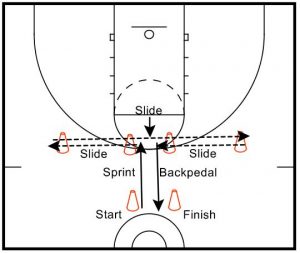


T-Drill w/ Defensive Slide– Start with a sprint to the middle cones, defensive slide to one of the outer cones, then slide to the opposite outer cone, and then back to the middle. 

Finish with a backpedal to the finish cone.


If interested in the Camp Sanderson S&C program powered by Blueprint Athletes App

Apple Phones   https://apple.co/2FYcJ00

Android Phones   https://play.google.com/store/apps/details?id=com.blueprintathletes.android

Jon Sanderson has been the head strength and conditioning coach for the University of Michigan men’s basketball team since 2009.

Regarded as one of the basketball strength and conditioning coaches in the business, Sanderson is the only strength and conditioning coach in NCAA history to participate in a Final Four as a player (Ohio State in 1999) and a coach (Michigan in 2013 & 2018).

Before joining the Michigan staff, Sanderson spent three years (2006-09) working at Clemson as the men’s and women’s basketball strength and conditioning coach, as well as the director of the Littlejohn Coliseum weight room. During Sanderson’s time at Clemson, the men’s basketball team won 20 or more games for three straight seasons — a first in program history. Also, during those three seasons, only North Carolina and Duke had more wins than Clemson in the ACC.

Prior to his time at Clemson, he served as the head strength and conditioning coach and sports nutrition coordinator for Olympic sports at Marshall University (2003-06). Before heading to Marshall, Sanderson was a strength and conditioning intern at North Carolina, working with the men’s basketball program (2002-03).

Throughout Sanderson’s career with the U-M basketball program, he has trained 11 student-athletes that have gone on to play professional basketball in the NBA, including MDarius Morris, Manny Harris, Tim Hardaway, Jr., Trey Burke, Nik Stauskas, Mitch McGary, Glenn Robinson III, Caris LeVert, D.J. Wilson, Derrick Walton, Jr. and Moritz Wagner.
Competitive Agility drills for the Pre-Season

By Brian Williams on October 6, 2018

By Jon Sanderson MS,CSCS,MSCC,USAW1,TPI,NASM-CES

Head Strength & Conditioning Coach

Michigan Basketball

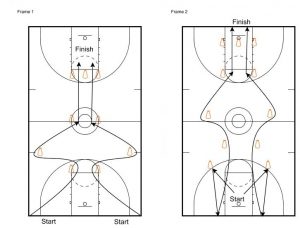
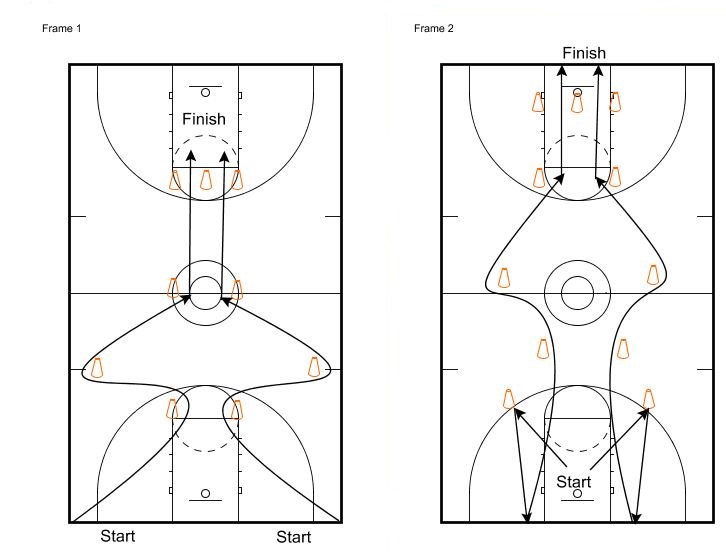
Below are 4 of my favorite agility drills that emphasize a competitive environment.

The first thing I do is pair up my athletes by size/speed.

For example, I want my point guards competing against each other or my bigs going against each other.

The paired athletes will line up opposite each other and essentially race each other to the finish line.

The race begins on the coaches command.  (Note that agility drill 2 and 4 begin with a close-out drill).

Diagrams created with FastDraw


If interested in the Camp Sanderson S&C program powered by Blueprint Athletes App

Apple Phones   https://apple.co/2FYcJ00

Android Phones   https://play.google.com/store/apps/details?id=com.blueprintathletes.android

Jon Sanderson has been the head strength and conditioning coach for the University of Michigan men’s basketball team since 2009.

Regarded as one of the basketball strength and conditioning coaches in the business, Sanderson is the only strength and conditioning coach in NCAA history to participate in a Final Four as a player (Ohio State in 1999) and a coach (Michigan in 2013 & 2018).

Before joining the Michigan staff, Sanderson spent three years (2006-09) working at Clemson as the men’s and women’s basketball strength and conditioning coach, as well as the director of the Littlejohn Coliseum weight room. During Sanderson’s time at Clemson, the men’s basketball team won 20 or more games for three straight seasons — a first in program history. Also, during those three seasons, only North Carolina and Duke had more wins than Clemson in the ACC.

Prior to his time at Clemson, he served as the head strength and conditioning coach and sports nutrition coordinator for Olympic sports at Marshall University (2003-06). Before heading to Marshall, Sanderson was a strength and conditioning intern at North Carolina, working with the men’s basketball program (2002-03).

Throughout Sanderson’s career with the U-M basketball program, he has trained 11 student-athletes that have gone on to play professional basketball in the NBA, including MDarius Morris, Manny Harris, Tim Hardaway, Jr., Trey Burke, Nik Stauskas, Mitch McGary, Glenn Robinson III, Caris LeVert, D.J. Wilson, Derrick Walton, Jr. and Moritz Wagner.
Pre-Season Strength and Conditioning Drills

By Brian Williams on July 28, 2016

These skill development drills are from Scott Peterman’s Skills Development Notes Collection.

The main purpose of sharing these drills is to get you thinking about ways that you can modify the drills that you use.

These notes are from Alan Stein.

Structured warm-up

1. Skipping while tapping ball to belly button then to back
2. Same as above but with ball side to side over shoulders; running forward then backwards
3. Same as above but now twisting with the ball side to side as they run forward then backwards
4. Shuffle steps with ball to belly then to back
5. Same as above with ball side to side over shoulders; change direction they face at half court
6. Same as above but now twisting with the ball side to side with shuffle steps; change direction they face at half court

Box Drill

1. 1 leg hoping over line to elbow
2. Shuffle
3. Back peddle with hands high
4. Quick feet over baseline up and back over line.

*Don’t ever walk by a teammate without showing love.

Dynamic Flex

1. Knee to chest then rotate leg out
2. Foot to butt opposite hand straight in the air
3. Touch floor opposite leg up behind you
4. Groin stretches

*There are only 2 Choices

1. Work Hard
2. Don’t Work Hard
There is no middle ground

Tennis Ball Warm-Up

1. Roll ball out, run 3 circles around it before it stops rolling pick up ball and run back.

2. Toss 1 ball out once players gets it he needs to find the other ball that was tossed behind him.

3. 2 ball drop; teaching reaction time. Catch before second bounce. Must catch three then switch.

4. 2 ball drop with back turned. Players turns on vocal cue, “ball”. Don’t make it easy; make it tough so that your teammates get better. Challenge each other.

5. 2 ball dance; tossing balls while moving all over the court. Players catch them then return them to teammate. Must catch on 1 bounce then can advance to no bounce. Do for 1 minute.

6. 2 ball drop with hands on top of teammates. Player drops ball and teammate must catch before it hits floor.

7. 1 ball drop with hands on ears or behind back. Teammate call out what hand to use.

Slider Disks/Plates (Can use simple wax paper plates instead of spending big $ on expensive Sliders)

Slider Disks/Plates (Can use simple wax paper plates instead of spending big $ on expensive Sliders)

1. Standing slide-lunges
*Note: Always hold the ball like a player except on picture day
2. Push up position; circle plate around outside of body.
3. Same as #2 except bring knee to chest then opposite across
body and back to start.
4. On back one leg in the air, butt off the ground and slide (on plate)
other leg under butt.

*Note: Push step vs. step slide
Stated that physiologically the push step puts less strain on the groin area and is easier and quicker.
Something to think about. How much do we actually step-slide on defense? I think maybe it looks good when you have a great defensive guard working the point guard all the way down the floor.

Core Series:

Capture2

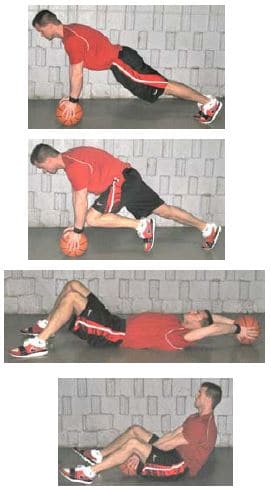
1. Ball plank for 1 minute then bring knee to chest.
2. Wood Choppers: on your butt slam ball into floor between legs and above your head for 1 minute.
*Be comfortable being uncomfortable, that’s how you improve.
3. Lateral bounds: push off back foot and land in a 1-2 stop.


Finishers

Corner Series:

Capture

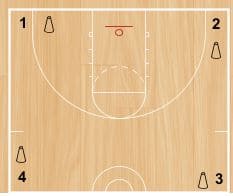
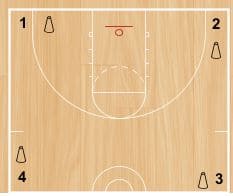
1. 4 players line up in each corner behind the cones set up.
2. Sprint to first cone then back pedal back to start
3. Same to second cone and back
4. Then sprint to next corner.
5. Done when everyone is back at their starting sport.
6. Can mix up what they do around cones or on sprint to next corner (shuffles, back pedals, sprints, etc.)

Competitive Shuffle

1. 4 players line up outside the free-throw lane.
2. They will make about 2 ½ slides to the other side of the lane
3. Then 1 good cross over run back to starting point
4. They should go 5 times up and back
5. The winner is out and you go again
6. Make it competitive and the intensity goes through the roof

4 Corner Circle

1. 4 players line up at the “4 corners” of the jump circle at mid-court
2. Coach calls out “1”, “2”, or “3”
a. 1 is sprint to your corner and back
b. 2 is sprint to slap the backboard and back
c. 3 is shuffle to sideline and back
3. Players on the sideline should echo calls
4. Coach can mix up calls such as “1,3,2,11,3,2”

Clean the Lane

1. 5 tennis balls in the key with 1 player
2. Players are lined up around the key
3. The player in the key’s job is to get all of the tennis balls out of the key (can’t throw the balls all over the
gym)
4. The players outside the key are constantly recovering balls and rolling them back into the key.
5. If the player in the center cleans the lanes then the guys outside have some consequence.
6. If the player doesn’t clean lane then guy in center has 10 pushups; or whatever.

This week’s eBook bundle contains 3 eBooks:

2011 NCAA Tournament Coaches – Basketball Skill Development
2012 USA Olympic Team Basketball Drills
130 Ways to Improve Your Program’s Attention to Detail

You can find out more information about the bundle at this link:

Skill Development Bundle

  • « Go to Previous Page
  • Page 1
  • Page 2

Primary Sidebar

  • Twitter
  • Facebook
  • Linkedin
coachestoolbox
personaldevelopmenttoolbox
basketballplayerstoolbox
basketballtrainer
athleticperformancetoolbox
coachingbasketball

© Copyright 2026 Coaching Toolbox

Privacy Policy