• Skip to primary navigation
  • Skip to main content
  • Skip to primary sidebar

  • Basketball Plays
    • Ball Screen Sets
    • Horns Sets
    • Man to Man Post Up
    • Man to Man Isolations
    • Backdoor Plays
    • Man to Man 3 Point Shot Plays
    • 2-3 Zone Attack
    • Baseline Inbound Plays
    • Sideline Inbound Plays
    • Combination Defense Attack
  • Drills
    • Defensive Drills
    • Offensive Drills
    • Competitive Drills
    • Passing Drills
    • Rebounding Drills
    • Shooting and Scoring Drills
    • Toughness Drills
    • Transition & Conversion Drills
    • One on One Drills
  • Blueprint
  • Practice
  • Mental Toughness
  • Skill Development
  • Offense
  • Defense
  • Store

Basketball Drills

Green Light Shooting License

By Brian Williams on August 14, 2019

This article was written by Dallas Wings Assistant Coach Mike Neighbors.

Coach has his monthly newsletter up and running again. If you would like me to forward your email address on to be added to his list, just let me know.

Do you know what the above items have in common with the Green Light Shooting License? Play-doh? Coca Cola? Ice Cream Cone? Potato Chips? Slinky? Dynamite?

Don’t be a millennial and Google it… Guess?

They were all discovered by accident. Now, you can look up each of them and learn when and how and why. But I want to share how Green Light Shooting was accidentally discovered.

I was a first year coach. We had on campus a prolific scorer who was on pace, and would in two seasons break our school’s All-Time scoring record. She was a junior. A team captain. A true leader. Everything a rookie coach would want.

We had also just signed the best recruit in the history of our program. She was a freshman. Was going to be a captain as a freshman. Was going to become a leader. And would graduate in four years the All-Time Leading scorer in the history of NCAA Division I Basketball.

We also had a roster full of players who were Shooters, not necessarily Makers, but players who had been recruited to fill that role.

See my dilemma?

We needed a system to help us determine Shot Distribution.

The old English proverb “Necessity is the mother of all invention” illustrated.

The birth of the Green Light Shooting License.

To earn the Green Light in practice each of our players were given the opportunity to come to the gym, with coaches, and attempt to earn their License.

Each Monday we placed three shooting drills with qualifying times/scores on each. If the shooter completed all three they earned the Green Light. If they completed 2, they earned the Yellow Light. If they completed none, they were on a Red Light. Green light meant they could shoot any shot, any time in practice that they felt they could make. Yellow Light meant they could take open shots in regards to time/score. Red Light meant they should take shots they were fully confident in making a very high percentage of the time.

The license was good for one week. Players must re-earn their license each week.

Week 1 we had 6 players attempt to earn their Green Light. 2 earned the Green, 2 earned the Yellow, and 2 were Red.
Week 2 we had 5 players attempt. Same 2 were green, 2 yellow but different than week 1.
Week 3 we had 4 players attempt. Same 2 green, 1 yellow, and 1 red.
Week 4 only the 2 Green Lights even attempted.

Green Light Shooting License

Our plan was beginning to take shape.

Players were “surrendering” to the team. When a player would stop coming to even try, that opened the door for a very easy conversation. We would ask them why they stopped coming to try. Their usual answer was that they couldn’t reach the standards of times/scores on the drills.

At first I was worried this might be a bad thing. But it wasn’t. It was a great thing. These players wanted to know “other things they could do” to earn playing time and help the team win.

When we started to have this crucial conversation with multiple players, we also introduced lineup efficiency to our team to reward things other than scoring. This was a simple chart that kept track of each lineup and what the score was when that lineup was on the floor together. Now, who scored was of less importance.

Although it would take some months for us to conclude this, we were also seeing our two best shooters gaining even more confidence because there wasn’t talk of them being ball hogs/shot searchers/etc. They could survive in the locker room and, in fact, thrive.

As our Green Light Shooters began earning the respect of their teammates they also began pushing each other during the drills.

It forced us as coaches to constantly be creative in our drill design to keep things fresh for them.

With four seasons of evidence at Washington, we were convinced the implementation of this system had the most impact on our program winning 98 games in four years, playing in 3 NCAA Tournaments, 2 Sweet 16s, 1 Final Four, while producing three of the programs Top 5 scorers of All-Time.

As a result, we have continued and modified some things with our transition to Arkansas. We might not have enough evidence to draw conclusions yet, but we do see many of the same signs and the same “unintended consequences” beginning to take shape.

Since implementing this system, we as coaches, have felt well equipped to have discussions with players, parents of players, and family on the topic of shot distribution on our teams. While we aren’t there yet at U of A, at Washington those conversations had virtually ceased.

We had one instance in which a parent asked for the meeting but once the player explained the system, the meeting never happened.

As we said earlier, 75% of this all happened by accident. The “unintended results” have been the magic though.

Our teams have tended to have:

1) Very identifiable roles for scorers
2) Team cohesion in the locker room and on the court
3) Tolerance and appreciation of other valued roles
4) Competition and desire to improve among the elite scorers
5) Produced teams who have peaked late in the season
6) … and is FUN!!!

Not here to tell you that it’s all rainbows, unicorns, and roses every day. It’s not. But what is in the game of basketball these days!!

Next want to delve into how and why we chart the drills. We keep record of every shot with our players. We post them for everyone to see as well. Even in today’s world of ever evolving technology, there is still something significant about seeing your name ranked among your peers.

We have made a board for each of our Green Light Drills. On the front of the board we have the Top 10 Scores/Times for our current teams. On the back of that same board, we have posted the Top 10 Scores/Times for any team that we have ever utilized the drills with.

Coach Neighbors has produced a Championship Productions Video (available as a DVD or an Instant Download).  You can find out more about it at this link:  Green Light Shooting: Determining Shot Selection and Shot Distribution

The Shooting Drills

You can use any drill you want to design to fit your system and your style of play. These are the ones that we have developed over the years. Some are 20 years old, with 20 years of times/scores. Some are newer. All are constantly being tweaked. Please let us know if you have good ones that we might could use as well.

It’s very important that all drills be simulated under the exact same conditions for each player. If you have two balls for one player, one morning, it’s very important you don’t allow another player to have three in a timed drill. Do your very best to simulate exact conditions. This will eliminate the appearance of bias.

We want our drills to vary skills and vary game situations. Some drills simulate Game Shots at Game Spots at Game Speed. Some may simply choose to emphasize Game Shot from Game Spot.

Vary your plan to fit your style of coaching, your style of player, and your current players.

Set the time/scores so that they will be a challenge to the very best scorer on your team. Even if that player is consistently #1 on your team, they will be motivated by the All-Time highs of past players.

One season we competed against another University in our drills. We would do weekly challenges and found great value in doing this.

Just like in most every other aspect of our great sport, the secret sauce is NOT in the WHAT you are doing… but the HOW and with WHO!!! You must make this your own. Borrow and steal some ideas to help you get started, but simply trying to copy it will not yield the desired effects!

  1. Click here to see the Sue Bird Shooting Dril on The Coaching Toolbox.
  2. Click here to download the PDF of Coach Neighbors article and see his AND 1 Shooting Drill (scroll down to page 10 of the PDF)
  3. Click here to download the PDF of Coach Neighbors article and see his Beat the Pro Shooting Drill (scroll down to page 11 of the PDF)
  4. Click here to see Coach Neighbors’ Shooting Star Shooting Drill on The Coaching Toolbox.
  5. Click here to see Coach Neighbors’ 3-6-9-12-15 Shooting Drill on The Coaching Toolbox

Coach Neighbors has produced a Championship Productions Video (available as a DVD or an Instant Download).  You can find out more about it at this link:  Green Light Shooting: Determining Shot Selection and Shot Distribution

Fake Snake Pick and Roll Drill

By Brian Williams on July 22, 2019

This drill and concepts are provided by our partners at Dr. Dish Basketball.

This drill was originally published on their blog at this link: Fake Snake Pick and Roll Drill

Like all drills that you see, you can either modify it or take parts of the drill for your use and your needs.

Please make sure your sound is on to see the video.

Click the play arrow to see the drill.

These drills are YouTube videos, so you will need to be on a server that allows you to access YouTube to see the drill.

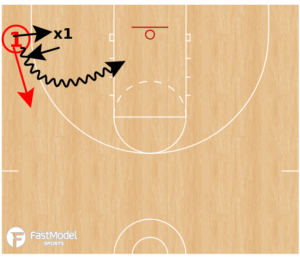
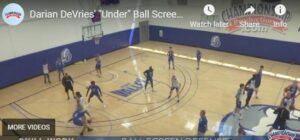
Here DJ is simulating the on ball defender going over the top of the ball screen while the screener’s defender showing a soft hedge. Typically to get to the open space in this situation is to “snake” the screen by crossing over. However, in this situation, DJ shows an in and out move to “fake snake” the screen and get to open space towards the wing area.

Practicing proper footwork is essential in this drill to cover maximum space and create an open shot. Make sure to practice this going both right and left.

Bob Hurley Sr. One More Passing Drill

By Brian Williams on July 10, 2019

This drill with legendary high school Coach Bob Hurley starts out as a drill to emphasize passing and then becomes a closeout and 3 on 3 defensive drill.

The video of this rebounding drill is hosted on You Tube.

You will need to be on a network that allows you to access You Tube.

Click the play arrow to view the video.

There is narration with the video, so please make sure that your sound is on.

You can make adjustments to the drill to fit your needs, the types of actions that you defend, and your defensive philosophy.

You can find out more about the Championship Productions video that this clip is from at this link:
(Bob Hurley Sr.) My All Time Favorite Practice Drills

3 on 2 Drive Kick Clear Concepts

By Brian Williams on June 22, 2019

This drill and concepts are provided by our partners at Dr. Dish Basketball.

Like all drills that you see, you can either modify it or take parts of the drill for your use and your needs.

Please make sure your sound is on to see the video.

Click the play arrow so see the drill.

These drills are YouTube videos, so you will need to be on a server that allows you to access You Tube to see the drill.

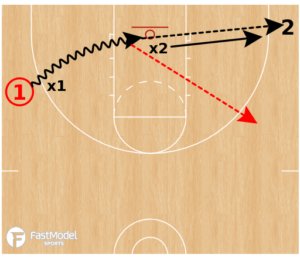
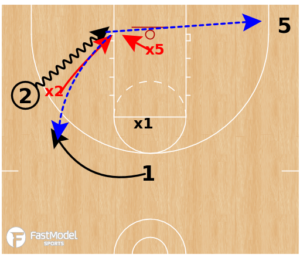
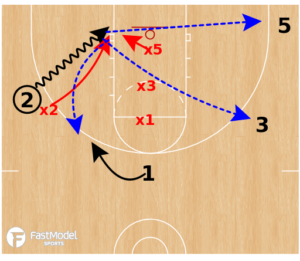
This is a great team drill progression that simulates a game-like situation and makes players make decisions.

Pass Tempo: 4-5
Pass Distance 4
Goal: Can be made, taken, time, etc. A good start is 20 makes and then reversing to the other side of the floor.
Dish Pass Locations: Slot and corner OR Slot and Wing (depending on the drill)

Click on the video to start it.

Toughness Togetherness & Transition Defense Drill

By Brian Williams on June 16, 2019

This post is with Mike Neighbors, Arkansas Women’s Basketball Coach.

This video and other basketball coaching videos are available on the Arkansas Women’s Basketball You Tube Channel

Mike also has one of the top newsletters for Basketball Coaches and is back sending again as of June 2019. If you are interested in joining his list, email me and I will forward your request on to him.

Like all drills that you see other programs use, you can either modify it or take parts of these ideas for your use and your needs. I hope to provide food for thought for you to use as a place to start for ideas to improve your program.

Please make sure your sound is on to see the video.

Click the play arrow to see the drill.

The drill is a YouTube video, so you will need to be on a server that allows you to access YouTube to see the drill.

Small Area Passing Drill

By Brian Williams on June 15, 2019

This drill can be used as a toughener and close quarters passing drill.

You could modify the rules to allow less physicality and or reduce it from 4 on 4 to 3 on 3. You could also change the number of passes required to win the drill.

I realize that this is not realistic spacing and probably not a good way to rehearse your offense, but there certainly is value in toughness with the basketball and getting open.

Another option would be to make the space bigger.

These videos of are hosted on YouTube, so you will not be able to access it unless you are on a server that allows YouTube access.

Click the play arrow to view the videos.

There is narration with the video, so please make sure that your sound is on.

Small Area Passing Drill

You can find out more about the Championship Productions video that this clip is from at this link: Toughness Drills to Improve Your Team Physically and Mentally

  • « Go to Previous Page
  • Page 1
  • Interim pages omitted …
  • Page 19
  • Page 20
  • Page 21
  • Page 22
  • Page 23
  • Interim pages omitted …
  • Page 96
  • Go to Next Page »

Primary Sidebar

  • Twitter
  • Facebook
  • Linkedin
coachestoolbox
personaldevelopmenttoolbox
basketballplayerstoolbox
basketballtrainer
athleticperformancetoolbox
coachingbasketball

© Copyright 2026 Coaching Toolbox

Privacy Policy