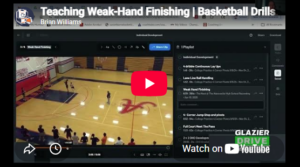
David Martinez, Head Boys Basketball Coach, Atascocita HS, TX
This video is a segment from one of the 120 Videos in Glazier Drive Basketball.
Explore coaching clinic replays, practice plans, skill development videos, and more. Click here to see all that’s included.
The full video that this clip came from is available on Glazier Drive: Building a Modern Positionless Offense
DEVELOPING THE WEAK HAND
The segment focuses on helping coaches develop players who can finish effectively with their non-dominant hand. Purposeful weak-hand repetitions give players another option around the basket instead of allowing them to rely exclusively on their dominant hand. The objective is to make weak-hand finishing a comfortable and dependable part of a player’s offensive skill set.
TEACHING FINISHES FROM DIFFERENT ANGLES
Coaches can develop the weak hand by having players finish from different locations and angles around the basket. Varying the approach requires players to adjust their body position, footwork, and use of the backboard. This creates a more complete finishing workout than repeatedly practicing the same shot from the same location.
EMPHASIZING FOOTWORK AND BODY CONTROL
Weak-hand finishing should include attention to the footwork and body control that lead into the shot. Coaches can use repetitions to reinforce balance and coordination as players approach the basket. The goal is for players to become comfortable combining proper footwork with a controlled weak-hand finish.
USING REPETITION TO DEVELOP TOUCH
Players need consistent repetitions to develop feel and touch with their non-dominant hand. Coaches should emphasize control and quality of the finish rather than simply completing a prescribed number of repetitions. Repeated work around the rim helps weak-hand finishes become more natural and reliable.
DEVELOPING MORE VERSATILE FINISHERS
A player who can finish with either hand gives the offense more options around the basket. Developing the weak hand allows players to respond to the angle of the drive, the position of the defender, and the available space instead of forcing the ball back to their dominant hand. Coaches can use this type of finishing work to develop players who are less predictable and better equipped to score in different situations.