David Martinez, Head Boys Basketball Coach, Atascocita HS, TX
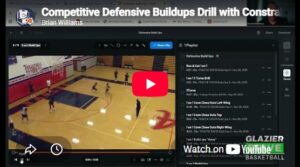
This video is a segment from one of the 120 Videos in Glazier Drive Basketball.
Explore coaching clinic replays, practice plans, skill development videos, and more. Click here to see all that’s included.
The full video that this clip came from is available on Glazier Drive: Man-to-Man Foundation: Shell Drills That Translate to Games
WHAT “BUILDUPS” ARE
This is a competitive practice drill where the team is split into two even squads (5 blue, 5 white). Both teams rotate through progressively larger scenarios—starting at 1-on-1 and building all the way up to 5-on-5—with each group getting two reps at every stage before flipping from offense to defense.
HOW SCORING WORKS
The drill uses a running scoreboard that carries through the entire session (it doesn’t reset between stages). Standard makes count as their normal point value (2s and 3s), but the coaching staff layers in bonus points to reinforce specific emphases:
- Straight-line drive layups: +2 for the offense
- Charges taken: +2 for the defense
- Offensive rebounds: +2 for the offense
- Defender leaving their feet on a shot contest: +1 for the offense
A manager tracks the score live, with coaches calling out point adjustments as they happen. Whichever team is behind at the end of all the rounds runs as a consequence.
PROGRESSION THROUGH THE STAGES
- 1-on-1: Works on reading the defender—either an L-cut to catch and attack, or a back-cut if the defender is out of position.
- 2-on-2: Focuses on closing out to a corner shooter (not a wing) to take away the middle drive—coaches feed the ball back and forth until calling “live.”
- 3-on-3: Introduces two on-ball defensive techniques—”keep” (staying attached to the matchup, giving a gap, fighting through screens) and “switch” (coming together, calling the switch, and switching with pressure).
- 4-on-4: Adds the wrinkle of keeping the big man low and maintaining that position throughout the possession.
COACHING PHILOSOPHY BEHIND IT
Rather than stopping play to correct mistakes, the coaches let reps continue and use the point system to penalize errors in real time (e.g., giving the opposing team points when a young player drives middle instead of closing out correctly). This keeps the drill live, competitive, and self-correcting, and the accountability of a visible score makes players buy in—nobody wants to be the team running at the end.