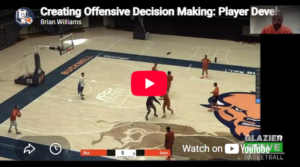
John Griffin III, Head Coach, Bucknell University
This video is a segment from one of the 120 Videos in Glazier Drive Basketball.
Explore coaching clinic replays, practice plans, skill development videos, and more. Click here to see all that’s included.
The full video that this clip came from is available on Glazier Drive: Creating Offensive Decision Making: Player Development Drills
SUMMARY: BASKETBALL PLAYER DEVELOPMENT DRILLS
This transcript shows a basketball coach demonstrating a series of small-group player development drills built around game-like decision making. Here are the key ideas.
CORE PHILOSOPHY
The coach builds short, targeted segments (8 to 12 minutes) around one skill or decision that happens in games. He repeats them daily, and he says the improvement is dramatic. Pivoting, for example, improves fast after five weeks of 12-minute reps. The goal is to build instinctive responses so players aren’t surprised when the game lights are on.
DRILL 1: CHIN IT, PIVOT, EXTEND
Players start as close to the basket as possible in a power dribble while coaches swipe at the ball. The player chins the ball, pivots, and extends to the rim. This simulates driving into “six feet, six hands” trying to take the ball while still having to score. The same cue is repeated every rep.
THE DRAW TWO
The program tracks a stat called a “draw two.” The player draws two defenders and makes the right decision, such as stepping through and kicking out to an open teammate in the corner. The player makes a specific call to alert the teammate. The coach likens it to a gold star on a football helmet. The drill builds four habits: pivot, protect the ball, avoid a difficult two-point shot, and draw two and make the right read.
3-ON-2 DEVELOPMENT SESSIONS
Three coaches work with two players, using blue cones to make the setup overly challenging on purpose. The coach emphasizes that these sessions should be harder than games.
- Reset dribble: The player drives, gets cut off, resets his feet instead of spinning, and goes the other direction.
- Coach decisions: Each coach then changes the situation. Sometimes nobody helps, so the dribbler must score. Sometimes a coach helps in, so the dribbler must read it and kick. Sometimes a coach denies the ball, so the receiver must step across, create separation, and swing it.
The player’s technique stays the same while the reads change, which trains decision making rather than memorized moves.
NO WASTED REPS
When multiple players are on the floor, every player gets a shot. A player who doesn’t start with the ball still gets a contested shot off the kickout. The coach says he learned this from the NBA, so nobody stands around.
PROCESS-DRIVEN SHOOTING
The coach only talks about holding the follow-through, whether the shot is made or missed. His reasoning is that no shooter is trying to miss, so the focus stays on controllable execution.
THREE-PLAYER VARIATIONS
With three offensive players, there are three shots per sequence. The coach changes the defensive action each time so players must adapt. One example is the coach stopping the ball at the nail, which forces the dribbler to look ahead. Another is the coach helping in, so the dribbler draws two and makes the right decision. A third is no help at all, so the player must finish through contact.
SCHEDULE AND TIME USE
His program runs 45-minute development sessions three times a week. In a regular one-hour practice, you can build an 8-minute segment around one decision your players face in games.
TAKEAWAYS FOR BASKETBALL COACHES
- Pick one game-relevant skill or decision and build a short daily segment around it.
- Use simple, repeatable cues like “chin it, pivot, extend.”
- Make drills harder than games by outnumbering players and adding obstacles.
- Use coaches as live defenders who change their actions to force reads.
- Track and celebrate good decisions (like the draw two), not just makes and misses.
- Give every player a shot so no reps are wasted.
- Coach the process (the follow-through) and let results follow.