• Skip to primary navigation
  • Skip to main content
  • Skip to primary sidebar

  • Basketball Plays
    • Ball Screen Sets
    • Horns Sets
    • Man to Man Post Up
    • Man to Man Isolations
    • Backdoor Plays
    • Man to Man 3 Point Shot Plays
    • 2-3 Zone Attack
    • Baseline Inbound Plays
    • Sideline Inbound Plays
    • Combination Defense Attack
  • Drills
    • Defensive Drills
    • Offensive Drills
    • Competitive Drills
    • Passing Drills
    • Rebounding Drills
    • Shooting and Scoring Drills
    • Toughness Drills
    • Transition & Conversion Drills
    • One on One Drills
  • Blueprint
  • Practice
  • Mental Toughness
  • Skill Development
  • Offense
  • Defense
  • Store

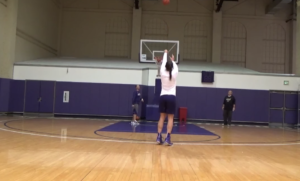
Kelsey Plum 99 Shooting Drill

Kelsey Plum 99 Shooting Drill

By Brian Williams on March 21, 2017

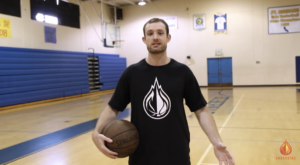
This basketball shooting drill came from Mike Neighbors’ Basketball Coaching Newsletter.

If you would like to subscribe, email me and I will forward your interest on to Coach Mike Neighbors.

The shooter in the video, Kelsey Plum, became both the Division I Women’s Career Leading Scorer and Single Season Leading Scorer during the 2016-17 season.

At the time this was filmed, Coach Neighbors was at Washington. He has since moved on to Arkansas.

This is Coach Neighbor’s description of the drill:

Fun drill that we got from a high school coach, but per NCAA rules does not allow me to mention them by name… but thanks!!

With a player like Plum who is in the gym so often it’s imperative to find new ways to keep score and track time during her shooting sessions.

This quickly became a favorite…

For us it’s a game spot/game shot drill. Not necessarily game speed but we still create some elements of relocation and 1-2 step shooting to make her move between attempts.

Like most drills, the secret sauce is varying the scoring to keep the challenge unique.

In 99, the shooter gets 3 points for every made shot. That score continues to accumulate as shots are made. If one shot is missed there is NO penalty, but if two shots are missed consecutively, three points are deducted from the overall score. The goal is to get to 99 points before the shooter falls below zero or a set time is reached.

Your best shooters will strive to never “go backwards’ by missing two in a row.

In this video, Plum gets to 99 in 2:09.60. Since then she has set a record of 1:53.10.

I can assure you she won’t stop doing this drill until she makes 33 in a row with no misses.

Another key: get a good rebounder. Notice I delegate that to Coach Todd Schaefer here, and I assumed the much, much more important role of timer.

Hope your players enjoy this.

We have since morphed this into a team shooting and small group drill that creates fun times in practice… Clutch shooters will emerge!!!

This is a YouTube video. Click the play arrow to watch
Greg Kampe on Role of Assistants

By Brian Williams on March 19, 2017

Oakland University Head Men’s Head Coach Greg Kampe discusses some of his views on the role of assistants in his program.

Coach Kampe has won 567 games in his coaching career.

Please make sure that your sound is on.

Click the play arrow to hear the talk.

This portion of Coach Kampe’s online presentation was taken from an online webinar that is available from the Glazier Clinics Vault.

You can get access to the vault by attending any Glazier Basketball Coaching Clinic, or by visiting this page: Glazier Vault.

Click the play arrow to hear the talk.

Teaching Creating Separation

By Brian Williams on March 16, 2017

Some teaching points from Drew Hanlen, Founder of Pure Sweat Basketball on teaching your players to create separation.

The drill is posted in the Pure Sweat YouTube channel. You can access their channel of instructional videos at this link:

Pure Sweat YouTube Channel

This is a YouTube video, so please make sure that you are able to access that network.

Also, please make sure your sound is on for the instruction with the video.

Click the play arrow to view the video.

Editor’s Note from Brian: My apologies for the misspelling of “Separation.” Not something I can fix. I do the best I can to pump out a lot of high quality articles for basketball coaches that will inspire thinking.

Separation Moves

Northwestern Basketball Plays

By Brian Williams on March 15, 2017

A couple of half court sets from Northwestern.

They are taken from the Chris Collins Northwestern Playbook which is included in the 4 for $35 basketball playbook eBook special.

You can see all 46 options to pick 4 from at this link: HoopScoop and Coaching Toolbox playbooks

Diagrams created with FastDraw

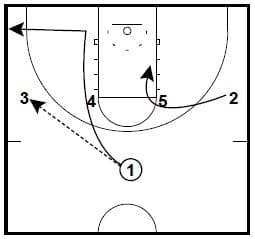
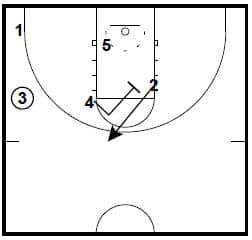
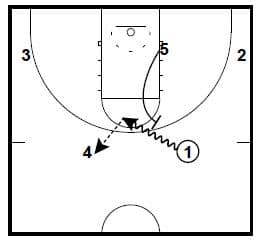
Northwestern Curl

1 hits 3.

4 sets UCLA screen for 1.

2 curls off 5.


Right after 2 curls off 5, he immediately turns and sets screen for 5.

5 takes screen to ball side block.


4 pins in for 2.

Even if you don’t use this exact play, you might be able to fit the double curl screen into something that you already run.


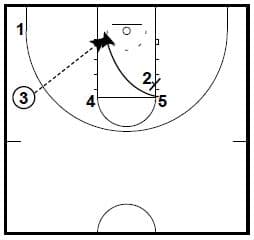
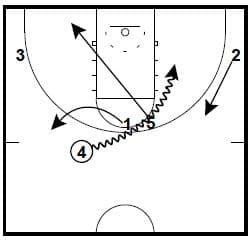
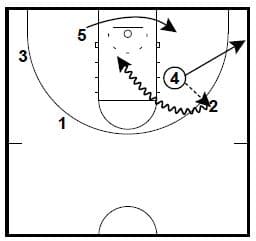
Northwestern DD

5 sprints and sets high ballscreen.

1 comes off 5 and drives middle.

1 pitches ball to 4 whose man is helping on drive.


4 drives the ball off 1 and 5 man diving away from the ball.


2 man fills behind the drive.

If 4 cant drive ball to rim for shot, kicks to 2 who catches and drives middle off of 4. 5 cuts opposite the ball for dump down.

These plays are taken from the Chris Collins Northwestern Playbook which is included in the 4 for $35 basketball playbook eBook special.

You can see all 46 options to pick 4 from at this link: HoopScoop and Coaching Toolbox playbooks

Bruce Weber Post Player Drill

By Brian Williams on March 14, 2017

A post player skill development drill to work with your post players on one on one moves when they catch the basketball off the block.

You might not want to use this exact drill, but I hope that it stimulates your thinking on how you can work with your inside players to improve their scoring skills.

The Coach in the video is Bruce Weber of Kansas State.

If you are interested in finding out more about the DVD that the video sample came from, click here:

Open Practice: Player Development Drills for the Ball Screen Offense – Basketball — Championship Productions, Inc.

Make sure your sound is on as you watch.

The video is a YouTube video.

Click the video to start the presentation.

Teamwork Intelligence

By Brian Williams on March 12, 2017

Unraveling the Mystery of Building a High Performing Team

The following  studies are intended to provide context to the team building and leadership development side of team sports.  The study of sports teams is often a difficult venture.  Access and commitment from research subjects is vital.  Without it the ability to derive valuable insights is limited.  The author is thankful to those coaches and student-athletes who allowed him to “observe” and “investigate” the social and psychological inner workings of team building.

About the Researcher
Dr. Cory Dobbs is an accomplished researcher of human experience–a relentless investigator always exploring “how things work.”  A skilled researcher, Cory’s ground-breaking research is the result of a decade of rigorous research and purposeful practice.   Cory’s A Leader in Every Locker and his workshop Teamwork Intelligence are the outcome of his decade of observation and investigation.  Dr. Dobbs has taught at Ohio University, Northern Arizona University and Grand Canyon University.  He is the founder and president of the nationally recognized Academy for Sport Leadership.

Oh Captain!  My Captain!
An Insight into the Team Captain Experience

Purpose:
The main objective of this study was to investigate the student-athletes experience in the role of team captain.

In prior research I found the number of team captains on a varsity athletic team to be most likely two or three student-athletes.  The previous study also revealed that the captains are generally chosen by the coach, though closely followed by selection of teammates.

Methods
Focus groups were used to obtain students’ opinion and experiences regarding participation on a varsity athletic team as a team captain.  Sixty (60) students were selected from a data base consisting of 200 student-athletes with each student-athlete assigned to one of six groups (ten groups with six participants).  A focus group design was used to investigate the student-athlete’s view of the role of peer leader and the experience of being a team captain.  The focus group process involved organized discussion with a selected group of individuals to gain information about their views and experiences of leadership and team captaincy.  To analyze the data the method used to code and categories focus group data were adapted from approaches to qualitative data analysis.

The student-athletes were arranged in ten groups of six students (no participants were coupled with team captains from the same team). To open up dialogue—the goal being student-athlete interaction—the moderator used ten open-ended questions that were related to their team captain experience. The following topics were used to stimulate discussion.

  1. How do you feel about being a team captain?
  2. How do you feel about leadership?
  3. Is there anything about the role of team captain that caused you to feel anxious about it?
  4. Would you like to talk about those leadership experiences which you found most anxiety producing?
  5. Which leadership experiences did you find enjoyable?
  6. What was the best thing that happened to you as a leader?
  7. What was the worst thing that happened to you as a leader?
  8. What did the other team captains worry about regarding the peer leadership experiences?
  9. How do you think the team captain experience can be improved?
  10. What is your expectation for you of future leadership experiences?

Results
The data from this study was very thick, intense, and very insightful.  Four prominent themes emerged.

  1. Lack of Preparation: From the student-athletes’ point of view,” initial anxiety,” proved to be a real threat causing an emotional state of uneasiness with the role of team captain. The participants overwhelmingly acknowledged feeling a sense of inner turmoil when enacting their first few leadership actions.  For many, they never got over the fear of rejection that might occur if a teammate dismissed an action (verbal or visual) performed by the student-athlete as a team captain.  Almost all of the participants expressed that at times they “dreaded” having to lead.

One of the student-athletes expressed:  “I was elated at my selection as a team captain.  I was quickly deflated when I made my first attempt to lead.”

  1. Lack of Feedback:   From the student-athlete’s point of view they felt “worry” and were often frustrated by the lack of feedback.  Most participants noted that feedback by coaches was minimal, often out of synch with the timing of need, and felt like “something” was wrong because no one, player or coach, offered valuable feedback.  They felt like they were on an island, and the only person they could (and would) relate the fear with were the other team captains.

One of the student-athletes expressed: “All I want to know is am I being effective.”

  1. Lack of Competency:  Fear of failure and making mistakes concerning  peer leadership was expressed by most of the student-athletes.  Because of this fear, many overlooked leadership opportunities preferring to stay on the “safe ground.”

One of the student-athlete’s expressed: “The year before I looked up to the team captain, but when I was placed in the role I felt like a fraud.  I never really knew if I was making a difference as a leader.”

  1. Lack of Confidence:   While almost all participants shared a sense of self-confidence as an athlete, the opposite was true of the role of team captain.  A healthy portion of the participants never overcame the sense of “self-doubt.”  Rather, they continued to lead with the expectation of confidence being discovered along the way.

One of the student-athletes expressed:  “I think I lacked self confidence because I had unrealistic expectations of the role.  I was more concerned with my teammates’ opinions than my ability.”

Conclusion
The result of this study showed that student-athletes were not satisfied with the outcomes of their role as team captain.  They experienced fear, uneasiness, and inner turmoil for most of the time they were team captains—as it related to the role of team captain.  Many participants never really felt competent  as a result of lack of preparation for the role.  Many of the participants were glad to have the opportunity to “reflect” on their experiences with others.  The reflection proved to be a trigger to learn more and take more risks in future leadership.

WHAT YOU THINK IS WHAT YOU DO

Problem:
 The need to identify how student-athletes conceptualize leadership.

Research Question:
 How do the ways in which high school student-athletes conceptualize leadership shape their participation in leadership of the team?

Data Collection: Four focus group sessions of ten student-athletes per group were conducted at individual school (four schools) sites.  Participants were selected randomly by school athletic director.  Participants were all “senior-to-be” and had three years of sport participation.  Groups watched a 15-minute series of video cuts of sport team practices (clips from various sports). The video was used as a tool for “priming the pump,” directing participant’s minds to sport leadership.  After viewing the clips, each participant completed a concept map with the simple instruction of “Leadership is….”  Concept maps are graphical tools for organizing and representing knowledge. They include concepts, usually enclosed in circles or boxes of some type, and relationships between concepts indicated by a connecting line linking two concepts.  While creating the concept map each participant was instructed to create a hierarchy of concepts—most important to least important.

Data Analysis:  Concept maps were coded and analyzed using six common themes: responsibilities, traits, abilities, skills, behaviors, relationships.  Using the concept maps and the participant rankings of the concepts the researcher created a brief profile of each participant’s conceptualization developing a personalized task assessment tool.  Post season surveys using the individual’s concept profile were given to respective participant coaches.  The participant’s coach rated the participant on the six dimensions citing: SE (strong evidence), LE (limited evidence), NS (not seen), and OE (opposing evidence).

Results:  After comparing individual concept map with coach evaluation the data indicate a moderate connection between participant conceptualization and leadership behavior.  However, the results show that the majority of participants were consistent; the actions and behaviors they did exhibit with strong evidence were those concepts at the top of their hierarchy of concepts (such as “effective leaders show they care about their teammates”).  Data also indicate—via concept maps—limited breadth and depth of knowledge of leadership.

Discussion:  The study participants were not given leadership training and sport team environments varied tremendously.  The culture of the team, the role of the player, and the leadership opportunities are difficult to tease out of the results.   However, the limited breadth and depth of knowledge of leadership illuminates a tremendous opportunity for coaches.  Further research is needed to better understand how an increase in knowledge will affect leadership behavior.  Also necessary is a better understanding of how taking actions and behaving like a leader can expand the student-athletes’ concepts of leadership.

A Case Study of a Volleyball Team Using Teamwork Intelligence™ to Build a High-Performing Team

Background:  The Madison High Girls Volleyball team is a perennial contender for the state tournament.  However, the team had never reached the championship round of their state championship tournament.  They’d lost their first-round game three years in a row.  With a desire to “get over the hump” and win a playoff game the team decided to invest heavily in “building a team to compete at the highest level.”

Purpose of study:  Many of the most admired and successful volleyball programs are generally more cohesive than the unsuccessful and least admired programs.  The admired programs understand that the best way to motivate players is not through rewards or threats, but by inspiring one another to find ways to enjoy the challenges of achieving team and individual potential while doing so with purpose (often found in the goal to “win the conference” or to “be a family”).  These teams too are consumed with playing to enjoy the experience.

Units of Analysis:  Because The 8 Roles of Teamwork is the organizing force it was the main unit of analysis as a way of building an adaptive and relational culture.  The study utilized the Academy for Sport Leadership’s 10 Elements of Team Culture for analysis of team growth and development.

Outcome:  For decades, researchers have proven that an organization’s culture determines its level of success.  Culture drives performance.   Many coaches fall prey to a myopic focus on task excellence at the expense of interpersonal relationships among team members.  Prior research has revealed that a single-minded focus on task/tactical performance can cripple relationships and adaptive performance.

In this study, the initial test of the team’s cohesion revealed a “pseudo team” in the early stages of development.  An apathetic behavior toward “limiting or stopping” individuals’ violations of team norms and expectations created a false sense of harmony.  Further evidence of this was found in the ratings of teammates on the Academy for Sport Leadership’s Rate Your Teammate scale.

The team underwent a “heart transplant” and individuals began to follow-through on commitments to develop in their selected role.  Every player recognized and capitalized on the opportunity to experiment with ways to improve their performance as a teammate.  Additionally, the introduction of The Academy for Sport Leadership’s Teamwork Debriefing process stimulated the quantity and quality of “team conversation” and had a much broader positive impact on relationship building.

The playing experienced became more meaningful and enjoyable, and the team’s attention to its culture was sustained throughout the season.  Practices were more productive and scores improved dramatically on the Teamwork Intelligence tool The 10 Elements of Team Culture.  The team was a #1 seed in its bracket and played for the state championship.  While the Madison High team did not win the championship, the team clearly committed to reaching its potential felt that they succeed in doing so.


To find out more about and order Sport Leadership Books authored by Dr. Dobbs including a Leader in Every Locker that this post was taken from, Click this link: The Academy for Sport Leadership Books


  • « Go to Previous Page
  • Page 1
  • Interim pages omitted …
  • Page 97
  • Page 98
  • Page 99
  • Page 100
  • Page 101
  • Interim pages omitted …
  • Page 288
  • Go to Next Page »

Primary Sidebar

  • Twitter
  • Facebook
  • Linkedin
coachestoolbox
personaldevelopmenttoolbox
basketballplayerstoolbox
basketballtrainer
athleticperformancetoolbox
coachingbasketball

© Copyright 2026 Coaching Toolbox

Privacy Policy