• Skip to primary navigation
  • Skip to main content
  • Skip to primary sidebar

  • Basketball Plays
    • Ball Screen Sets
    • Horns Sets
    • Man to Man Post Up
    • Man to Man Isolations
    • Backdoor Plays
    • Man to Man 3 Point Shot Plays
    • 2-3 Zone Attack
    • Baseline Inbound Plays
    • Sideline Inbound Plays
    • Combination Defense Attack
  • Drills
    • Defensive Drills
    • Offensive Drills
    • Competitive Drills
    • Passing Drills
    • Rebounding Drills
    • Shooting and Scoring Drills
    • Toughness Drills
    • Transition & Conversion Drills
    • One on One Drills
  • Blueprint
  • Practice
  • Mental Toughness
  • Skill Development
  • Offense
  • Defense
  • Store

Get a Grip on Reality: Unlock Your Coaching Potential

Get a Grip on Reality: Unlock Your Coaching Potential

By Brian Williams on July 21, 2017

by Dr. Cory Dobbs, a national leader in providing leadership resources for coaches and student-athletes. The most recent resources include A Leader in Every Locker for coaches and Teamwork Intelligence: a workbook for the student-athlete along with a facilitator’s guide for the coach.

An excerpt from “Coaching for Leadership”

Are you a talented coach on the rise? Do you want to be an “A‐Level” coach? Are you interested in becoming an elite leader? Think deeply about these three questions before moving on.

Instead of assuming leaders are born with the “right stuff” to lead, I start with the assertion that leadership is a talent. If that talent is to be advanced the coach needs a context that supports the development, get the experiences they need to cultivate their leadership ability and possess the drive to master learning to lead.

Let me make another claim: talented people want to be challenged, not coddled. As a coach to coaches I know this to be true. And as a coach I’m sure you will agree success isn’t something you simply hope happens. It is high achievement accomplished by consistent, deliberate, and intense preparation and commitment to a goal with a daily plan of action based on choices you make.

In your version of reality you may have “high potential” stamped on your forehead and be successful in your own mind. All this may be true, but don’t be deluded. Odds are you’re nowhere near where you want to go and who you want to be. If you really want to stand out, lift your performance to its peak, break into the small circle of elite performers, then accept that life is not a do‐it‐yourself project. If you surround yourself with winners—or are fortunate enough to have a skilled and caring mentor in your corner—you are likely on a winning path toward the success you covet. We all need people who help us look at situations from a different perspective.

Today, top athletes, actors, musicians and corporate leaders have begun to use performance coaches to help them reach their potential. They’ve chosen coaching as a way to shorten their path to sustained success. What they know is that good coaching will get them where they want to go, help them achieve what they want to achieve, and transform them into who they want to be.

REALITY BITES
Here’s your first bite of reality. As determined as you are, you might never get to where you want to go. You ask; why is this?

The answer: blind spots. All coaches have blind spots. Yes, we all have blind spots, but this is about you.

I know how badly you want to be good—no great! So it’s important for me to let you know that blind spots are real and really capable of derailing your efforts to reach your potential.

You’ve spent most of your life committed to particular ways of thinking, doing, and being, and that’s a good thing; and a bad thing. It guarantees blind spots. Don’t checkout yet. Let me be clear about this: it is never easy to bring about a mindset change. But that’s not enough. Another bite of reality is that it’s more difficult to replace a simple way of thinking with a more complex way; which of course, is likely necessary to become an elite coach.

So, what is a blind spot? A blind spot is a weakness that other people see but we don’t. The crazy thing is, because a blind spot is not known to us, we simply don’t know what we’re doing wrong and what we can do to get better outcomes. We have no idea how a certain coaching behavior of ours is coming across to our stakeholders—players, parents, coaches, and administrators—but it is. A blind spot is an outer reality. That is, it exists outside of us, yet inside of others.

There are various sorts of blind spots that can lead to ineffective coaching to some degree or another, but one particular form holds many coaches back from great success. That is, a behavioral blind spot. A behavioral blind spot is the unproductive or destructive behavior that undermines or erodes interpersonal influence and the building of durable and enduring relationships.

To ease into the idea of blind spots think of it as something similar to the blind spots we encounter when driving a vehicle. Several years ago while driving a large truck I bumped up against a car in the other lane, hidden in my blind spot, without knowing it. The car sped up to get alongside me. I spotted a crazy man pumping his arms and screaming at me. I pulled over and, sure enough, unbeknownst to me I had sideswiped the driver‐side door of the crazy guy’s car. Yes, I failed to use the tool built for reducing blind spots—the mirror.

Getting a grip on reality requires a heavy dose of reality. Here’s a start: Deep changes in how people think, what they believe, and how they see the world are difficult to achieve. Experts will tell you such change is downright impossible to bring about through compliance. You’ve got to want to change.

THE EDGE OF REALITY
Self‐awareness has limits. Taken in isolation, the problem with self‐awareness is that what others think of our behavior takes place outside of our awareness. The built in constraint is that self-awareness only reveals what we can see as what we can know, not what we can’t see and not know. We are essentially disconnected from the effects of our behavior; we are blind to the internal reality of the other. All this makes it difficult to know there’s a need to change our behavior. I think this is what author and psychologist R.D. Laing meant when he said, “The range of what we think and do is limited by what we fail to notice. And because we fail to notice that we fail to notice, there is little we can do to change; until we notice how failing to notice shapes our thoughts and deeds.”
[thrive_leads id=’36827′]
Because people don’t know blinds spots exist, they aren’t searching to understand how others’ experience them. Consequently, if someone tries to bring a blind spot to one’s attention, it’s likely to be brushed off. The message will be disregarded and discarded. Let’s be clear, if someone told you that you are behaving in a way that is having a negative impact on others, your initial reaction will be to take a defensive posture.

Our ability to confront ourselves is crucial to building insight and understanding and tackling the truth of our blind spots. Our willingness to venture out of our comfort zone and see things from others’ perspectives is vital to achieving peak performance. This takes courage but offers great rewards.

Reality demands change. The biggest threat, the most resistant barrier, to personal change is you. Please do not take this to mean that you’re not motivated or talented. You wouldn’t be where you are, in position to get to the peak of your mountain, if that were the case. It’s just that desire and motivation aren’t enough. The reality is that the ability to initiate and persist with deep change is often exasperatingly elusive for most of us. Grasp that reality!

Yet, as the world maddeningly changes, so must we. The greatest power we have is the ability to envision our own fate and to action to change ourselves. However, the unavoidable question is can you do it by yourself?

REALITY CHECK
Like the rest of the world—government, medicine, education, and business— sports has relied on the doctrine of scientific management: the theory that any task process can be broken down to its component parts and then reassembled in an efficient “scientific” manner. That sort of thinking, a mechanistic view of management, fostered assembly lines and military hierarchies. And it’s fostered a social preference in which building relationships is not as important as task accomplishment—winning trumps all.

Today, we still have many assembly lines (such as schools) and hierarchies are still a favored organizational structure. However, more frequently these industrial age artifacts are adapting to and changing how the individual, the organization, and society interrelate. Change invariably reveals blind spots, and blind spots are deep and difficult impediments to growth.

Let me step onto thin ice. Every coach utilizes “constructive yelling” (my quotes) under the theory that if a player can’t survive a spirited “talking to,” the opponent will kill her. This idea may work, sometimes. And other times it might not. Rather, it’s simply a taken‐for‐granted coaching behavior, a “coaching style,” a way of “motivating” athletes. But until we have the courage to explore such coaching behaviors from a variety of frameworks—certainly to include the athlete’s perspective—we might just be feeding a blind spot.

Here’s how it happens. A team is a human community. It is a living system, like a plant. So, all teams are made up of people. And people are emotional. When engaged emotionally people easily lose perspective. Because people are emotional and lose perspective things are not always as they seem. In a nut shell, to lead effectively involves the need to recognize and acknowledge the importance of dealing with both one’s own feelings and emotions and those of the others in an interaction.

Now, stay with me. Every relationship involves reciprocal relational dynamics such as trust or distrust, respect or disrespect, liking or disliking, and dominance or autonomy. Consequently, these dynamics either reinforce relational growth processes or introduce limiting forces that impede the development of a durable relationship.

Here’s a reality check. Without recognizing how certain behaviors negatively impact others, you won’t be able to change your unproductive and destructive behaviors. Most of us fall into this trap, thinking we are always acting in the best interests of the student‐athletes. That’s just not true. Unfortunately, we continue unaware of the negative impact our behaviors create. The causal chain is clear: the fastest way to cause cohesion and morale to erode is to deny that a behavioral blind spot exists or to ignore it.

Discipline and determination are necessary, but it is the discovery of behavioral blind spots that is essential to unlocking your coaching potential. The better you know your strengths and weaknesses, your likes and dislikes—the better you know where you’ve been, where you want to go and what it will take to get you there—the better you can set your goals and craft a plan to get there. However, if you have a faulty behavioral blind spot you are destined to limit your growth and development into the great coach you want to become.

NEW RESOURCE FOR COACHES

In Leadership Quest Dr. Cory Dobbs offers student-athletes a leadership fable that is engaging, instructive, and transformative. This book provides a simple, yet powerful, model of leadership that will build confident and effective team leaders for any sport. Using the power of storytelling, Leadership Quest presents a proven framework for student-athletes to follow and become exceptional leaders on the playing field and in everyday life. Leadership Quest advances an athlete-centered approach to developing the leader within each and every student-athlete.

Click here for more information on the: Leadership Quest Pack

About the Author

Cory Dobbs is the founder and president of The Academy for Sport Leadership, a national leader in research‐based curriculum for coaches and student‐athletes. Dr. Dobbs is a college educator, a coach to successful coaches (helping coaches attain a higher level of success), and an accomplished human performance specialist whose expertise is in the field of leadership, team building, and creating a high‐performance culture in the arena of team sports. Cory blends social‐personality, psychology, and applied social psychology, which means he studies how people’s thoughts, behaviors, and preferences are influenced by both who they are and the situations they’re in. He uses Teamwork IntelligenceTM to help teams explore how the mix of perspectives brought by their individual members influences their work together. Dr. Dobbs recently joined Jamy Bechler on the “Success is a Choice” Podcast – hear his thoughts on team leadership and developing a leader in every locker here.

What to do: Contact Cory directly. Start a conversation on how you can reach your coaching potential.
Dr. Cory Dobbs
(623) 330.3831 (call or text)
Shake and 14 High Raise Man to Man Plays

By Brian Williams on July 19, 2017

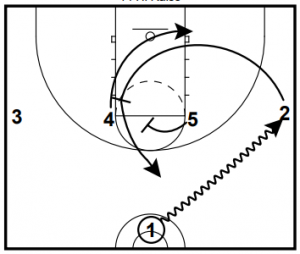
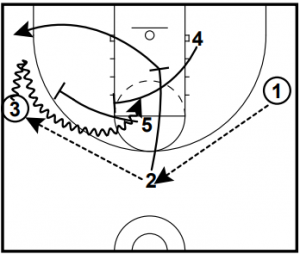
A couple of half court man to man sets from the Uptempo Playbook .

It is paired with the Meet the Press Playbook as this week’s featured bundle.

You can find out more by clicking the link below:

Up Tempo and Meet the Press Playbooks

Or, you can purchases any four of our digital playbooks for $35 (62 titles in all–Virginia, Texas Tech, Duke, Kentucky, Brad Stevens, and many others included!) 20 new titles on July 11!

Click this link for all choices! 4 digital playbooks for $35

Diagrams created with FastDraw

The real value of the plays is if you can take a few of the parts and enhance what you already run.

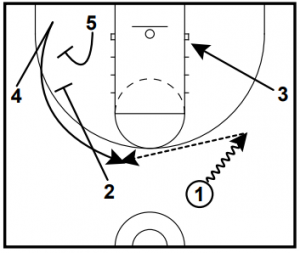
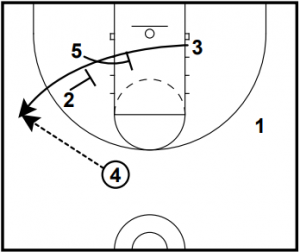
1-4 Hi Raise

1 dribbles to wing while 2 cuts through then sets screen for 4

5 will screen the screener for 2


The ball is reversed thru 2 who will then set a down screen for 4

5 sets wing screen and pops out for shot

4 comes off down screen and sets second ball screen

3 comes off the double ball screens looking to make a play

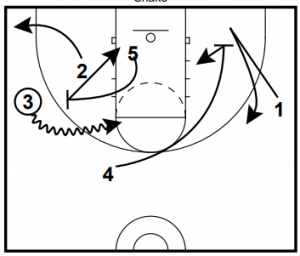
Shake

1 dribble at 3 who goes back door

2 and 5 set staggered screen for 4 who comes off screen looking for a shot


If 4 does not have a shot then 5 and 2 set a second staggered screen this time for 3


If 3 does not have a shot then 2 clears to the corner while 5 sets wing pick and roll

4 sprints to set a pin down screen for 1


They are taken from the Chris Collins Northwestern Playbook which is included in this week’s eBook special.

It is paired with the Meet the Press Playbook as this week’s featured bundle.

You can find out more by clicking the link below:

High School Up Tempo and Meet the Press Playbooks

If you have any questions about the eBoooks, feel free to call/text me at ‪317-721-1527 or email me at [email protected]

The Two Most Valuable Offensive Breakdown Drills

By Brian Williams on July 18, 2017

Submitted by Coach John Kimble
CoachJohnKimble.com

Retired high school and college coach

Follow him on Twitter @CoachJohnKimble

Diagrams created with FastDraw

The “Pivot and Pass Offensive Drill” and the “55 Second Offensive Drill” are the two most valuable drills that any offense could have to improve players’ performances and techniques.  Besides the individual offensive techniques and skills that these drills teach and give players opportunities to improve on, the drills maximize time efficiency.  Each drill is multi-faceted, with several techniques being able to be worked on at the same time by different participating players.  The drills are game-realistic and competitive which brings out the best in players and also includes physical conditioning.  This saves valuable practice time, so that these and other drills can be used more often for coaches to teach,  coach, and correct players as well as for the players to learn and improve in the various skills that are needed for individual and team success.

The “Pivot and Pass Offensive Drill”

An invaluable offensive fundamental that is needed for a team to be successful in the execution of any offense is the crucial fundamental of all players being able to dribble against pressure, to pivot away from or around individual defensive pressure and then to be able to deliver the ball to an open teammate. This could be against man-to-man pressure, against half court zone or trap pressure or against full court defensive pressure. Teams must be able to move the ball both on the perimeter as well as to the inside to constantly attack defenders in the many various defenses that could be executed against them.

This drill should be utilized only after instilling the attitude to all players that the drill is a multi-purpose drill needed for each player to become a well-rounded and fundamentally sound basketball player.  It is not just a dribbling, pivoting and passing drill for 01. It is not just a defensive drill for X2.   It also is not just a drill for 03 to catch the ball and to then work on shooting techniques.  Instead, the “Pivot and Pass Offensive Drill” is an all encompassing offensive drill where all three players can work specifically on the offensive techniques that they individually need to improve on.  After three rotations of players, all three players in each group will have worked on the three segments of the drills–the fundamentals of the dribbler/passer, of the defender and of the pass receiver/shooter.  Because it is such a time-efficient and valuable drill and because it includes so many different fundamentals, this drill should be used more than once in every practice (for just short periods of time).

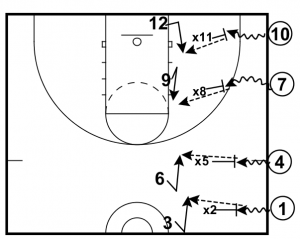
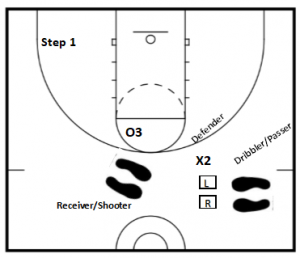
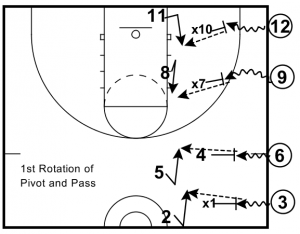
The dribblers/passers (01, 04, 07, and 010 in Diagram 1) work on the obvious dribbling, pivoting, and passing techniques and skills that are required for them to be solid offensive ball handlers. The first technique to be worked on is the actual dribble as the dribbler approaches the defender. Dribbling quickly (but in a very controlled manner) with the head up in a semi-crouch stance is the first point of emphasis for this offensive player. Protecting the ball with the non-dribbling hand and dribbling with either hand is one of the most important skills and techniques that each dribbler should also work on.  Another important skill for the ball handler is to work on the skill of passing the basketball with either hand. Still, another vital skill of the ball handler is being able to pivot with either foot as the pivot foot.

Working on defending a dribbling ballhandler and pressuring him when the dribble is killed is very necessary for a team to have pressure on the basketball during a game.  X2, X5, X8 and X11 are the first “on-the-ball defenders” in this drill.

Being able to catch the ball on the move, making a quick pivot and shooting quickly are necessary for an offensive basketball team to be able to score.  03, 06, 09 and 012 are the first cutters/shooters in this drill.  Notice that while 03 and 06 cut to their left to receive the passes, 09 and 012 cut from the left to their right.  These directions can be alternated periodically.  Diagram 1 illustrates the placement of an entire team so that each player in each three-man group can work on their specific techniques that are needed to be practiced.  See Diagram 1.

After a pre-designated time limit, all three offensive players rotate to their next position in the group.  An example of the first rotation of the drill would be to have 01 rotate to become the next defender while 02 now becomes the next designated pass receiver/shooter.  03 rotates from being the first receiver/shooter to becoming the next designated dribbler/passer, also placing 06, 09 and 012 as the other new dribblers/passers.  The newly designated defenders are X1, X4, X7 and X10.  The newest pass receivers/shooters will be 02, 05, 08 and 011 after the first rotation of offensive personnel.

After all three players in each of the four groups (for example, 01, 02 and 03 in the first group with 04, 05 and 06 in the second group) have rotated through all three of the positions: the dribbler/passer, the defender and the pass receiver/shooter; the drill starts over but with the pass receivers/shooters now breaking in the opposite direction that they originally started the drill.  In the first repetition of the drill, two of the designated groups have their shooters cut from the right to the left while the other two groups cut originally from the left side towards the right.  In the second repetition of the drill, all three players in each of the four separate groups will start in their initial positions.  But the actual shooters will break from the opposite directions that they originally started.  Therefore, this repetition of this drill will now have two shooters (03 and 06) break to their right, with the imaginary basket still being at the sideline behind the initial dribblers/passers.  That makes these shooters’ left shoulder, heel and foot the so-called “inside” shoulder and heel/foot.  The second two groups have the first designated shooters (09 and 012) cut towards their left.  This now makes their right side the “inside shoulder” and “inside heel and foot.”

A quota of a designated number of passes and shots in the set time limit can make the drill more accelerated and competitive.  There could be a contest between the defenders and the dribblers/passers of how many “successful” completed passes and deflected passes take place in the time limit.  “Winners” and “losers” could be defined with a small penalty given to the “losing player” after the conclusion of the drill.

Diagram 1

The designated pass receivers (03, 06, 09, 012 in Diagram 1) work first on the “pre-catch and pre-shooting stance.” The coaching staff constantly should be emphasizing to the (potential) shooter to “get your feet and hands ready!—to get behind the ball—give the passer a target!”  See Diagram 1.  In this scenario, the pass receivers/shooters (09 and 012) are breaking to their right and the imaginary basket is directly behind the passers at the sideline.  Even before the actual catch of the basketball, the pass receiver should try to already have his “inside shoulder” (shoulder closest to the basket, which is the left shoulder in this example) facing the basket and to have both his “guide hand” and “shooting hand” up (as if he is already shooting the ball). With the “shooting hand” in that position, it gives a good target to the passer. The pass-receiver should always pivot off of the heel of his “inside foot” (the foot closest to the basket, which is the left heel in this example). If the pass-receiver is in a stationary position, he can start with the “inside heel” already touching the floor and the remaining portion of that foot not yet touching the floor.  If the pass receiver is on the move, he might have to “chop up his steps” in order to time the “inside heel” hitting the floor (to pivot) just as the ball hits the palm of the “shooting hand.”  From there, the heel being planted first will stop the pass-receiver’s forward momentum of his cut toward the passer.  After the shot, the shooter should be able to rise straight up and come back straight down and not “float” in either direction. Stopping all of the momentum from the shooter’s cut before he shoots the ball will greatly improve shooting accuracy.  Each shooter (03, 06, 09, and 012) shoots as if the original passer (01, 04, 07, and 010) is the basket, so that the ball is returned for that passer to restart working on his skills and techniques.  See Diagram 1.

Once the momentum of the cutter is stopped, the inside heel actually will allow for a smooth, easy and complete pivot toward the basket, as the shooter swings his free (outside foot and leg) around so that he is completely “squared up” to the basket.  In this offensive drill, the pass/receiver/shooter “shoots” the ball  at an imaginary basket back to the original passer. The passer (01, 04, 07, and 010) is now quickly ready to resume working on his technique of passing to the shooter again, so the shooter can again quickly work on the “foot and handwork” part of his shooting technique (beginning with a new dribble and jump stop.

The men in the middle of the drill  (X2, X5, X8, and X11 in Diagram 1) utilize the drill as a defensive drill, who initially are guarding the dribblers/passers (01, 04, 07 and 010).   Effort and the emphasis on defensive fundamentals (such as proper stance and other various defensive techniques) should not be taken lightly by players or the coaching staff, as the drill is stressed to them as being a defensive fundamental drill.  These defensive players work on defensive techniques only on the original dribbler/passer and not on the pass receiver/shooter.

Diagram 2

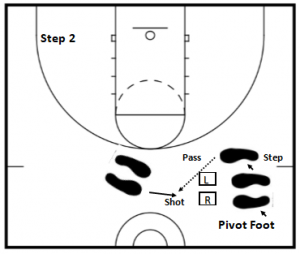
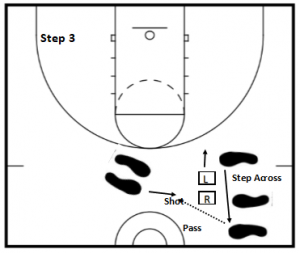
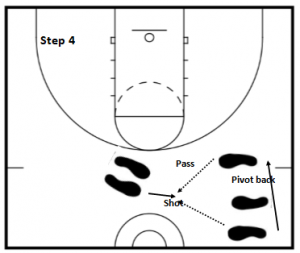
The specific footwork and techniques of each passer/dribbler are demonstrated in the four steps are shown in Diagrams 2 through 5.

Step 1 of the “Pivot and Pass” Technique—As the dribbler approaches the defender and kills his dribble, the dribbler should take a small bunny hop and land simultaneously on both feet. This allows the “killed dribbler” to use either foot as the pivot foot. See Diagram  2.

Diagram 3

Step 2 of the “Pivot and Pass” Technique —If the passer wants to attack the defender by passing laterally around the defender’s left side, the dribbler should land and make the right foot (the foot directly facing the defender’s left foot) the free foot and therefore make his left foot the actual pivot foot. This makes the passer’s right foot the foot that can laterally step toward the outside of the defender’s left foot. As this is taking place, the passer should protect the ball by firmly holding the ball with both hands with the ball held behind the knee of the free knee (the right knee in this example). If the passer’s free foot is laterally outside the defender’s foot, the passer then could “fake low and go high” or “fake high and go low” (passing high over the defender’s left hand or passing low under the defender’s hand). Constantly tell the dribbler-turned-passer to “protect the ball behind the knee” and to “step due east or due west.” This means that the dribbler/passer should constantly attack the flanks of the defender by stepping laterally around the defender and not toward the defender. See Diagram 3.

Diagram 4

Step 3 of the “Pivot and Pass” Technique —If the on-the-ball defender counters the dribbler’s first lateral attack, the dribbler should “rip the ball low and hard across his shoe tops” as he steps with a front pivot across the face of the defender to laterally attack the defender on the opposite side (in this scenario, it is the defender’s right side). The ball ends up on the inside of the passer’s knee of the free leg (the right knee in the diagrams). If the passer’s free foot (right) gets outside defender’s (right) foot, the passer looks to pass the ball around the defender (“fake high and go low” or “fake low and go high”) on the opposite side from the initial side of attack. Again, coaches should strongly emphasize to the pivoting passer to protect the ball behind the “free knee” (right) and again step “due west and/or due east” in the lateral attacks on the ball defender.  See Diagram 4.

Diagram 5

Step 4 of the “Pivot and Pass” Technique —If the ball defender reacts quickly and takes this second technique away, coaches should emphasize to the offensive player to remain in the semi-crouch stance, to then quickly reverse-pivot off of the same (left) pivot foot and to then attack the ball defender’s original (left) lateral side. The ball should now be back behind the outside of the knee of the free (right) foot.

Again, the main three points of emphasis to the passer are:

  • Protect the basketball by placing the ball behind the “free” knee,
  • Step outside the defender’s foot (by going east or west),
  • “Fake high and go low” or “Fake low and go high.” If the defense counters this step, the dribbler should reverse pivot and look to make a lesser contested pass to a another teammate or attempt to use all three techniques again. See Diagram 5
Diagram 6

After the 55 seconds expires, the dribbling/pivoting/passing player (01) switches to the defensive station, while the first defender (X2) switches to work at the pass-receiving station/shooting station, and the first pass-receiver/shooter (03) rotates to the dribbling/pivoting/passing station. This rotation should take less than 5 seconds and the drill starts again. 55 seconds later comes the next rotation of the three players.  After the third 55 second time frame has concluded, coaches can start the second round with all offensive dribblers using a different dribbling hand and making the right foot as the new pivot foot. Three minutes will allow for all three players to rotate through each position again.  In just six minutes, three players have each had almost two minutes of concentrated work on all three stations—the dribbling, pivoting, and passing phase, the defensive phase, and also the pass-catching and shooting phase.  See Diagram 6.

The “55 Second Offensive Drill”

Every offensive/shooting and shooting drill has definite characteristics, but all drills must be “game-realistic.”  To make these drills as “game-realistic” as possible,  coaches should incorporate as many types of pressures (on the players) as possible. They should try to incorporate “success” and  “competition” pressures–trying to beat other players, other squads, or other types of opposition.  The other types of opposition could be pre-set standards and can be time on the clock.   Obviously, accuracy should be stressed in all shooting drills, but also “quantity” should be emphasized.   All shooters, passers, and rebounders should always go at “game speed” in practice because they will be going at that speed in the games.   Coaches should continually accelerate rebounders, passers, and shooters in each and every shooting drill.  They should have pre-set “quantity AND  quality” standards  set for  each  shooting drill used.  That increases the game realism, because each individual is trying to succeed not only for himself, but for his team (or group or squad).  Every shooting drill has a pre-set standard of a specific number of attempts the shooter must take as well as a standard of how many shots he should make. Again, this forces the tempo and intensity level up for each shooting drill used.  Game realism also means rewards for the winners and penalties for not winning.  None of the penalties are harsh or hard, but they are a true penalty. They could be some type of a running penalty, some pushups, or sit-ups. Competing against the clock is always beneficial, because everyone has a common opponent and measuring stick.

Using the scoreboard clock not only gives every player a common opponent, but a clear, visible and constant opponent.  Using time limits always speeds up the shooting groups–it does not allow a shooter to take too much time in shooting.   The phrase “Be quick, but don’t be in a hurry” is a great phrase that should be used often in this drill and in games.   When in a game does a shooter, a passer, or any player have the luxury to take his time and to go at a “comfort speed?”  By continually accelerating players in all drills (not just shooting), coaches get players used to having a much-quicker “comfort speed.”

Every drill must also be as time-efficient as possible, because no practice time can afford to be wasted. This can be accomplished by incorporating other offensive techniques and fundamentals into each shooting drill, such as passing, rebounding, cutting, coming off of screens, catching, pivoting, as well as the shooting.  Coaching staffs should incorporate the spots where the player will most likely get those shots in games, as well as the types of passes used in games. Also coaches should place the passers where they will pass the ball in game situations.   Shooters should start in their initial locations and the shooters are required to cut and break to the spots where they most likely will take the shots in games. Passers are required to use the same type of passes they will use in a game, always at game speed.   Passers are forced to quickly AND accurately make the appropriate passes that they will make in a game. Sometimes have managers or coaches can have their hands up in front of the shooters to act as dummy defenders. Rebounders are encouraged to aggressively offensively rebound the basketball before making quick and accurate outlet passes as they would in a real game. If the coach constantly emphasizes the speed and intensity needed, other drills that follow in that day’s practice will naturally pick up the same speed and intensity levels that are required for those drills to be successful.  Another by-product from these shooting drills can be conditioning. If everyone works at meeting the “quantity and quality” standards that have been set, every player’s physical conditioning will also improve.

Diagram 7

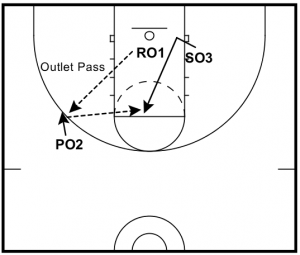
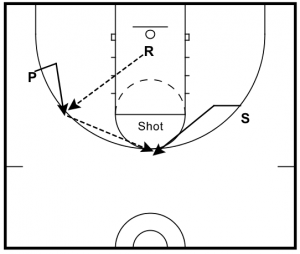
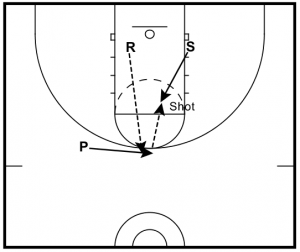
In the many different types of shooting drills that incorporate the “55 Second Offensive/Shooting Drill” theme, there are three players involved.   See Diagram 7.

One player is the designated “Passer” (02), one the designated “Shooter” (03), and one is the “Rebounder” (01).  After 55 seconds, all three players rotate over one designation and the drill is executed again.

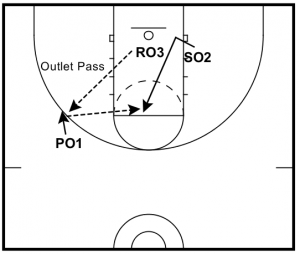
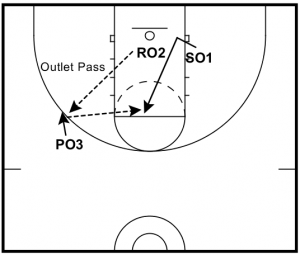
The “Passer” rotates to the “Shooter,” the “Shooter” rotates to the “Rebounder” station and the “Rebounder” rotates to become the next “Passer.”  See Diagram 8.  55 seconds later, the three players then rotate for the last time (on that side of the court.)  See Diagram  9.

Diagram 8
Diagram 9


There should not be more than 5 seconds for the transition and the player rotation. In three short minutes, each player receives almost one minute of concentrated work on offensive skills of passing, catching and shooting, and rebounding and outlet passing. The best rotation is from “Passer” to “Shooter” to “Rebounder” and on to a different shooting location, where the three-man rotation starts again. It is important to notice that this drill is not only called the “55 Second Offensive/Shooting Drill to demonstrate the drill lasts 55 seconds (before there is a rotation), but to also emphasize that the drill is not just a shooting drill, but a rebounding and outlet passing drill, a cutting and pass receiving drill, and a passing drill.  Otherwise this would mean that the remaining two players in the drill other than the shooter are not as important and do not need to work as hard at the various fundamentals they need to be working on.  On the contrary, the two players that are not shooting in this drill are equally important and should work just as hard as the shooter in the drill.

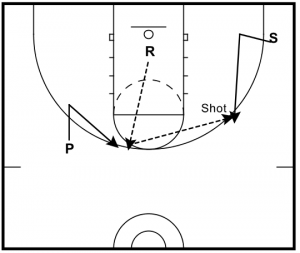
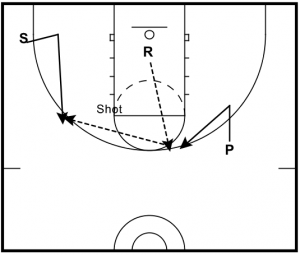
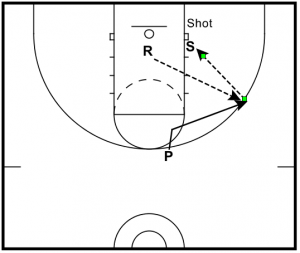
Diagrams 10 and 11 are illustrations of the shooter shooting from the wing areas on the offense’s right and left side of the court, with the passer making the pass from the top of the key.  Other examples could be of the shooter shooting from the deep corner after receiving the pass from various spots where he could receive the ball from in games.  Those spots could be from the weakside wing area on a “skip pass,” from the ballside wing area on a “down pass,” or possibly from the ballside low post area on a “kick-out pass.”

Diagram 10
Diagram 11


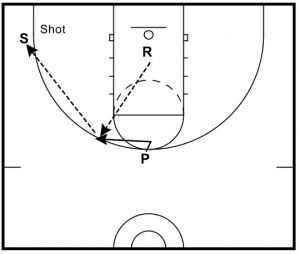
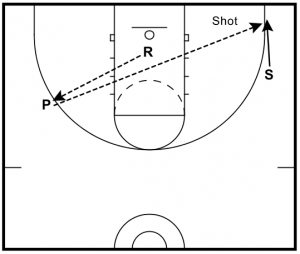
The locations of the designated “Shooters” and the placement of the designated “Passers” can vary to fit the specific offense’s needs, while the “Rebounders” obviously always remain near the basket to grab the rebound, outside pivot (away from the imaginary defense or against a manager), and make the outlet pass to the “Passer.” See Diagrams 12 thru 16 for just some of the possible combinations of passing and shooting locations the drill could utilize on just one side of the court (even though the drills could and should be utilized on both sides of the court).  These passing and shooting spots should be determined by the coaching staff analyzing the particular offense(s) used and where passes and shots are generated from those offenses.

Diagram 12
Diagram 13
Diagram 14
Diagram 15
Diagram 16


The “Pivot and Pass Offensive Drill” and the “55 Second Offensive Drill” are the two most valuable drills a coaching staff could use because they allow coaches an excellent opportunity to not only teach the techniques the proper way, but they give each player game realistic opportunities to learn the skills, to practice the skills and to improve those necessary skills.  Each drill is multi-faceted, with several techniques being able to be worked on at the same time by different participating players.  The drills are game-realistic and competitive which brings out the best in players and can then include physical conditioning. This saves valuable time in the practices, so that these and other drills can be used more often for coaches to teach and coach players as well as for the players to learn and improve in the various skills that are needed for individual and team success.

About the Author

Coach Kimble held the Head Basketball Coaching position at Deland-Weldon (IL) High School for five years (91-43) that included 2 Regional Championships, 2 Regional Runner-Ups and 1 Sectional Tournament Runner-up. He then moved to Dunlap (IL) High School (90-45) with 2 Regional Runners-up, 1 Regional, 1 Sectional and 1 Super-Sectional Championship and a final 2nd Place Finish in the Illinois Class A State Tournament. He was an Assistant Basketball Coach at Central Florida Community College in Ocala, FL for 1 year before becoming Offensive Coordinator and then Associate Head Coach for 3 additional years He then was the Head Basketball Coach at Crestview (FL) High School for 10 years, averaging over 16 wins per season.

He has had articles published in the following publications such as: The Basketball Bulletin of the National Association of Basketball Coaches, the Scholastic Coach and Athletic Journal, Winning Hoops, Basketball Sense, and American Basketball Quarterly. He has also written and has had five books published along with over 25 different DVDs by Coaches Choice and Fever River Sports Production.

See him on Twitter @CoachJohnKimble and his Web Page “www.CoachJohnKimble.com”

Warriors FT Rip

By Brian Williams on July 16, 2017

This play was contributed by Matt Wheeler to the FastModel Sports Basketball Plays and Drills Library.

Matt Coaches at Olympia High School in Orlando Florida.

You can also find out more about FastModel Play Diagramming software by clicking this link: FastDraw

The point of the post is not that you have to take the play as is.

The hope is that you can take parts of this to include with what you do, or that this will stimulate thinking and discussion among your staff to find ways to enhance your current system.


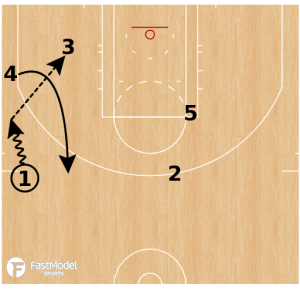
1 dribbles to the wing.

4 cuts up top.

1 passes to 3 in the post.


5 sets a back screen for 2.

4 screens for 1.

3 passes to 5 for a shot.


Celtics Swing Punch Rip

By Brian Williams on July 16, 2017

This play was contributed by Ryan Nguyen to the FastModel Sports Basketball Plays and Drills Library.

Ryan is a WHP Performance Analyst for Canada Basketball.

You can also find out more about FastModel Play Diagramming software by clicking this link: FastDraw

Set run by the Boston Celtics.

This is a counter out of the Boston Celtics “Swing” series.

Rather than 2 passing to 4 and receiving a back-screen from 5 for a shuffle screen, 2 dribbles at 4 and 4 back-cuts to the basket for a post-up.

After 4 receives the ball on the block, 5 sets a back-screen for 2.

2 cuts to the basket looking for a drop pass from 4 for a layup.

The point of the post is not that you have to take the play as is.

The hope is that you can take parts of this to include with what you do, or that this will stimulate thinking and discussion among your staff to find ways to enhance your current system.

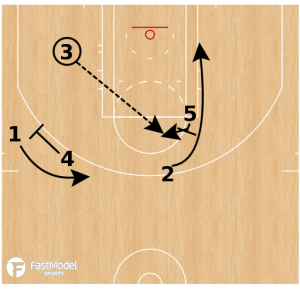
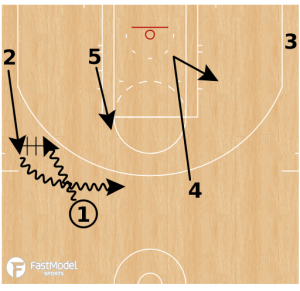
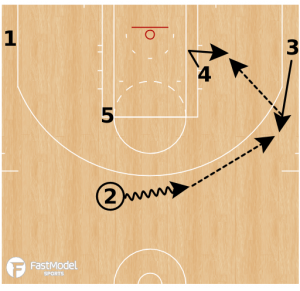
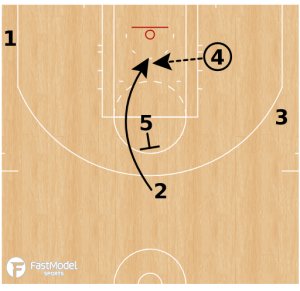
1 runs a dribble hand off with 2.

4 back-cuts to basket when 2 dribbles at him


3 comes up for a catch from 2.

3 passes to 4.


5 sets back-screen for 2. 2 cuts to basket.

4 passes to 2 for layup.


Double Spartan Back

By Brian Williams on July 16, 2017

This play was contributed by Evan Orzolik to the FastModel Sports Basketball Plays and Drills Library.

You can also find out more about FastModel Play Diagramming software by clicking this link: FastDraw

Set run by the Utah Jazz.

Includes a double screen that turns into a flip DHO into the spread pick and roll.

Creative false action to get into the spread pick and roll alignment.

The point of the post is not that you have to take the play as is.

The hope is that you can take parts of this to include with what you do, or that this will stimulate thinking and discussion among your staff to find ways to enhance your current system.

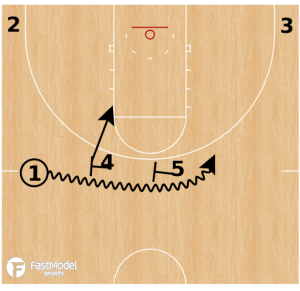
1 dribbles off double ball screen from 4 and 5

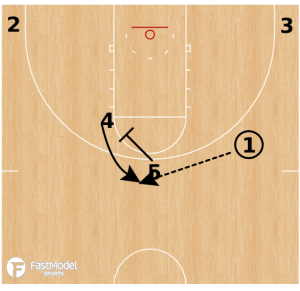
4 rolls to elbow after 1 dribbles past 4


5 down screens for 4

1 passes to 4 at top of the key


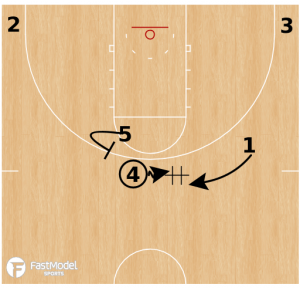
4 dribbles back to 1 and flips the ball to 1

5 gets ready to set elbow ball screen for 1


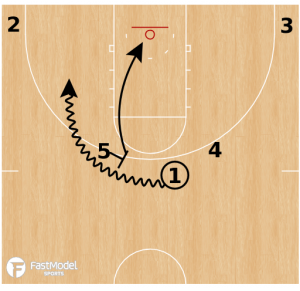
1 dribbles off elbow ball screen from 5

5 rolls hard to rim

-In Spread Pick and Roll


  • « Go to Previous Page
  • Page 1
  • Interim pages omitted …
  • Page 88
  • Page 89
  • Page 90
  • Page 91
  • Page 92
  • Interim pages omitted …
  • Page 288
  • Go to Next Page »

Primary Sidebar

  • Twitter
  • Facebook
  • Linkedin
coachestoolbox
personaldevelopmenttoolbox
basketballplayerstoolbox
basketballtrainer
athleticperformancetoolbox
coachingbasketball

© Copyright 2026 Coaching Toolbox

Privacy Policy