• Skip to primary navigation
  • Skip to main content
  • Skip to primary sidebar

  • Basketball Plays
    • Ball Screen Sets
    • Horns Sets
    • Man to Man Post Up
    • Man to Man Isolations
    • Backdoor Plays
    • Man to Man 3 Point Shot Plays
    • 2-3 Zone Attack
    • Baseline Inbound Plays
    • Sideline Inbound Plays
    • Combination Defense Attack
  • Drills
    • Defensive Drills
    • Offensive Drills
    • Competitive Drills
    • Passing Drills
    • Rebounding Drills
    • Shooting and Scoring Drills
    • Toughness Drills
    • Transition & Conversion Drills
    • One on One Drills
  • Blueprint
  • Practice
  • Mental Toughness
  • Skill Development
  • Offense
  • Defense
  • Store

Utah Jazz Horns Down Flex

Utah Jazz Horns Down Flex

By Brian Williams on March 7, 2018

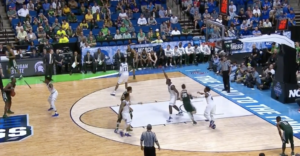
Two plays run by Quin Snyder and diagrammed in Coach Scott Peterman’s Utah Jazz playbook.

These actions do not have to be run as is.

Take the movements and add to them or implement parts of them in what you already run.

Click this link if you are interested in learning more about the
Utah Jazz playbook.


Diagrams created with FastDraw


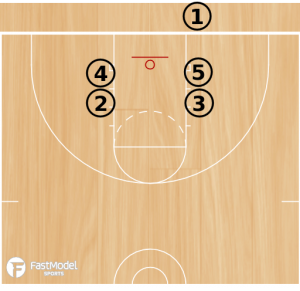
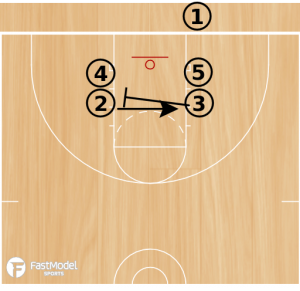
Horns Down Flex
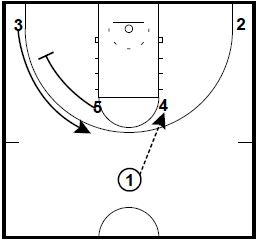
 

1 passes to 4

5 screens down for 3.
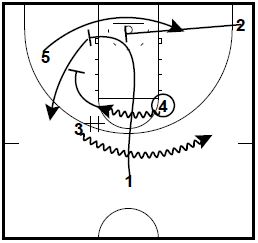


1 cuts into the lane to set a double cross screen for 5.

4 DHO with 3 and then follows into a down screen for 1.


Horns Pin DHO
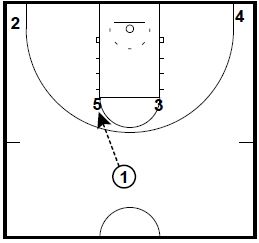
 

1 passes to 5.
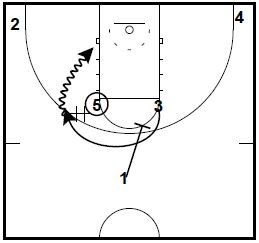


1 screens down for 3 who cuts around 5 for a hand off.



Rip Series Finishing Drill

By Brian Williams on March 6, 2018

This drill is from Mike Neighbors. The drill is available on the Arkansas Women’s Basketball YouTube Channel

Please make sure your sound is on to see the video.

Click the play arrow to see the drill.

The drill is a YouTube video, so you will need to be on a server that allows you to access YouTube to see the drill.


Norming the Team

By Brian Williams on March 2, 2018

Why Norms are the Driver of Team Culture

Dr. Cory Dobbs, The Academy for Sport Leadership

“It’s not enough to know how to lead; you need to know how to build leaders too.”

On a scale from one to ten, how important is having a positive culture to your team’s ability to reach its potential?  When I ask coaches this question, most of them answer in the nines and tens.  Even the most inexperienced of them agree that, like it or not, the team’s culture holds the key to a team’s capacity.  Talent is the foundation for winning, but culture is the guiding force that determines a team’s potential.

Even the least talented team can enjoy its experience if it’s imbued with a positive and motivating culture.  Let’s face it, only one team will win the conference championship.  However, every team will rise to its capacity if its culture is carefully nurtured.

Think of culture like a vibrant and dynamic river.  All rivers are powered by the volume of water, the pull of gravity, and the focus produced by a river’s banks.  The volume of water comes from many small sources—tributaries—flowing in the same direction and landing in the river.  Think of a team’s members as the many small sources, each contributing volume to the rush of the river that is the team’s culture.  The pull of gravity provides force as the river rages toward its goal—the ocean.  And just like the ocean, team’s pursue an ultimate goal—a desired end-state.  The banks, like a team’s norms, provide boundaries that serve to concentrate and funnel the flow thereby giving the river more force and power.  A team’s norms contribute to its social structure that like the river’s banks provides stability, direction, and intensity of organized effort.

Unfortunately, many teams are more like puddles or ponds than powerful rivers.  They stop-short of reaching their capacity and the team experience becomes one of struggle, conflict, and dysfunction.  The channeling effect of the river’s banks makes all the difference between a puddle and a vigorous and focused river.
[thrive_leads id=’36827′]
So, how do you go about creating a high-performing team culture?

The golden rule of culture building is found in relationships.  How team members interact and the kinds of relationships they form has everything to do with what kind of culture emerges, has everything to do with the emergence of trust, commitment, and individual and team performance.  Much of the success of a team lies in the crafting of a sense of “us.”  It lies in the norms, values and priorities that emerge to shape the shared understanding of “who we are.”  A team’s norms channel the sum of all these forces.

Generally speaking, norms are shared standards that define what behaviors are acceptable and desired by a team’s members.  They are informal “agreements,” not formal rules or policies.  So much of how players see and interact with the social universe around them is shaped by norms which are developed, discovered, or invented aspects of daily situations.

Norms emerge and develop from individual behaviors that take place one-to-one, as well as team norms of one-to-many and many-to-many.  Two players may have a relationship that includes good-natured ribbing of one another, while the ribbing might not be a desired behavior in a team meeting.  Norms act as guidelines, embedded rules of behavior if you will, that inform behavior and expectations in interpersonal interactions.

In the scheme of the well-worn Tuckman’s five stages of a team—forming, storming, norming, performing, and adjourning—the norming stage occurs when conflict has been resolved and team unity and harmony emerge.  Once the norming stage kicks into gear the aspirations of the team become visible and elicit inspiration.  A team that has achieved a high degree of maturity relating to team norms is likely to have a strong culture, whereas an immature team—low agreement and adherence to team norms—is likely to have a weak culture.  Simply said, norms are vital for developing a high-performing team culture.

STAGE 3: NORMING The Cohesion Stage

During this stage, team conflict and chaos subside as the team achieves a sense of cohesion.  When the team reaches this stage, team members feel a sense of unity and responsibility to other team members.  Encouragement and acknowledgement of individual and team successes are the norm and commitment to team goals begins to take shape.  A collective identity materializes.  Close relationships will bring trust allowing team leaders to offer team members more constructive feedback.

Team leaders should know that their teammates might be asking themselves:

Do my teammates appreciate me for who I am and what I contribute?
What is my role on the team?
Do my teammates value me as a member of this team?
Who is committed to our team’s mission and goals?

During the norming stage team leaders might:

Assess progress toward team cohesion and team goals.

Identify and find ways to break down “new” barriers that are limiting commitment to each other and the team’s goals.

Keep team members focused on the team norms-those acceptable behaviors that are shared by the team’s members.

Revisit the “I can trust you when…”  and “I can’t trust you when…” exercise.

*Passage taken from The Academy for Sport Leadership’s Teamwork Intelligence Workbook for Student-Athletes

Here’s a sample of norm statements:

▪We put team needs in front of our individual needs.  Encourage members to learn new things.
▪We are committed to open, honest, and tactful dialogue.  Everyone must speak and listen.
▪We support one another personally even when we are in conflict.
▪We challenge members to become a better person.
▪We respect one another at all times.  Yet we see each others’ bad habits and help them to work on them.
▪Each of us is to be aware of our impact on the others and seek to ensure that our ideas, actions, and emotions challenge and support the team.
▪Each of us is responsible for understanding and managing our own behaviors and emotions in ways that support the team.
▪Each of us is responsible for holding each other accountable for owning our behaviors and emotions and to helping us grow and develop as responsible people.

LEADERSHIP RESOURCE FOR COACHES

Coaching for Leadership: How to Develop a Leader in Every Locker. ($24.99)


The Academy for Sport Leadership 

About the Author

Dr. Cory Dobbs is a national expert on sport leadership and team building and is the founder of The Academy for Sport Leadership.  A teacher, speaker, consultant, and writer, Dr. Dobbs has worked with professional, collegiate, and high school athletes and coaches teaching leadership as a part of the sports experience.  He facilitates workshops, seminars, and consults with a wide-range of professional organizations and teams.  Dr. Dobbs previously taught in the graduate colleges of business and education at Northern Arizona University, Sport Management and Leadership at Ohio University, and the Jerry Colangelo College of Sports Business at Grand Canyon University.

Dr. Dobbs recently joined Jamy Bechler on the “Success is a Choice” Podcast – hear his thoughts on team leadership and developing a leader in every locker here.

Back Screen X Switch Tactic

By Brian Williams on March 1, 2018

Army Assistant Men’s Basketball Coach Zak Boisvert posted these videos on his tremendous resource site for coaches. PickandPop.net

Coach Boisvert has posted several videos of some of the better schemes he has seen. His You Tube channel is: Zak Boisvert You Tube Channel

He also is also very active on Twitter: @ZakBoisvert


Editor’s Note from Brian.  The post is provided as food for thought, not to imply that you should implement this in your defense.

If nothing else, at least you can see how other teams are defending.


X Switch for Chin and Back Screens

And, another post he made on using X Switch when defending STS.

X Out Switch for Defending Screen the Screener

Triple Baseline Inbound Plays

By Brian Williams on February 26, 2018

Sharing an idea for a baseline inbounds play to run against man to man defense.

Regardless of the inbound play that is being run, the play begins as soon as the inbounder receives the ball from the official.

Slapping the ball, yelling “go,” or using any other way to signal the start of the play wastes time on the five second count.


It is worth mentioning, that just like any inbound play, or any type of play you run, your players must be sound in screening, cutting, passing, catching, and faking for the play to succeed.


The numbers are for identification purposes only.

You do not need players that fit the stereotypical 1 through 5 positions to run the play.

Always inbound the ball to the first open player to minimize the risk of a five second count.


3 screens for 2


4 screens for 3. This is the first screen the screener for this play.

You can have 2 break beyond the 3 point or inside it.

5 screens for 2.

You can have 2 break beyond the 3 point or inside it.


4 screens for 5 and then opens to the ball (or 5 can screen for 4 if you prefer). Second STS for this play.

2 breaks out as safety release.

You can also consider have the player who ends up in front of the ball release to the elbow for your inbounds pass.

Teaching Your Defensive Philosophy

By Brian Williams on February 25, 2018

This post was submitted by Coach Tom Kelsey.  Coach Kelsey has been a Head Coach at Belhaven University, Faulkner University, and Greater Atlanta Christian High School.  He has also been an assistant at LSU, Alabama, Murray State, and Lipscomb.  He played at Lipscomb under Coach Don Meyer.

Does your team have a defensive identity?

Do your players know what you want on the defensive end of the floor?

Can you quickly state what you want your team to be known for on the defensively?

What defensive concepts will help put your team in the best position to win your league?

All these questions you need to answer when putting together your defensive philosophy.

Taking ideas from years of coaching and finding how respected coaches teach their teams.

Here is a list I have used with my teams and it helps remind me as a coach the areas we need to concentrate on for each game and practice.

Defensive Philosophy

  1. Transition

As soon as the ball changes hands (made shot, missed shot, turnover) we are sprinting back to half court to pick up our defensive assignment. Whether man or zone, we make every defensive transition a sprint to half court. Once we get to half court, our next immediate job  is to find the person we are guarding. If we are in a zone, our job is to pick up shooters in our defensive area.

  1. Stop the Ball

It is the point guard’s responsibility to stop the ball from getting into a penetration area (inside the three-point area). Off the break, we are going to keep our opponent outside the three-point line.

  1. Pressure the Ball

Once a team enters into their offensive set or motion offense, we will keep an extreme amount of pressure on the basketball. We do not want the offensive at any time to be able to pick apart our defense. Point guards will pick up the ball from the half court area and all other players are to keep pressure on their man if they have the ball within 25 feet of the basket.

  1. Contain the Dribble

Players will keep the ball in front of them. Containing the dribble is a key component to us having success on the defensive end of the floor. We have to each be able to contain the dribble by being aware of how close we can guard the offensive player.

  1. Deny the next penetrating pass

We will have a hand in the passing lane when the player we are guarding is the next possible receiver and they are a penetrating pass away. Our goal is to deny each penetrating pass for the player with the ball.

  1. Helpside defense

Our ball side defense will make us tough and our help side defense will make us great. Our defense each possession is a team defense. We have a particular player to guard, but we will guard them as a team. Each player must be ready and willing to rotate spots as the ball changes positions on the floor. We will not allow easy drives to the basket in our half-court defense.

  1. Fronting the Post

We teach each post player to defend the post. When the ball is above the baseline, we will front on the high side. When the ball gets to the baseline, we will rotate our position and guard from the low side. We never want to be directly behind a post player unless our scouting report dictates that is the only way we can guard that particular post player.

  1. Doubling the Post

We will double in the post from different areas of the floor. Depending on the player and the opposing team, we will double from different areas of the floor. We will never double the post leaving a shooter open on the floor.

  1. Guarding Screens

Our way of guarding screens will vary from game to game depending on the opponent. We will start the season by not switching any screens in the post or on the perimeter that are away from the ball.

  1. Guarding Ball screens

On ball screens, we will work on switching the screen, going on top of the screen and staying with our man and we will work on trapping the ball screen.

  1. Closing Out

We will contest each shot taken by our opponent. Each day we will work on our closeout position and stance. We will sprint half way to the opponent then break down in a defensive stance using short chopping steps to closeout. Our weight will be back and our hands will always be up with one hand contesting the shot. We will leave our feet each time to closeout on the shot.

  1. Block out and Rebound

We take pride in making sure to have a good block out each time an opponent takes a shot from the field or free throw line. Our goal is to give our opponent only one shot each time they come down the floor. Once the ball comes off the rim or backboard, we want to put the basketball under the chin with our elbows out.

  • « Go to Previous Page
  • Page 1
  • Interim pages omitted …
  • Page 71
  • Page 72
  • Page 73
  • Page 74
  • Page 75
  • Interim pages omitted …
  • Page 288
  • Go to Next Page »

Primary Sidebar

  • Twitter
  • Facebook
  • Linkedin
coachestoolbox
personaldevelopmenttoolbox
basketballplayerstoolbox
basketballtrainer
athleticperformancetoolbox
coachingbasketball

© Copyright 2026 Coaching Toolbox

Privacy Policy