• Skip to primary navigation
  • Skip to main content
  • Skip to primary sidebar

  • Basketball Plays
    • Ball Screen Sets
    • Horns Sets
    • Man to Man Post Up
    • Man to Man Isolations
    • Backdoor Plays
    • Man to Man 3 Point Shot Plays
    • 2-3 Zone Attack
    • Baseline Inbound Plays
    • Sideline Inbound Plays
    • Combination Defense Attack
  • Drills
    • Defensive Drills
    • Offensive Drills
    • Competitive Drills
    • Passing Drills
    • Rebounding Drills
    • Shooting and Scoring Drills
    • Toughness Drills
    • Transition & Conversion Drills
    • One on One Drills
  • Blueprint
  • Practice
  • Mental Toughness
  • Skill Development
  • Offense
  • Defense
  • Store

Purdue 3 Low Twist Baseline Inbound Play

Purdue 3 Low Twist Baseline Inbound Play

By Brian Williams on March 18, 2018

This baseline inbound play run by Purdue in the opening round of the 2018 NCAA tournament was posted to the FastModel Sports Basketball Plays and Drills Library by Tony Miller. Tony is the men’s assistant basketball coach at Bob Jones University in Greenville, SC.

You can also find out more about FastModel Play Diagramming software by clicking this link: FastDraw

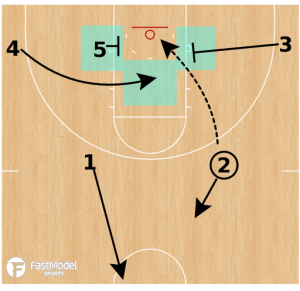
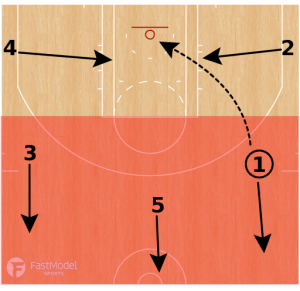
The play uses both misdirection and guard-to-big screens for an open look inside with this 3 Low OOB from the Purdue Boilermakers.


Purdue Boilermakers – 3 Low Twist to Back Screen BLOB
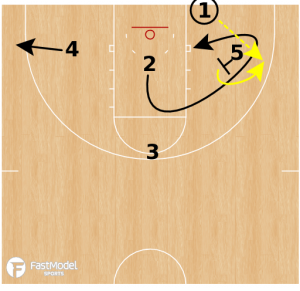
5 screens for 2 who looks back around to strong side block.

4 spaces to weak side corner.

1 inbounds to 5.
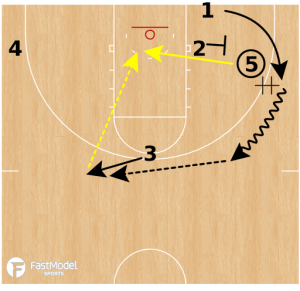


5 hands off to 1 who dribbles toward wing.

1 passes to 3, while 2 sets cross screen for 5.

3 passes to 5.
 

Man to Man Offense Building Blocks

By Brian Williams on March 15, 2018

These two PowerPoint outlines were submitted by Coach John Kimble, retired high school and college coach CoachJohnKimble.com

Follow him on Twitter @CoachJohnKimble

Building Blocks for Your Man to Man Offense

This is a 4 slide PowerPoint. You can advance the slide by clicking in the frame. There is no sound with the presentation. There is also a download link below the presentation.

Loader Loading...
EAD Logo Taking too long?

Reload Reload document
| Open Open in new tab

Download [93.57 KB]

Multi-Phase Offensive System

This is a 2 slide PowerPoint. You can advance the slide by clicking in the frame. There is no sound with the presentation. There is also a download link below the presentation.

Loader Loading...
EAD Logo Taking too long?

Reload Reload document
| Open Open in new tab

Download [60.54 KB]

Offensive Rebounding Concepts

By Brian Williams on March 12, 2018

These concepts were posted to the FastModel Sports Basketball Plays and Drills Library by Jordan Peterson of Positionless Basketball.

You can also find out more about FastModel Play Diagramming software by clicking this link: FastDraw

This is what Jordan said about the post:

Examining some of the recent trends in offensive rebounding concepts.

The weak side flood was made famous by Illinois coach Brad Underwood.

The triangle concept is a more traditional approach.

The abandonment concept is a new trend that many colleges and NBA teams like the Nets, Hawks, Spurs and Warriors have implemented.

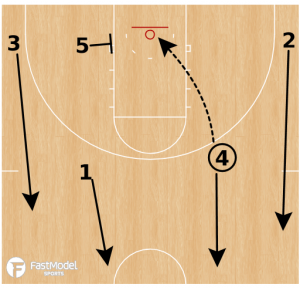
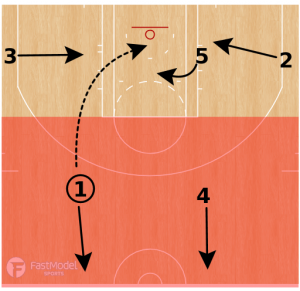
The top back concept. Players above the free throw line extended when the shot is taken are getting back on defense. Players below the free throw line extended are crashing the offensive glass.

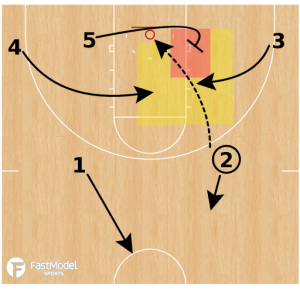
Weak side

Red: Opposite Inside-player from the strong side of the shot circles under the rim to the weak side of the shot.

Yellow: Weakside Flood-next two or three players flood the middle and weakside of the floor.

PG retreats for transition defense.


Triangle

PG and shooter retreat back on defense.

The other three players fill the strong side block, weak side block and middle lane to form a triangle.


Abandonment

Sending all 5 players back on defense or allowing best rebounder to crash the offensive glass while the other 4 players get back on defense after a shot.


Top Back Concept

1 and 4 are above the free throw line extended so are sprinting back on defense.

2, 3 and 5 are below the free throw line extended so they are crashing the offensive glass.


1, 3 and 5 are above the free throw line extended, so they are getting back on defense.

2 and 4 are below the free throw line extended and are crashing the offensive glass.


When (Key) Players Clash: Turning Conflict Into Strength

By Brian Williams on March 12, 2018

by Cory L. Dobbs

John chose Yoko over Paul, George, and Ringo.  Shaq couldn’t stand Kobe.  Steve Jobs was fired by John Scully, his hand-picked CEO.  Socrates rejected Plato’s theory of forms.  Both the West Coast rapper Tupac and the East Coast legend The Notorious B.I.G. were killed as a part of a hip-hop rivalry.  And Carl Jung drifted far from Freud, his close friend and mentor.  Relationships between people of high status often prove challenging.  It not need be this way.

Have you ever been on a team where the players can’t get along?  How about having coached such a team?  Maybe it’s simply a matter of personalities.  Or the circumstances, such as a losing streak, over- power the desire to get along with one another.  Conflicts easily erupt when team relations become dysfunctional.  Yet, many coaches I’ve witnessed seem to think everyone will get along because they are forever preaching teamwork.  This is not so.

The Facts of Life

Your team is only as strong as its weakest relationship.  Yes, I know that’s a strong statement, so let me say it again.  Every team is only as strong as its weakest relationships; and great teams—players and coaches—never assume everyone will get along.  Oh, almost every coach says they spend enough time on relationship building.  Yet when I’ve asked coaches to journal their activities, slowly but surely team building and internal (player) leadership take a back seat to the tasks “necessary” to practice and master the game plan.

Two Sides to Every Story

In an effort to be transparent, let us agree that we like to think of ourselves as being reasonable, mostly right, and when in some level of conflict we often make negative attributions about the other person’s intentions.  Indeed, in the privacy of our own minds, we hold, with white knuckles, our position with a high degree of confidence and certainty.  We must be right, we reason.  The problem is, the other person we are engaged in conflict with is holding tightly to their “reasonableness” too.

Thus a dance of defensive routines emerges.  Each participant—combatant to be sure—thinks that their conclusion is factual, that their view is complete (rather than partial), and the other person is the problem.

The result: conflict.  The condition of the team changes at that moment.  The one-sided nature of each player’s perspective can, and often does, set in motion a roller-coaster of irrationality which invariably will snare more players into its trap.

Nip this in the Bud

You know that to solve a conflict requires slowing things down.  It’s crucial to find out how we got from “there” to “here.”  But the game plan doesn’t allow for this, “We must continue to move forward” you’re likely to think, say—and do.  While you might get back on track, this is why and how things get swept under the carpet.  You know relational issues will catch up with you, but you think if you run fast enough you might out-run the fall-out.  The questionable news is, you just might get away with nipping the problem in the bud.  But it will get you.  It’s just a matter of time.

The Vulnerability of Relational Blindness

Several years ago I worked with a successful high school basketball team.  After a deep run in the playoffs the team wanted to understand how to get over the hurdle and get to the proverbial “next level.”

During a leadership training exercise a senior-to-be, a starter and major contributor, broke down and apologized to his teammates.  He acknowledged the team’s loss should be attributed to him.  As the team’s point guard, with the clock running and down by one point in the state semi-final game, he had the ball in his hand and an opportunity to pass to either of two open teammates.  One teammate was not a scorer (1.5 ppg), while the other was the team’s leading scorer (19.0 ppg) and best shooter.  Down by two, he crosses half court and sees the two teammates open in each corner.  He had a choice.   And he knew the team’s best option.  So do you.  He passed it to the non-scorer, coincidently his best friend, who put up a shot with time expiring.  Air ball.

The caring young man, in his desire to be transparent, admitted that personal bias led to the sub-optimal choice of shooters.  He said it was rooted in a fight he had with the leading scorer around mid-season.   And after the fight was broken up by teammates, he willingly “recruited” the underclass team members to “side” with him.  They did.  And in effect they split the locker room into upperclass vs. underclass; seniors against the juniors.  No coach witnessed the fight, never heard that it happened, and the coaching staff was completely unaware that the locker room split.  The players, in a twisted show of team work, hid the division—the fault line—that ultimately cost the team a shot at the State Championship.

Any time you talk about relationships it’s easy to gloss over the fact that people create and sustain them.  People matter.  Relationships matter.  Student-athletes make a wide range of choices that affect relations, mostly unconscious as in the incident mentioned above.  Importantly, it’s utter folly to think that you, or any coach, will know all that goes on with team member interpersonal interactions.  This, of course, is a reason for team leaders—you need your players to engage in detecting and correcting problems encountered as they build the team.

Over the course of a season incidents like this pile up and drag down practices, film study, and in-game behavior.  Don’t get me wrong, I’m not suggesting coaches are blind to such deviant behavior.  What I do know though is that when the choice for spending time is either better spent on direct team building or the game plan; it is the relationship side of things that usually falls by the way side.  Relationship building is sorely neglected during the course of a season.

Hit the “Pause” Button: Rebuilding Trust

The good news is that when conflicts and dysfunction rear their ugly heads, you can, and should, turn them into team building teachable events.
[thrive_leads id=’36827′]
When two players (or more) clash, you need not throw your hands up and declare the issue unsolvable.  Actually, this is the moment to explore the “honesty” in perspectives.  Most coaches ignore this moment.  It stresses them out.  But if you’re willing to, you can use the “argument” to strengthen the relationship.

In the dictionary, the antonym of honesty is lying.  Thus a participant in any conflict is going to protect himself.  In most cases differences of opinion arise out of one’s desire to feel respected, appreciated, and needed.  And the opposite of arguing is agreement.  The curious thing is that the conflict participants are, for the most part, seeking agreement—however one-sided it is to begin with.

You can capitalize on this moment of truth by harnessing honesty and agreement.

You task, and goal, is turn the adversarial relationship into one in alignment with the team’s mission.  Now is the time to hit the pause button—literally.

Give the participants their own quiet space in which to reflect and respond to the following questions.

  • What is the outcome I want here?
  • Do I want a relationship with this person?
  • What is the outcome our teammates want?
  • What goals do we share?
  • How do I want this to end?

These reflective questions help the student-athlete learn to see themselves as architects of their own experience.  They determine the need and desire to shift to acting on the end they want and the future they’re trying to achieve.

During the course of a season the absence of interpersonal conflict is unlikely.  Conflict is natural.  What you do with conflict will have much to do with the growth, or stunting the growth, of your team building efforts.

New to the Second Edition of Coaching for Leadership!

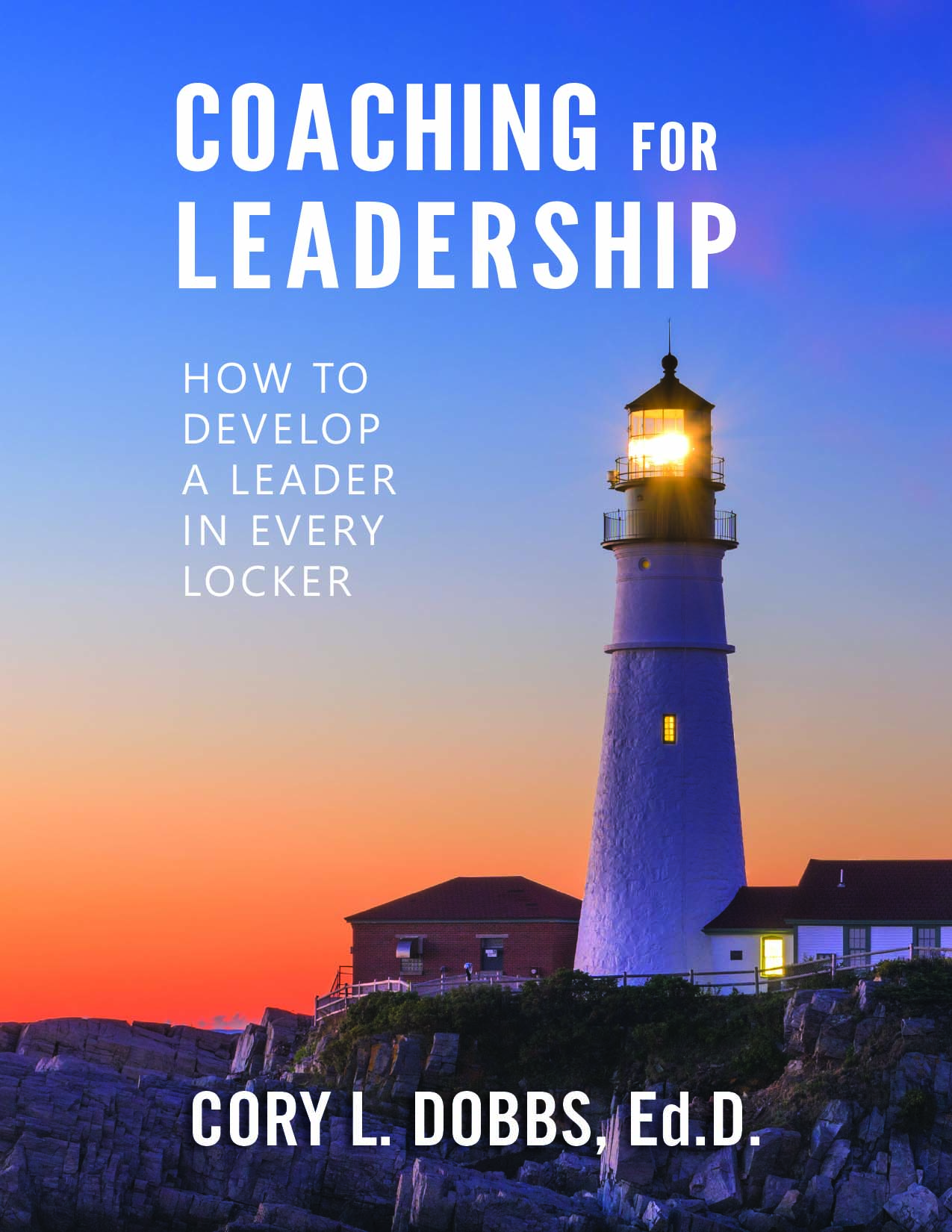
We are pleased to announce a new chapter to the second edition of the best-selling Coaching for Leadership. The chapter, The Big Shift: Unlock Your Team’s Potential by Creating Player-Led Teambuilding, connects the previous edition of this book to its origin, as well as to the future of team sports. The new chapter sets forth a practical and applicable agenda for change and improvement. The reader is introduced to seven vital elements of change; seven shifts of traditional mental models that lead to the new core principles necessary for creating a player-led team culture. Click here for more information about Coaching for Leadership

The Academy for Sport Leadership 

About the Author

Dr. Cory Dobbs is a national expert on sport leadership and team building and is the founder of The Academy for Sport Leadership.  A teacher, speaker, consultant, and writer, Dr. Dobbs has worked with professional, collegiate, and high school athletes and coaches teaching leadership as a part of the sports experience.  He facilitates workshops, seminars, and consults with a wide-range of professional organizations and teams.  Dr. Dobbs previously taught in the graduate colleges of business and education at Northern Arizona University, Sport Management and Leadership at Ohio University, and the Jerry Colangelo College of Sports Business at Grand Canyon University.

Laker Outlet Drill

By Brian Williams on March 10, 2018

This post was submitted by Coach Tom Kelsey.  Coach Kelsey has been a Head Coach at Belhaven University, Faulkner University, and Greater Atlanta Christian High School.  He has also been an assistant at LSU, Alabama, Murray State, and Lipscomb.  He played at Lipscomb under Coach Don Meyer.

Use this basketball drill to cover key areas for your team.

I like to use drills which combine areas of the game which will help us improve.

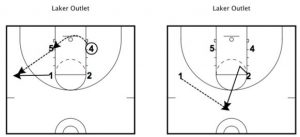
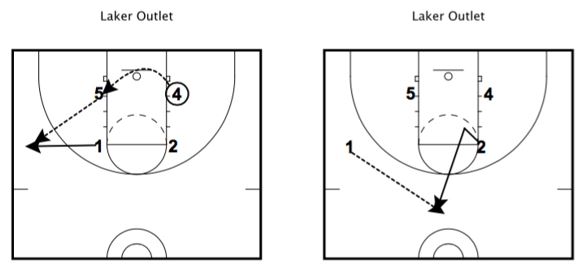
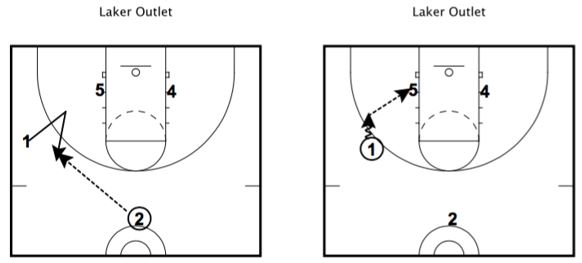
The Laker Outlet Drill works on blocking out, handling the basketball, getting open, feeding the post, hitting the open man, setting screens, on the ball defense, denying the pass and post defense.

The important part of anything combination drill is not to lose focus on any area. Each technique is emphasized. As with any basketball drill you want to concentrate on the technique. Don’t do drill for the sake of doing the drill. Work on the small details.

Laker Outlet forces players to concentrate and each move is critical. I like this also because it makes players work in a confined area of the court. Do not allow lobs to be thrown. Make offense work to receive each pass. Players also have to be solid with the ball on each catch, utilizing pivots to create space.

To begin work with, no defense.

Coach or player can throw the ball off the backboard and players will work on the block out position and technique. Start with designated offense and defense. Later once they understand the drill, you can make it competitive and whoever gets the ball off the rebound is offense.

As with any drill, you must think of how to break down and what are the teaching points. Here is a how to break it down into teaching points.

Teach rebounders

  • Hands up
  • Make contact on the block out
  • Chin the ball
  • Make outlet pass to a teammate by throwing the ball away from the defense.

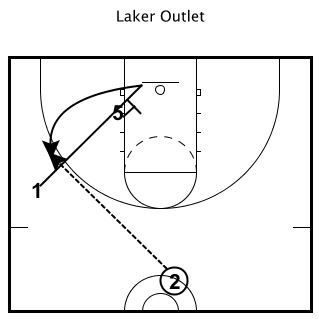
Once rebound is secured, the wing will v-cut to get open for the outlet pass. Working on technique of getting open: Quick v cut, pushing off outside foot, changing speed and direction.

  • Hands up to receive the pass
  • Secure the ball
  • Catch with back to sideline
  • Turn and face up the floor
  • Look for teammate and make strong, quick pass

Player on top will now work on getting open. Same techniques as before with the wing.

Once player receives the ball up top, wing must v-cut again to get open.

Wing now dribbles down to feed the post player.

  • Using pivot to create space
  • Low to the ground
  • Dribble with outside hand protecting the ball
  • Jump stop on the wing
  • Use pivot again to create space
  • Pass fake first before making the post feed (either fake high to make bounce pass or low to feed high)

Post player will work on technique of catching the ball.

  • Give hand target to passes
  • Come to meet the pass
  • Secure the ball and chin
  • Use one dribble move to get to the basket
  • Once defense is added have post player move away and then v cut back into the post area.


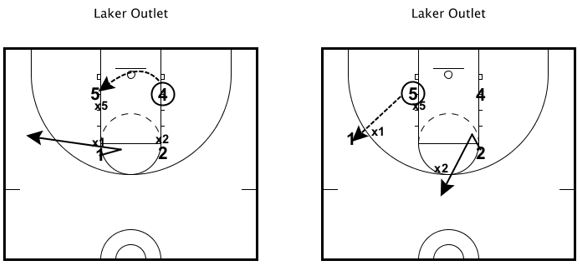
Add screening for another option. Guard up top looks for wing coming off the screen from the post player. Working on setting and using screens.

  • Wing must make v-cut and use the screen by coming off shoulder to shoulder with screener.
  • Hands up and target for passer
  • Screener must work on staying still on the screen
  • Once wing comes off screen, screener will look for the ball with hands up on the slip
  • Here you can work on different cuts off the screen, pop out, curl, flare, back pick.

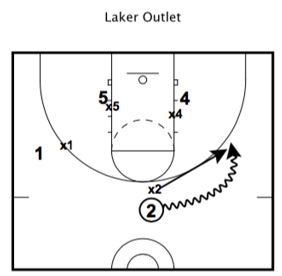
Now add in the defense. Working on technique for denying passes, guarding the dribble and fronting the post.


Another option guard on top once receiving the ball dribbles away from where the pass came and looks to feed the post.

To make it competitive divide into teams and play to a predetermined score.

Guards are not allowed to make a move to get open until passer has the ball. The wing cannot move to receive outlet until teammate has the rebound.

Guard on top cannot make a move to get open until wing has the ball. The creates more emphasis on working to get open.

Finding a Coaching Mentor

By Brian Williams on March 8, 2018

This article was contributed by:

Justin Matthew Brandt
[email protected]
CoachJB.weebly.com
Here is a link to his YouTube channel
Here is a link to his Instagram

One of the best pieces of advice I can give any person is to find a mentor. Notice I did NOT say student, athlete or aspiring coach. This bit of advice should be applied by everyone, both young and old, experienced and novice. SEEK OUT MENTORSHIP! We do a fantastic job of telling our youth that they should go to college, find a trade or join the military. However, what we tend to fail to suggest, is to find someone who has experience in our desired field or holds a position in which we hold in high regard.

As the great Andre “3000” Benjamin once said, “they say selling is a sin. Well so is telling young men that selling is a sin, if you don’t offer new ways to win.”

The fact is that knowledge in itself is NOT power. The application of knowledge is power, and if we do not seek out opportunities to apply the knowledge we acquire, we are then wasting precious prospective moments to grow and reach our highest potential. A simple way to apply your knowledge while growing more, is seeking out mentorship and always asking how you can help. Yes, the idea behind mentorship is for you to learn, grow and gain some real-world application of knowledge. Conversely, being selfish and always taking from your mentor will only help you lose the trust of your mentor quickly. Remember, relationships are a two-way street. It’s not about what you know, nor is it about who you know, but it’s about who knows you and thinks highly of you, OR, even best, who thinks of you when they are in a time of need.

Anytime you can help lighten your mentor’s workload, you are doing a great deal of good in your personal development. Consider the following…

  • Your mentor asks you to cut some film for them. While this may seem like a long painstaking process, you have the opportunity to watch the game, take any kind of notes on the current objective (offense, defense, player development) and learn the process behind cutting film if you’ve never done it before. Not to mention, if you mess up or haven’t done it correctly, your mentor will offer advice as opposed to you drastically getting something wrong for your boss.
  • Your mentor asks you to run the NBA (youngest age group) section of camp. Again, this may seem like a long painstaking process, BUT THIS IS A COMPLIMENT! Anyone and everyone can coach or work with people who excel at their job. But it takes someone special to do the little things that others do not care to do. In addition, working with people who do not already have a refined skillset allows you to learn how to teach them the smaller nuances of the craft and how to make it enjoyable!

These will be critical moments for your personal and professional growth. Remember, be the person that people think of when they are in a time of need. This past week I reached out to my mentor by sharing with them a motivational quote and journal prompt that I use for the classes that I teach.

Emphasis of the Day: “Timing, perseverance, and 10 years of trying will eventually make you look like an overnight success.” – Biz Stone (co-founder of Twitter)

Journal Prompt: How did the person you look up to get to where they are today?

Like clockwork my mentor responds with a solid gold nugget.

I will give my feedback Give me your thoughts

Introspective Questions a leader should ask themselves.

  • What impacts winning? Why?
  • Is culture important? Why?
  • What is culture?
  • Do believe in rules or standards?
  • Is there a difference?
  • How do you create “believe in/buy in”?
  • Coach k his team the five fingers of hand. What 5  adjectives would you use to describe your ideal team?
  • What value on a scale of 1-5 with 1 being the lowest and 5 being the highest would you put on these 5 traits: 1. High character. 2. Talent. 3. Work ethic. 4. Being a great teammate. 5. Winner. 6. Coach-ability.
  • Two types of character skills: performance and moral skills are important I feel. Write down 5 performance skills and 5 moral skills that are important to you.
  • Now define in your words what those 5 performance and 5 moral skills mean.

This is the quintessential example of how the mentor/protégé relationship works. The protégé shares information with the mentor that they believe the mentor might enjoy, and the mentor responds with a critical thought provoking response that has a direct correlation to progressing in their chosen career, in this case, as a coach.

Don’t get me wrong, I understand that education is vital and that you will not get far in this world without some type of a degree. However, please be reminiscent of the adage, “knowledge is not power, it’s the application of knowledge that is power.” If you attain higher education but do not apply it in your daily life or throughout your career, how can you expect to reach your highest potential? Likewise, if you do attain that higher level of education but then get complacent, you will be surpassed by those individuals who continue to grow/learn and do a tremendous disservice to those whom you coach, teach or mentor.

I would like to end this by saying thank you to my mentor, Coach Kevin Sutton. Coach Sutton has continually helped me throughout my career despite what is going on in his. There has never been a time where I have not been able to count on him responding to my phone calls, e-mails or text messages. I hope that one day I will be able to leave as great of a positive impact on another person’s career/life as he has mine.

  • « Go to Previous Page
  • Page 1
  • Interim pages omitted …
  • Page 70
  • Page 71
  • Page 72
  • Page 73
  • Page 74
  • Interim pages omitted …
  • Page 288
  • Go to Next Page »

Primary Sidebar

  • Twitter
  • Facebook
  • Linkedin
coachestoolbox
personaldevelopmenttoolbox
basketballplayerstoolbox
basketballtrainer
athleticperformancetoolbox
coachingbasketball

© Copyright 2026 Coaching Toolbox

Privacy Policy