• Skip to primary navigation
  • Skip to main content
  • Skip to primary sidebar

  • Basketball Plays
    • Ball Screen Sets
    • Horns Sets
    • Man to Man Post Up
    • Man to Man Isolations
    • Backdoor Plays
    • Man to Man 3 Point Shot Plays
    • 2-3 Zone Attack
    • Baseline Inbound Plays
    • Sideline Inbound Plays
    • Combination Defense Attack
  • Drills
    • Defensive Drills
    • Offensive Drills
    • Competitive Drills
    • Passing Drills
    • Rebounding Drills
    • Shooting and Scoring Drills
    • Toughness Drills
    • Transition & Conversion Drills
    • One on One Drills
  • Blueprint
  • Practice
  • Mental Toughness
  • Skill Development
  • Offense
  • Defense
  • Store

What Are Your Summer Goals?

What Are Your Summer Goals?

By Brian Williams on June 10, 2018

This post was written by Texas A & M Assistant Coach Bob Starkey and shared on his Basketball Coaching Blog, HoopThoughts

Editor’s Note from Brian.  Even if you are able to practice and play games in the summer, there are several ideas here that you might be able to fit into what you do.

I’m a big believer that what a player and/or team does when the coaching staff is NOT around goes a long way into the success level of said player and/or team.  Discipline is about what you do when no one is around to watch.  Obviously, there is no bigger range that the summer months when on the collegiate level, we have no access to our players in regard to what they are doing on the court.

Keys to a good summer should include:

1. Commitment: The staff can make the gym available but it is up to the player and the team to make use of it.  During our Final Four run at LSU, the players would drive us crazy to open the gym for them.  Seimone Augustus would play 2 hours of pick up with the Lady Tigers and then drive across town and play pick up with a boys high school team.  Several of our players would head to the rec center to play with men after pick up.

2. Concentration: It is not enough just to walk in a gym and play.  The great players/teams go into each opportunity knowing there are specific things that they need to work on and they must have a high level of focus during pick to improve upon those areas.  Habits can be developed and improved upon in the summer –good ones and the bad ones — based on the commitment and concentration of the player(s).

3. Effort: The average player goes through the motions in pick up and in their summer workouts.  They will give a little effort at times but nothing consistent.  And that is largely why they are “average” players.

While we can’t be there with them, there are ways for us to enhance the off-season process for the players.  The first thing is to meet with the players individually and the team as a whole and talk to them specifically about the areas that need to be worked upon in the off-season.

My suggestions would be to give each player something they do well and encourage them to continue to improve in that area.  John Maxwell talks often about how the great ones know what their strengths are and work hard so that it remains a strength.

Obviously you should also give them a couple of weaknesses to improve upon.  With some players, you might be able to list 7 or 8 things — don’t.  Less is more.  Pinpoint a couple and challenge them to come back in the fall better in those areas.

Be specific in how they need to go about improvement.  It is not enough to tell a player to work on her dribbling with her weak hand in the off-season.  Give her some specific drills that she needs to do during the summer and how often you think she needs to do them to gain improvement.  We had one player at LSU that was a very good player but had a poor left-hand.  We gave her a list of drills to work on her game.  But we also told her she was not allowed to use her right hand in pick up — and we told her team this as well.  We wanted everything she did (other than shoot) to be off of her left hand.  Don’t expect to tell a player to work on something and not tell her how.

Finally, you should be specific in what you expect to see in them when workouts in the fall start. Paint a picture of what you want to see and share that vision with them.  Part of this process should be follow up.

“How’s the work on your left hand coming?”

“Are seeing and feeling any improvement?”

The other thing we did at LSU and now at Texas A&M was to create guidelines for playing pick up.  These not only applied in the summer but anytime during the fall and spring when we were out of season and playing pick up.  Obviously they need to specific to your philosophy and how you play the game.  These were typed on a sheet and placed in their notebooks and we went over them with the team in detail early in the fall and right before summer.

Here is what our guidelines at Texas A&M are for pick up games

1. ALWAYS PLAY MAN TO MAN DEFENSE
Good pressure on the basketball (even if you get beat on the drive)
Get a hand up on every shot
Make contact, blockout, and finish the possession
Get in the passing lanes
No switching

2. RUN OUR OFFENSIVE SETS
Spacing: High and Wide
Minimize your dribble usage
Take good shots
Set good screens to get your teammates open
No ball screens
No plays or entries

(This is also a great opportunity for your veteran players to teach your new players a few of your offensive sets)

3. START WITH HALF COURT GAMES
Even if you have enough for 5/5, start with a couple of half court games
Will help us to develop our man defense and offense principles

4. UTILIZE CONVERSION
After half court games, finish up with full court games

5. GET BACK ON DEFENSE
Even 4/4 games can be played full court

6. TAKE ADVANTAGE OF EVERY OPPORTUNITY TO PLAY
3/3, 2/2, 1/1
Play, play, play

7. BE A GOOD TEAMMATE
Encourage teammates
Upperclassmen teach our freshman how we play
Help freshman to understand offensive/defensive principles

8. PLAY HARD
Is there any other way?!

A few weeks ago I attended a Coaching Roundtable in Arlington, Texas with some very bright coaches from the collegiate and professional ranks.  One of the topics that was brought up was maximizing summer pick up.  Here are some of the things I took way from that discussion.

  1. LET PLAYERS PICK THE TEAMS

Gives them a chance to know where they stand with their teammates.  Makes captains give thought as to who they think can help them win.

  1. PLAY SHORT GAMES

Play to 7 or 8 points.  This creates a greater sense of urgency and can cultivate more intensity.

  1. VALIDATE THE WIN WITH A FREE THROW

After a team gets to the point total needed to win, a player (selected by the losing team) must hit a free throw for the victory to be complete.  Otherwise another game is started at 0-0.

THERE WILL COME A TIME

WHEN WINTER WILL ASK,

“WHAT HAVE YOU DONE THIS SUMMER?”
130 in 2 Full Court Shooting Drill

By Brian Williams on June 10, 2018

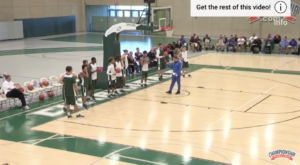
This full court shooting drill is from Coach Mike White.

The video is hosted on YouTube.

You will need to be on a network that allows you to access that site.

Many programs do a similar drill.

I like the fact that the bigs shoot different shots besides layups.

In my opinion, any time you do conditioning, it is best to do it by passing, catching, shooting, and dribbling while you are running.

The goal for the drill is to score 130 points in 2 minutes.

You might need to set your standard a little lower depending on the level that you coach.

You can also adjust the scoring if you want players to shoot 3 point shots in the drill.

Or, you could set the standard lower to begin and then increase it as your team improves at this drill.

The video is from the Championship Productions YouTube Channel

If you are interested in learning more about the Championship Productions Basketball Coaching Video (available in both DVD and Instant Video Format) that this drill came from, you can click the following link: Mike White: Team Skill Development

Click the play arrow to view the video.

There is narration with the video, so please make sure that your sound is on.

Non Stop Shooting Drill

By Brian Williams on June 5, 2018

This drill was contributed by Jordan Petersen to the FastModel Sports Basketball Plays and Drills Library.

Jordan is the Founder and Director of Positionless Basketball. Varsity Assistant at Stillwater High School (MN). Former Graduate Assistant at MSU-Moorhead. Former college player at UW-Eau Claire.

You can also find out more about FastModel Play Diagramming software by clicking this link: FastDraw

These are Jordan’s comments on the drill:

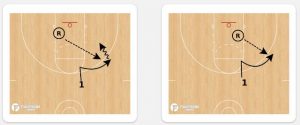
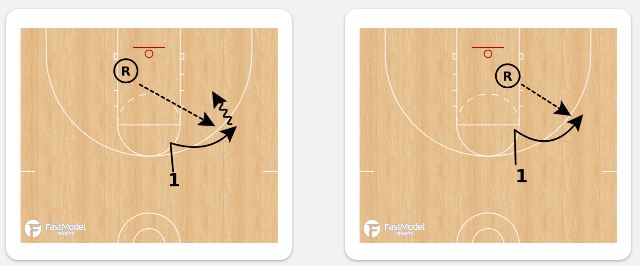
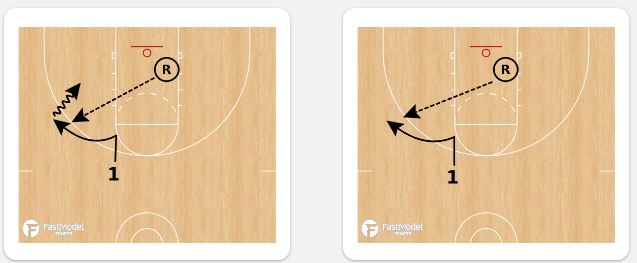
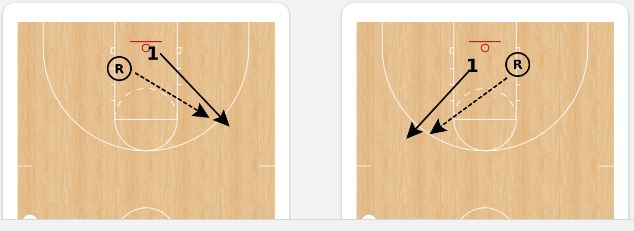
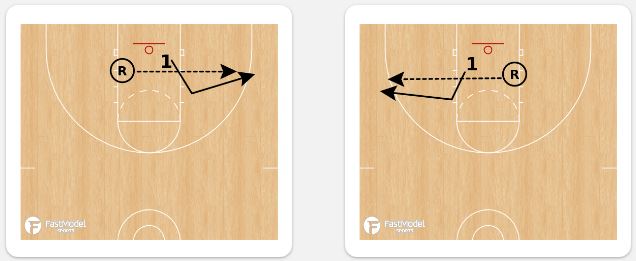
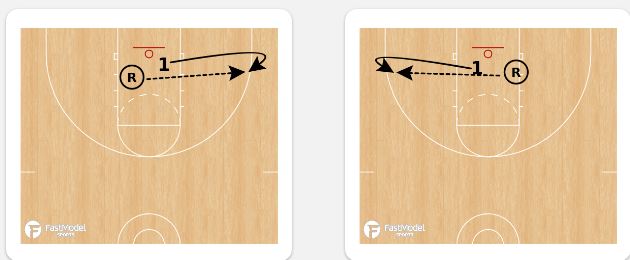
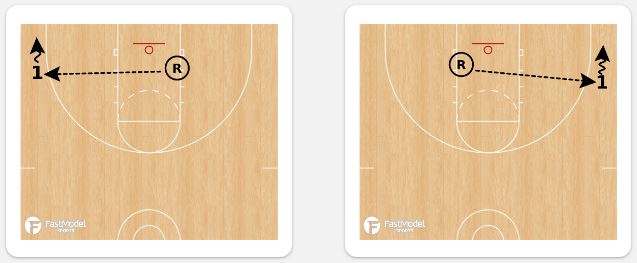
Great shooting drill to work on all types of shooting along with conditioning. 6 minutes of non stop shooting, 30 seconds on each action.

Editor’s Note from Brian: Modify the shots and the passing angles to fit the spots that your players get shots from in your games.

You can also develop a scoring system and standards for your level to make the drill competitive.

Cut off a flare screen shot fake and pull up going right, then cut off a flare screen going right for 3 point shots.

Cut off a flare screen shot fake and pull up going left for 30 seconds, then cut off a flare screen going left for 3 point shots for 30 seconds.

Cut off a pin down going right for 30 seconds, then cut off a pin down going left for 30 seconds.

Fade cut on the right side for 30 seconds, then fade cut on the left side for 30 seconds.

Corner 3s on the right side for 30 seconds, then corner 3s on the left side for 30 seconds.

Lateral dribble left corner 3 for 30 seconds, then lateral dribble right corner 3s for 30 seconds.

Defining What it Means to Compete

By Brian Williams on June 4, 2018

This post was contributed by Youth Ice Hockey Coach Karl Norton. I believe that the article contains many points that are also applicable to coaching basketball.

These are Coach Norton’s comments:

We will also be combining this (His 3 on ice objectives for his team) with our culture and compete objectives that we will ask the players to develop. I attended a coaching conference in June hosted by The Way of Champions and Changing the Game Project. There were about 60 coaches involved with a wide range of experience. This was one of my biggest take-aways and I’m looking forward to combining these ideas with my focused goals. The other element is the inclusion of the parents in the team culture so that they know what to support and encourage. This will be quite a challenge!

The intent of the process is to end up with 3 main points for Culture and Compete. A lot of words and phrases are synonymous so they will lend themselves to grouping of key ideas. The really big point is that it comes from the players!

I want to acknowledge where the underlying ideas come from. James Leath, Dr. Jerry Lynch, John O’Sullivan, and Reed Maltbie, as well as many others have been a major influence on my thought process. My own thoughts have melded with those who have ideas that I am attracted to!

Team Culture

At the start of the season, when we have all the players together, I would like to start working with the them on developing their Team Culture and their goals for competition.  What is important to them?  How do they want to play?

Objective #1: Players establish a set of team values.  What is important for your team?  What do you want to be known for?

Divide the players into 2 groups and ask each group to list 5-10 specific things that are important to how they want their team to be.  Combine the groups, discuss the ideas, and establish their team values.

Core values should be inspiring, believable, hold everyone accountable, things that will be rewarded daily in practices and games.

Words that describe great teammates and culture:

Grateful
Team player
Caring
Giving – what can I give for the team effort
Encouraging
Helpful
Good Sportsmanship
Supportive
Respectful
Great attitude
Fearless
Communicator
Positive
Focused
Kind
Gives all-out effort
Loyal
Listener
Trusting
Never gives up
Never loses confidence
Is never defeated – the other team cannot take away their mission

Objective #2: Players define what it means to Compete.

Establish a Warrior Culture

Internal focus – not immediate outcomes
Process driven
Self-less attitude
All effort
Every day excellence
“When you compete, you’re difficult to beat.”

Divide the players into 2 groups and ask each group to list 5-10 specific ways that, when executed, demonstrate what it means to compete.  Don’t focus on winning, focus on competing “like crazy with your hair on fire!”  Combine the groups, discuss the ideas, and establish how they wish to compete.  This is their Mission.  The “exceptional execution of extraordinary excellence”.

For example:

Scrap for puck
Sprint hard on back checks
Play In-Your-Face tenacious defense
Be “present” on defense
Defend together
Attack together
Identify your man
Head up, feet moving
Communicate
Reaction to mistakes – move on quickly
Work hard

All tasks that are controllable, doable and easy to accomplish.

Combine groups and create a master list “This is how we will compete!”

Show up to compete!

Focus on competition – do the little things brilliantly

Controllable
Calm, Relaxed
Focused
Extraordinary performance

How to Build a Competitive Spirit in Athletes

By Brian Williams on June 4, 2018

This article was written and submitted by JP Nerbun of Thrive on Challenge

You probably have had the realization that you want to win more than your players do; most young people today seem to lack the competitive fire that makes for a special athlete.

And in the cases when they do have a strong competitive fire, it seems to burn out of control, most often taking the shape of pouting and blaming others when they lose and taunting others and boasting when they win.

Let’s talk about what a healthy competitive spirit looks like and how we can develop it in our athletes

The Fight of the Century: Micky Ward vs Arturo Gatti

The fight was like something out of Rocky!

On May 18, 2002, Micky Ward faced Arturo Gatti in what would be hailed as one of the greatest boxing fights of all times. Both fighters were known not for their defensive prowess, but their ability to take a punch! People knew it would be good—just not that good!

The fight was a bloodbath for both fighters, especially in Round 9 (go to 33:40 in the link to the fight). When watching this fight, you cannot help but stand up and cheer for both men. You may even get goosebumps. It’s not about the brutality of the fight, but the resilience of both fighters. Just when you think one fighter is surely done, they come right back and continue the fight.

But the most inspirational part of this fight comes after this epic battle between the two fighters (which put them both in the hospital with severe injuries). As the final bell rings, you can see them embrace each other, literally holding each other up and congratulating each other on such a hard battle.

The fight itself was the start of a friendship that would last until Arturo Gatti’s untimely death. But before Gatti died, the two of them would go on to have two more epic battles—the latter being Micky Ward’s final fight—and Ward would also go on to train Gatti for the final fight of his career. This is literally something we see in Rocky 3, when Apollo Creed trained Rocky Balboa!

While we can be inspired by their resilience and toughness, what we do not want to miss is their competitive spirit—The truth that competition not only brought them closer together but helped them make each other better! The story of their trilogy is that of true competitors striving to give and be their best.

If you want to know more about this fight, check out the HBO documentary. It is definitely one of the best sports documentaries I have ever seen.

Competere

“The joy of playing does not need to be sacrificed in the name of competition. On the contrary, the joy of playing includes winning and performing at your highest possible level. Sports ask for all of your mind, body, and spirit to win the game. It also demands that it be done with virtue. Accepting anything less transforms play into a selfish work.”
—Dr. Bill Thierfelder

Competition comes from the Latin word competere, which means “to come together or strive together.”

When you watch competitions like the Gatti-Ward fight, you can’t help but think this is what the Romans meant by the word.

Sadly, competition in today’s sporting culture seems to be more divisive than unifying. It is more about dominating or conquering others instead of striving for excellence.

Rivalries in sports can make for some of the most exciting sporting moments and they can bring out the best in people. For example, here are some of the greatest rivalries in sports:

• Duke and North Carolina
• Lakers and Celtics
• Yankees and Red Sox
• Bears and Packers
• Michigan and Ohio State

Just mentioning these legendary rivalries elicits intense emotions in fans and memories of the most epic games of sports fans in general. These rivalries can highlight people’s finer qualities as well, Take, for instance, when the legendary UNC Coach Dean Smith passed. Duke fans and players honored his passing with a moment of silence before taking the court in the biggest rivalry game in college basketball.

But moments like this one aren’t often the case, as we can see in the behavior of fans and players at competition, on social media, and within the community. People seem to feel that winning at sports can somehow makes them superior to others.  I grew up in Columbia, SC, around one of the great rivalries in college football—South Carolina and Clemson. But on November 29, 2004, that rivalry turned into an all-out, onthe-field brawl between the players. On that day, those men were more like a bunch of thugs than competitors.

This does not just happen at the collegiate and professional level, as we continuously hear of instances of fan violence as well. Just this year in my previous hometown of Chattanooga, TN, a fight broke out between teams and fans of two local high schools.

Attend any youth sporting tournament and you will struggle to see athletes honoring and congratulating each other as you watch them line up to shake hands. The purpose of this tradition was sportsmanship and providing players the opportunity to honor each other and the spirit of competition. However, this tradition has become less prevalent in sports.

Sports, rivalries, and competition provide a great vehicle in which to build character, but sadly, the culture surrounding sports is making this process more and more difficult. I am not saying it didn’t exist before, but the investment of time and money in sports has led to a greater emphasis on winning and personal achievement.

Building a Competitive Spirit

At the top of John Wooden’s pyramid of success was “competitive greatness.” He defined it as, “A real love for the hard battle, knowing it offers the opportunity to be at your best when your best is required.” He understood the importance of that spirit and knew it was about being your best—not about being better than anyone.

As coaches and parents, how can we develop the spirit of competition? Not as our current sporting culture defines it, but as the competere of ancient Rome?

1. Model Sportsmanship. As a coach, consider being the first person in line for your team and taking the time to congratulate and shake each opponent’s hand as you move through the line at the end of the game. As a parent, consider congratulating opposing fans and praising some aspect of their team or a particular player.

2. Communicate Respect. Don’t demoralize or speak poorly of an opponent in an effort to motivate your team. Instead, respect the opposing team by acknowledging their effort and skill.

3. Be Grateful. Instead of blaming referees, we should be thanking them, along with the administrators, timekeepers, and scoreboard operators. Consider texting, calling, or writing a letter to the opposing coach or team to offer praise. Just this season, Cuonzo Martin, the head basketball coach at Missouri, went as far as visiting the opposing team to praise their effort after a hard-fought game.

4. Create a Competitive Practice Environment. Iron sharpens iron! Create a competitive cauldron wherein nearly every aspect of the practice is competitive and recorded. Check out Anson Dorrance’s Training Soccer Champions or Brian McCormick’s 21st Century Basketball to read more about how to do this in a way that promotes healthy competition within a practice. While competition can drive a wedge between players and foster a fixed mindset, when it is implemented and reinforced with the right message, it will do just the opposite. Like in the Gatti-Ward fight, it will bring players together as they strive to become better!

5. Value the Process. Don’t demoralize losers and glorify winners. Continue to communicate to your players that the sport is just a game and your performance does not make you any more or less valuable as a person. What does matter is who you are as a person and who you are becoming through the process. Create a mission for the people on your team to grow as athletes and as people by using sports and competition both in practice and in games to learn and grow.

Call to Action

More and more leagues are moving to a system at the lower levels in which they do not keep score. I disagree with that approach, as it moves to another extreme and is failing to capitalize on the opportunity sports provides to build character through competition.

Handling winning and losing with class need to be taught from the earliest ages. Communicating the importance of having a healthy outlook on the outcome of the game is critical! We should want to be winners every time we take the court, but whether we win or lose, it shouldn’t impact our self-worth or keep us from learning and growing.
Whether we are a coach, a parent, or a player, let’s use our platform by honoring our competition, giving our best, and respecting the opponent.

Competere! Strive together for excellence.

Works Referenced
Less Than a Minute to Go by Dr. Bill Thierfelder

Basketball Post Defense: Scram Switch

By Brian Williams on June 3, 2018

Army Assistant Men’s Basketball Coach Zak Boisvert posted these videos on his tremendous resource site for coaches. PickandPop.net

Coach Boisvert has posted several videos of some of the better schemes he has seen. His YouTube channel is: Zak Boisvert You Tube Channel

He also is also very active on Twitter: @ZakBoisvert

There is a narration with the video, so please make sure that your sound is on.

This is a YouTube video.

If you are having trouble viewing the video, the reason could be that the network you are on blocks YouTube videos.

These are Coach Boisvert’s comments on the video:

Embedded below is a video compilation of the “Scram Switch” the Celtics have been executing when Cleveland attempts to post the smaller Boston guards. The coverage differs slightly from the “Kick Out” scheme the Celtics have been deploying most of the year. With the “Kick-Out” coverage, a weakside big is looking to switch onto the screener as soon as he begins rolling. As you can see in the clips, the “Scram” doesn’t happen until the ball is thrown into the post.

-As I mention in the video, Golden State was the first team I saw utilize the “Scram Switch.” For a video of their Scrams, click HERE. For my post on all of Golden State’s switching concepts, click HERE.

-It seems that in the past 2 games, Stevens has started to encourage his guards to front the post with the “Scram” still coming as soon as the ball is thrown. With the post front, this scheme very much resembles the “Red” coverage that was featured last month.

Boston Celtics Scram Switch

Click the play arrow to view the video.

  • « Go to Previous Page
  • Page 1
  • Interim pages omitted …
  • Page 64
  • Page 65
  • Page 66
  • Page 67
  • Page 68
  • Interim pages omitted …
  • Page 288
  • Go to Next Page »

Primary Sidebar

  • Twitter
  • Facebook
  • Linkedin
coachestoolbox
personaldevelopmenttoolbox
basketballplayerstoolbox
basketballtrainer
athleticperformancetoolbox
coachingbasketball

© Copyright 2026 Coaching Toolbox

Privacy Policy