• Skip to primary navigation
  • Skip to main content
  • Skip to primary sidebar

  • Basketball Plays
    • Ball Screen Sets
    • Horns Sets
    • Man to Man Post Up
    • Man to Man Isolations
    • Backdoor Plays
    • Man to Man 3 Point Shot Plays
    • 2-3 Zone Attack
    • Baseline Inbound Plays
    • Sideline Inbound Plays
    • Combination Defense Attack
  • Drills
    • Defensive Drills
    • Offensive Drills
    • Competitive Drills
    • Passing Drills
    • Rebounding Drills
    • Shooting and Scoring Drills
    • Toughness Drills
    • Transition & Conversion Drills
    • One on One Drills
  • Blueprint
  • Practice
  • Mental Toughness
  • Skill Development
  • Offense
  • Defense
  • Store

The Read & React: Celtics’ Offensive Offense

The Read & React: Celtics’ Offensive Offense

By Brian Williams on July 25, 2018

Submitted by Rick Torbett of Better Basketball

Are you ready for the shift that’s happening in coaching? Do you know the one key that is developing many of the top offenses in the country? Hint: It’s not more creative set plays.

The NBA community is in a fight. It’s a struggle against an enemy that almost everyone has fought at one time or the other: TRADITION. And there’s no better place to read about this battle than right here on the Celtics Blog.

TRADITION says the coach should call the plays from the sideline – just like good ol’ American Football! The players should execute the play and the contest should go to the coach with the best plays and the players who can best execute.

Yeah, right – if you’re playing basketball in 1918 instead of 2018!

This enemy (TRADITION) carries a lot of pressure with it: peer pressure, media pressure, fan pressure, etc. “This is how we’ve always done things; this is the lens through which we understand basketball, so don’t rock the boat, Coach!”

But the skills and athleticism of the players have evolved in my lifetime. Defenses have evolved so much that rules like “3 seconds on defense” had to be created. These changes have created a dilemma in the hearts and minds of the new generation of coaches. These Neo-Coaches (for lack of a better term) can sense that TRADITION is not getting the most out of the BEST BASKETBALL PLAYERS IN THE WORLD!

The Neo-Coach might be thinking:

“Why would I take the highest skilled players with the highest basketball I.Q. and force them to be little robots who carry out my micro-managed possessions in the form of Set Plays? The game is fast and quick; decisions must be made and changed in a split-second based on multiple defensive factors. Shouldn’t I be able to get MORE if I allow the players to make the moment-by-moment decisions while I (the coach) GUIDE them based on our strengths and weaknesses?”

The short answer is “Yes!” (This is why I developed the Read & React Offense)

But, Enemy #2 will raise its ugly head in the NBA: Player Buy-In. Players have to provide the effort and must acquire a “Next Action” attitude when playing Read & React.

In the article, Coach Stevens elaborates:

“We have to play harder on offense. You have to run to your spots in transition, you have to screen, you have to cut. You can’t just watch, you can’t just pound the ball. You have to move with a purpose.”

This new flow that players need to learn can completely transform your offense and it’s amazing to see how much more effort your players will put forth when they are able to play with the flow of the game.

Quote from the article:

“Stevens’ read-and-react offense is predicated on players taking advantage of every decision that a defense makes. With or without Kyrie, those little moments where a player sets a screen or decides to zig instead of zag make a cumulative difference.”

That’s an understatement! The cumulative difference the Read & React makes for our Tribe of coaches at Better Basketball is an extra 20 points per game above what they’ve been scoring! That makes it WELL worth the battle!

If you’re that new breed of coach, hang in there! I have even more guidance via the The Read & React Offense headed your way!

And guess what? They aren’t the only team running a Read & React system. Teams like the Denver Nuggets have transformed their offense with it.
Moves on the Move

By Brian Williams on July 23, 2018

This drill to work on live ball dribble moves was contributed by Coach Joel Hueser to the FastModel Sports Basketball Plays and Drills Library.

Coach Hueser has been a head high school coach for 29 years. He is currently at Papillion-LaVista South High School in Nebraska.

Here is what Coach Heuser said about the makeup of the drill.

In order to break down a defender on the move, we encourage all players to develop a go-to move and counter move. Consider the following points as well:

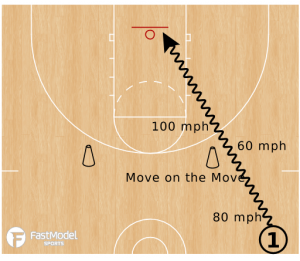
1. Maintain a speed of 80 mph (80%).

2. Attack the defense right between their eyes. Go right at them!

3. Make your move a stride or two away and attack the defender’s outside shoulder at 100 mph (full speed).

4. Finally, close the gap once you get by them.

5. Be sure to practice these moves on both sides of the floor!!!

Inside-Out Move

If you are dribbling with your right hand, step laterally (to the left) with your inside foot and then return to the outside as quickly as possible. Do not change hands with the dribble. However, learn to sell the defender with an inside-out dribble to compliment your inside-out footwork. Master this from both sides.

Crossover Move

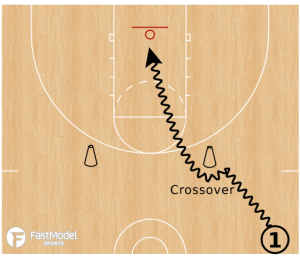
If you are dribbling with your right hand, plant your right foot and quickly cross the ball over to your left hand. When you get by the defender, keep a very low dribble and close the gap. Learn to do this tight and compact with both hands.

Hesitation Move

Dribble right at the defender, then slow down with a quiet stutter and momentarily begin to rise up, as soon as the defender freezes or becomes off balance, explode past him. Push the ball out in front with a low dribble.

Between the Legs Move

Same as the crossover, but dribble the ball between your legs.

Create

Without over dribbling, challenge your creativity on the move. This could be around the back or a combo of other moves. Don’t be afraid to make a mistake when you practice!

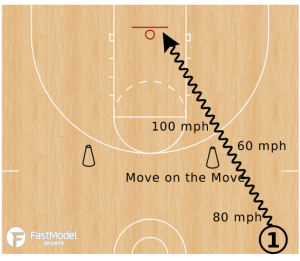
Player 1 starts at halfcourt, favoring a sideline.

He dribbles at the chair or cone at “80 mph,” makes his move on the move at “60 mph” and attacks the rim at “100 mph.”

Always practice your go-to and counter moves together.

We always practice in this sequence:

1. Inside-out
2. Crossover
3. Hesitation
4. Between the Legs


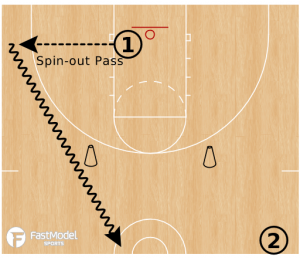
Player 1, after finishing strong off of two feet, gets his own rebound and passes to himself with a “spin-out.”

It’s important this happens outside the arc to enable him to “turn, look and go.”

This is to simulate breaking backcourt pressure with the same move back.

Meanwhile, player 2 goes to work.


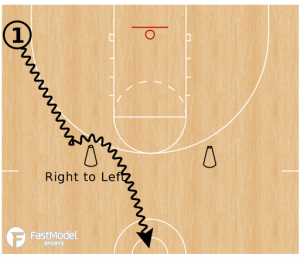
Crossover counter move shown here.


Turn, look and go and repeat the same exact move.

Do the same for hesitation and between the legs moves (not shown).

We sometimes add a 5th move and the players “create.”

This should be a fun move challenging their creativity.

Pick and Roll Defense: Stunting

By Brian Williams on July 11, 2018

The following defensive stunting techniques came from the Encyclopedia of pick and roll defense playbook assembled by Chris Filios for Scott Peterman’s Basketball HoopScoop.

It is paired with The Comprehensive Ball Screen Playbook as this week’s featured bundle.

You can find out more about the bundle by clicking on this link: Encyclopedia of Pick and Roll Defense & Comprehensive Ball Screen Playbooks.

Diagrams created with FastDraw

Or, you can purchases any four of our digital playbooks for $35 (62 titles in all–Virginia, Texas Tech, Duke, Kentucky, Brad Stevens, and many others included!) 20 new titles on July 11!

Click this link for all choices! 4 digital playbooks for $35

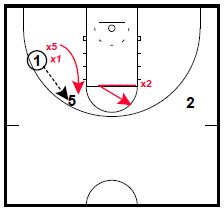
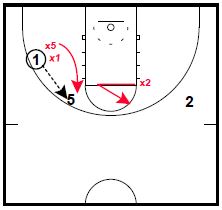
Regular Stunt

If the screener is not a perimeter shooting threat and is a limited play-making threat, the defense will use a standard stunt.

In a regular stunt, x2 will stunt/bluff at the ball as it is arriving to pop man/screener. On the catch, the big will see the guard motioning toward him creating indecision in the big.

x2 will not over or fully rotate to the ball. It is a couple hard steps at the ball and recover back to his man.

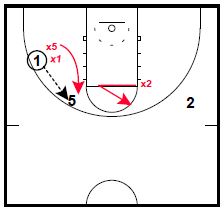
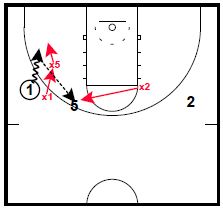
“Quick” Stunt

If the big is not a great shooter or perimeter threat…the defensive will give a quick stunt.

As guard is picking up dribble, the defense will quickly stunt at the popping big. This will create indecision with the ball-handler and buy time for the defensive big to get back to his man.

This will also be used in case the defensive player stunting is guarding a good perimeter shooter.

*This is slightly different from a regular stunt as the stunt occurs PRIOR to the guard picking the ball up.

In a regular stunt coverage, the help side defender will stunt as the ball is arriving to the pop man.


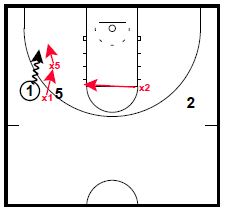
“Hold” Stunt

If the big is good perimeter shooter, the defense can “hold” stunt.

The guard rotating will stunt at the ball and will stay until defensive big can recover to the ball.

This should force the offensive big to become a non-threat, thinking pass.

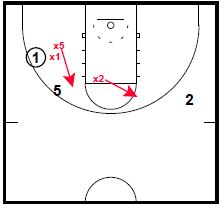
Full Rotation

This is another option when guarding against a skilled big that is a threat from the perimeter. It can also be used in an emergency situation.

The rotating guard will fully commit to taking the ball. Thus taking away any jump shot or driving opportunity. This neutralizes the threat from the
offensive big.

In this case, instead of the defensive big recovering to his man he and the other help defenders are forced to rotate as the ball is moved.

If you are interested in adding to your Coaching Toolbox take look at what I believe is our best offer.

CLICK HERE to select from a list of more than 70 eBooks.

Full Court Pressure Release Drill

By Brian Williams on July 8, 2018

The full court pressure release dribbling drill was contributed by Matt Monroe to the FastModel Sports Basketball Plays and Drills Library.

Coach Monroe is in his third year as the head varsity boys’ basketball coach at Saint Ignatius College Prep and his 17th year overall as a basketball coach.

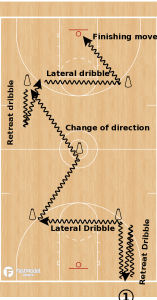
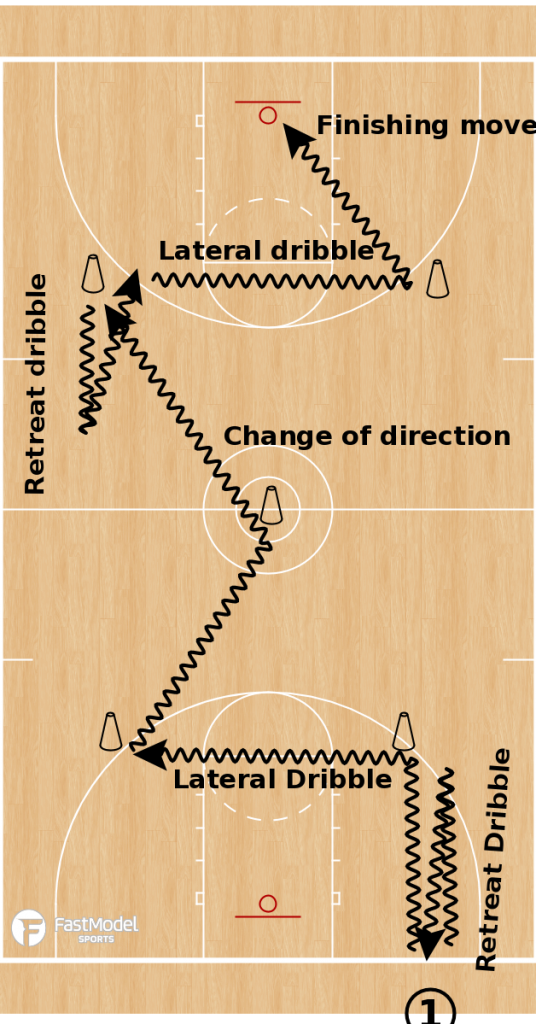
See Diagram Below

• #1 dribbles to the first cone and then performs a retreat dribble.

• After the retreat dribble, #1 dribbles back towards the same cone.

• #1 then completes a lateral dribble to the next cone.

• Once they reach the second cone, they drive hard to the middle cone with their right hand and complete a change of direction move.

• At the fourth cone, #1 completes another retreat dribble and attacks the same cone again.
• They then complete a lateral dribble from the fourth cone to the fifth cone.
• #1 makes a change of direction move at the fifth cone and completes a designated finish around the basket.

You can also find out more about FastDraw Play Diagramming software by clicking this link: FastDraw


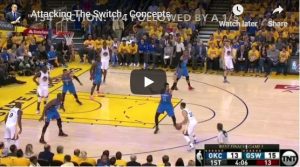
Concepts for Attacking the Switch

By Brian Williams on July 1, 2018

Army Men’s Assistant Zak Boisvert has assembled some of the ways that the Golden State attacks defensive switches.

Coach Boisvert has posted several videos of some of the better schemes he has seen. His YouTube channel is: Zak Boisvert You Tube Channel

He also is also very active on Twitter: @ZakBoisvert

He has an outstanding resource site for coaches. You can access it here: PickandPop.net

The voice-over that you hear is Coach Boisvert


Concepts to Attack Switching Defenses

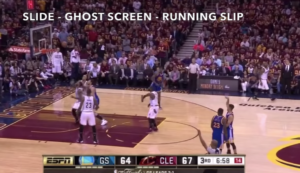
Actions and Sets to Attack Switching Defenses

By Brian Williams on June 30, 2018

Army Men’s Assistant Zak Boisvert has assembled some of the ways that the Golden State attacks defensive switches.

Coach Boisvert has posted several videos of some of the better schemes he has seen. His You Tube channel is: Zak Boisvert You Tube Channel

He also is also very active on Twitter: @ZakBoisvert

He has an outstanding resource site for coaches. You can access it here: PickandPop.net

Coach Boisvert has also diagrammed the plays from the video and has provided a download link to the pdf. You can download the pdf here.

The voice-over that you hear is Coach Boisvert.


Sets and Actions to Attack Switching Defenses

  • « Go to Previous Page
  • Page 1
  • Interim pages omitted …
  • Page 62
  • Page 63
  • Page 64
  • Page 65
  • Page 66
  • Interim pages omitted …
  • Page 288
  • Go to Next Page »

Primary Sidebar

  • Twitter
  • Facebook
  • Linkedin
coachestoolbox
personaldevelopmenttoolbox
basketballplayerstoolbox
basketballtrainer
athleticperformancetoolbox
coachingbasketball

© Copyright 2026 Coaching Toolbox

Privacy Policy