• Skip to primary navigation
  • Skip to main content
  • Skip to primary sidebar

  • Basketball Plays
    • Ball Screen Sets
    • Horns Sets
    • Man to Man Post Up
    • Man to Man Isolations
    • Backdoor Plays
    • Man to Man 3 Point Shot Plays
    • 2-3 Zone Attack
    • Baseline Inbound Plays
    • Sideline Inbound Plays
    • Combination Defense Attack
  • Drills
    • Defensive Drills
    • Offensive Drills
    • Competitive Drills
    • Passing Drills
    • Rebounding Drills
    • Shooting and Scoring Drills
    • Toughness Drills
    • Transition & Conversion Drills
    • One on One Drills
  • Blueprint
  • Practice
  • Mental Toughness
  • Skill Development
  • Offense
  • Defense
  • Store

Finland Diamond

Finland Diamond

By Brian Williams on October 3, 2018

These two plays came from the FastModel Sports Basketball Plays and Drills Library.

They were posted by Ryan Nguyen.

You can also find out more about FastModel Play Diagramming software by clicking this link: FastDraw

Here are Ryan’s comments about the first play:

This is one of the many “Diamond” sets from Henrik Dettmann of the Finnish National Team.

2, a shooter, sets the back screen for 4.

As x2 helps on the back screen, 5 dribbles out of the post into a handoff for 2.

Because x2 bumps 4 on his cut, he is trailing behind 2 out of position to contest.

Finland – Diamond 2
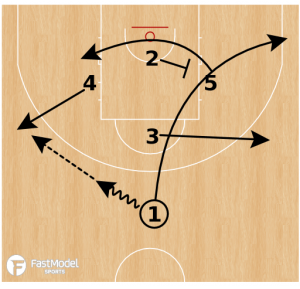
 

4 pops out to wing for pass from 1.

2 screens for 5.

4 feeds 5 in the post (inadvertently left off the diagram)
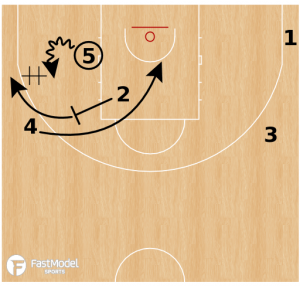


2 sets rip screen for 4.

5 dribbles out of post into hand off for 2.

2 stops behind for shot.


Finland – Diamond 53

This is one of the many “Diamond” sets from Henrik Dettmann of the Finnish National Team. As 4 slips the ball screen, this creates an advantage for the offense as x5 has to help on the slip. As x5 helps, 5 sets a pindown for 3. Because x5 is helping on the slip from 4, the offense creates a 2-on-1 advantage on the weak side since there is no help on 3 as he comes off the screen.
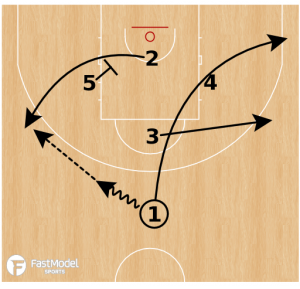
 

5 sets a pindown for 2.

1 passes to 2.
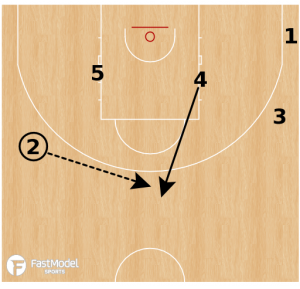


4 flashes high.

2 passes to 4.
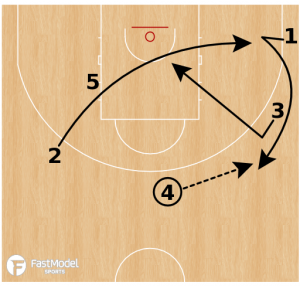


3 cuts backdoor when 4 looks at him.

1 comes up to the wing.

4 passes to 1.
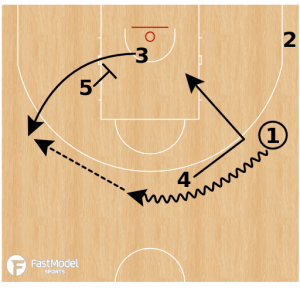


4 fakes ball screen then slips to rim.

5 pindown for 3.

3 comes off screen looking for shot.

1 passes to 3.
Ingredients of a Successful Basketball Practice

By Brian Williams on September 28, 2018

This post was written by Texas A & M Assistant Coach Bob Starkey and shared on his Basketball Coaching Blog, HoopThoughts

I’ve known Sam Nichols for around 20 years now — whether he was working our basketball camps at LSU or running into him at Don Meyer’s Coaching Academy.  And while he was an outstanding coach, he’s saved his best act for post retirement where is Founder and President of Basketball Smiles, a program of free basketball camps in the inner city playgrounds of the Bahamas. Below is a post by Sam with a great list on how to have successful practices:

Recently I had a young coach ask me for some suggestions on how to plan more efficient and productive practices. Here’s a few ideas for I came up with for coaches to consider to help you plan your practices. Believe me, during my 33 years of coaching I learned there is an art to designing and executing your daily practices to where they contribute successful team development.

Hopefully, these thoughts will be helpful – here they are, in no particular order:

  1. You can’t be good at everything.

I heard Jim Calhoun say this at a clinic years ago. He said, “As a coach, pick out three things that you want to excel in, and focus on them. And your practices should reflect these three priorities. Another coach should be able to walk into your practices and be able to pick out those three things based upon what you’re doing in practice.”  Set priorities for your program and organize your practices to reflect your priorities. One of my favorite quotes: “We always find time for the things we put first.” Decide what’s important to and frame your practices around those priorities.

  1. Coach both the “What” and the “Why”

Don’t just tell your players “What” to do, tell them the “Why.” Fundamentally, people “buy in” to the “Why” of anything, and if you take time to explain to your players the logic and reasoning behind your press or offensive philosophy, I believe your practices will be more fruitful.

  1. Remember the 90-10 Rule

This comes from one of my mentors – Coach Dale Brown who always told me, “Be careful and not talk too much in practice – let them practice their skills 90% of the time and you talk only 10% of the time.”  There’s a difference between teaching and overcoaching.

  1. Have some part of practices stressful with consequences

Frankly, basketball is a game of performing under pressure and some segments of practice must be framed with pressure with resulting rewards for performing at a high level and consequences for poor performance.

  1. Situational Segments

I learned the value of this from my Dad who, as a baseball coach, had us practice “situations” every day. Coaches cannot do all of the thinking for their players, nor make all of the pressure-packed decisions for their players – players have to think for themselves, and situational segments develop the confidence in players to where they believe they can make good decisions in games, because they have practiced similar situations in practice. Set up game-like situations on a regular basis and make them a routine – it will pay off!

  1. Don’t just work your starters together during situations

Shuffle your lineup during situations – late in the game, chances are, not all five of your starters will be in the game for one reason or another, so work situations with different lineups.

  1. Make your players think for themselves and get themselves out of trouble

In a loud gym in a meaningful game, your players won’t be able to hear you “coach every dribble,” so, especially in situational drills, keep your mouth shut and don’t blow your whistle to correct every mistake. Instead, be quiet, and make your players work together to come up with a solution. Pat Riley says, “You must be a participant in your own rescue.” Make them think – get themselves out of trouble – it will build their self-confidence and sense of teamwork.

  1. Praise Extra Effort

If you want your players to play hard in games and give extra effort, you must praise and reward it on a daily basis in practice. As Don Meyer was fond of saying, “Your players will reproduce what you emphasize.”  I encourage coaches, “Catch your players being good!”  Unfortunately, we all do a much better job catching them making mistakes. Let’s balance that by intentionally praising extra effort. As you do this, that extra effort will be contagious.

  1. Focus on You and Your Stuff

During the season, especially during Conference play, it’s a great temptation to spend a disproportional amount of time on your opponent’s offense and defense, out-of-bounds plays, etc.  The result – you neglect your stuff – your press break, your offensive sets, your defensive, then of course, on game day your execution suffers.

  1. Drills should relate to your offense and defense, and not just be “trendy” drills

As my Dad was fond of saying, “Know why you’re doing, what you’re doing.” Practice time is too precious to waste, so don’t just run drills that you saw at a clinic – run drills with a purpose. Utilize drills that have a direct correlation to your offensive and defensive schemes.

  1. Understand there will be good practices and bad practices

Don’t get overconfident and complacent when you have a good practice and everything clicks, and don’t overreact and burn the gym down when you have a bad practice. The season is a grind and there is an ebb and flow to practices – you’ll have some great ones, and from time to time your practices will, frankly, stink. A great coach knows that every day is a new day – build on the great practices, and flush the bad ones.

  1. Practice doesn’t happen in a vacuum

As much as we would like to have our players total focus and attention, we have to remember that they (and you) bring the sum of their entire day with them to practice. Develop relationships with your players so, hopefully, you can identify when one of them is having a bad day with issues maybe unrelated to basketball, but is affecting their performance.  It’s also important to know yourself – if you’re tired, on edge, etc., it can make you a miserable coach during practice.  I heard Coach K say one time, “When you are tired as a coach, you fall back into bad coaching habits.”  So true!

  1. Know When to Quit

Some days, your practices get bogged down and it’s better to just shut down and call it a day! It’s not your fault, it’s not your players fault – as I said, the season is a grind, and there are times it’s not going to be a productive day, so shut it down and re-group the next day. For sure, some days, when it gets bogged down, you have to push through and keep going, but that’s where you must know your players and use good judgement. But, don’t be afraid to know its time to send them home for today!

  1. The Three Laws of Learning – Repetition, Repetition, Repetition 

Not every player “gets it” the first time or the tenth time, and if something is important, you must organize your practices where repetition of that skill ii systematic. You can’t teach skill development on a “every now and then” basis – if you want your players to learn something, you have to teach it over and over and over again! Repetition is the key to knowledge.

  1. “See everything – overlook a great deal – correct a little” – Pope John XXIII 

This is one of my favorite quotes of all time and I had it written on every daily practice plan because I tended to “See everything – overlook nothing – correct everything.”  I finally discovered that seeing every mistake and correcting it was counterproductive to what I was really wanting to develop in my players – individually and as a team. When I learned to relax and show some mercy, patience, and understanding, the entire atmosphere in practice improved and so much more was accomplished. I found a balance – I could still hold my players to a high standard of accountability, but I could do that with a lot less pressure on me and them!  We all enjoyed that so much more!

Run Out Shooting Drill

By Brian Williams on September 21, 2018

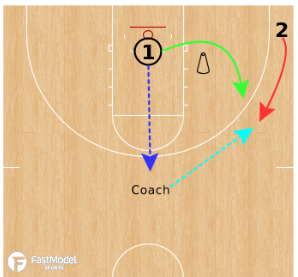
A competitive shooting drill posted in the FastModel Sports Basketball Plays and Drills Library by Mike Shaughnessy of Dr1ven Training and Stockton University.

You can also find out more about FastModel Play Diagramming software by clicking this link: FastDraw

– Player 1 starts with the ball at the free throw line.

– Player 2 starts parallel with player 1 spaced out free throw line extended.

– The drill is initiated with player 1 passing the ball to coach.

– Once the ball is passed to coach, player 1 is sprinting below the cone to try and run player 2 off the 3 point line preventing them from a rhythm 3.

– As the ball is passed, player 2 is drifting to the corner being shot ready.

– The ONLY shot the player can shoot is a catch & shoot 3

– If the player makes the shot, they stay on offense.

– First player to make 4 3’s wins.

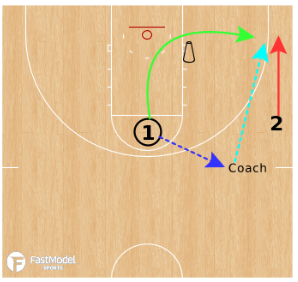
Editor’s Note from Brian: In order to keep players from practicing taking bad shots, you could give a point for a shot turned down that is not a good shot because it is challenged. No point awarded for turning down a shot that the player should take. Then, make the made shots worth 2 (if player is on or inside the line) or 3.

Additional rules:

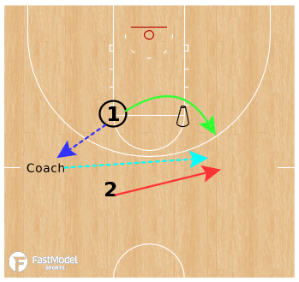
– Play with no shot fake and just has to be a rhythm catch & shoot 3.

– Play with shot fake w/ no dribble.

– Play with shot fake w/ side step using 1 dribble.

– Play with 1 dribble to score vs. the defender running the shooter off the line.

Same rules apply putting the players in a different position and situation. Frames 2 & 3 are added ways to play this small sided game.


Move The Nail Defender

By Brian Williams on September 12, 2018

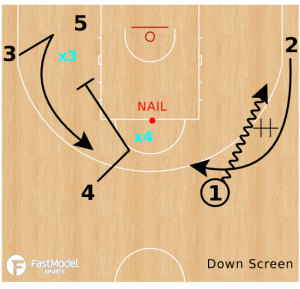
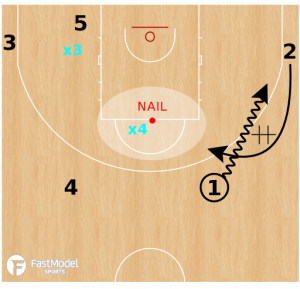
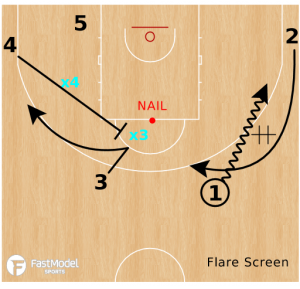
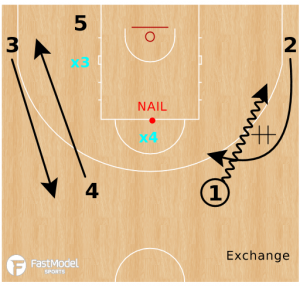
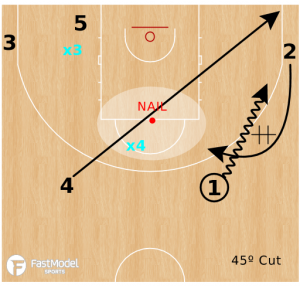
Six tips for moving the “NAIL” defender to aid in top penetration contributed to the FastModel Sports Basketball Plays and Drills Library by Randy Sherman of Radius Athletics.

You can also find out more about FastModel Play Diagramming software by clicking this link: FastDraw

Some thoughts on ways to employ false motion and spacing to move the help defender and create driving opportunities from the top.

You might not be able to use all of these, but you can employ one or two to improve your spacing.


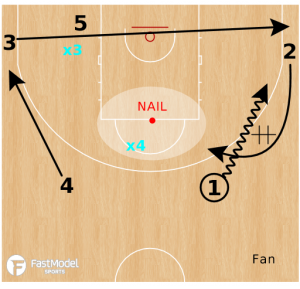
1 dribbles at 2 for the DHO

X4 moves to help on the nail

3 & 4 must find a way to engage and move the nail defender!


1 dribbles at 2 for the DHO

X4 moves to help on the nail

3 & 4 must find a way to engage and move the nail defender!

4 diagonal down screens for 3


1 dribbles at 2 for the DHO

X4 moves to help on the nail

3 & 4 must find a way to engage and move the nail defender!

4 flare screens for 3


1 dribbles at 2 for the DHO

X4 moves to help on the nail

3 & 4 must find a way to engage and move the nail defender!

3 and 4 exchange


1 dribbles at 2 for the DHO

X4 moves to help on the nail

3 & 4 must find a way to engage and move the nail defender!

4 makes a 45º Cut to open gap space


1 dribbles at 2 for the DHO

X4 moves to help on the nail

3 & 4 must find a way to engage and move the nail defender!

4 cuts at 3 who fans along the baseline


Making the Most of My Off-Season

By Brian Williams on September 9, 2018

I received this post from Randy Lambert, Head Men’s Basketball Coach at Division III Maryville College in Maryville, TN.  Coach Lambert has accumulated 701 victories in his college coaching career!

One of the more frustrating things I deal with is trying to make the most of our pre-season.  Because of NCAA rules, we are not allowed to be on the court with our players until October 15th.  All of our workouts must be voluntary and monitored by our upperclassmen.

Regardless of the level, I think these basic ideas will apply to any basketball program.  We emphasize to our players the importance of having a personal plan to follow and holding yourself accountable to the plan.

Editor’s note from Brian:  Regardless of what your governing body’s rules allow you to do prior to the start of practice, some good thoughts to share with your players any time of year.

Making the Most of My Off-Season

The Intangibles

• Be a Leader- By example or vocally, project enthusiasm by my constant “reminders” of the price we pay for success.
• Be a good teammate- We are a family and I must do what I can to bring us together.
• Be coachable- Buy-in with my teammates to the process.
• Demonstrate toughness- In everything I do, eliminate the ABC’s: arguing, blaming and complaining.
• Minimize the distractions- Get my life in order off the court (academically, socially, and spiritually) to insure the ultimate productivity on the court.

The “Givens”

• Be in the best possible condition- We play fast and I have to be in shape and able to run the floor.
• Bring physicality to my position- I must be as strong as I can be to be physical and manage the demands of a season.
• Know my role- With the help of my coaches, carve out my role for this team.
• Maintain composure- Be poised and in control of my emotions through every situation.
• Be fundamental and a student of the game- The foundation of my skills will determine my effectiveness as a player.

The Dream

• Run the floor- I will try to be one of the first ones back on every offensive and defensive possession.
• Take good shots- Be a finisher and value efficiency by sharing the ball and hitting the open man.
• Defend and motivate your team to get stops- Coach yourself to stay in a stance and rotate to provide good help.
• Rebound- Be the best rebounder at your position and initiate contact on your blockouts.
• Play team basketball and incorporate sound principles on both ends of the floor

Maryland Shooting Drill

By Brian Williams on September 8, 2018

This drill is from Mike Neighbors.

It is designed to create some chaos in practice to lead to calmness in games.

Like all drills that you see other programs use, you can either modify it or take parts of the drill for your use and your needs.

Please make sure your sound is on to see the video.

Click the play arrow to see the drill.

The drill is a YouTube video, so you will need to be on a server that allows you to access YouTube to see the drill.

  • « Go to Previous Page
  • Page 1
  • Interim pages omitted …
  • Page 59
  • Page 60
  • Page 61
  • Page 62
  • Page 63
  • Interim pages omitted …
  • Page 288
  • Go to Next Page »

Primary Sidebar

  • Twitter
  • Facebook
  • Linkedin
coachestoolbox
personaldevelopmenttoolbox
basketballplayerstoolbox
basketballtrainer
athleticperformancetoolbox
coachingbasketball

© Copyright 2026 Coaching Toolbox

Privacy Policy